RETURN TO
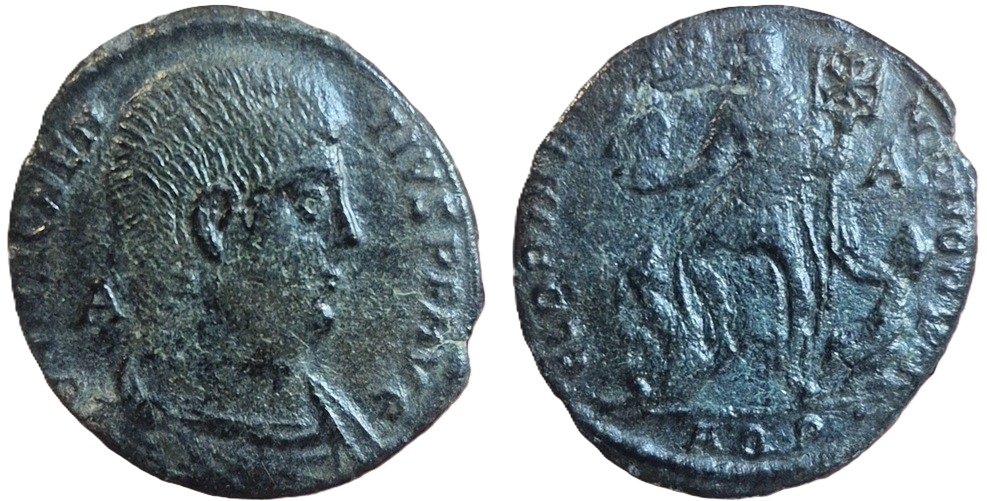
Roman Imperial. Magnentius Large AE2 (24mm, 4.12g, 6h), Aquileia, c. 350 CE.
Obv: DN MAGNENTIVS P F AVG / A (left). Bare-headed, draped bust right.
Rev: GLORIA ROMANORVM / A (right) / AQP. Emperor standing left, holding Victory on globe & Chi-rho labarum, spurning captive to left; kneeling supplicant to right.
Ref: RIC VIII 148; Esty Type 6.4; Failmezger 430MG (p. 42 & pl. 38). According to Esty, “RIC says “Common” but in fact scarce or rare.”
Prov: Uncertain group lot c. 2000s.
Notes: This reverse type is interesting in that, rather than bound captives, it shows one figure in the classic “mourning pose” (being spurned) and another in the classic “supplication pose.”
As I’ve mentioned elsewhere on my “captives” page, there is a certain ambiguity to the mourning figures. That is, it’s not (always) clear whether to consider them “captives,” strictly speaking. From the start, the mourning figures were associated with the figure of the bound captive, but sent a slightly different message (e.g., Caesar’s Gallica, Vespasian’s Judaea Capta, Trajan’s Dacia Capta series). Rather than depicting a captive warrior (or, in some cases, a specific enemy king), the mourning figure itself tends to depict a personification of a defeated territory or people.
Moreover, the typical depiction suggests a different relationship to Rome. The personification has been defeated, to be sure. But she has not been entirely subjugated, like the bound and shackled captive, who likely awaits slavery or execution, as Rome wills it. Instead, there remains some hope for a future under Roman hegemony, especially when there are no other images to associate her with captivity (as, for example, on Hadrian’s and Antoninus Pius’s Britannia coinage, who would become a new Province).
In fact, this coin’s imagery even demonstrates how such a “merciful” outcome may be achieved. To the right, we see a figure (the personification, again?) in the classic pose of “the supplicant.” (See, e.g., Naiden’s [2003, AJN] “Supplication on Roman Coins.”) By accepting the authority of the state, kneeling before the Emperor — and perhaps the religion, before the Chi-rho banner — and begging Rome’s mercy, the personification may hope to receive the Empire’s welcome and “benevolence.”
It is worth noting also that granting such mercy not only reaffirms the Emperor’s power, but demonstrates an important virtue of a good ruler, as the Romans saw it. Both sides of power are thus shown, the spurning control of the defeated foe to left, and mercy (Clementia) to right.