Roman Republic & Empire
[35+ Coins]
Created: 27 Mar 2024 ; Last Updated: 3 Sep 2026. Change Log.
(Recent: Divus Septimius, Marcus Aurelius Sestertius, Div. Aug. Sest., Philip I, Pinkerton’s (?) Britannia, Gallienus Hybrid, Molo Quadrans, LENT. Quinarius, Domna, Carausius, Constantine+Licinius Dattari, Constantine DiMarzio, Carisius d’Este; banner image)
Other Pages in this Series:
- Return to: The “Top Shelf”: Object Biography, Plate Coins & Provenance Glossary
- Return to: Page I (Greek, West: Celts through Central Greece)
- Return to: Page II (Greek, East: Asia Minor, Persia & Jewish Coinage)
- Return to: Page III (Roman Provincial: Europe & Asia)
- Return to: Page IV (Roman Provincial Egypt)
- Continue to: Page VI (Byzantine & Contemporaries)
Contents of This Page:
RRC I: 2nd Punic War to Middle Republic [5+ coins];
RRC II: Late Republic & Imperatorial [6 coins];
RIC I: Twelve Caesars [7+ coins];
RIC II: Adoptive to Severan [6 coins];
RIC III: Crisis [7+ coins];
RIC IV: Late Roman Empire [4+ coins];
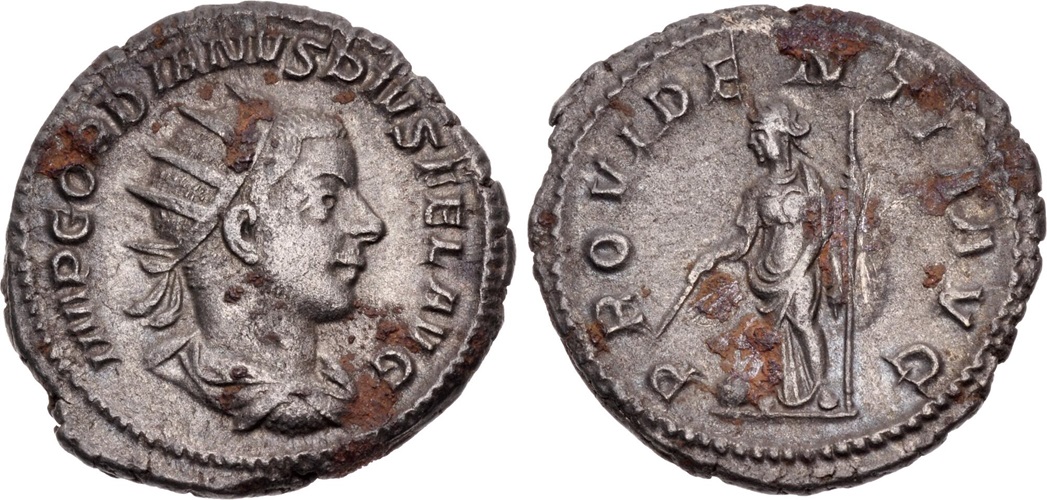
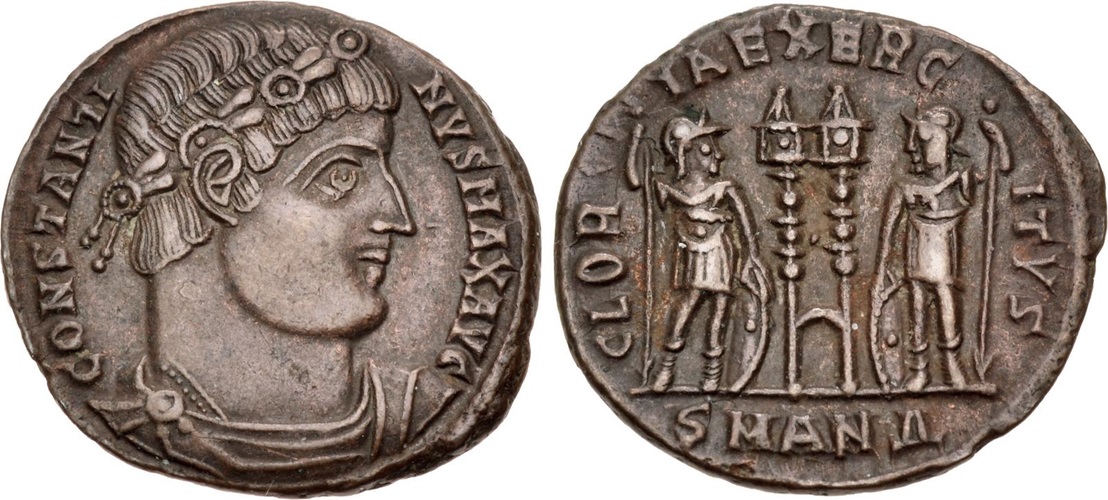
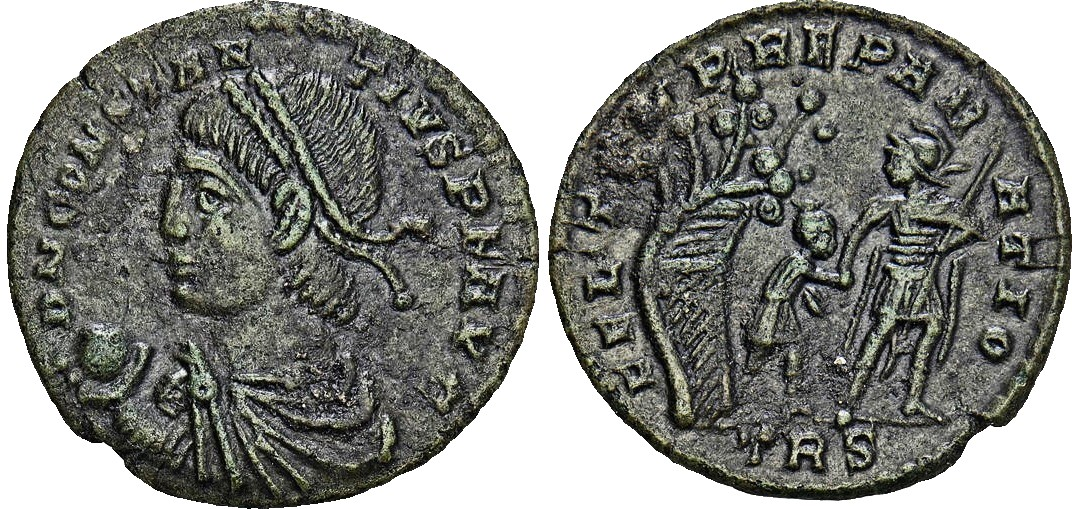 should load fully to left (Constantius II AE), if not, trying zooming in/out
ROMAN REPUBLICAN, PART ONE: 2ND PUNIC WAR TO MIDDLE REPUBLIC [top]:
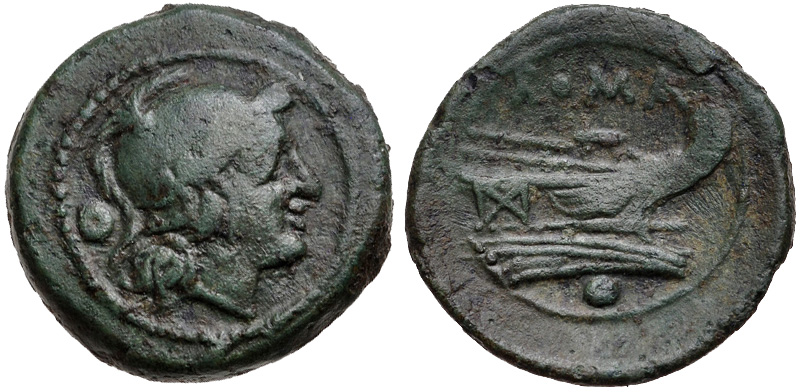
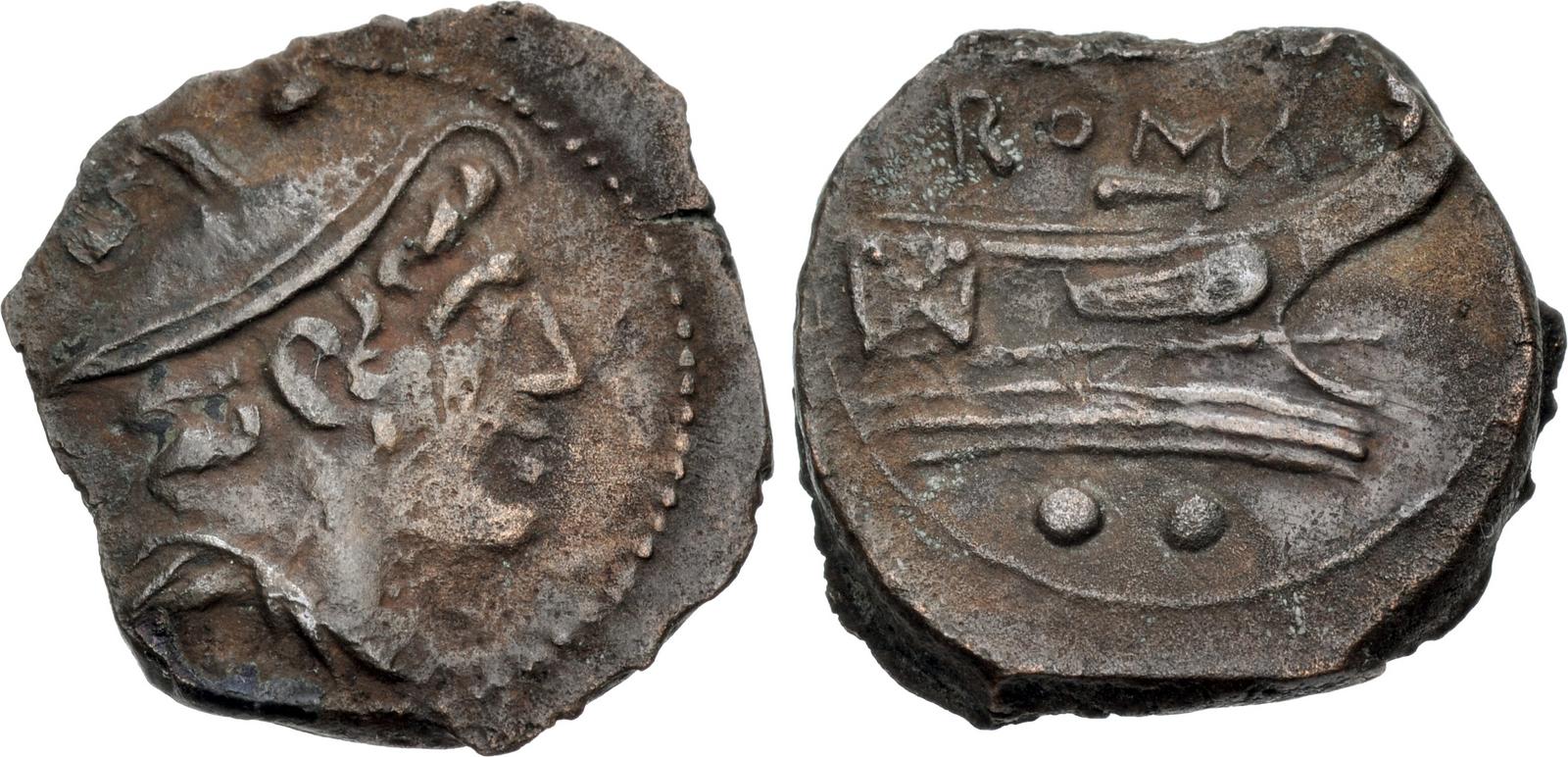
Anonymous AE Uncia (18mm, 4.91g), Second Punic War Issue, 215-211 BCE. Roma / Galley, long prow-stem. (McCabe G3; Crawford 56/7)
(Photo Credit: CNG.) Collection History:
– Richard Schaefer (1946-) Collection [AKA “Goodman Coll.”];
– RBW Collection Duplicates, with his white envelope [Richard B. Witschonke (1945-2015), from RS, Apr 1989 ; CNG EA 374 (11 May 2016), 436];
– Shetland Sheepdog Collection [CNG EA 548 (18 Oct 2023), 403].
(See RBW-Schaefer-Russo note.)
Notes: This die exhibits the defining feature of McCabe’s Group G3 (see also the Sextans below): the long, low prow-stem — so much so that it appears to overlap the dotted border!
Anonymous AE Sextans (19mm, 4.06g), Second Punic War Issue, 215-211 BCE. Mercury / Galley, long prow-stem. (McCabe G3 [?]; Crawford 56/6)
(Photo Credit: CNG.) Collection History:
– Ex “old Italian Hoard from off the Italian coast” [Elsen 37 (17 Dec 1994), 209-227 (some group lots): “…une petite partie d’un grand trésor trouvé anciennement dans la mer en Italie“];
– RBW Collection Duplicates [Richard B. Witschonke (1945-2015), from Elsen 37 (17 Dec 1994), 219 ; Agora 42 (6 Oct 2015), 116];
– Dr. Jay M. Galst (1950-2020) Collection [CNG EA 550 (15 Nov 2023), 457].
(See RBW-Schaefer-Russo note.)
Related: This copy of Essays in Honour of Roberto Russo, inscribed to Galst by RBW & van Alfen, is now in my library, reunited with Galst’s Sextans, a touching artifact of the friendship between two fine numismatists.
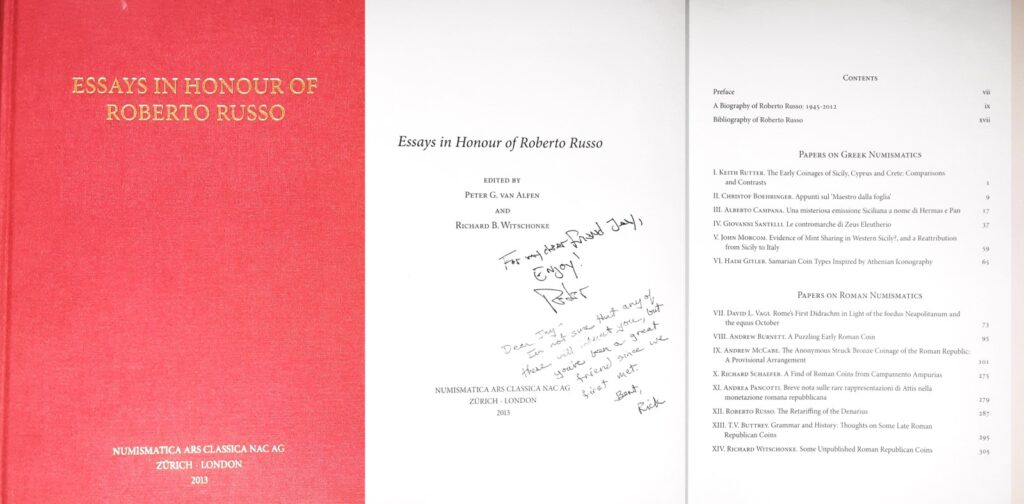
Notes: Galst owned only a few Republican bronzes. (The galley prow’s apotropaic eye fit the ophthalmological theme of his collection.) He bought this Sextans eight months after the death of his friend, the great RRC collector and scholar, RBW. I suspect he got the coin to accompany the copy of Essays Russo, shown above, that RBW had inscribed to Galst (along with co-editor, Peter van Alfen).
Did RBW know that, sooner or later, Galst would take his inscription as a challenge (“I’m not sure that any of these will interest you...”)? A credit to Galst that, being inexperienced in RRC, he nonetheless found a coin to perfectly fit the book, both in substance and in provenance.
The volume includes Andrew McCabe’s important essay on “The Anonymous Struck Bronze Coinage of the Roman Republic,” using many of RBW’s coins as data (and Schaefer’s, though neither of the present coins were included).
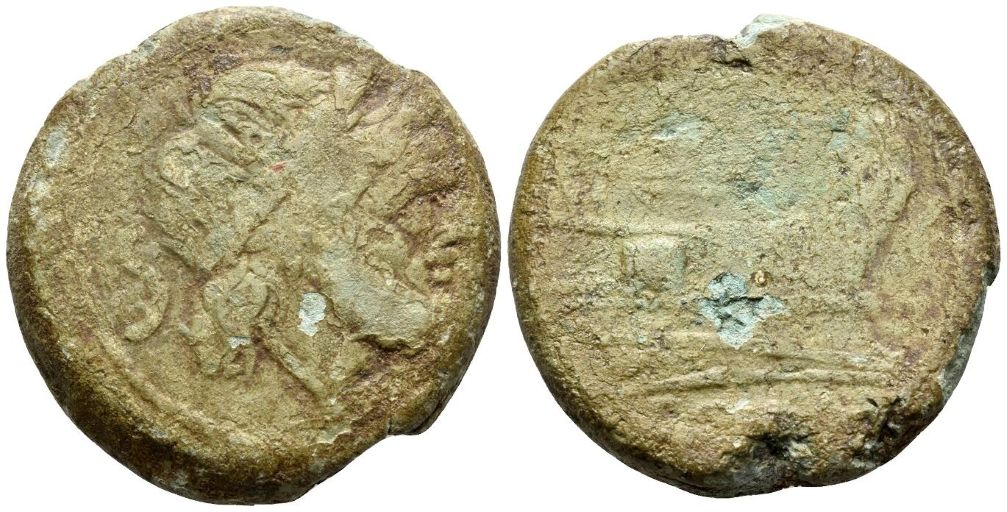
Anonymous AE Semis (32mm, 24.40g, 8h), Second Punic War Issue, 215-211 BCE. Saturn / Prow (Russo 9 = McCabe A1.Sm.2; Crawford 41/6e)
(Photo Credit: Nomos.) Collection History:
– Robert Hoge (1947-) Collection [Nomos Obolos 34 (10 Nov 2024), 798];
– RBW Collection Duplicates, with his white envelope [Richard B. Witschonke (1945-2015), gift from Russo, 1997 ; CNG EA 376 (15 June 2016), 761 (part), corr.: “Crawford 56/3(?). Very rare issue.”];
– Roberto Russo (1945-2012) [by 1997].
(See RBW-Schaefer-Russo note.)
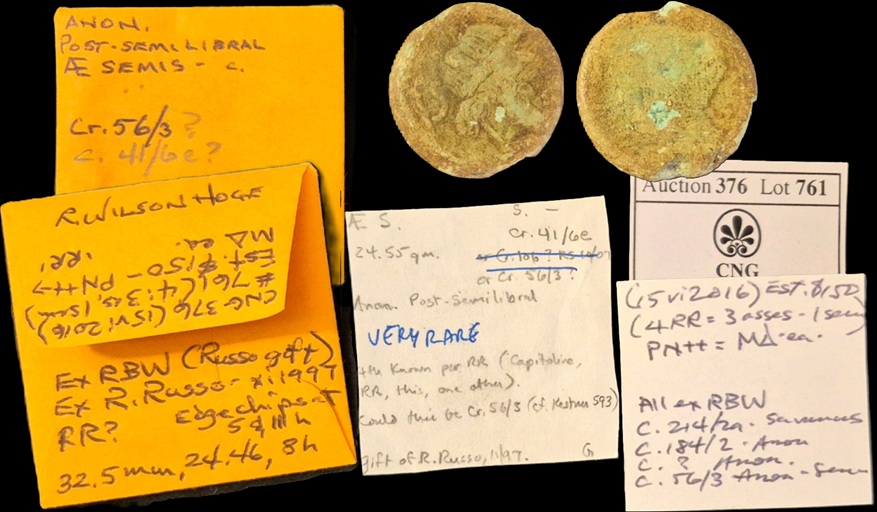
Notes (1): Shortly after gifting this coin to RBW, Russo published the primary reference for its type, “Unpublished Roman Republican Bronze Coins” (1998, Essays Hersch). Though not cited, this ex. is an obv. die match to Russo 9 (later one of McCabe’s [2013] Group A2 plate coins). Once considered very rare, enough examples have appeared in the past 25 years that it is now only “somewhat rare.” (RBW’s tag labels it “4th Known per RR,” though both his and RHW’s tags indicate they struggled to ID it as Cr. 41/6e rather than as the very similar Cr. 56/3, as CNG labeled it. In this condition, it is hard to blame them, though once you’ve seen Russo’s plates, the die-match is clear.)
Notes (2): RBW & Hoge (“RWH”) were both ANS curators. After RBW’s death, Hoge bought dozens of his Republican bronzes, I suspect, in memory of his colleague. Based on the Nomos & CNG sales, he appears to have previously owned only a handful, bought decades earlier (1960s-80s).
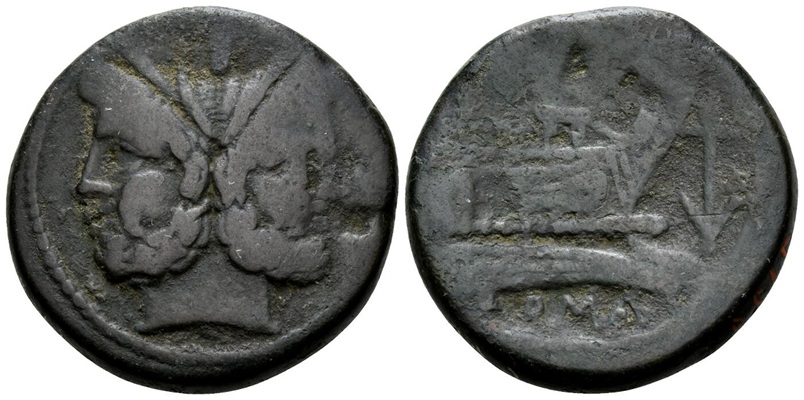
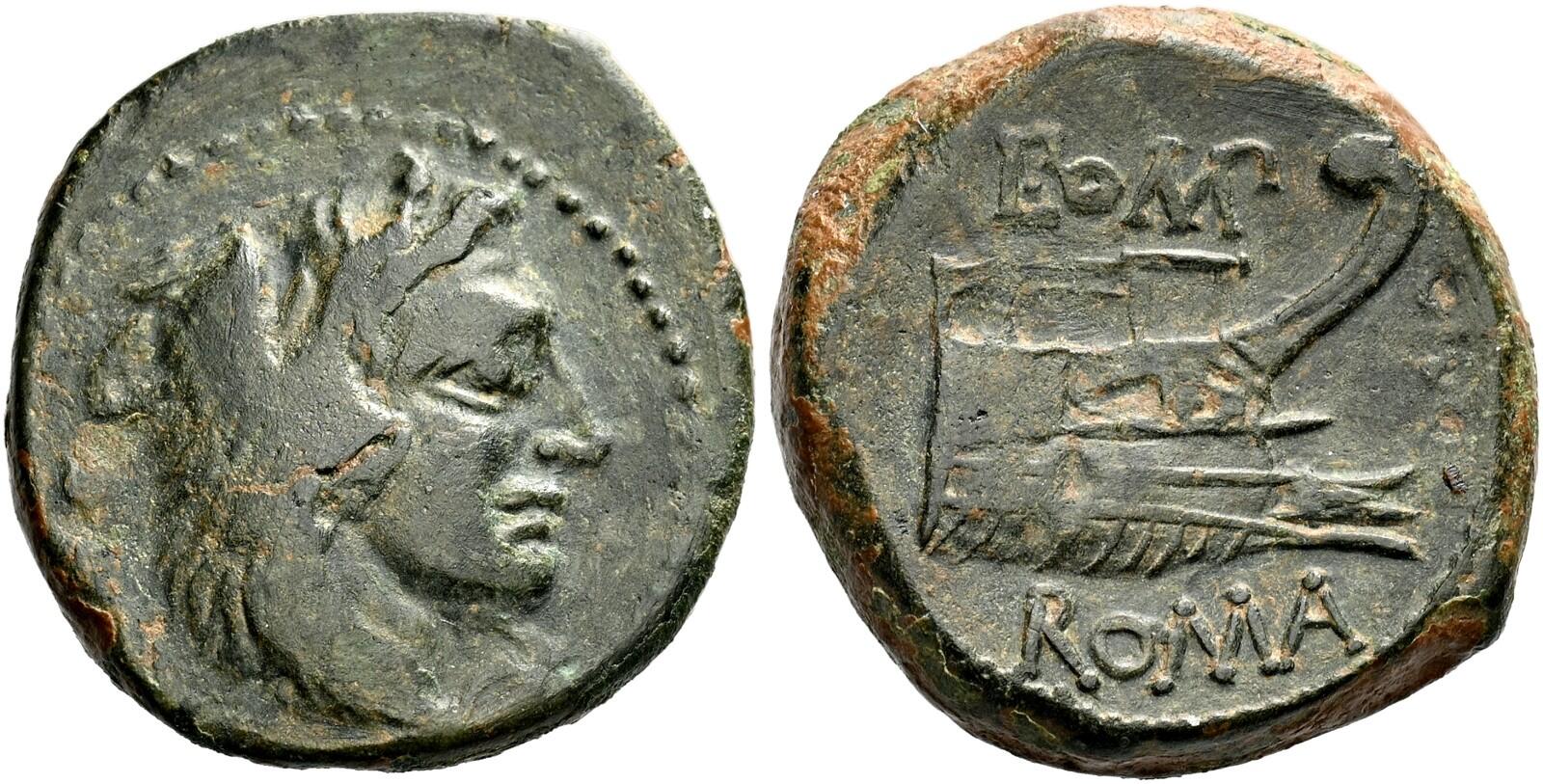
Republican AE As (33mm, 28.07g, 9h) 209/8 BCE. Janus / Prow, anchor (Crawford 50/3)
(Photo Credit: Nomos.) Collection History:
– Robert Hoge (1947-) Collection [Nomos Obolos 34];
– RBW Collection Duplicates [Richard B. Witschonke (1945-2015), Agora 57 (14 Jun 2016), 122];
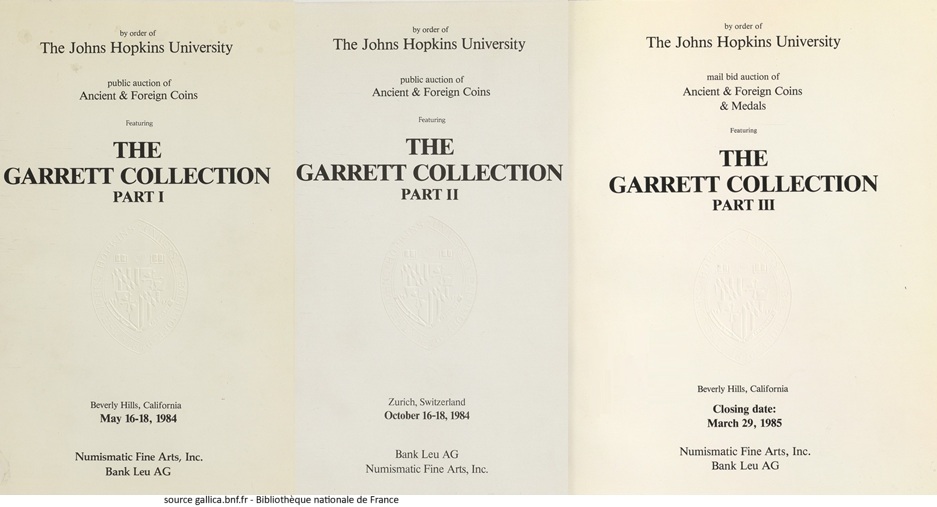
– Johns Hopkins University / “Garrett Collection” [Part III, NFA & Bank Leu (29 March 1985), 384 (part of)];
– Wolfgang Helbig (1839-1915) Collection, No. 128, his white inventory no. painted on edge [sold to JHU in 1888].
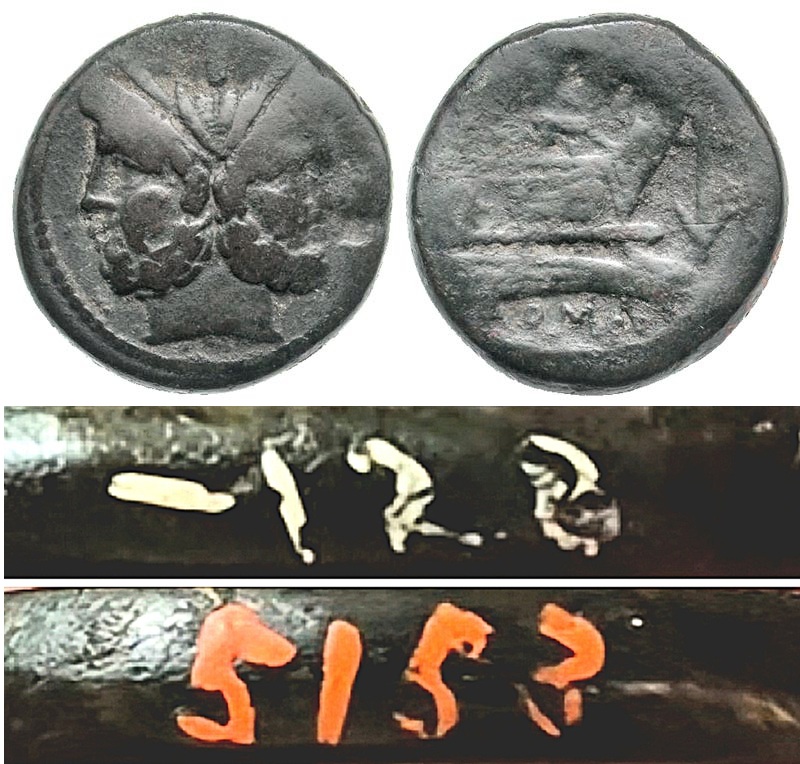
Institutional History: Johns Hopkins University, Inv. No. 31.2.(86, 91, or 94?), w/ orange no. 5153 painted on edge (c. 1888-1942), acq. for JHU with assistance from Robert Garrett (1847-1896), T. Harrison Garrett (1848-1888), et al. in 1888.
Curated by John Work Garrett (1872-1942) at his residence, Evergreen Museum & Library (Baltimore), which was also bequeathed to Johns Hopkins University. The orange collection numbers found on the edges of many JHU-Garrett coins appear to be in his hand (cf. hand-writing samples in Part I catalog), but I haven’t found confirmation.
Notes: Helbig, German archaeologist in Rome and this coin’s earliest known collector, is reputed to have started the tradition of throwing a coin in Trevi Fountain..
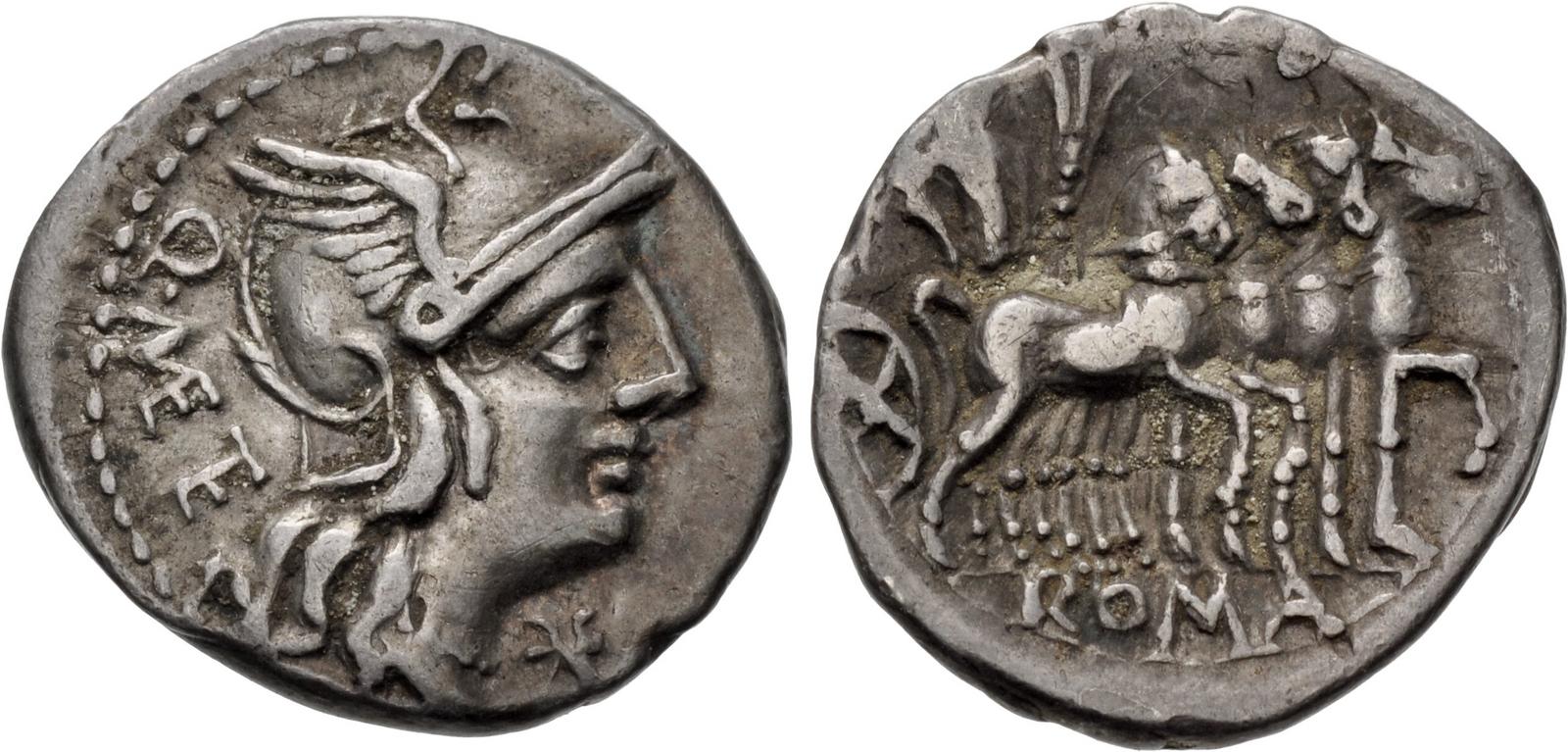
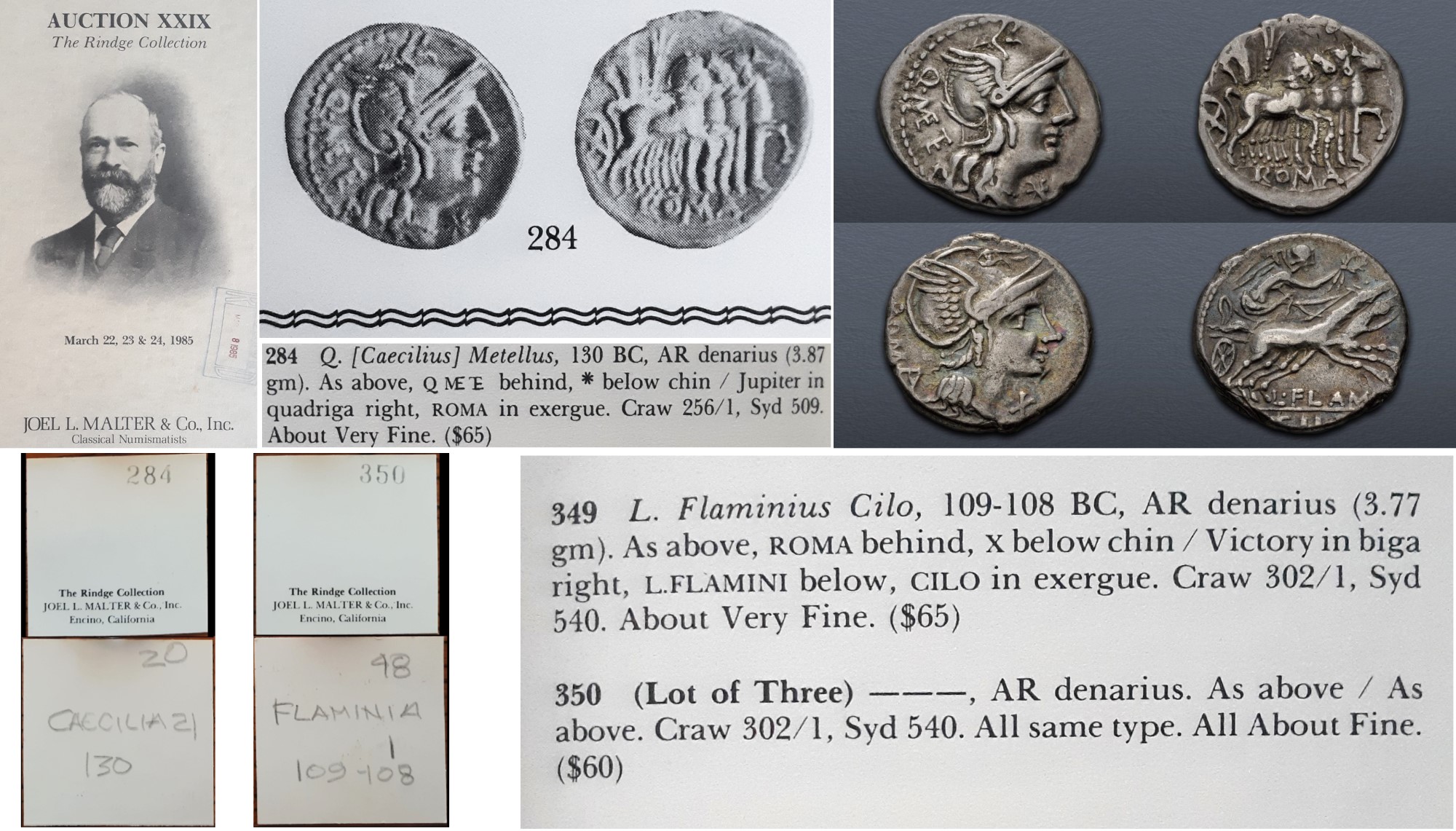
Q Caecilius Metellus AR Denarius (19.5mm, 3.91g), 130 BCE. Roma / Jupiter, Quadriga. (Crawford 256/1)
(Photo Credit: CNG.) Collection History:
– Frederick Hastings Rindge (1857–1905) Collection [Part I, Malter XXIX (22 Mar 1985), 284];
– S & S Collection [acq. Malter XXIX ; CNG EA 536 (12 Apr 2023), 424].
Institutional History: Boston Museum of Fine Arts, c. 1880s-1905/1941 (long-term loan/exhibition).
Notes: Rindge’s Republican coins were among the first and most important to be shown at the BMFA from at least 1889 until 1905 (but prob. later). Also in my collection: L. Flaminius Chilo Denarius, ex Rindge/BMFA loan [CNG EA 536, 440].
ROMAN REPUBLICAN, PART TWO: MARIUS TO OCTAVIAN [top]:
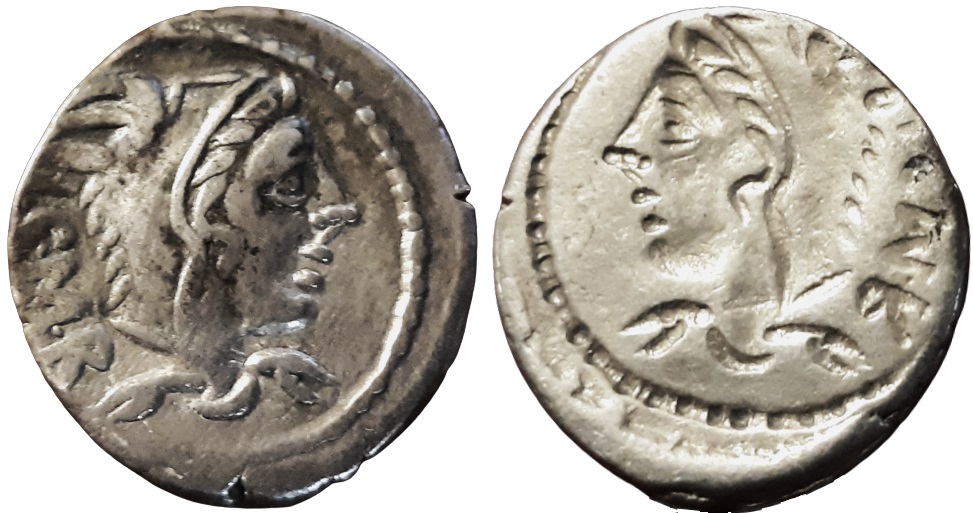
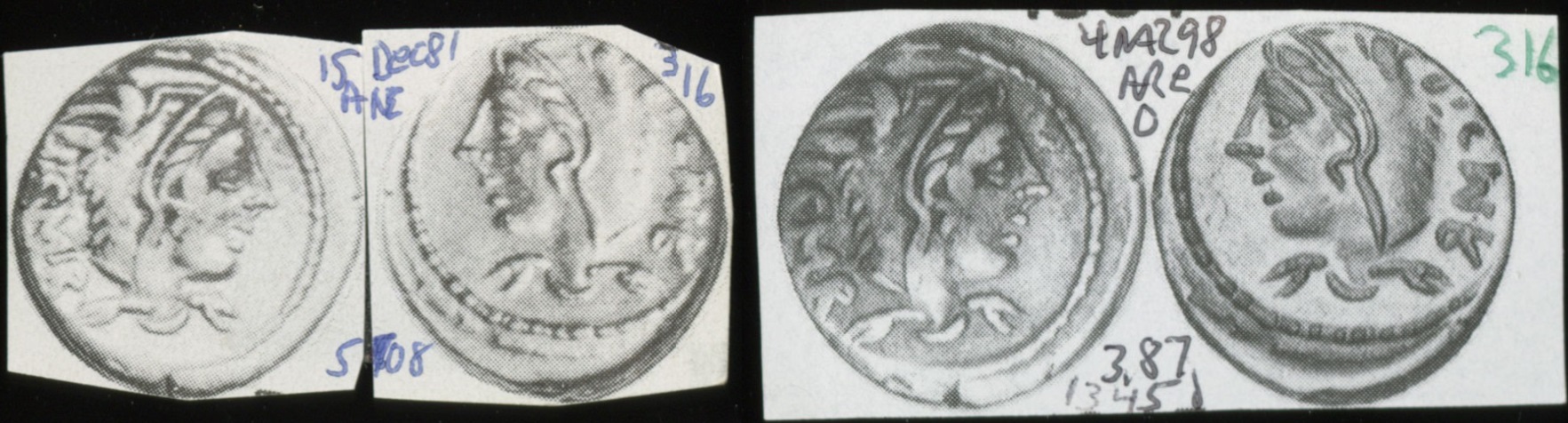
L. Thorius Balbus AR Denarius (19mm, 3.87g), 105 BCE. Juno Sospita / Incuse. (Obv. Brockage, Crawford 316/1)
(Photo Credit: CJJ.) Collection History:
– Alba Longa Collection (José Fernández Molina, d. 2003) [vol II, Aureo & Calicó 339 (14 Nov 2019), 1398];
– Aureo 89 (4 Mar 1998), 1345;
– A.N.E. (Xavier Calicó), Asociacion Numismatica Española (Barcelona, 15 Dec 1981), 508.
See also: ANS, Roman Republican Die Project, “Richard Schaefer Binder” No. 22, p. 2 (this coin illustrated twice from the 1981 & 1998 sales above).
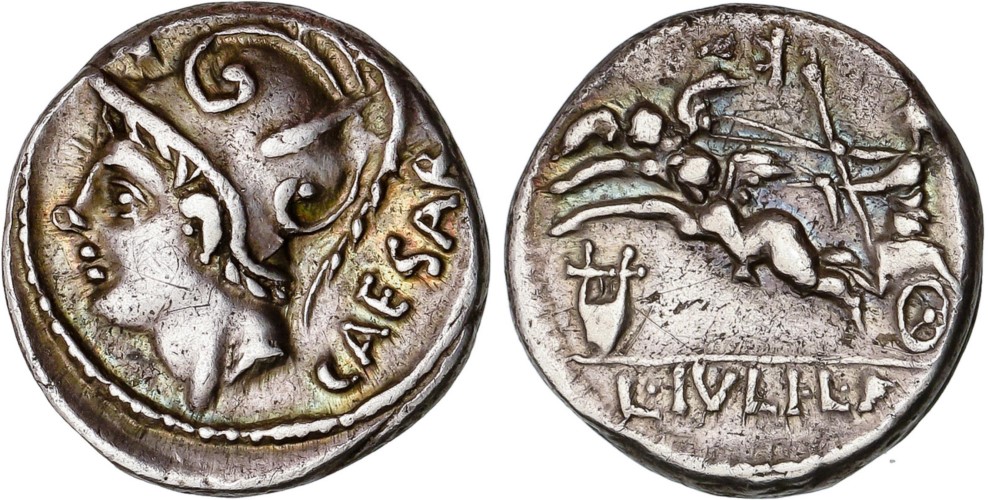
L. Julius L. f. Caesar AR Denarius (17mm, 3.92g), 103 BCE. Mars / Venus, biga driven by Cupids, L•IVLI•L•F. (Crawford 320/1)
(Photo Credit: Soler y Llach.) Collection history:
– Ex Crippa FPL 1971 / 1, No. 379;
– Kricheldorf 29 (3 Mar 1975), 249;
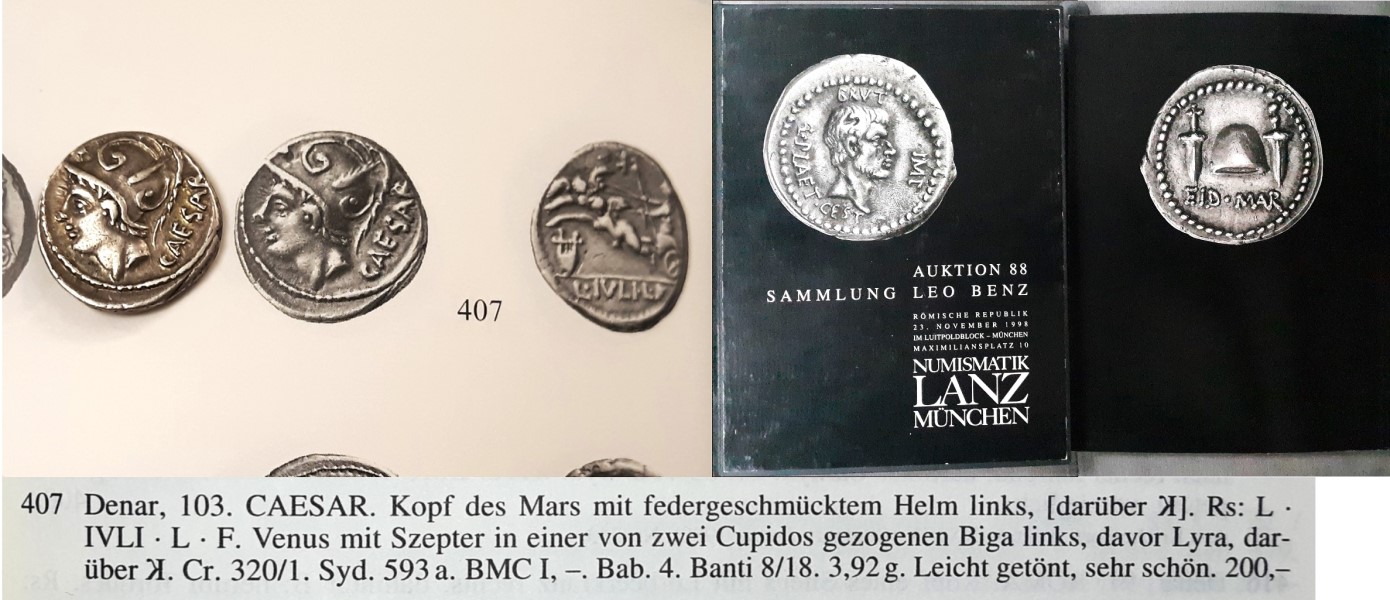
– Sammlung Leo Benz (1906-1996) [Part I, Lanz 88 (23 Nov 1998), 407];
– Colección Scipio [Part III, Soler y Llach 1124 (23 Feb 2022), 458].
Published:
– CNR 8/18 (this coin illustrated) in A. Banti (1980-2), Corpvs Nvmmorvm Romanorvm, vol. 5 (pp. 91 [photo], 93 [text], corr.: ·ꓘ not ꓘ).
See also: Illustrated twice in ANS, Roman Republican Die Project, Schaefer Binder #19 (Processed, 300-399): pp. 320_08_od [142, corr.] (ꓘ) & 320_10_od [144] (·ꓘ).
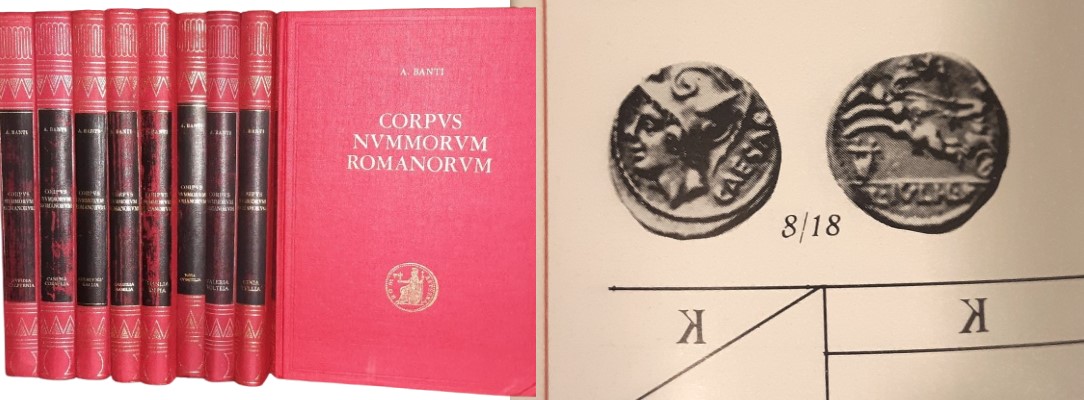
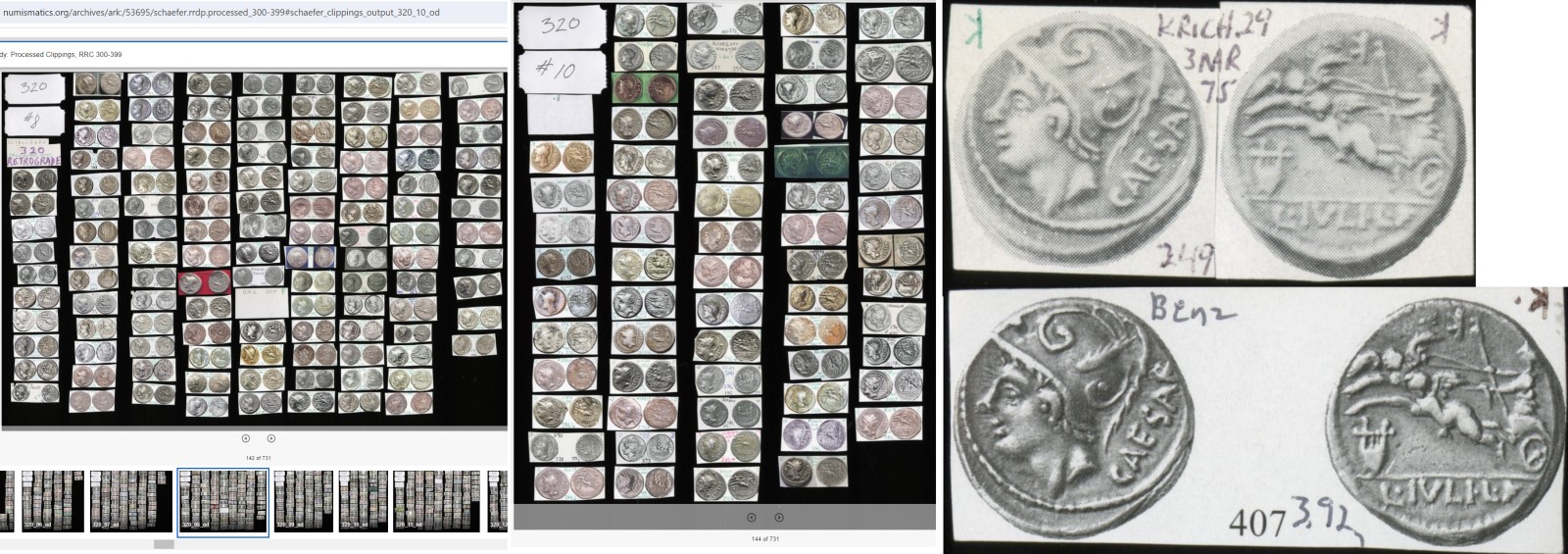
Notes: One of my favorite catalog sets! Rare hardbound Leo Benz (Lanz 88, 94, 100), ex Lanz Library. (Plus a set of the standard-issue softcover Benz catalogs.)
L. Pomponius Molo AE Quadrans (20mm, 7.17g), c. 93-91 BCE [* dating]. Herakles / Galley, L·POMP, ROMA. (Value marks: •••.) (Crawford 334/5)
(Photo Credits [edited for layout & size, see below]: McCabe [on Flickr] & NAC.)
Collection History:
– Richard Schaefer (1946-), Goodman Collection, Part 3, w/ tickets [CNG 45 (18 Mar 1998), 1626 ; acq. 1989, ex Lluís Lalana (Barcelona)];
– Richard B. Witschonke (1945-2015), RBW Collection [Duplicate, priv. sale to A.M.];
– Andrew McCabe, Ahala Collection (AM#13127-72) & Lambeth Bridge Collection [NAC 152 (18 May 2025), 235 (incl. prov. collage & video)].
(See also RBW-Schaefer note & the Sextans above re: McCabe’s contribution to Essays Russo.)
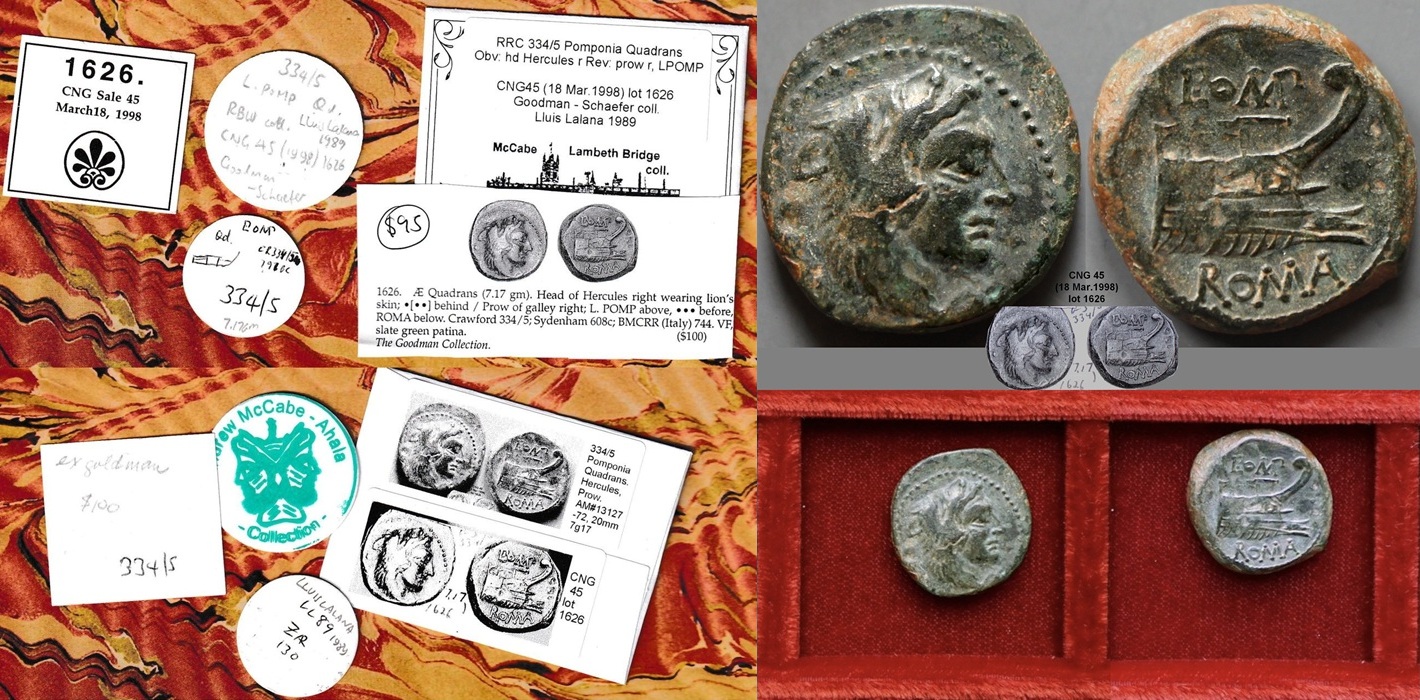
Notes, Provenance: Collage above edited from photos published online by AM of the coin, sale listings & collector tags.
Left: cropped, from online listing, NAC 152, Lot 235; Top R.: from AM’s Flickr album; Bottom R.: cropped from AM’s Ahala Coll. Trays, Obv. & Rev. (see also CoinTalk [27 Oct 2019]).
A. McCabe’s (2018, The Asylum) article, “Imhoof-Blumer, Fontana, and Quadras y Ramon Kibitzing My Collection,” discussed another example from his & RBW’s Collections. That one (NAC 61, 1194 = RBW 1199) was reportedly ex Knobloch Collection (Stack’s 1978, 249, no photo) and Lockett (though I find no record of his Roman Republican collection).
It is interesting to consider the relative desirability of the two provenances: This coin’s is reportedly much younger, but its earliest photograph (1998) is actually 13 years older. Lockett and Knobloch would generally be considered “better” pedigrees (and satisfy the pre-1970 standard), but one could argue Schaefer (Goodman) is more important for Republican AE. Then again, an unpublished “RBW Duplicate” is far less significant than the primary RBW reference coin (i.e., from NAC 61, NAC 63, or Triton III, all published in Russo, 2013, The RBW Collection of Roman Republican Coins).
I bid on many of McCabe’s coins, but was particularly excited about this one, as it passed through three of the most important private Republican AE collections in recent memory. The combination is important: one of those collections is great, but two shows a relationship, the start of a network; better yet, three begins to outline an intellectual community.
* Dating (return): Crawford originally dated the L. Pomponius Molo coins to 97 BCE, but later agreed (p. 173) with Mattingly (1977, NC) that a more likely date is 93 or even 91. (As it happens, Sydenham 703, usually dis-preferred to Crawford on dating, had given 93.) See also: Champlin 1968: p. 53, Luce 1968: p. 28, McCabe website.
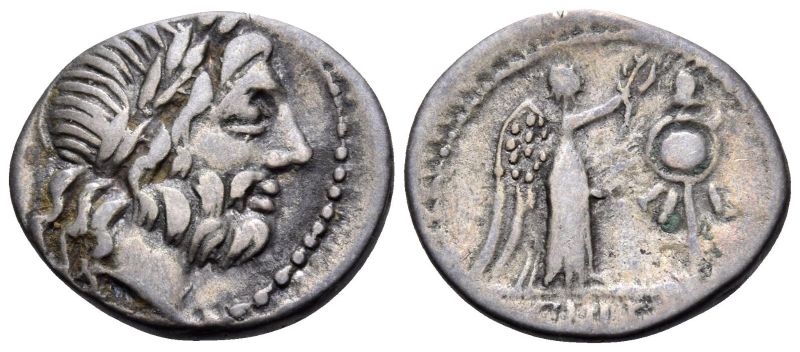
Cn. Cornelius Lentulus Clodianus AR Quinarius (15.5mm, 1.84g), 88 BCE. Jupiter / Victory crowning trophy, CN•LENT. (Crawford 345/2)
(Photo Credit: Nomos.) Collection History:
– Robert Hoge (1947-) Collection [Nomos Obolos 34 (10 Nov 2024), 900 ; bt. Dan Brown, c. 1964];
– Ex Frederick Knobloch inventory [sold to Dan Brown, Jan 1964, #55, uncertain FPL or BBS (see Yale Note)];
– Ex Yale University Collection;
– (possibly) ex Edward Ingraham II (1887-1972) Collection [donated c. 1963 (see Yale Note)].
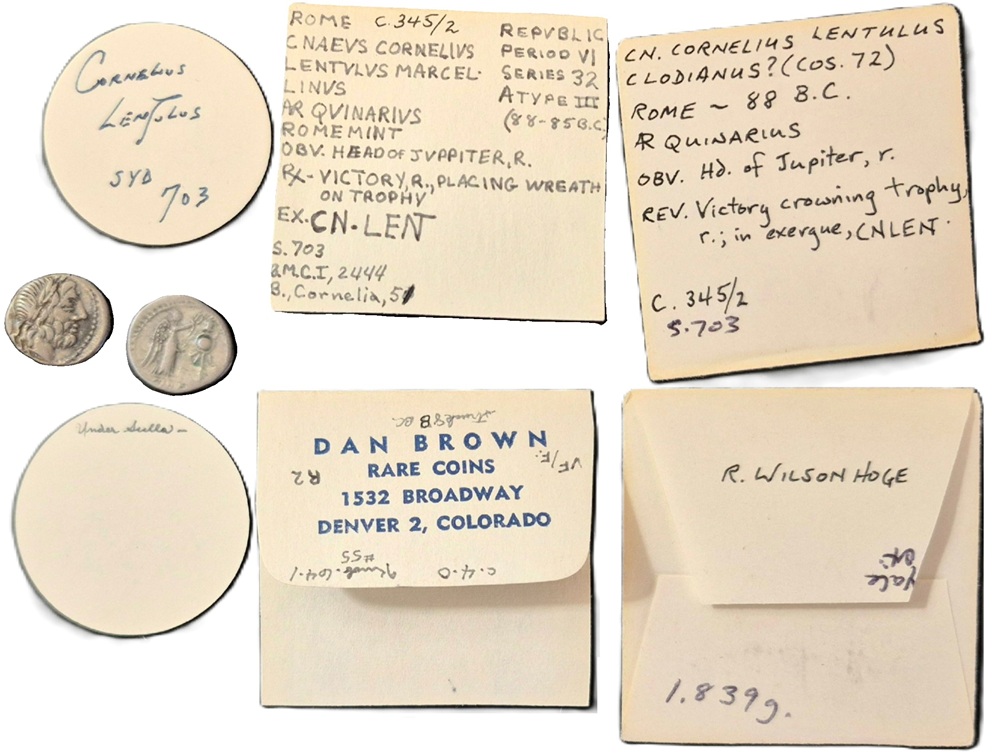
Notes: Struck around the end of the Social War (91-87) and Sulla’s “March on Rome” and first Consulship (88/87). The reverse imagery may refer to the Social War or the Moneyer’s ancestor Marcus Claudius Marcellus’s victories in the Second Punic War, or may simply be generic imagery without specific referent. The Moneyer named on this coin (Gnaeus Cornelius Lentulus Clodianus) later served Pompey as Praetor in 75 BCE, then was Consul in 72 BCE during the Third Servile War (War of Spartacus).
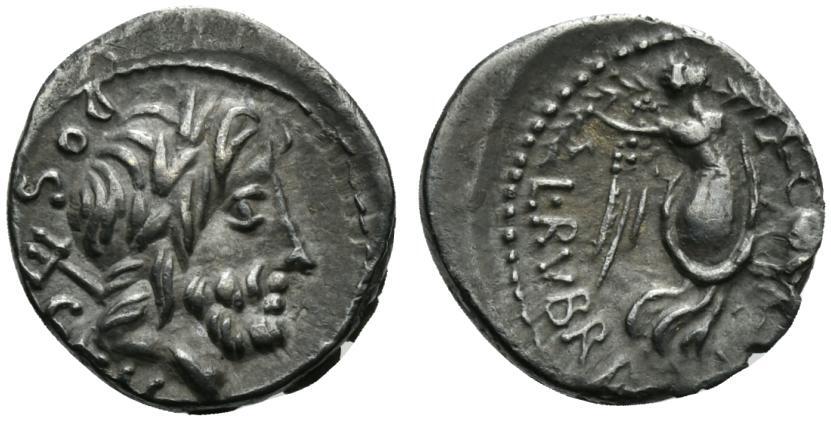
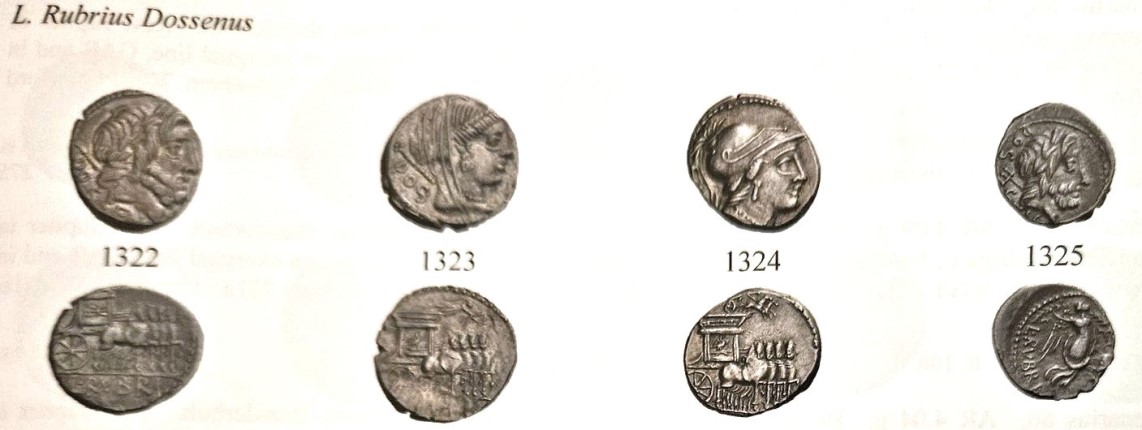
L. Rubrius Dossenus AR Quinarius (14mm, 1.68g), 87 BCE. Neptune, trident / Victory, palm & altar. (Crawford 348/4)
(Photo Credit: Bertolami.) Collection History:
– “John Quincy Adams (1767-1848) Collection,” added by Charles Francis Adams (1807-1886) in 1860s London while serving as Minister to the UK [see Adams-RBW Provenance note, below];
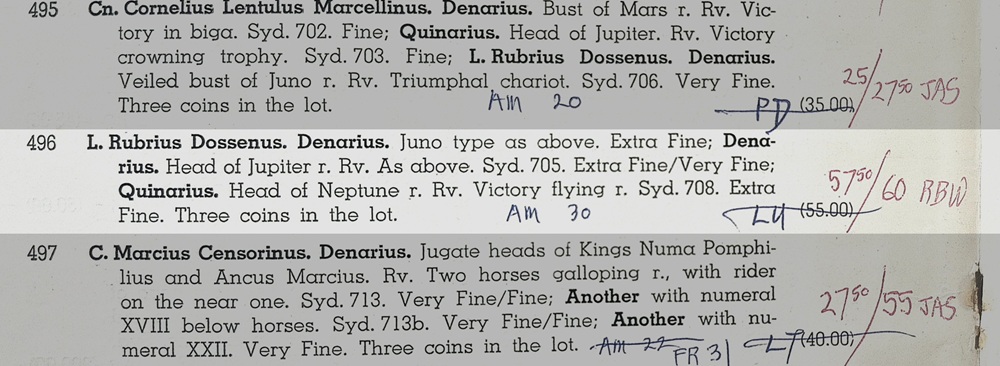
– Massachusetts Historical Society, donated by Henry Adams (1838-1918) in 1914 [deaccessioned, sold: Stack’s (5 Mar 1971), 496 (part); see Adams-RBW Provenance Note below]];
– RBW Collection [Richard B. Witschonke (1945-2015), Part II, NAC 63 (17 May 2012), 101].
Published:
– RBW 1325 (this coin illustrated), in: Russo, Robert (2013), The RBW Collection of Roman Republican Coins (Zurich: NFA);
– Mike Markowitz (2025), “The Adams Family Collection of Ancient Coins,” pl. 19-21 (this coin illustrated).
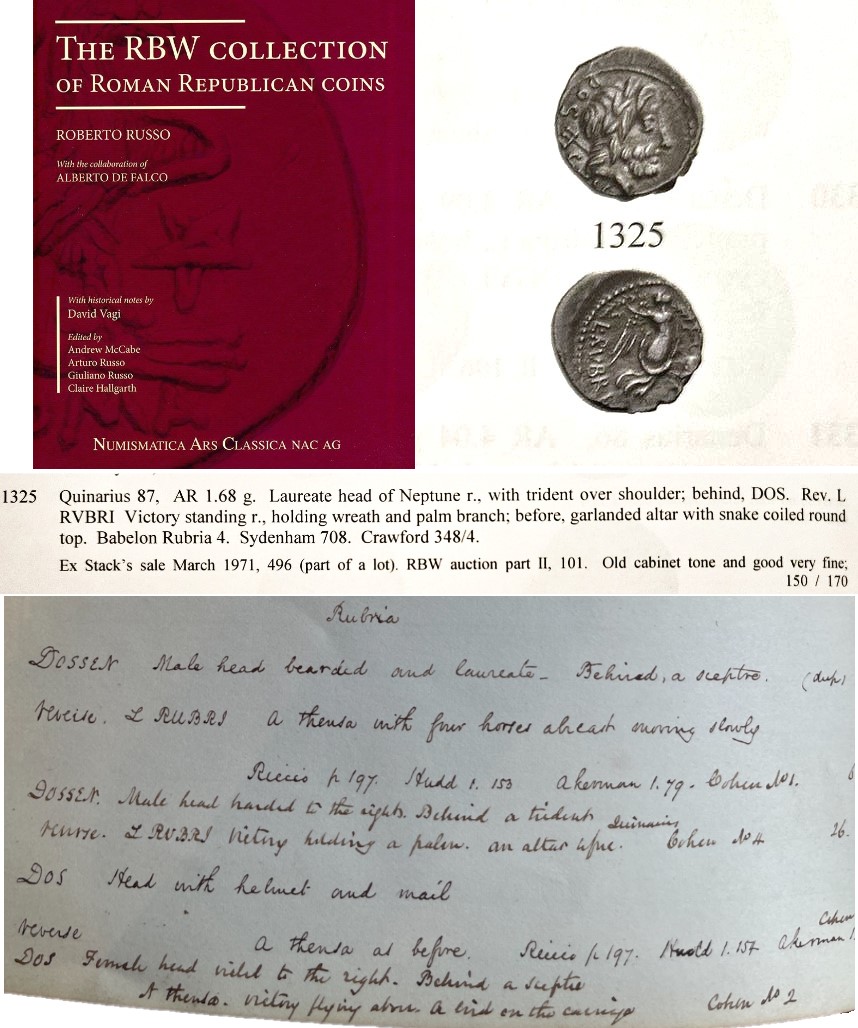
My thanks to Jordan Montgomery for the RBW images, and to Humilau for the image from Charles Francis’ 1913 catalog, showing corr. weight of 26 grains.
My catalog collection includes Christian Blom’s annotated saleroom copy of the 1971 “John Quincy Adams” sale catalogs, with hand-written buyer names. For Lot 496 (this coin), Blom marked RBW as buyer. (The neighboring lots are marked “JAS,” confirmed by the 1979 Sawhill catalog.)
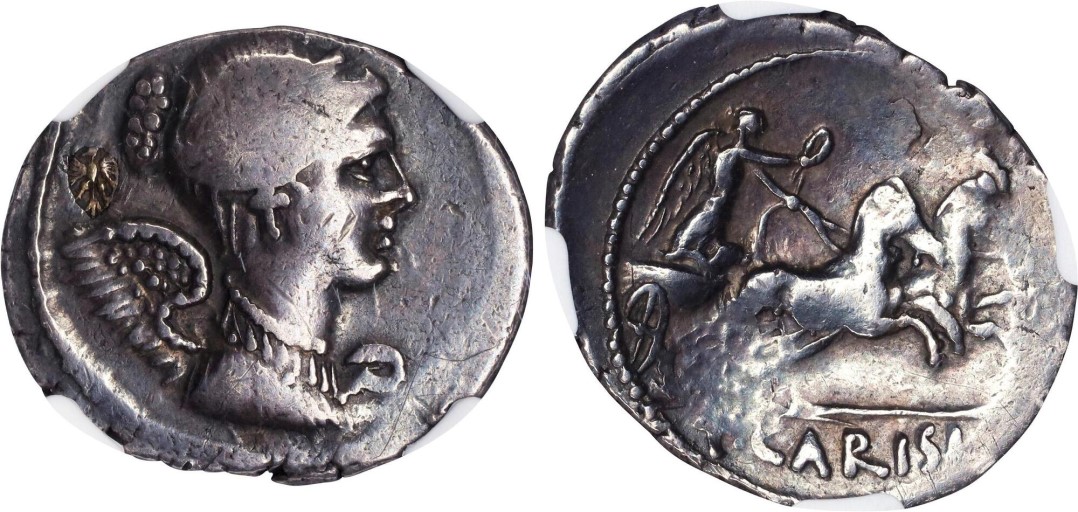
T. Carisius AR Denarius (21mm, 3.79g), 46 BCE. Victory (w/ Este Aquiletta) / Biga. (Crawford 464/4, Babelon Carisia 2)
(Photo Credit: Stack’s.) Collection History:
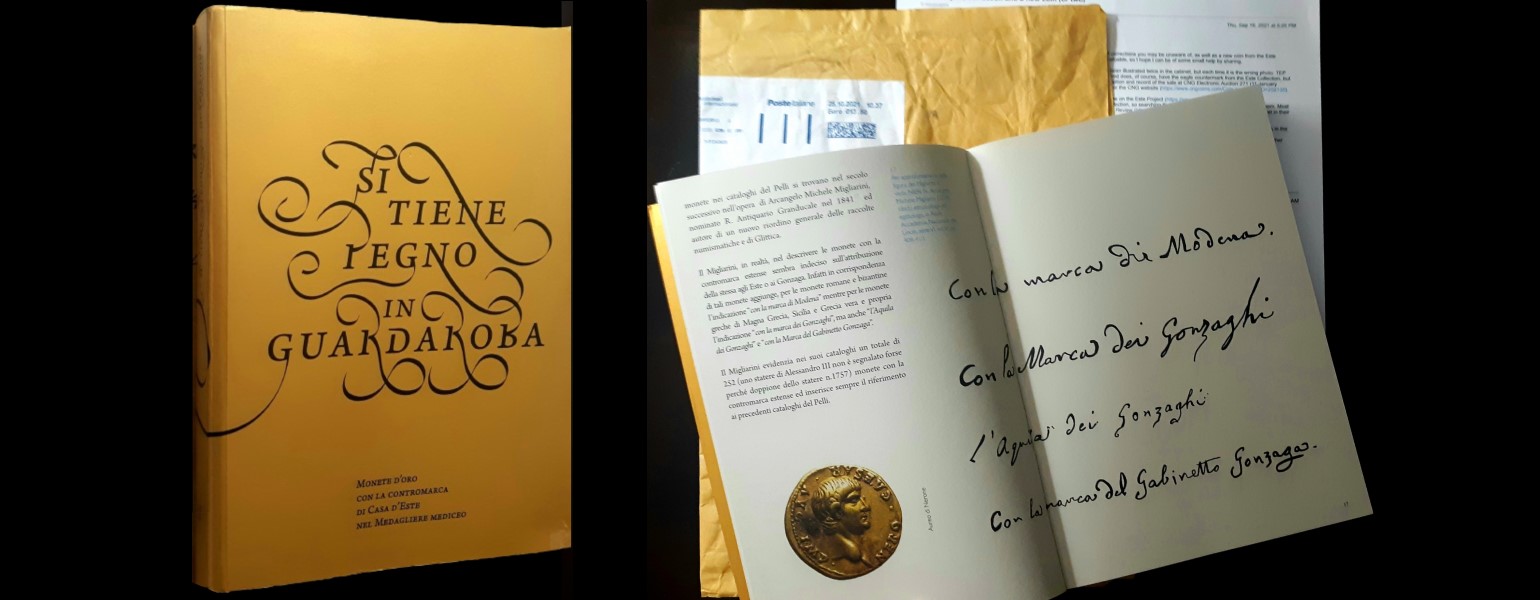
– Este Family Collection (erroneously dubbed “Gonzaga Collection“), begun by Leonello d’Este c. 1430, countermarked w/ gold Aquiletta by Alfonso II c. 1574;
– “Collectionneur Anonyme” (Horst-Ulbo Bauer?) [Monnaies et Médailles Vente Publique 52 (1975), Lot 263, one of 24, the largest such private collection to be published];
– David B. Simpson Collection [Stack’s Bowers Global Showcase (12 Aug 2024), Lot 40053].
Published/Exhibited:
– Important exhibition at the Este Castle, c. 1571-4, curated by Pirro Ligorio (perhaps only 10% of the Este coll. was countermarked, being the 1,200-1,500 coins exhibited);
– T.E.P. (this coin, uncertain number), The Este Project, F. Catalli et al. (database down).
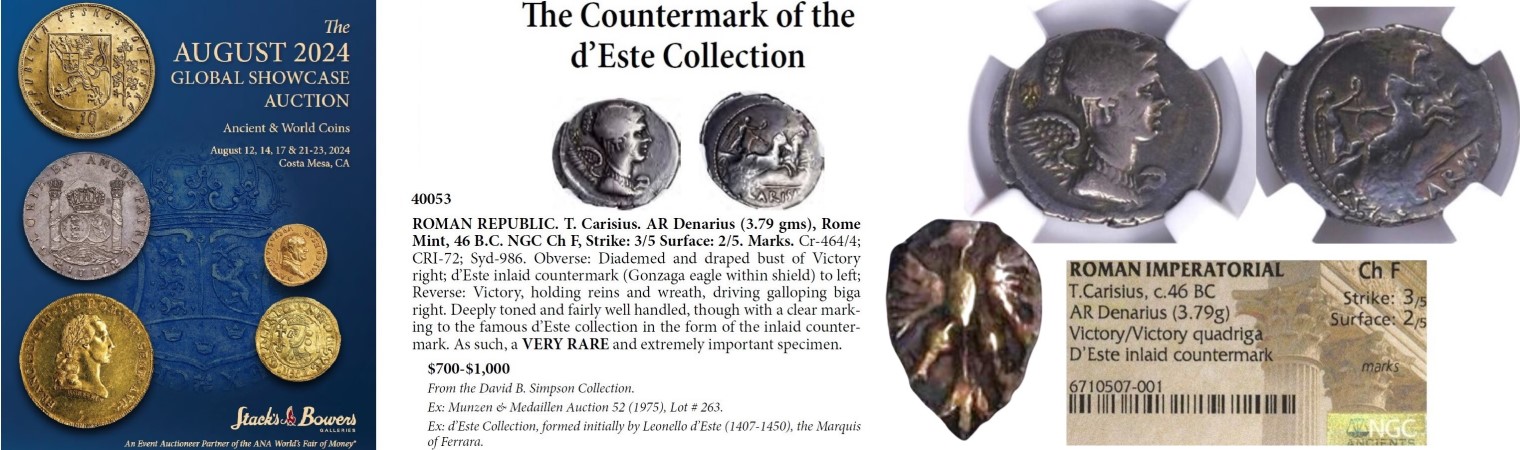
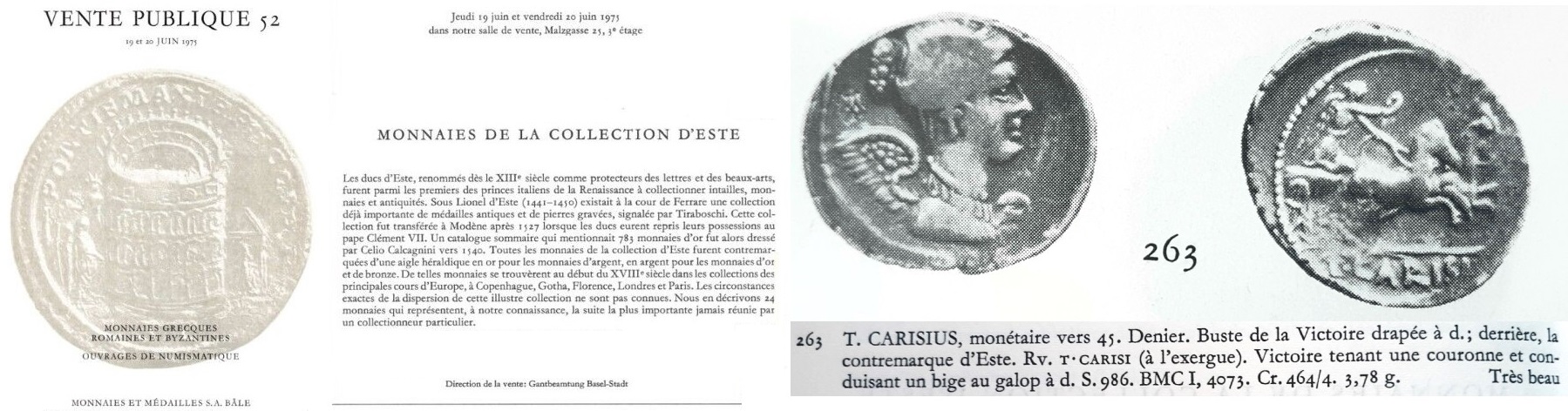
Notes: I know where this coin was in 1574 and 1975. Where was it for the intervening four centuries? This coin was part of the magnificent collection of 24 coins with Este Aquilette formed the anonymous collector (H.U. Bauer?) of MM 52. Most of those coins came from famous collections of the 19th and 20th centuries, but I have yet to find this one among their sales. Fortunately, I love nothing more than a question of provenance to research. I’m sure I’ll find more soon (i.e., within a few decades or less).
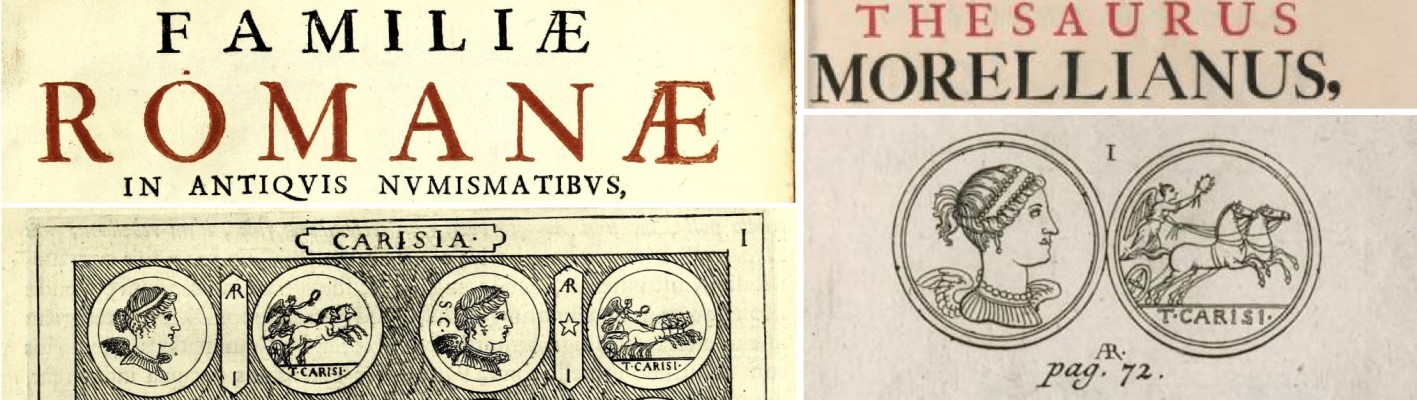
Although this coin is not known (yet) to have been published in the centuries immediately after it was famously exhibited at the Castello Ferrara, c. 1571-4, Fulvio Orsini published the earliest illustration (to my knowledge) of its type a few years later, in 1577. In 1734, Morrel published at least one Este coin in his Thesaurus, also illustrating the present type. Though a common coin, one wonders if the authors weren’t familiar with this specimen, having seen the famous collections of their time.
ROMAN IMPERIAL, PART ONE: TWELVE CAESARS [top]:
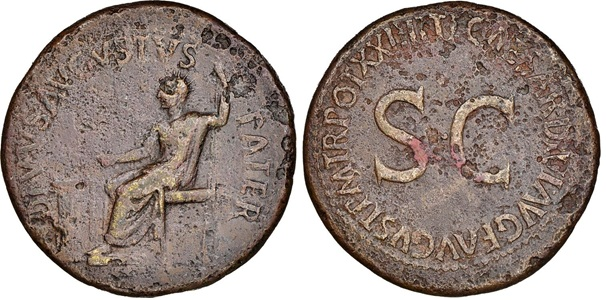
Divus Augustus AE Sestertius (35mm, 25.64g, 7h), under Tiberius, Rome, 22-23 CE. Statue of Augustus radiate, seated before altar / large S-C. (RIC 49)
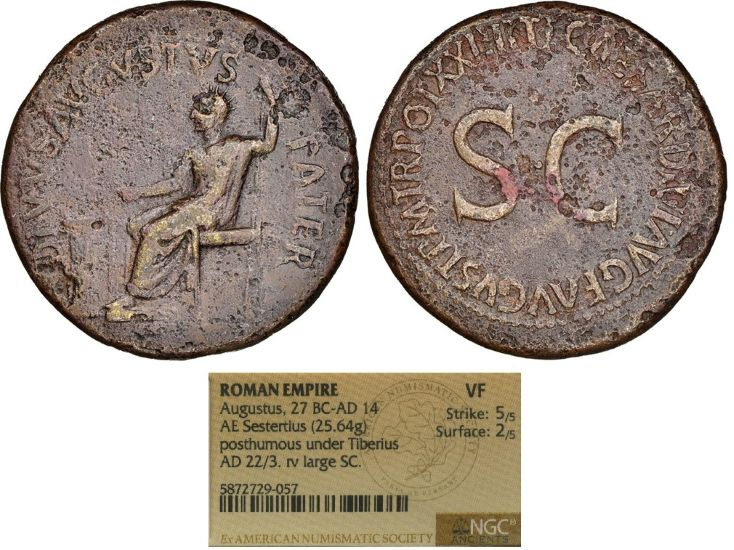
(Photo credit: CNG.) Collection/Sale History:
– Ex Birkler & Waddell III (10th NYINC, 10 Dec 1981), 260;
– Robert W. Bartlett (1931-2017);
– American Numismatic Society [Bartlett Bequest; CNG Keystone 4 (2 Sep 2021), 141];
– NGC 5872729-057 encapsulated w/ custom “Ex American Numismatic Society” label.
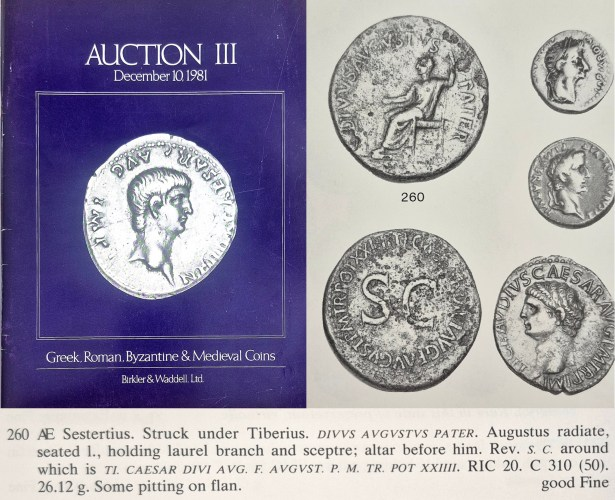
Substantine Notes: This coin’s depiction of Augustus seated is generally believed to represent the long-lost statue of the divine Augustus commissioned by Livia at the Theater of Marcellus, described by Tacitus (Ann. 3.64 [Perseus, Latin]; Engl. trans. [ToposText]). (See, e.g., Kuttner 1995: 40.)
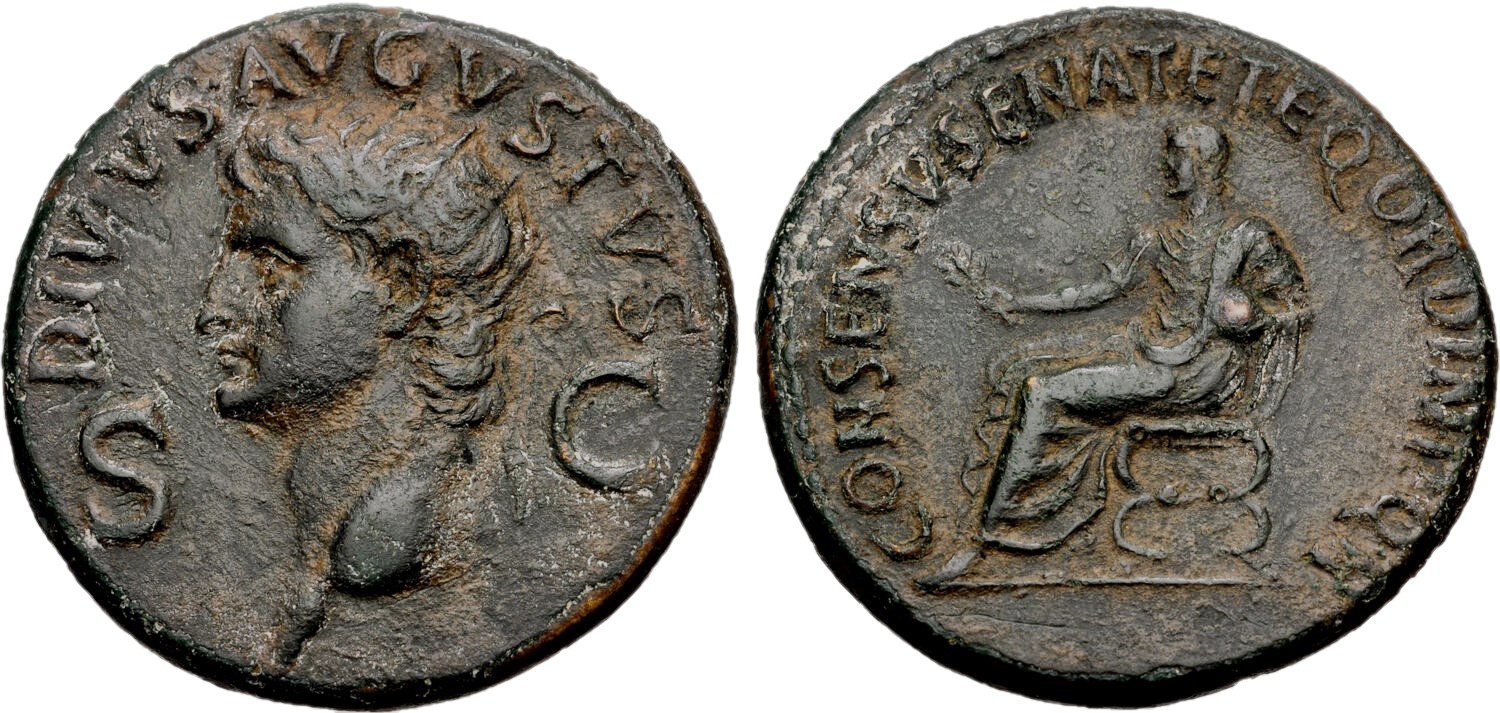
(The same is occasionally suggested for the Dupondius below, but its seated figure is surely Caligula. It may have commemorated Caligula’s completion of the Temple of Divus Augustus.)
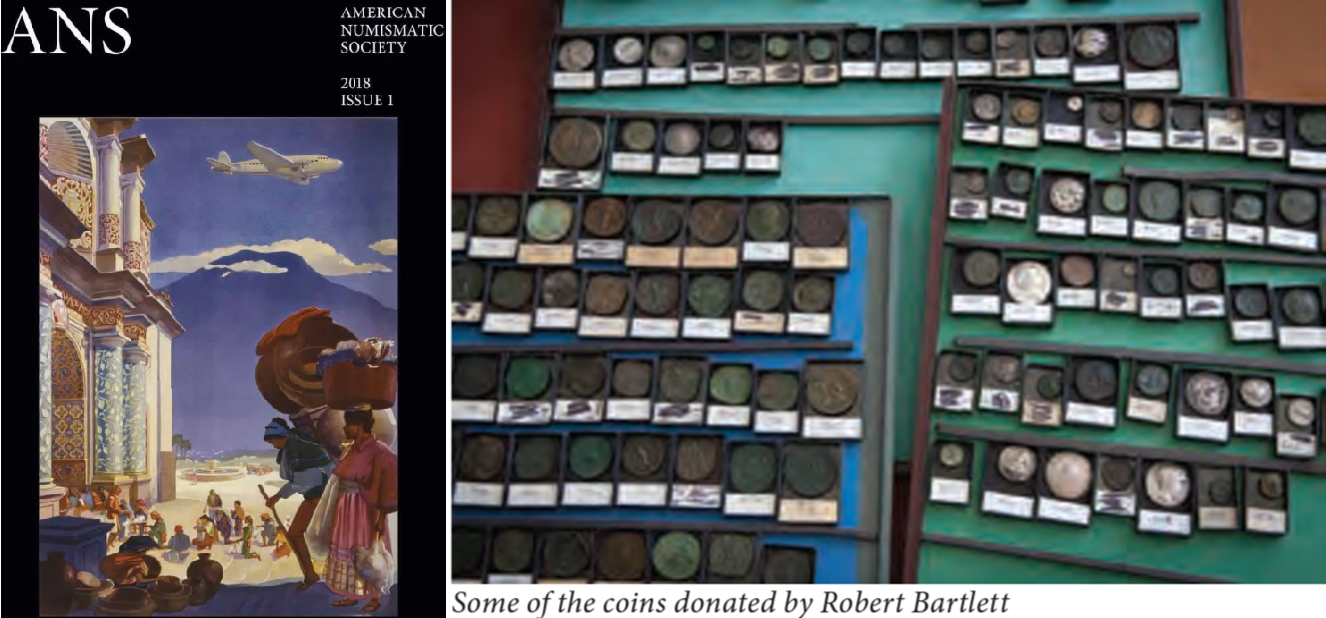
Provenance Notes: Although he collected other types as well, Bartlett specialized in Roman Imperial Sestertii. Of the 62 coins from his bequest in the ANS online catalog, at least 48 are Sestertii. Shown above: ANS Magazine 2018, Issue 1: p. 62; group photo, Bartlett bequest in trays at ANS, New York. For edited photo highlighting which coins I think are mine (this coin & Bretti bronze), see my Bartlett provenance photos on Imgur.
Divus Augustus AE Dupondius (29.5mm, 16.57g), under Caligula, Rome, 37-41 CE. Augustus radiate / Caligula in curule. (RIC 56)
(Photo Credit: CNG.) Collection History:
– Archer M. Huntington (1870-1955) Collection;
– Hispanic Society of America [HSA 1001.1.22981, donated 1940s];
– American Numismatic Society [ANS 1001.1.22981, long-term loan (received 13 June 1947), accessioned, deaccessioned ; CNG EA 397 (17 May 2017), 469];
– Lampasas Collection [CNG EA 488 (24 Mar 2021), 404].
Published (for Institutional Use): Hispanic Society of America. n.d. (c. 1947). Coins (A.M. Huntington Collection) on Loan to the American Numismatic Society. Photographic Record. NY: HSA. Plate 936.
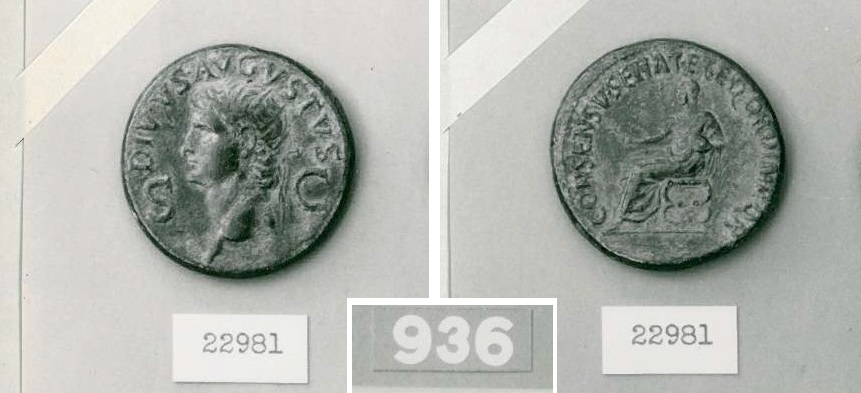
It appears some white powder was applied to the Dupondius, perhaps to make the details more easily visible in photographs? A bit of it still remains on the surface. Two Huntington Augustus AEs shown below still with the same peach museum tags 80 years later:
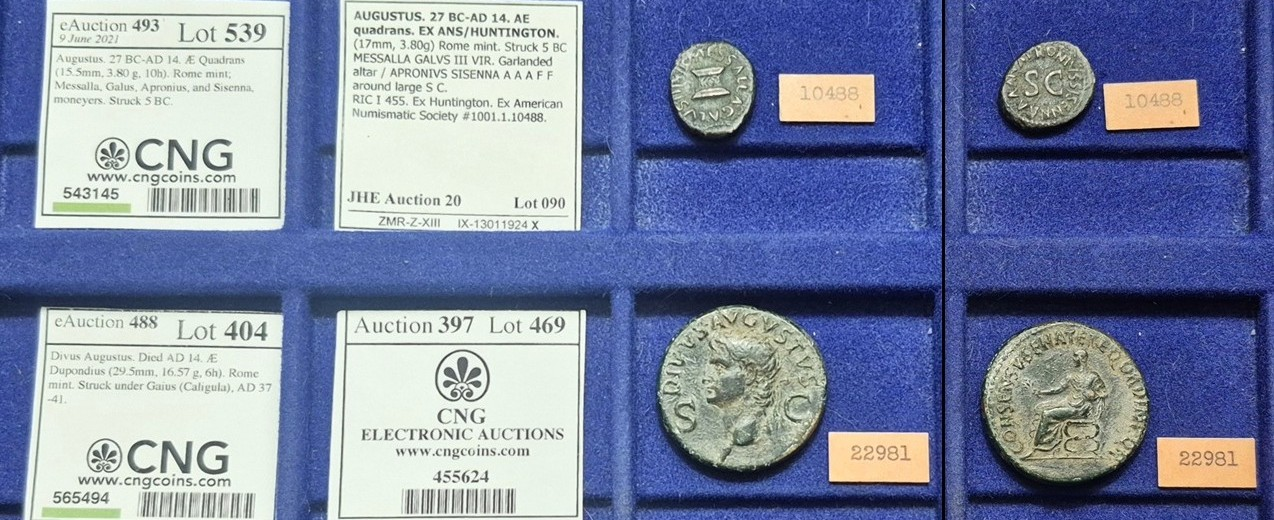
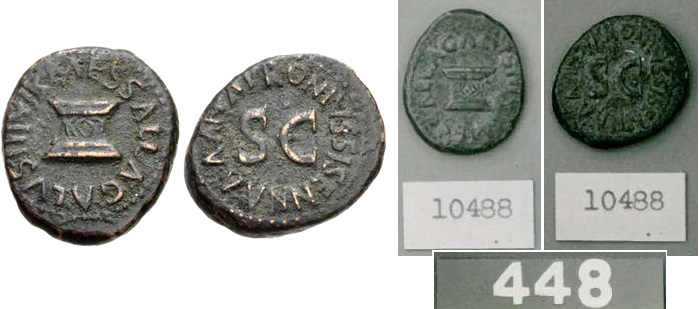
Also: Augustus AE Quadrans. (RIC 455)
– Archer M. Huntington (1870-1955) Collection;
– Hispanic Society of America [HSA 1001.1.10488, donated 1940s];
– American Numismatic Society [ANS 1001.1.10488, long-term loan (received 13 Dec 1946), accessioned, deaccessioned ; Jencek 20 (8 Apr 2014), 90];
– Lampasas Collection [CNG EA 493 (9 Jun 2021), 539].
Published (for Institutional Use): Hispanic Society of America. n.d. (c. 1947). Coins (A.M. Huntington Collection) on Loan to the American Numismatic Society. Photographic Record. NY: HSA. Plate 448.
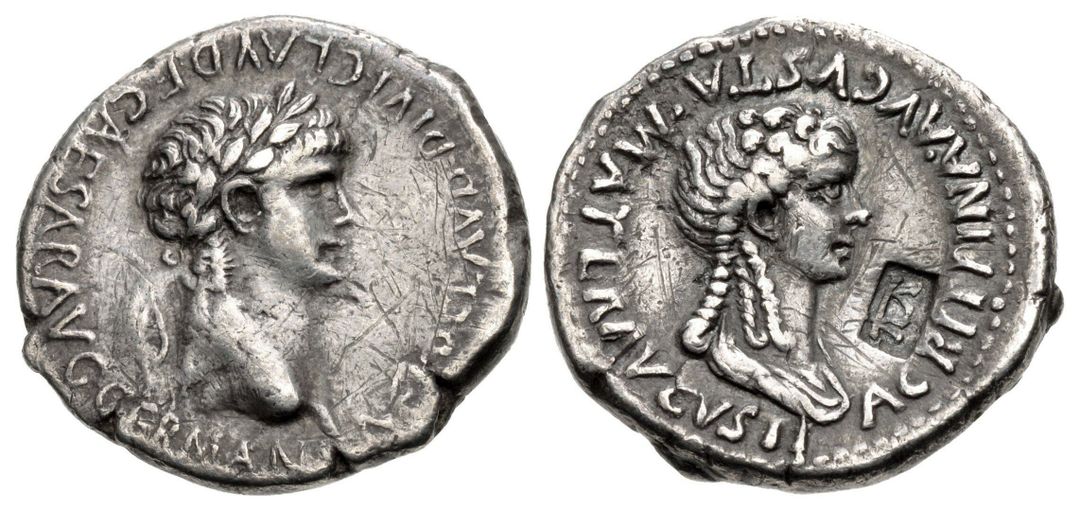
Nero & Agrippina II AR Drachm (18mm, 3.68g, 12h), Caesarea, c. 54/5 CE. Countermark “KK” in rectangular incuse.
[this coin also shown on my RPC page]
(Photo credit: CNG.) Collection & Selected Sale Hist.:
– (prob.) 1906 Caesarea Hoard (Noe 1937: 179) [dispersed by Indjoudjian Frères, Paris & Istanbul];
– Franz Trau Jr. (1881-1931) [Hess/Gilhofer & Ranschburg, (22 May 1935), 394];
– Walter Niggeler (1878-1964) [Leu/Münzen & Medaillen AG, Slg. Niggeler, Part II (21 Oct 1966), 659];
– Peter J. Merani (1936-2020) [CNG Triton XXIV (19 Jan 2021), 139; video on YouTube];
– Four additional sales not naming consignors.
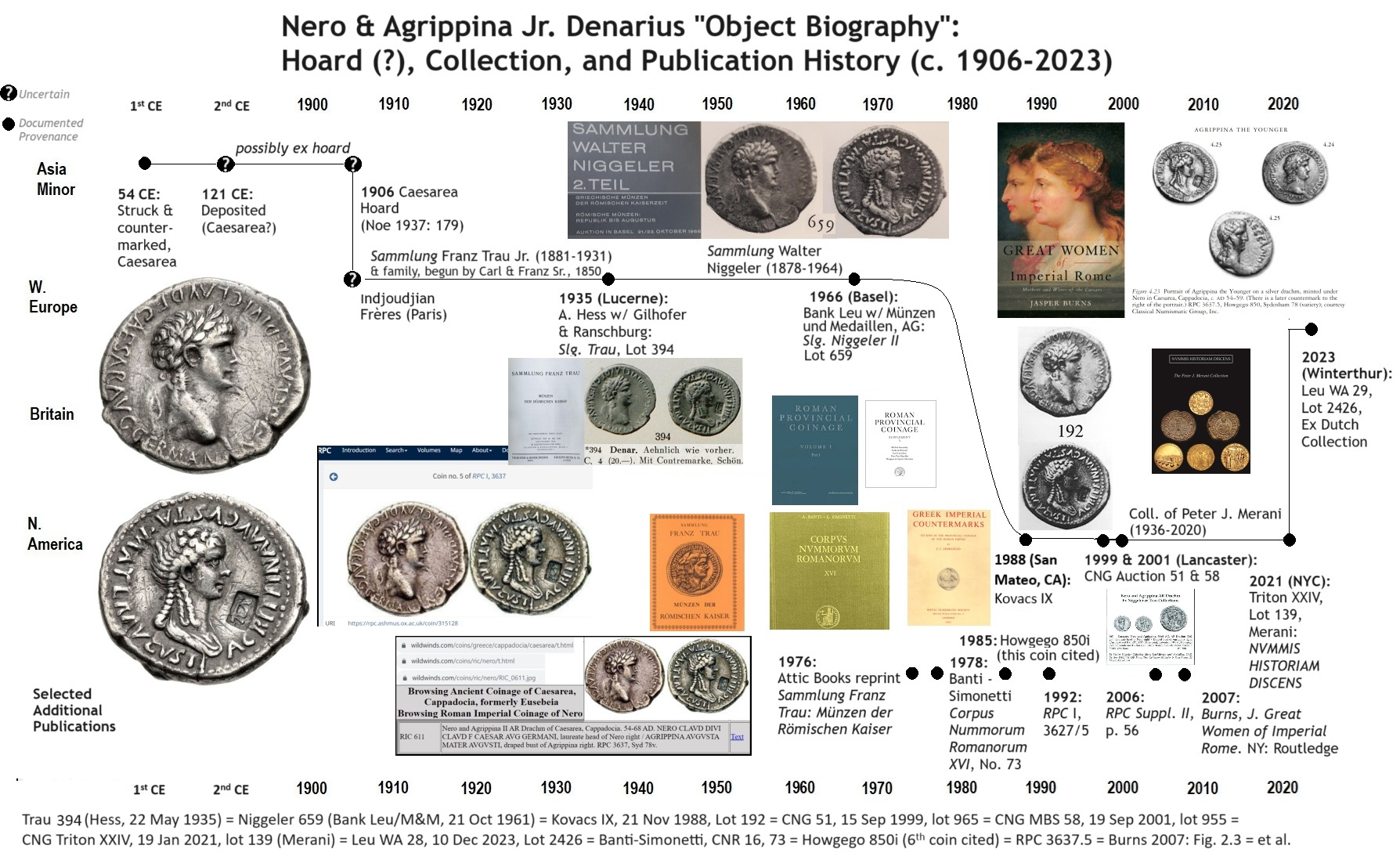
Selected Publications:
– RPC I 3637, ex. 5 (this coin illustrated);
– RPC Supplement II (2006) p.56 & Consolidated Supplement (2015), 3637.5 (this coin cited);
– CNR 16, p. 136, no. 73 (this coin illustrated), in: A. Banti & L. Simonetti (1978), Corpus Nummorum Romanorum, Vol XVI: Da Messalina a Nerone;
– Trau 394 (this coin) in: Attic Books (1976) reprint, Hess/Gilhofer & Ranschburg, Sammlung Franz Trau: Münzen der römischen Kaiser;
– Howgego 850i (6th coin cited);
– Sydenham-Malloy 79a (this coin cited, “Niggeler Sale #659,” on p. 142 in Malloy’s 1978 Supplement);
– Burns Fig. 4.23 (this coin illustrated on p. 83) in: Jasper Burns (2007), Great Women of Imperial Rome (Routledge) [my “association copy” is signed & inscribed to someone from the acknowledgements list];
– Wildwinds “digital plate coin,” Caesarea & Nero pp.
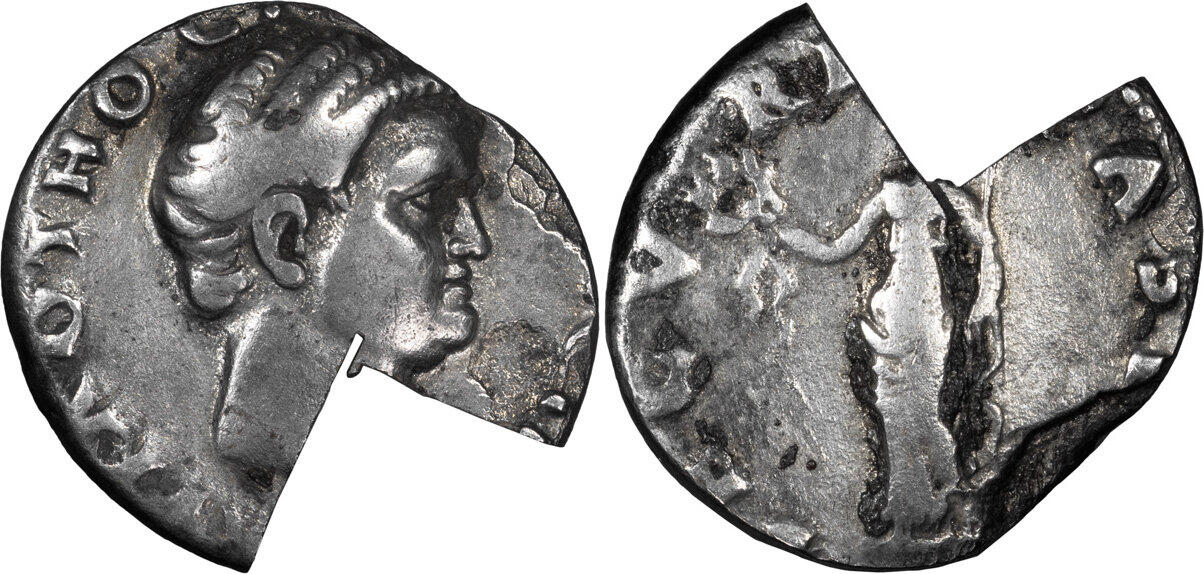
Otho AR Denarius (17mm, 3.50g), Rome, 69 CE. Otho in wig / Securitas. (RIC 8)
(Photo Credit: HJB.) Collection History:
– Jyrki Muona Collection [HJB 212 (9 Sep 2020) 511 (part of 35 denarii)];
– This coin among dozens of denarii donated to science by Muona — drilled, sliced, and quartered so we would all know what is inside. The results totally changed what we knew about Roman silver coins & the economy (from Walker’s 1976 surface analysis): A few more notes in Otho “Numislit Exhibit”.
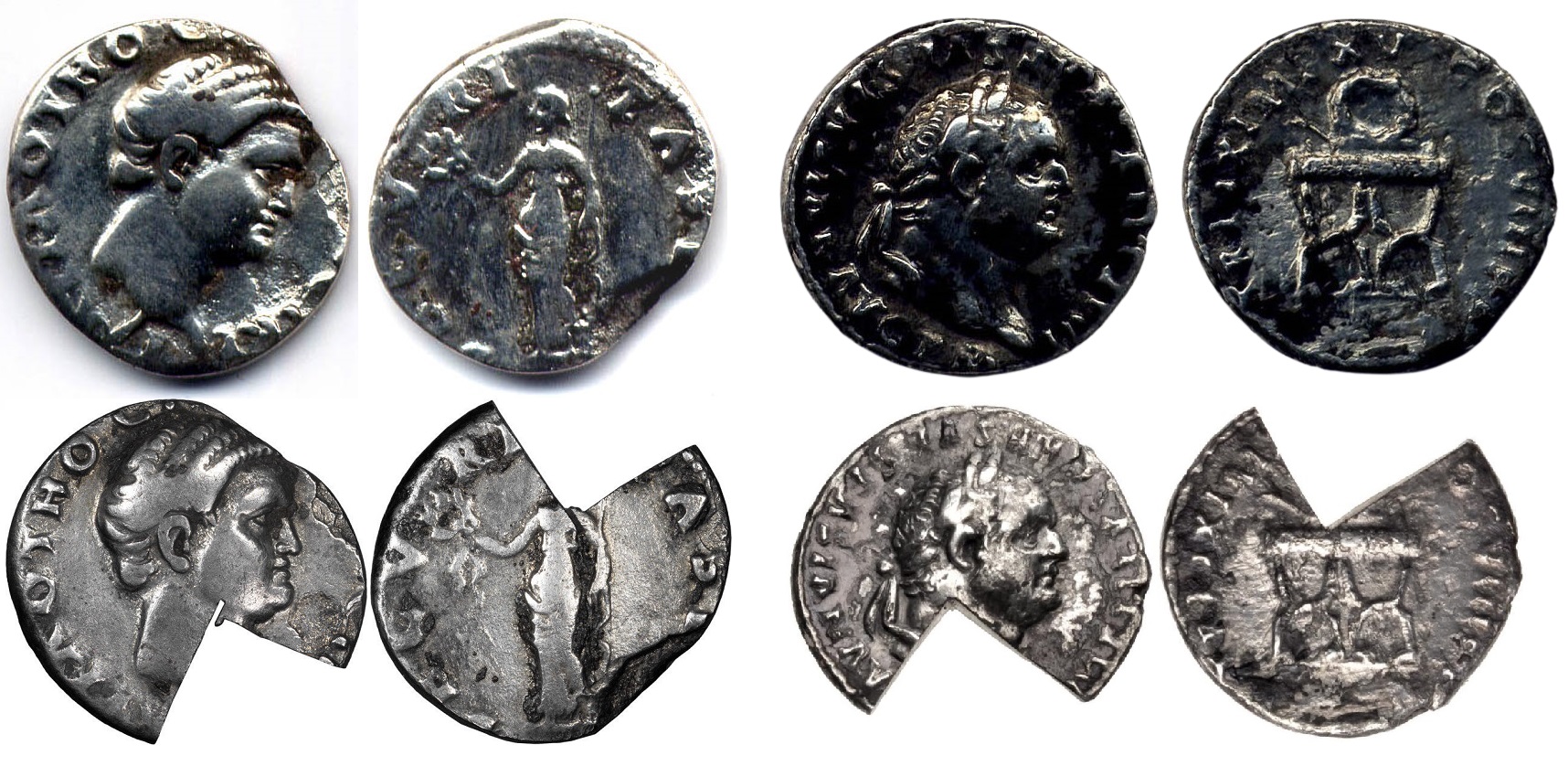
Selected Research/Publication History:
– Ponting & Butcher (2005/2015), Archaeology Data Service, UK: No. M16 (this coin illustrated, before cut), Public Dataset: “Analysis of Roman Silver coins, Augustus to the reform of Trajan (27 BC – AD 100)”;
– Butcher & Ponting (2014), M16 (this coin analyzed & illustrated by microscopic cross-section), pp. 136 & 253, in: Metallurgy of Roman Silver Coinage, from the Reform of Nero to the Reforms of Trajan (Cambridge);
– Butcher, Ponting & Muona (2009), M16 (this coin illustrated by microscopic cross-section), pp. 299-303, in: “The Denarii of Otho: A Stylistic and Compositional Study,” RIN 100: 291-310.
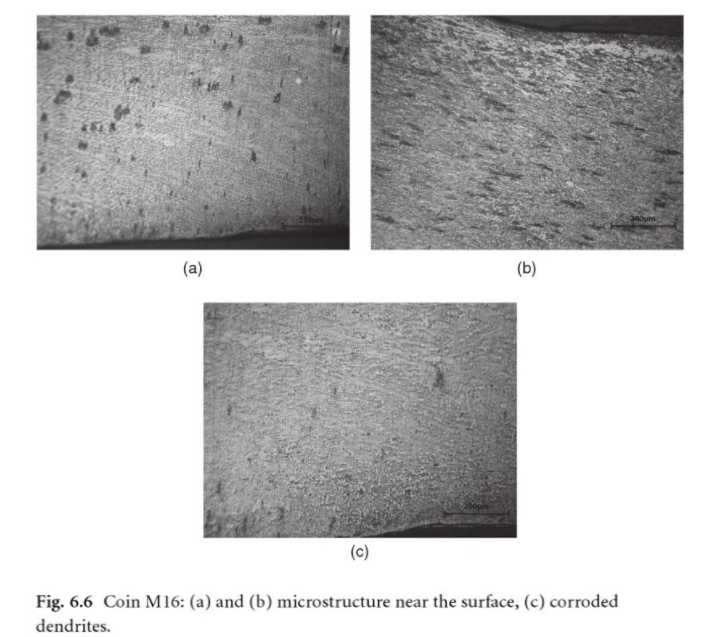
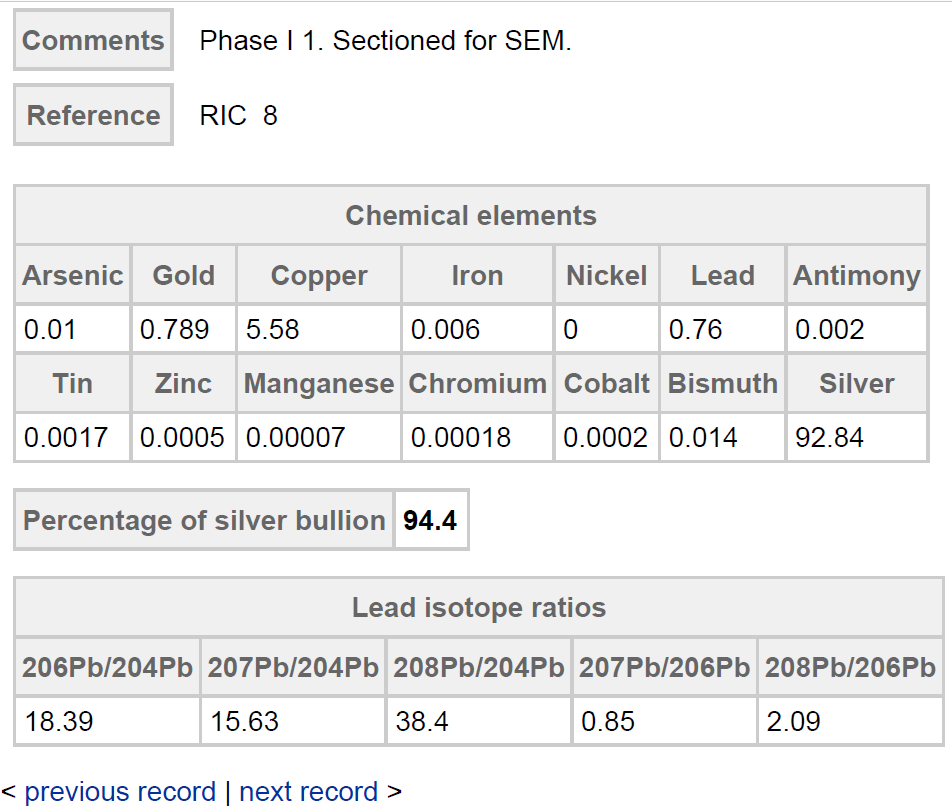
Note: I also have a Titus (ex Muona & Orfew/Andrew Short Collection) from the same group & appearing in some of the same research as “M40.”
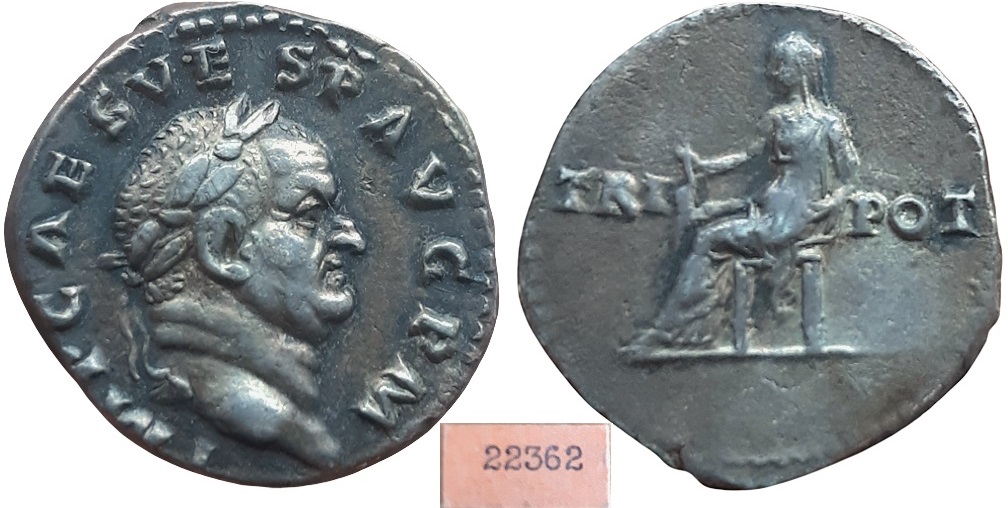
Vespasian AR Denarius (17mm, 3.50g), Rome, 71 CE. Vesta. (RIC 46)
(Photo Credit: CJJ.) Collection History:
– Archer M. Huntington (1870-1955) Collection;
– Hispanic Society of America, w/ original museum tag [HSA 1001.1.22362, donated 1940s];
– American Numismatic Society [ANS 1001.1.22362, long-term loan (received 13 June 1947), accessioned, deaccessioned];
– Lampasas Collection [CNG EA 397 (17 May 2017), 522 ; CNG EA 487 (10 Mar 2021), 510];
– Charles Chamberlain Collection [CNG EA 509 (9 Feb 2022), 664].
Published (for Institutional Use): Hispanic Society of America. n.d. (c. 1947). Coins (A.M. Huntington Collection) on Loan to the American Numismatic Society. Photographic Record. NY: HSA. Plate 915.
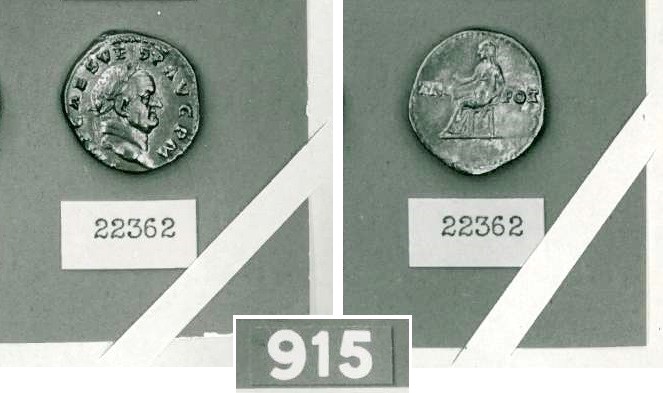
Note: The little peach museum tags with deaccessioned Huntington coins were issued by the Hispanic Society of America (HSA) and retained by the American Numismatic Society (ANS).
They look white in the HSA’s 1946 inventory photos, but upon enlarging & comparing closely (i.e. centering), it becomes clear that the very same labels still accompany most of the coins.
My Huntington Augustus AEs also have their HSA tags, photographed above.
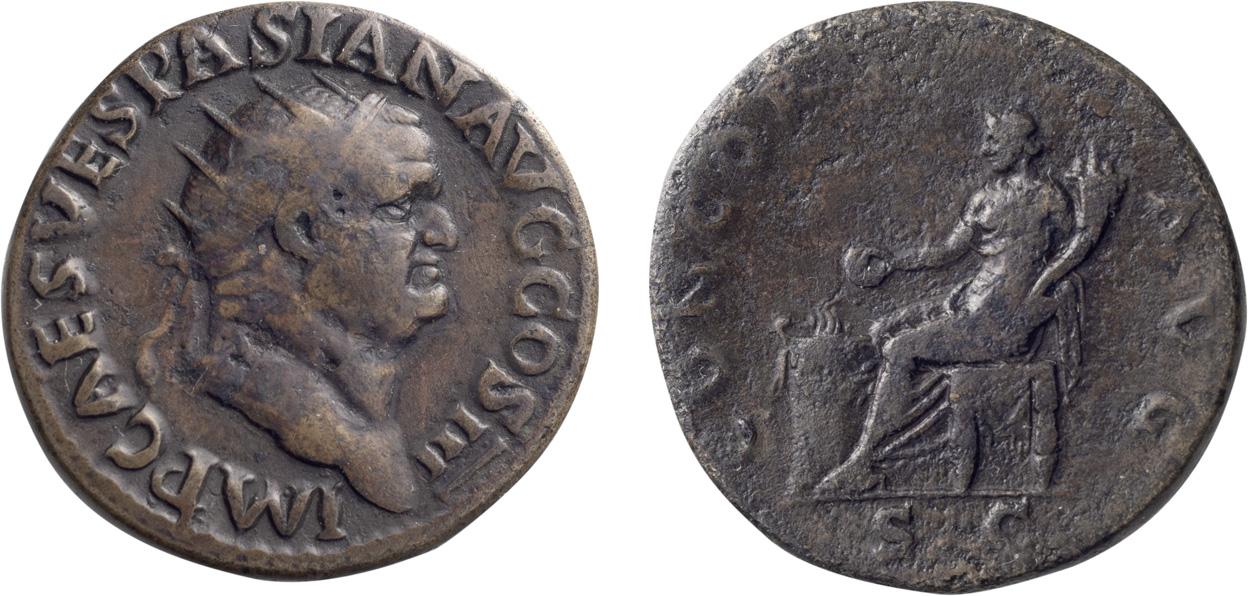
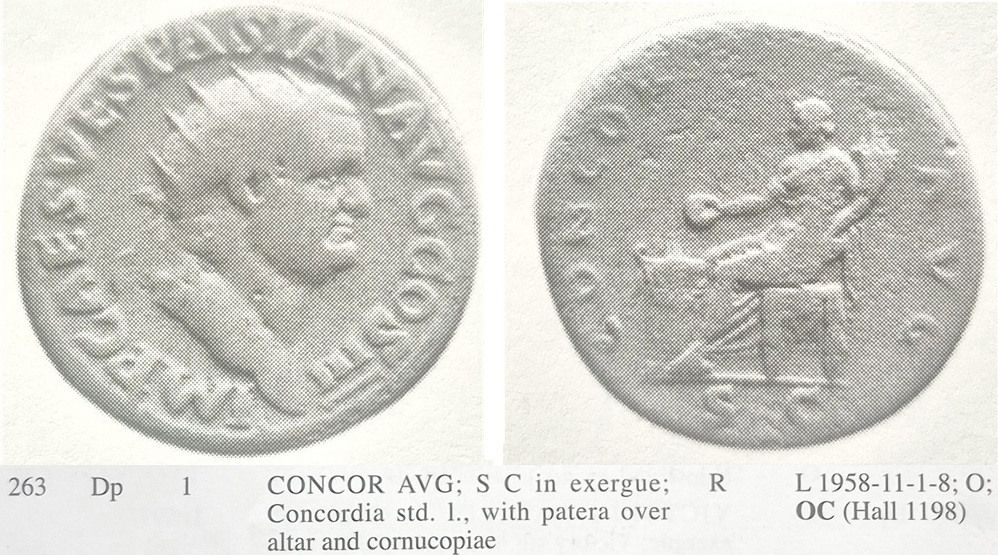
Vespasian AE Dupondius (27mm, 13.45g), Rome, 71 CE. Vespasian radiate / CONCOR AVG. (RIC 263)
(Photo Credit: HJB.) Collection History:
– Henry Platt Hall (1863-1949) Collection [Part II, Glendining “Catalogue of the important collection…” (16 Nov 1950), 1198 (part)];
– (probably, see Hall-Trau note) ex Sammlung Franz Trau Jr. (1881-1931) [Hess/Gilhofer & Ranschburg, (22 May 1935), 561];
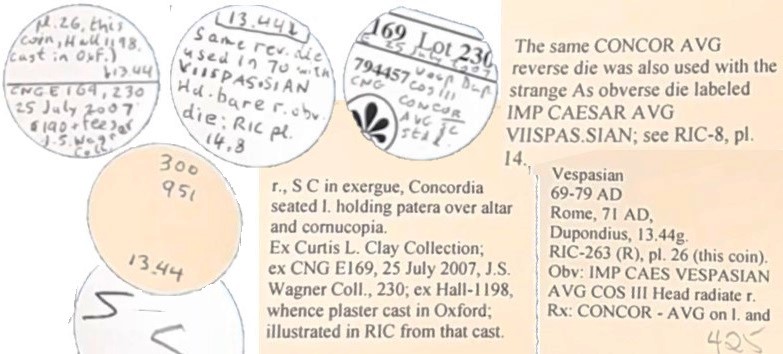
– JSW Collection, w/ tray tag [J.S. Wagner, CNG EA 169 (25 Jul 2007), 203];
– Curtis Clay Collection, w/ tray tags [Part II, HJB BBS 225 (30 Nov 2023), 23].
Institutional/Publication Hist.:
– RIC II.1 263 (this coin illustrated from plaster cast in the 2007, 2nd ed.);
– Plaster cast after Hall Collection, held at Heberden Coin Room of Ashmolean Museum, Oxford University.
“Digital Plate Coin”:
– Wildwinds (RIC 263, after CNG EA 169) on Vespasian page;
– Romanatic database Nr. 3073 (archived), citing Oxford Cast Collection (former website of Simon Wieland, Lars Rutten).
See also: Hall-Trau Provenance Note and Clay-Kraay Note below.
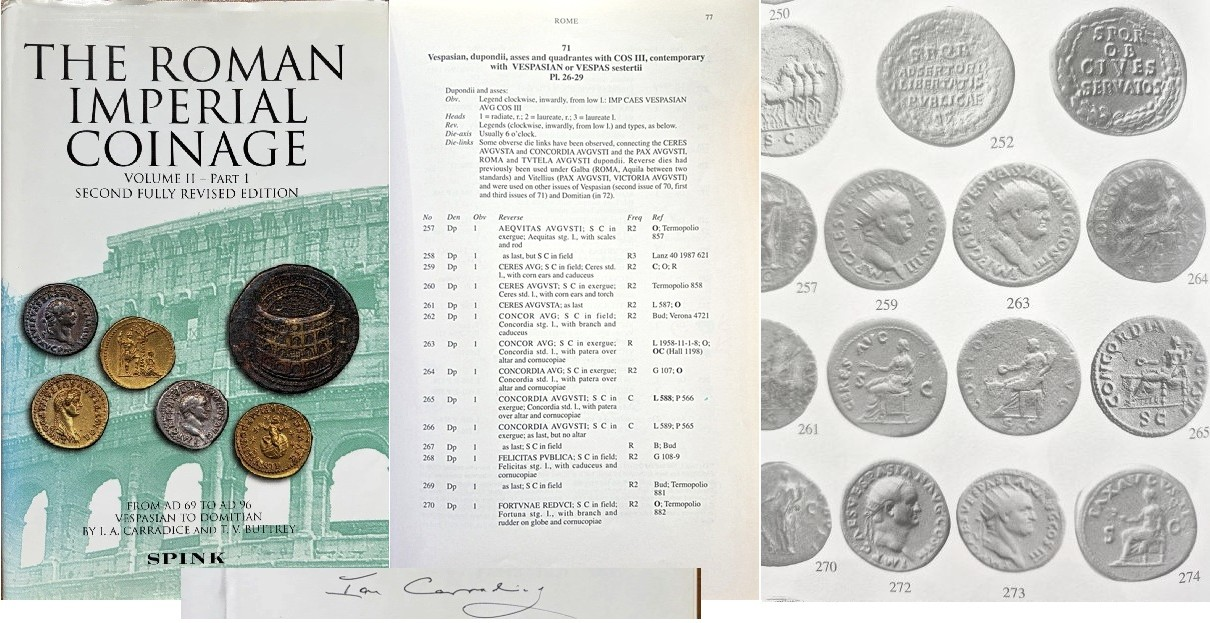
Above: My autographed copy of RIC II.1 (signed by Ian Carradice), ex David Hendin Library.
Notes: Additional examples of this type in Turin & Budapest cited by Fabressi et al. (1881) Regio Museo di Torino 4: p. 271, no. 665 and Gohl (1907) in both Numizmatikai Közölny VI: p. 79, no. 14 & Rivista Italiana Numismatica XX: p. 539, no. 14 (cited in BMCRE2, p. 426). No photos or weights. I have not yet verified current disposition to rule out one being sold as a duplicate to Trau (then Hall et al.). A couple others have appeared at auction since the mid-2000s.
(Photo Credit: CJJ / CNG.) Collection History:
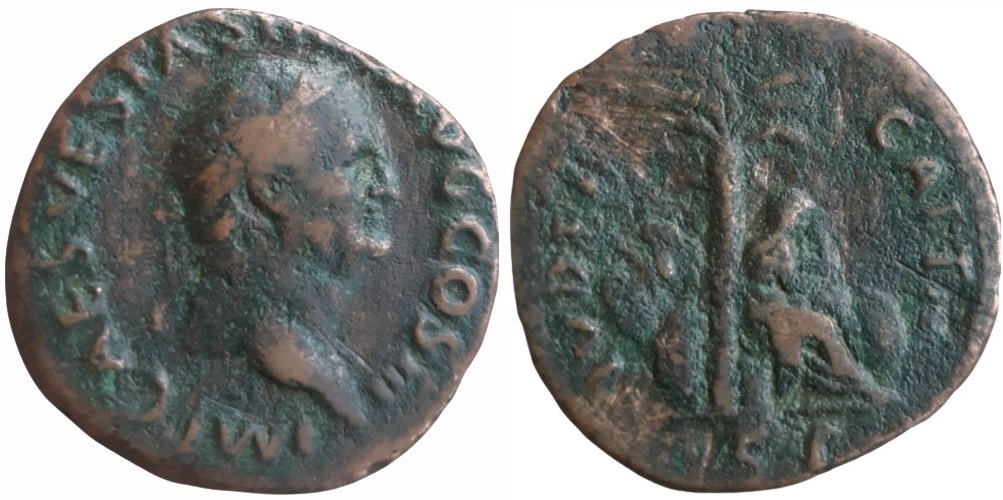
– Kenneth Bressett (1928 – ) Collection [bought for $8 in 1957 from M. Salton ; CNG Keystone Auction 6 (11 Mar 2022), 3156 (corr.: legends, ref., date & mint all in error)];
– Mark M. Salton-Schlessinger (1914-2005) [with his tag & uncertain envelope];
– (possibly) Ex Hesperia (V. Clain-Stefanelli/R. Hecht, Baltimore) FPL 1 (Spring 1951), 386 (“F/VF”) or 387 (“G”).
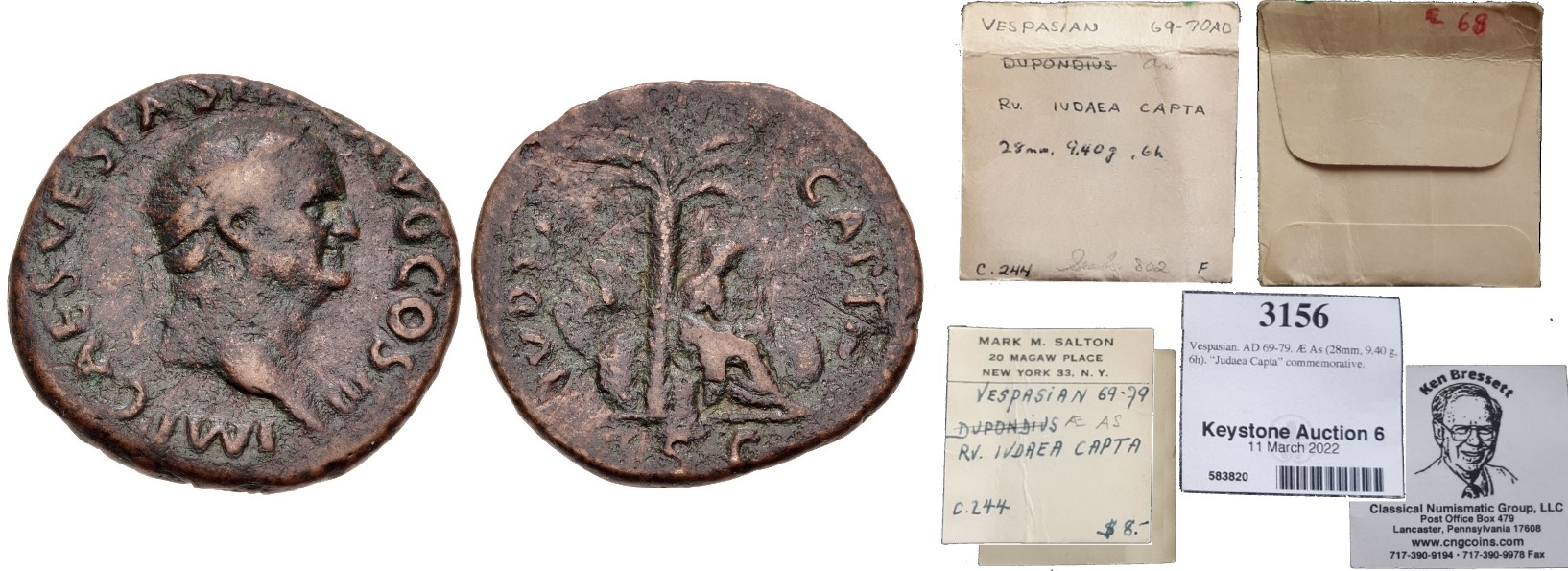
Notes: See also Salton-Hesperia Provenance Note below. This coin on “captives” page.
This legend is sometimes described as a misspelling (IVDEA for IVDAEA), but that is unlikely, as it was repeated on multiple dies for several As and Sestertius types.
ROMAN IMPERIAL, PART TWO: ADOPTIVE EMPERORS TO SEVERAN ERA [top]:
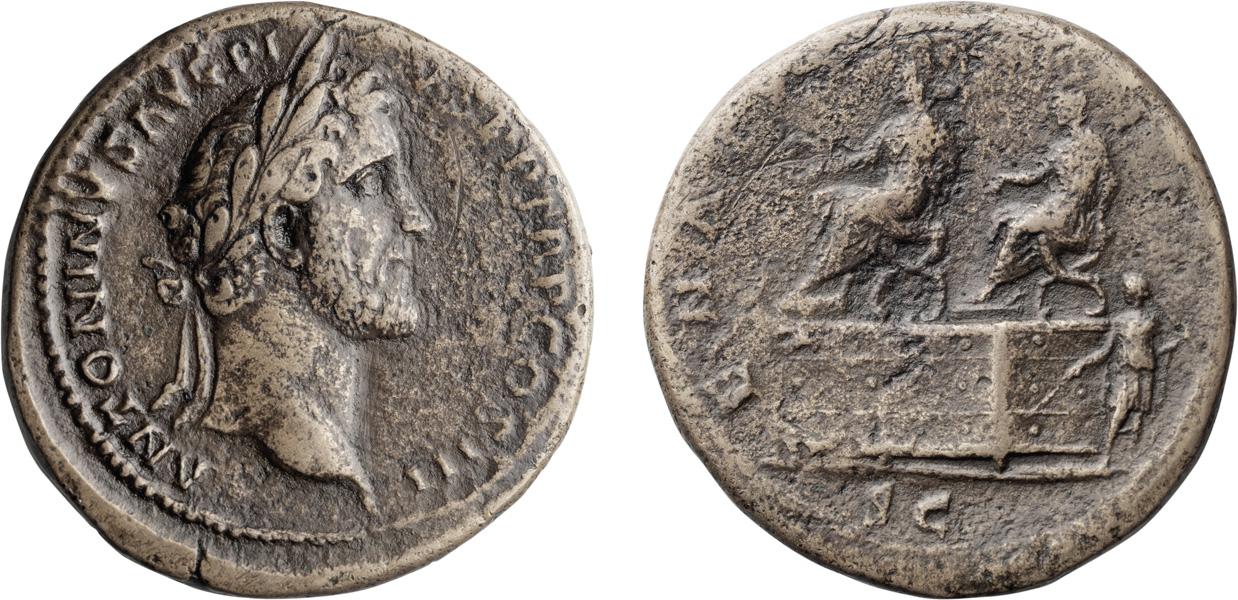
Antoninus Pius AE Sestertius (34mm, 24.11g), Rome, 140-144 CE. Congiarium scene, Antoninus Pius & Marcus Aurelius (Clay-Kraay Overstrike: GENIO SENATVS). (RIC 628; undertype: RIC 605)
(Photo Credit: HJB.) Collection History:
– Apostolo Zeno (1668-1750) Collection [formed c. 1722-1747];
– St. Florian Monastery Collection [1747-1955 ; Dorotheum, Zeno Part I (13 Jun 1955), 952, ill. on plate 16];
– c. 1941: taken by Nazi Sonderauftrag Münzen for collection of planned Führermuseum (Kunstmuseum Linz), recovered May 1945 from Salzbergwerk Altaussee (Altaussee salt mine) by US 3rd Armed Div. (w/ “Monuments Men”), moved to CCP Munich & restituted to St. Florian (c. 1948 f.);
– Ex Alex G. Malloy (uncertain sale), 574 & Silenos (Angel Borislov, eBay, 11 Nov 2005);
– Curtis Clay Collection, w/ tray tags [Part IV, HJB BBS 227 (14 May 2024), 93 ; Berk’s coin-in-hand video].
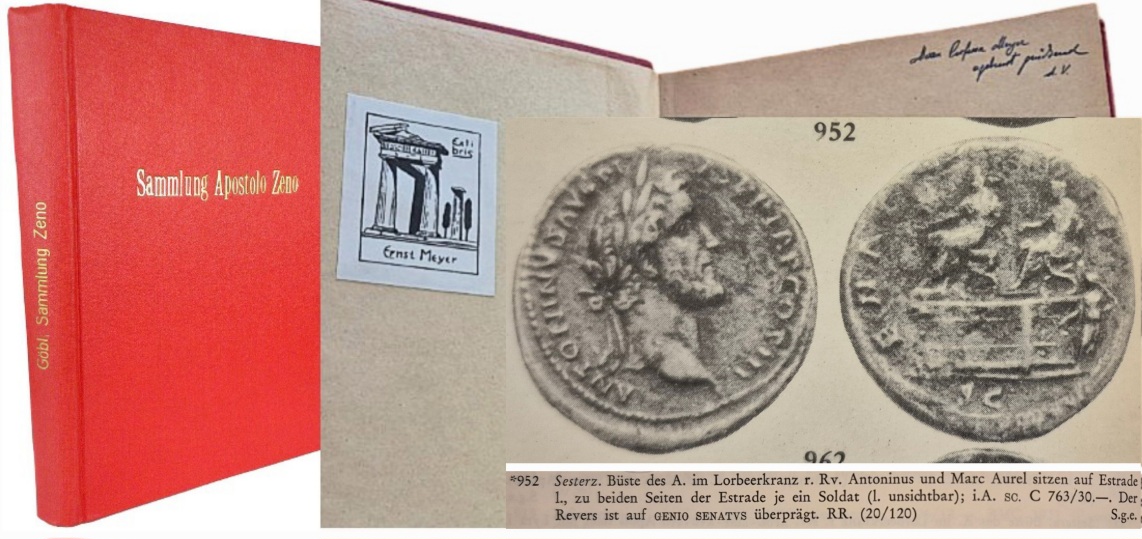
Notes: My Apostolo Zeno catalog set (Parts I-III) is a custom bound “association copy,” inscribed to Prof. Ernst Meyer (1898-1975) by the cataloger, Prof. Robert Göbl (“d[er]. V[erfasser].”).
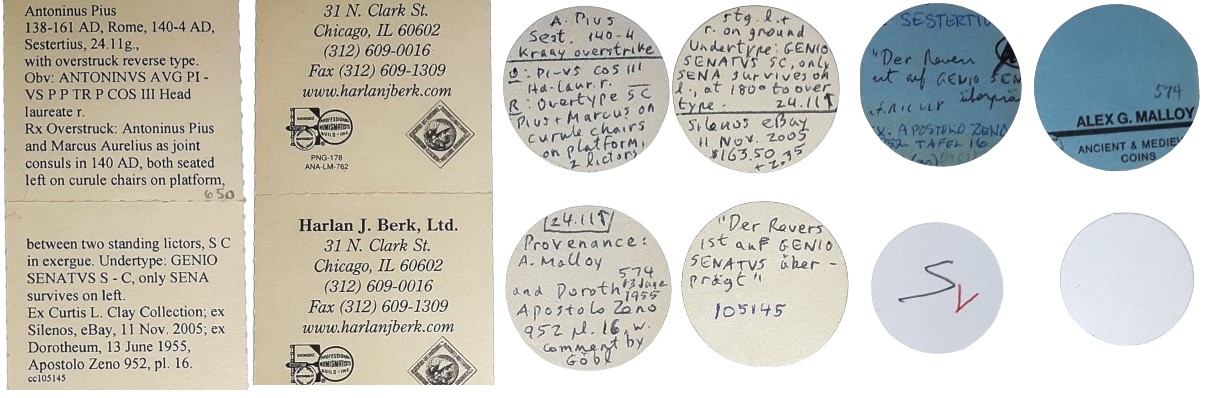
See also: Zeno-Clay-et al. Notes and Clay-Kraay Note below.
This coin has an especially fascinating and historically important object biography, but my comments ran too long, so I’ve moved them below.
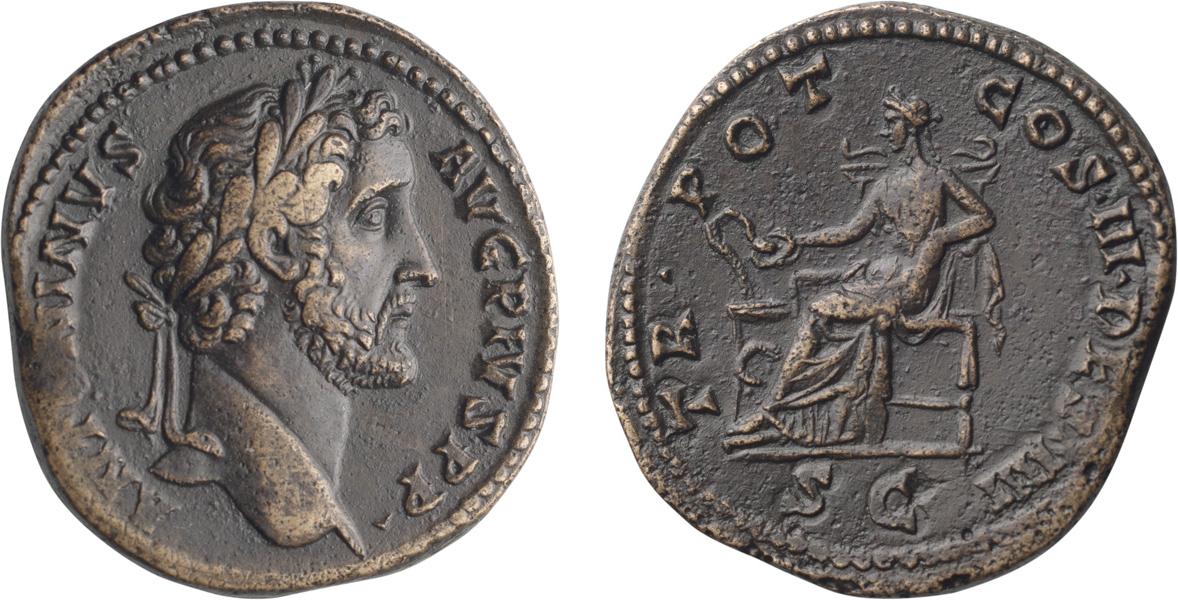
Antoninus Pius AE Sestertius (32mm, 27.60g), Rome, 144 CE. Salus seated (TR·POT COS·III·DES·IIII – S C). (RIC 753)
(Photo Credit: HJB.) Collection History:
– Sammlung Dr. Karl Gustav Elberling (1797-1873), published 1864/5;
– Curtis Clay Collection, w/ tray tags [Part IV, HJB BBS 227 (14 May 2025), 97 (w/ video, also on vimeo) ; acq. NAC Auction I (19 May 1999), Lot 1990];
– (probably, see note) Francis Hobler (1796-1869) Collection, published 1860 (p. 440: nr. 930, incorrect weight?) [Sotheby (4 Jul 1859), Lot 523 (part, 2nd coin)];
– additional sales c. 1906-8 at bottom of this entry (see also post-Elberling endnote).
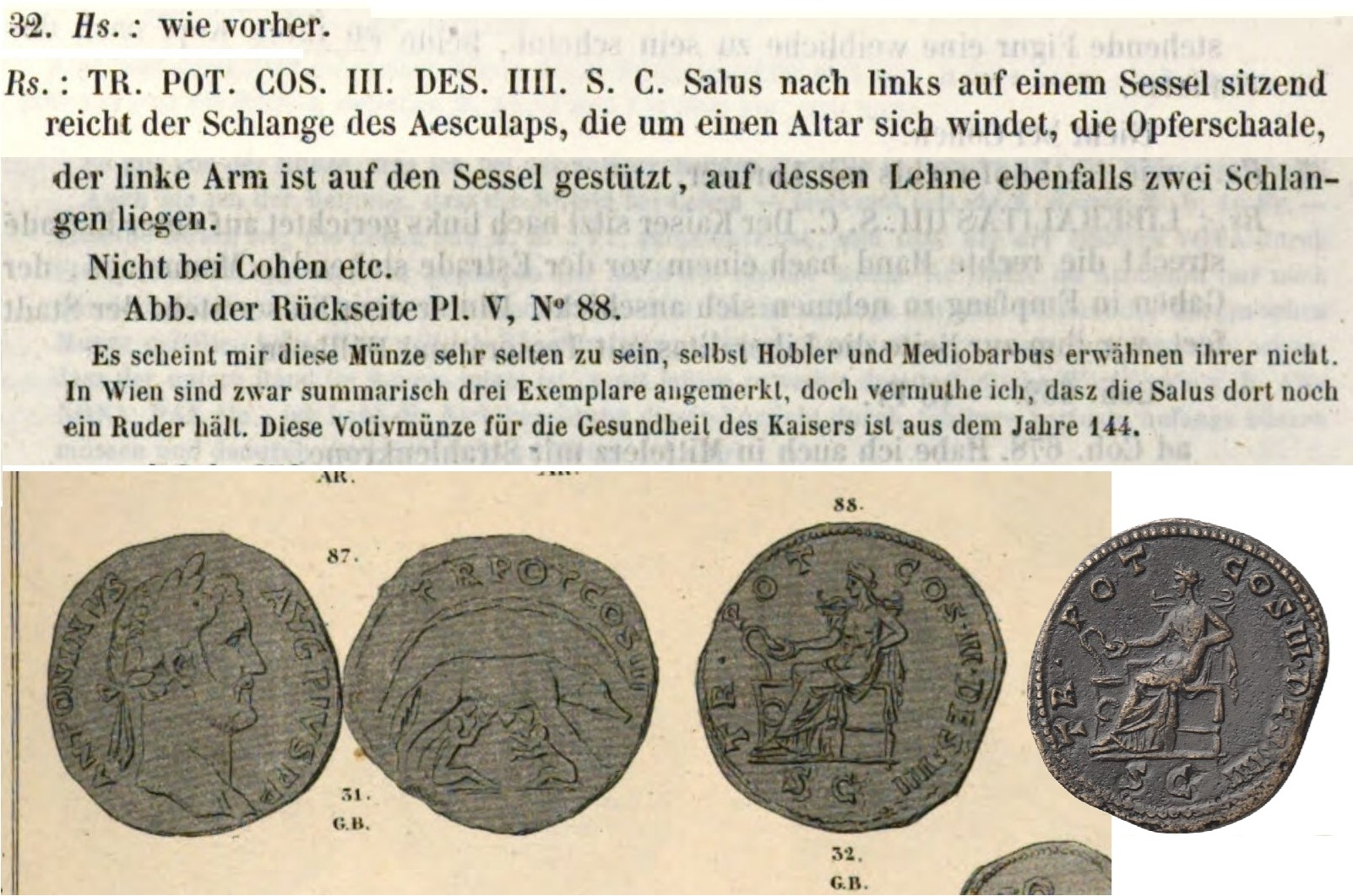
Publication History:
– Elberling 32 (this coin illustrated) on Pl. V, Nr. 88, in “Die Wichtigsten Exemplare in Meiner Sammlung Römischer Münzen,” Part III, in Publications de la Section Historique de l’Institut Royal Grand-Ducal de Luxembourg (v. 20, 1864/5).
Elberling described this coin as “very rare, even Hobler and Mediobarbus do not record it” (transl. by C. Clay). Yet Hobler describes this exact type, probably this very coin!
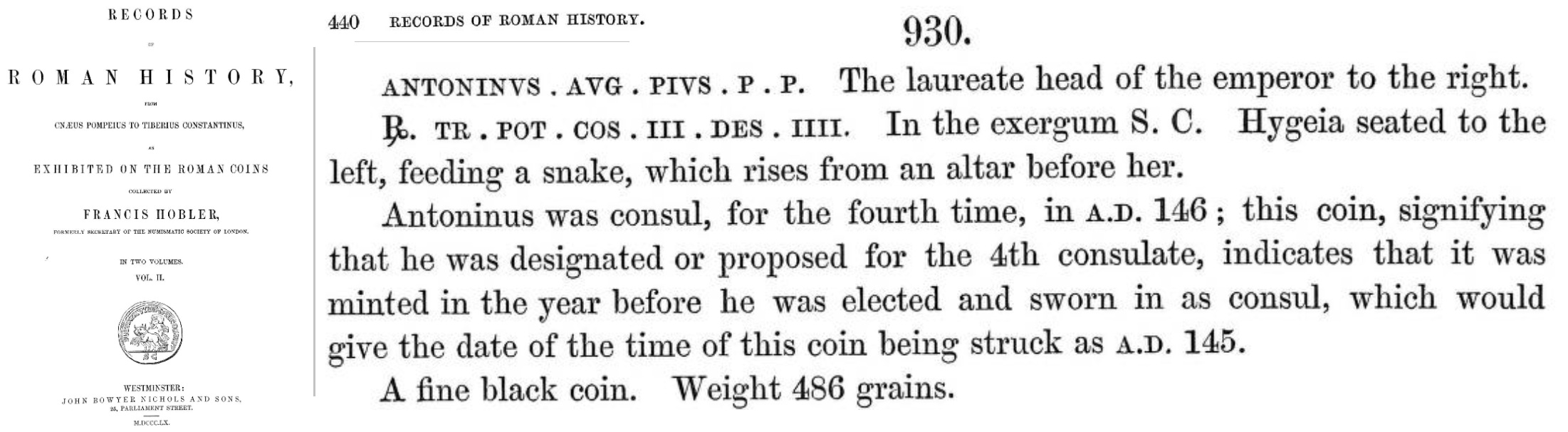
-Hobler 930 (probably this coin described on p. 440), in: Francis Hobler (1860), Records of Roman history from Cnæus Pompeius to Tiberius Constantinus on the Roman coins (volume 2)
[but weight listed in error (?) as 486 grains rather than 426, see note].
This coin referenced in the literature, after Elberling & Cohen:
– Cohen VII [Supplement] (1868: p. 155) 114 (10 Fr.) (this coin described), in Description Historique des Monnaies Frappées sous l’Empire Romain… [on Google books];
– Cohen (1882: p. 359) 929 (4 Fr.) (this coin described), in Feuardent’s revised 2nd edition [on Google books] (notice that, 14 years later, Feuardent had reduced Cohen’s est. by 60%!);
– BMC 1651, note (this coin cited), in Coins of the Roman Empire in the British Museum, vol 4 (Mattingly & Carson, 1940: p. 266, note) [on Archive];
– RIC 753 (this coin cited with note of doubt, “probably same Rev. as No. 750”), in The Roman Imperial Coinage, vol III (Mattingly & Sydenham, 1930: p. 122 & note);
– Strack +83 (this coin cited as “probable”);
– ERIC II 780 (this coin cited as unverified).
See also: OCRE RIC III 753 (zero specimens).
See also: Elberling-Clay Note, below.
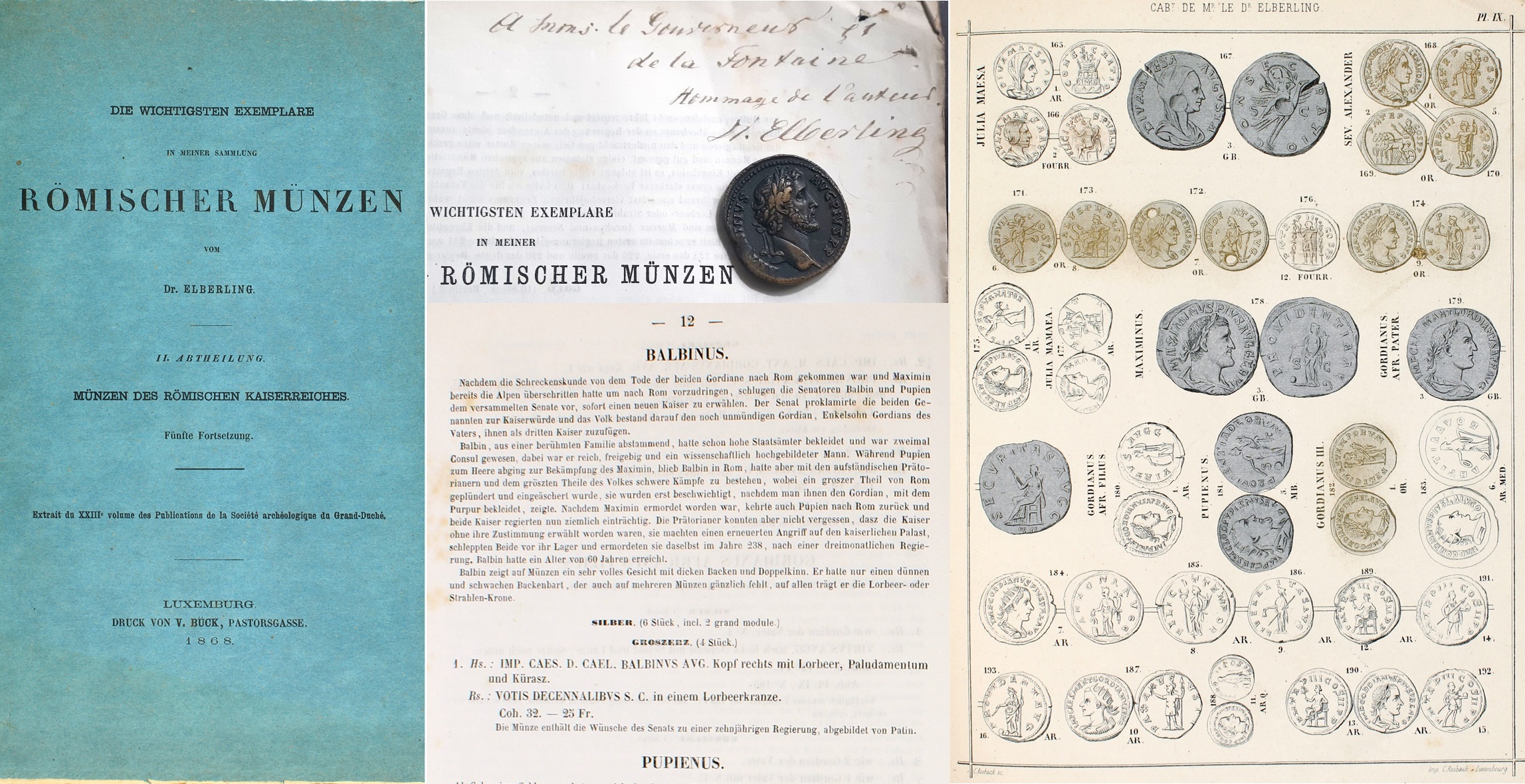
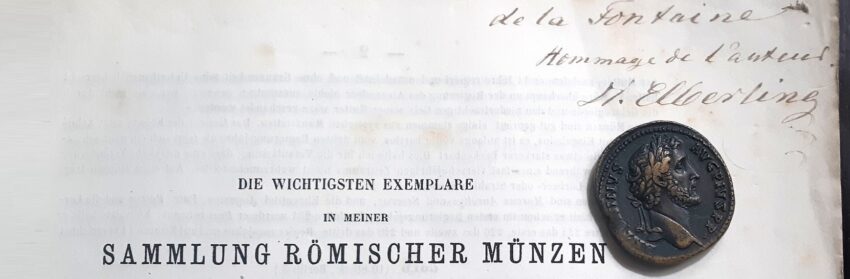
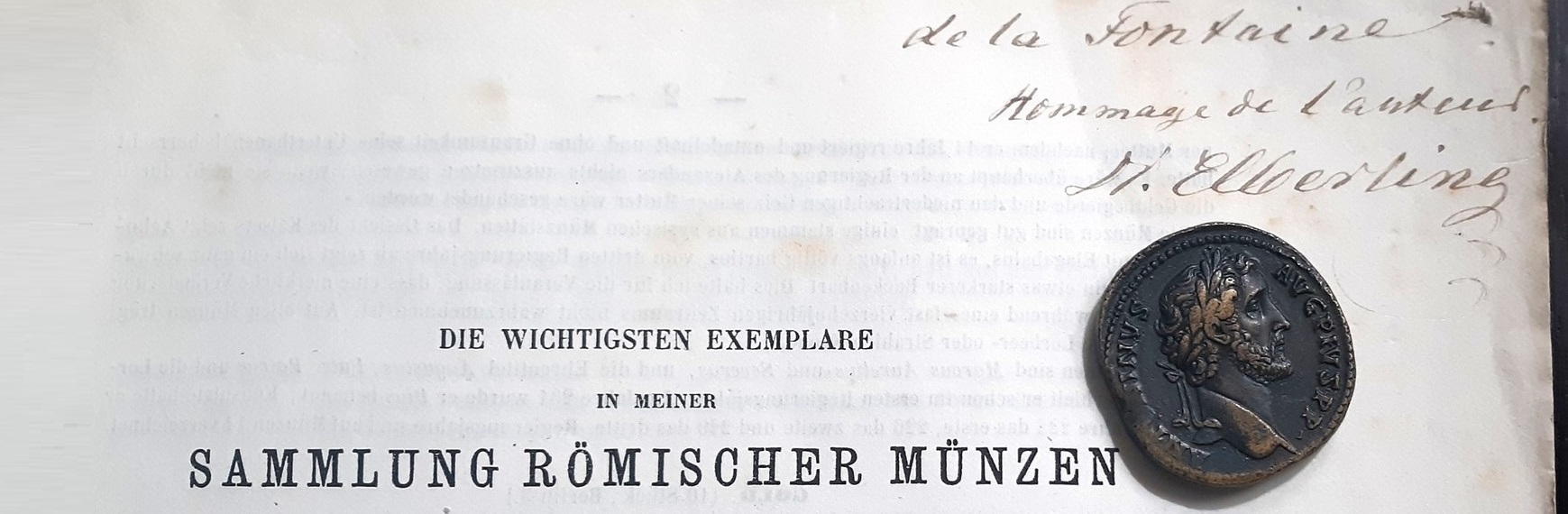
Related: Also in my collection, Elberling’s later article from the same series, “Wichtigsten Examplare in Meiner Sammlung… [Teil V]” (PSH v. 23, 1867/8), which he signed & inscribed to GTI de la Fontaine (1787-1871), Luxembourg’s first Prime Minister (1848) & co-founder of the Grand Duchy’s historical institute (to which Elberling’s collection was promised, but ultimately not delivered).
Additional Probable Collection/Sale History (see also post-Elberling endnote) (back to top):
– Nicolò Majer, Catalogo di monete antiche e moderne… FPL 8 (8 Oct 1908), page 66, no. 1497 (citing Cohen 898, var. based on 1859 edition);
– Stiavelli et Autre Collectionneur Distingué, Santamaria 1 (6 Apr 1908), 525.2 (part)
[Stiavelli died in 1905, before the Spink sale below, so this coin must have been from the unnamed “other distinguished collector”];
– Spink Numismatic Circular 158 (Jan 1906), no. 23130).
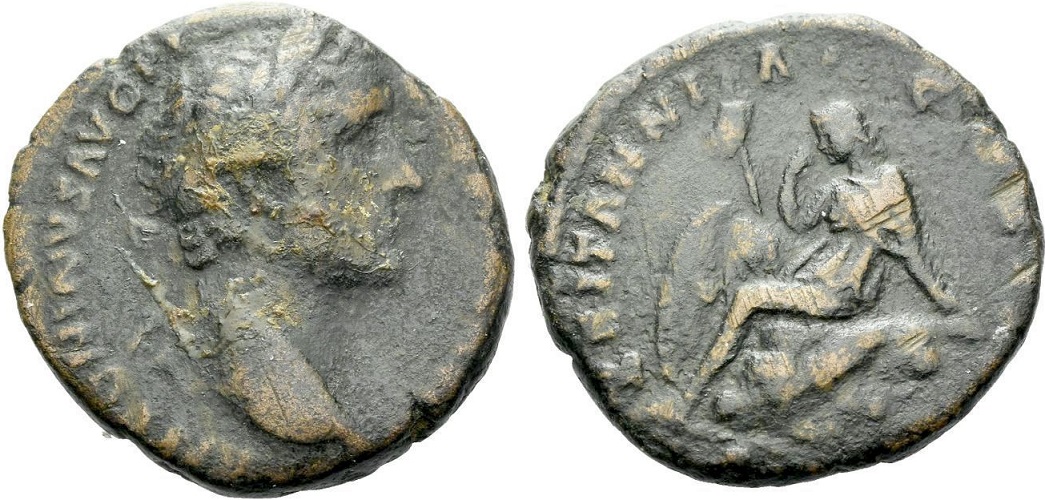
Antoninus Pius AE As (25mm, 9.83g), Rome (for British circulation), 154 CE. Britannia seated in mourning. (RIC 934)
(Photo Credit: Naville.) Collection History:
– “Mentor Collection” (property of George Muller) [Naville 84 (8 Oct 2023), Lot 460].
Suspected Publication & Collection History:
– Pinkerton Pl. III, No. 6 (this reverse possibly illustrated by I. Barlow from “the author’s casket”), in: John Pinkerton (1784/1789/1808 eds.), An Essay on Medals: Or, An Introduction to the Knowledge of Ancient and Modern Coins and Medals; Especially those of Greece, Rome, and Britain;
– John Pinkerton (1758-1826) Collection, sold to Neve;
– Philip Neve, Esq. [Neave] (c. 1748-1824) Collection;
– Thomas Thomas, Esq. (c. 1770-1843) [Sotheby, 8 July 1844, Lot 909 (noting, below, ex Pinkerton, “No. 6 of plate 3…from Mr. Neave”; “fair state of preservation”)];
– (possibly also) Marmaduke Trattle (1751-1832) Collection & Matthew Young (1770-1838) (see Thomas-Neve note).
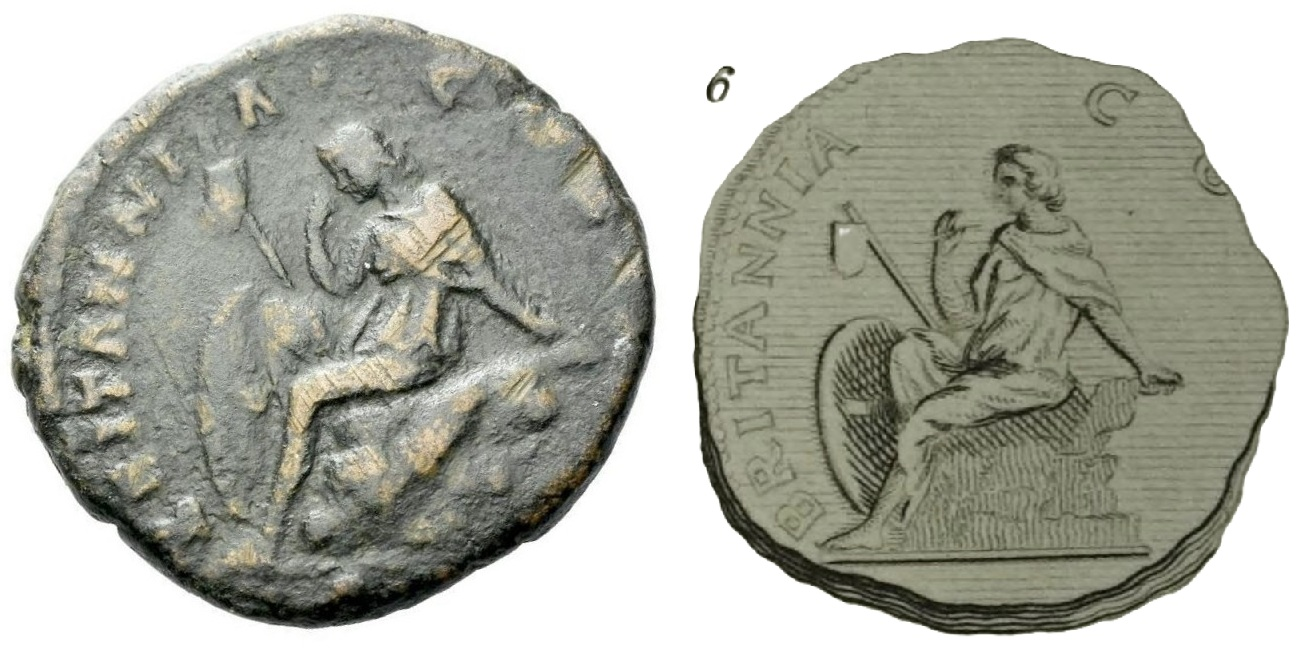
Notes: Sometimes provenances can be positively identified from very old line drawings, beyond a reasonable doubt (e.g., Elberling’s Antoninus Pius Sesterius, above).
This is not one of those. I suspect, based on circumstantial evidence and physical similarities, that this coin is the same one illustrated in Pinkerton’s 1784 Essay on Medals, “from the author’s casket.”
Fittingly, Sotheby’s described the condition only as “fair” (which, as today, meant it wasn’t the worst possible, but not good either).
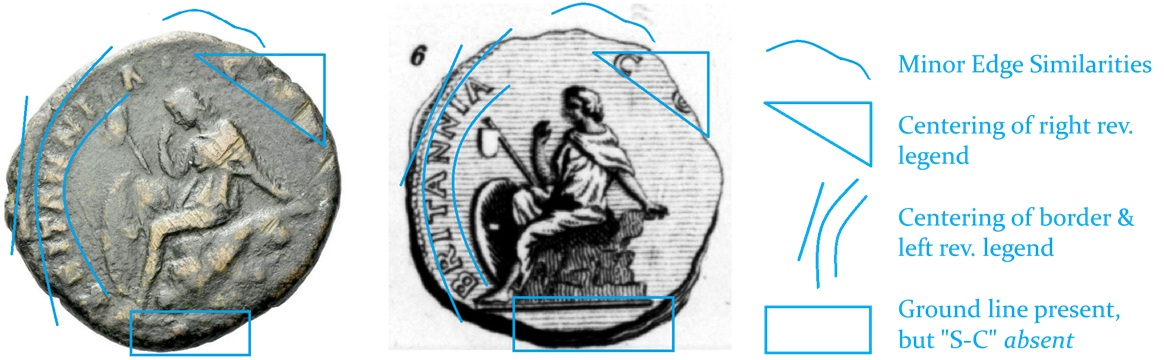
My coin and the engraving share a combination of distinctive features of centering: “BRITANNIA” placed just at the edge w/ “COS” falling off the flan; the dotted border begins & ends almost identically; the “S-C” (below) & “IIII” (to r.) are missing (though the engraver has added a blank exergue & wide base to the rock that should not exist; see below). Notice also the distinctive (but not unique) shape of the banner and especially the short curly hair (an erroneous detail), which may be inspired by the minor tooling on the nape of my Britannia’s neck.
The biggest difference is the lower-right “corner” of the flans, mine being much shorter. However, the details support my hypothesis: If the lower-right flan had actually been present as engraved, the “S-C” would certainly have been visible (probably also “IIII”). Instead, they are absent, suggesting that portion of the flan was missing. Additionally, the base of the rocks (truncated on my coin) is far too wide in Pinkerton’s illustration, probably modeled on the broader Sestertius reverse. (For the full rev. legend, see BM 2012,4083.6 or Ackerman’s drawing below.)
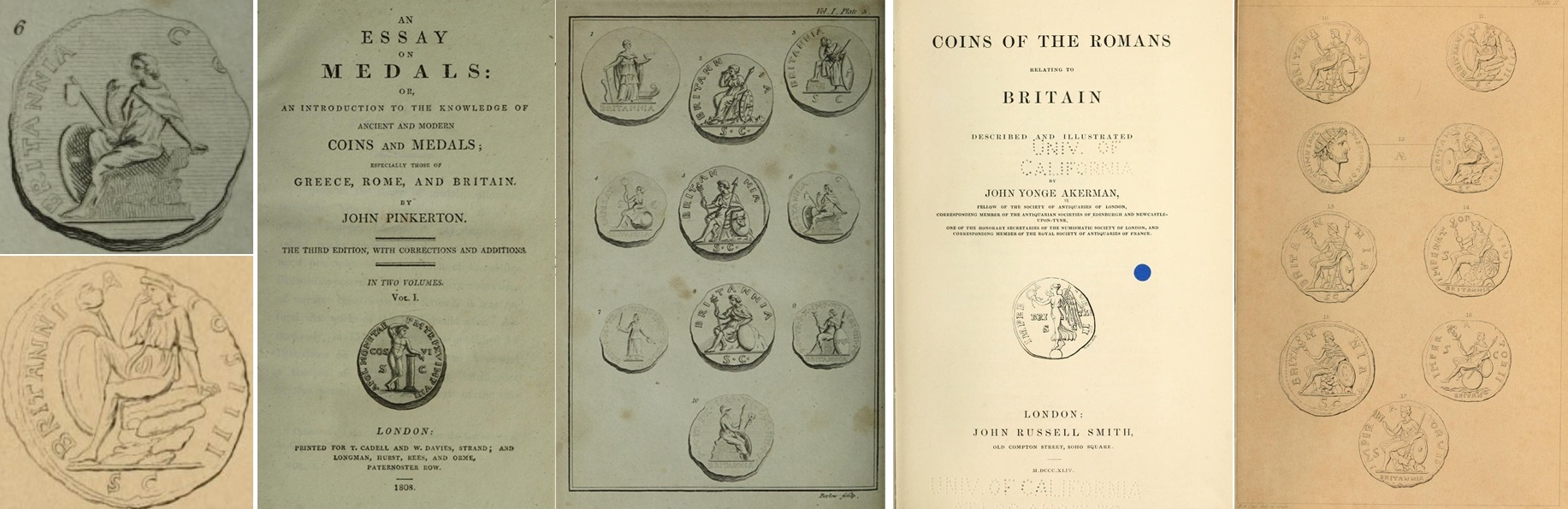
Pinkerton’s illustrations were, to be sure, idealized, as usual for the late 19th cent. (Compare, above, to Ackerman’s accurate drawings of the same types 60 years later. Sources: S&S Lib., UCLA.) But we can make educated guesses about which details Pinkerton rendered more faithfully.
This was one of only two coins illustrated from Pinkerton’s own cabinet (Pl. III, 6; the other, Pl. III, 10, “Maria, wife of Honorius”). The vast majority were from the Hunterian, where they remain now, so we can compare drawings & photos for some insight.
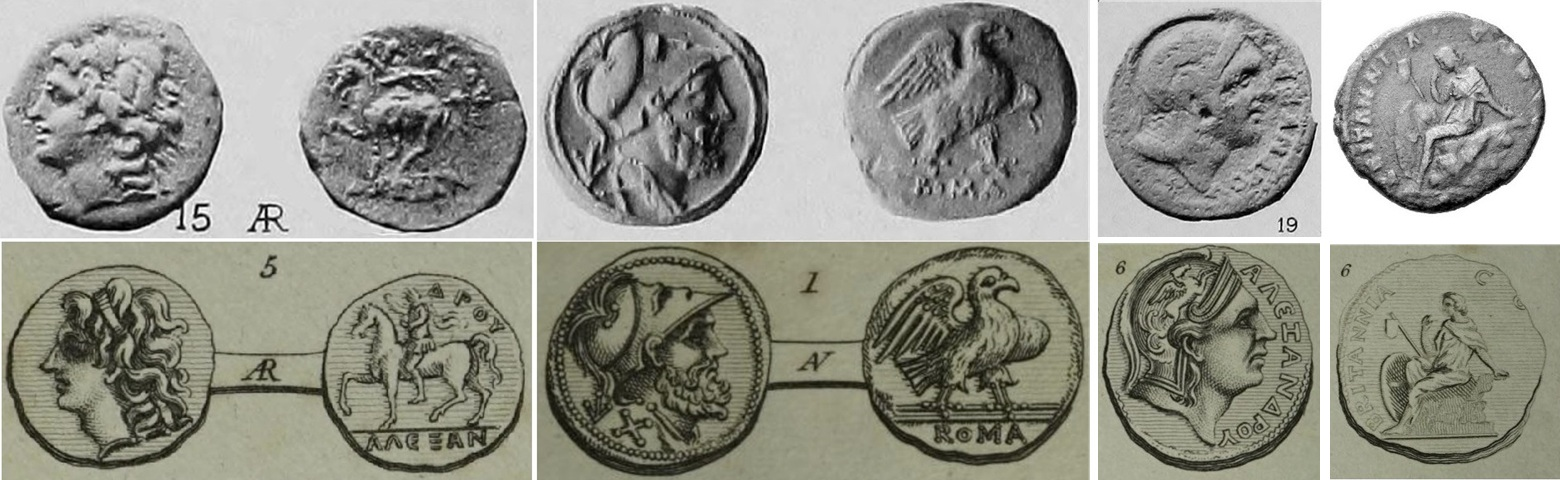
The details that Pinkerton tended to represent most faithfully were the centering and visible portions of the legends and the dotted borders. (Damage, wear, and major devices were subject to artistic license — for which Ackerman harshly criticized him.)
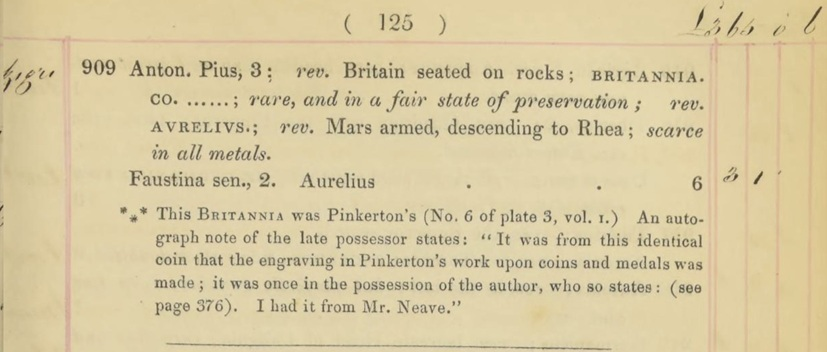
We can trace the Pinkerton coin’s fate to at least 1844, as summarized in Sotheby’s Thomas catalog. But the trail runs cold soon after the Thomas sale, where it was bought by Giuseppe Bassegio, an Italian antiquities dealer living in London.
If it’s the same coin, it was still in London a century or so later, when it came into the possession of Spink’s director of ancient coins, George Muller (“Mentor Collection,” formed c. 1940s-70s).
A final clue to my coin’s biography: The obverse is spackled in old animal glue of the kind commonly used in the 18th and 19th centuries, suggesting it was once affixed to some sort of display with Britannia facing outward.
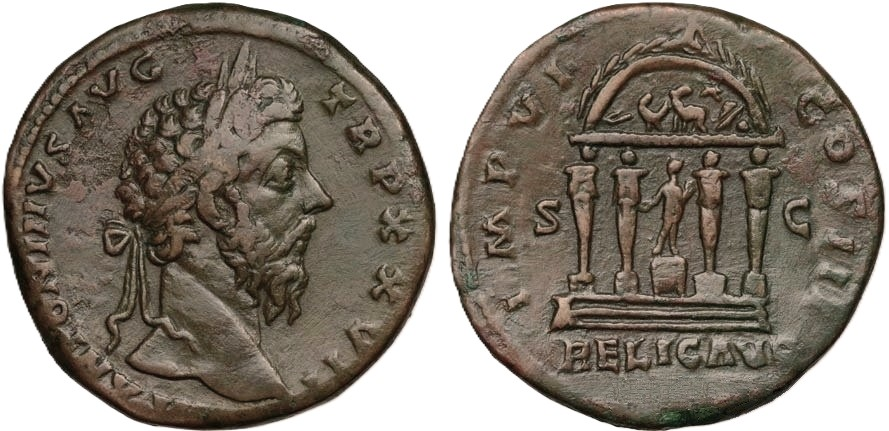
Marcus Aurelius AE Sestertius (31mm, 26.68g, 6h). RELIG AVG. Temple, statue of Mercury. (RIC 1075)
(Photo Credit: CGB.fr [edited].) Collection History:
– Ex Fürstlich Waldeck’schen Münzkabinettes in Arolsen [collection formed principally by Prince Christian August of Waldeck-Pyrmont (1744 – 1798), sold early 1930s to E. & H. Cahn, Münzhandlung Basel];
– Ex Sammlung August Voirol (1884-1967) [MMAG 38 (6 Dec 1968), 456, catalog by Herbert A. Cahn (1915-2002), from whom Voirol probably bought it (see Voirol-Cahn note below)];
– Ex Bryan O’Neal [purchased CGB.fr (4 March 2025), Lot 113, consigned HJB 234 (29 Jan 2026), 386 (unsold, discounted after-sale)];
– NGC Encapsulated: 5873015-010 (“VF Strike: 4/5 Surface: 2/5 smoothing“).
Publication Hist.:
– Mittag (1994) Fig. 2 (this reverse illustrated), in: Peter Franz Mittag, “Kaiser oder Philosoph? Kurze Bemerkungen zur Münzprägung Marc Aurels,” Schweizerische Numismatische Rundschau 73: 61-74.
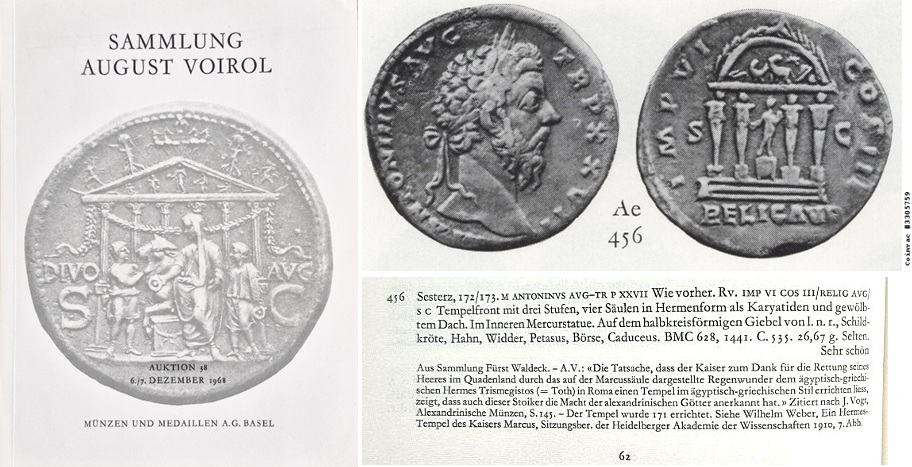
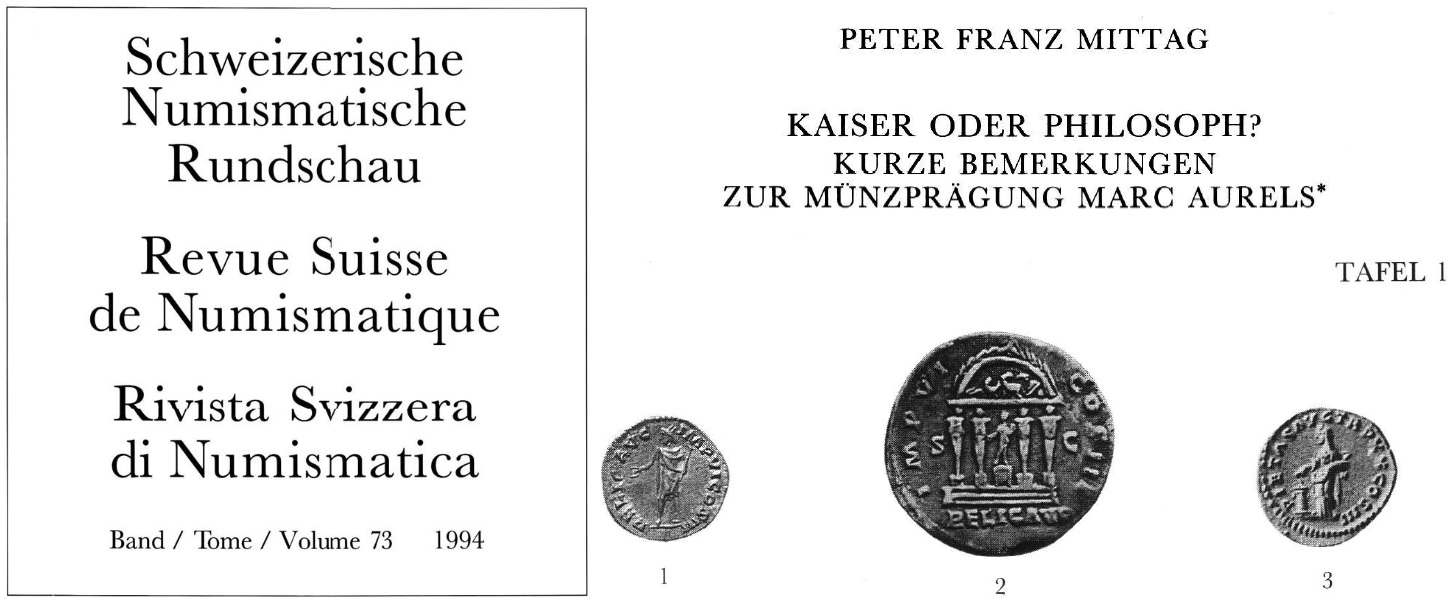
Notes: The Princely Waldeck Collection, housed for nearly two centuries at Arolsen Castle, was acquired by a young Herbert A. Cahn (1915-2002) and his brother Erich for the initial inventory for their new firm, Münzhandlung Basel (early 1930s).
The firm was later renamed Münzen und Medaillen, A.G. This coin’s collector, August Voirol, became a partner in MMAG, alongside, among others, his close friend H. A. Cahn. Cahn wrote Voirol’s SMB obituary & cataloged the sales of both the Voirol and Waldeck Collections.
Given the biographical context, the Voirol sale catalog is a uniquely valuable source not only for identifying ex Waldeck coins, but for understanding how they were dispersed.
Notes, Basel Auctions containing Waldeck Coins (or NOT): H. Cahn’s Voirol catalog (MMAG 38) identifies 54 coins “aus Sammlung Fürst Waldeck,” 48 from Münzhandlung Basel Auctions 3, 4, 6, and 10, the other 6 presumably acquired privately. (Auctions 4, 6, 10 also incl. other colls.)
Importantly, Voirol’s coins from Münzhandlung Basel Auction 1 (28 Jun 1934) are not identified as ex-Waldeck (MMAG 38, 423 & 468).
John Spring’s (2009) Ancient Coin Auction Catalogs, 1880-1980 identified Auction 1’s consignor (“alten fürstlichen Sammlung“) as Waldeck, an attribution widely adopted since.
Recently, however, some provenance researchers have raised doubts (NF 5 Jun 2024). While Cahn himself later identified the Prinz W. of Auctions 3, 4, 6, 8, and 10 as Waldeck (e.g., here, in MMAG 38; see also Poinsignon III, 4203), he never identified Auction 1 as the same collection. (Even after dropping the anonymity for the other sales.)
Cahn’s Voirol catalog supports the conclusion that Spring was mistaken. In fact, the coins in Münzhandlung Basel Auction 1 were not from the Waldeck Collection.
Lost & Found Provenance: While I don’t use AI provenance research (i.e., machine-learning image-matching), it’s always possible a prior collector or dealer did so. The present coin is the only one in my collection for which I know that to be true, since the owner-creator of CoinCabinet.io (Bryan O’Neal) posted about it on Facebook. He bought it from CGB (no provenance), found the Voirol sale, and consigned it to Aaron Berk, from whom I bought it.
I never buy a coin unless I can extend the provenance, so it was fortunate that he missed the Waldeck collection and the article published by Mittag.
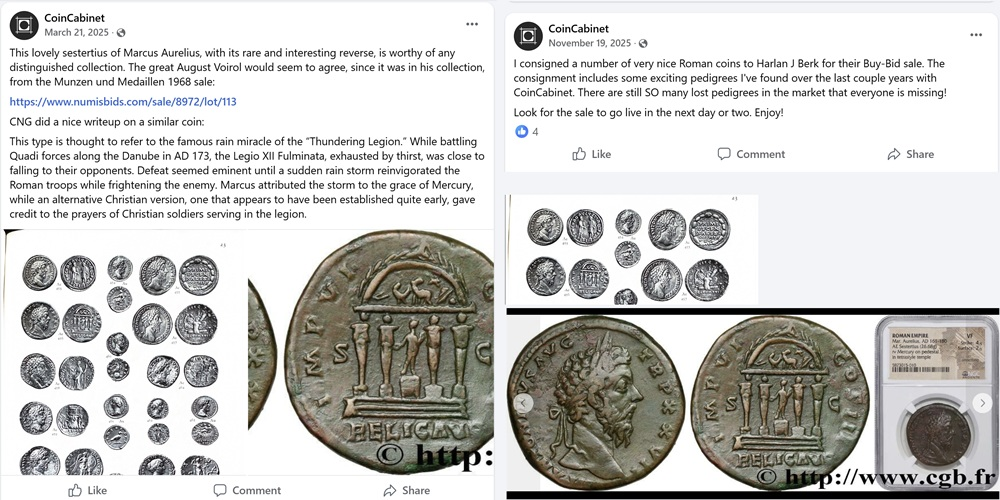
While I don’t use AI tools myself, since the prior owner did, I can now use this coin to illustrate the changing technology of provenance research. (Much as my Mazaios Stater illustrates both Merrill-Lynch’s 1990s ancient coin investment fund and the early history of slabbing ancient coins, c. 2002.)
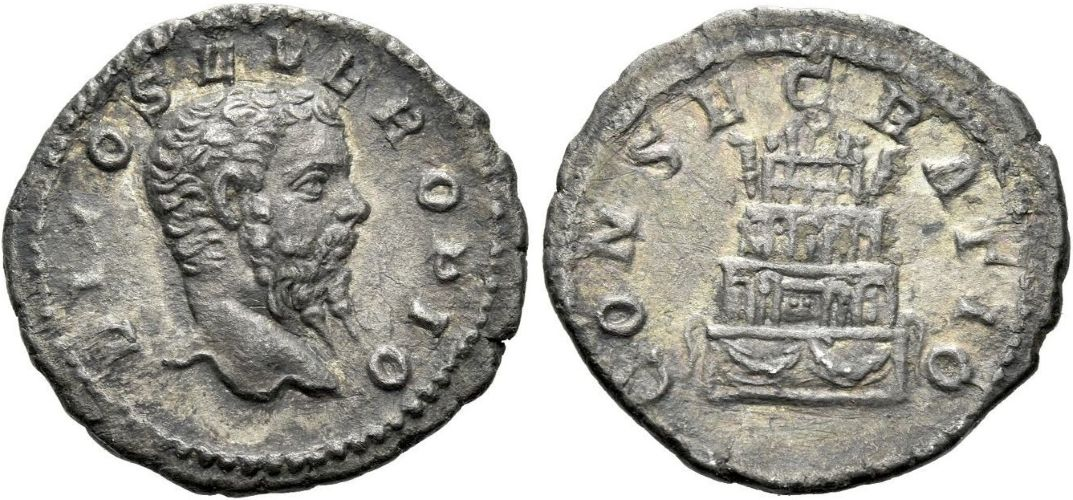
Divus Septimius Severus AR Denarius (19mm, 2.64g, 6h), Rome, 211 CE. CONSECRATIO, funeral pyre. (Cohen 89, RIC 191f [Caracalla])
(Photo Credit: Naville) Collection History:
– Ex “The Bavarian Collection,” with hand-written tag [NFA XXXI (18 Mar 1993), 1090 (illustrated)];
– ex A.E. Cahn FPL XXVII (1927), No. 1739 for 6 Marks (per collector tag);
– ex Lionel Tenby (1932-2022) Collection [Naville 102 (5 Jul 2026), 629].
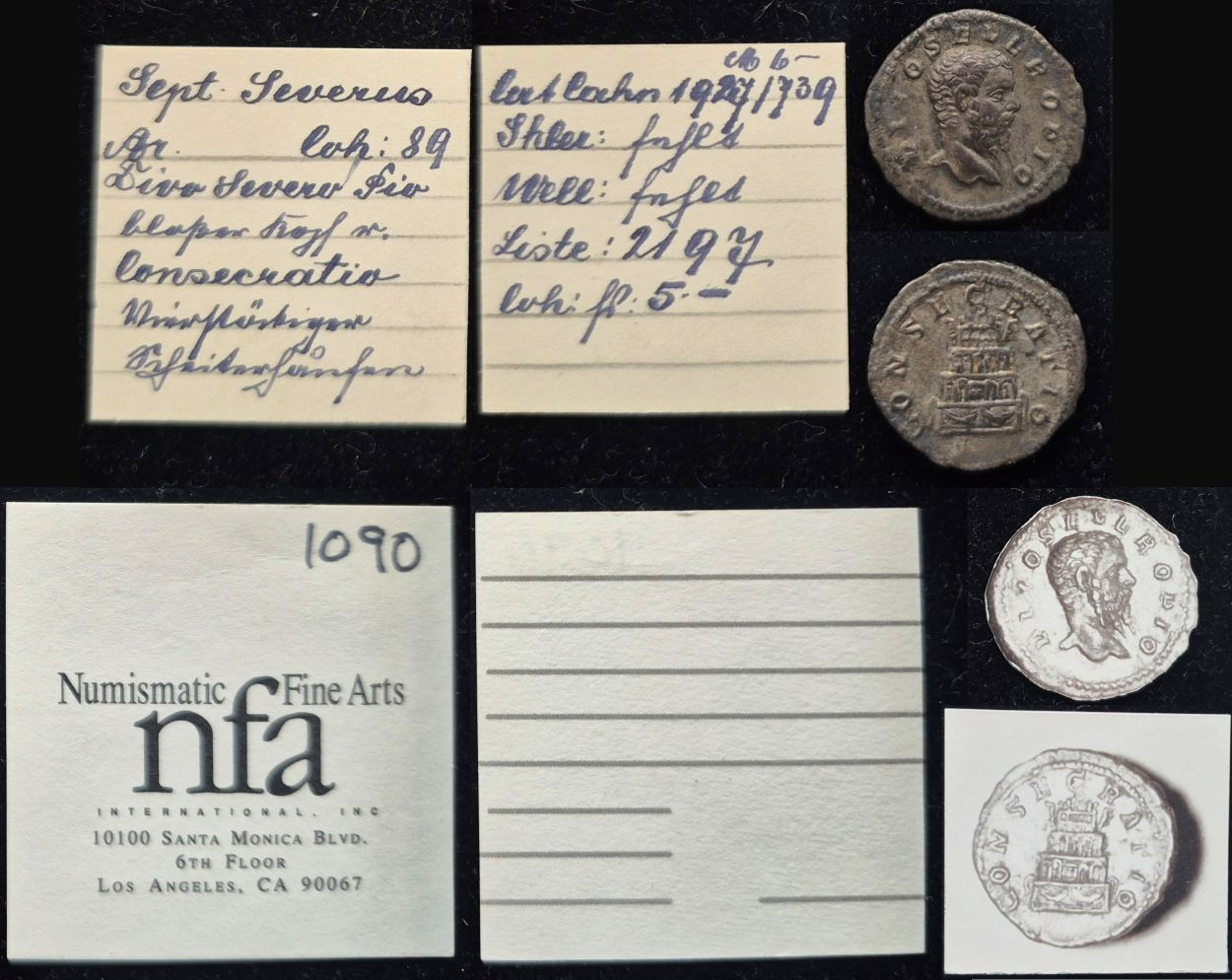
Notes: While H.A. Cahn auction catalogs are widely available and digitized (I have at least 3 in hard copy, coins from several others), the fixed-price lists are much harder to find (“Katalog Verkäuflicher Münzen und Medaillen“). Apparently issued every year or two, they were much longer and unillustrated (this one, Katalog XXVII, was 311 pages with 9,655 listings). Although I haven’t found a copy, the lot no. is roughly consistent with the placement in other issues and with other coins reportedly sold from this catalog.
Incidentally, Cahn sold an example of this type (Cohen 89) in their 1925 Auktion 54, Lot 576, ex Sammlung Sigmund Krausz (the famous Hungarian-born American photographer). No weight or photo was given for that one, but it was only “Schön” (today’s “Fine” or “F/VF”). Being relatively scarce, might the 1925 coin have reappeared in Cahn’s 1927 FPL? Absent some miracle of documentary evidence, it is only speculation.
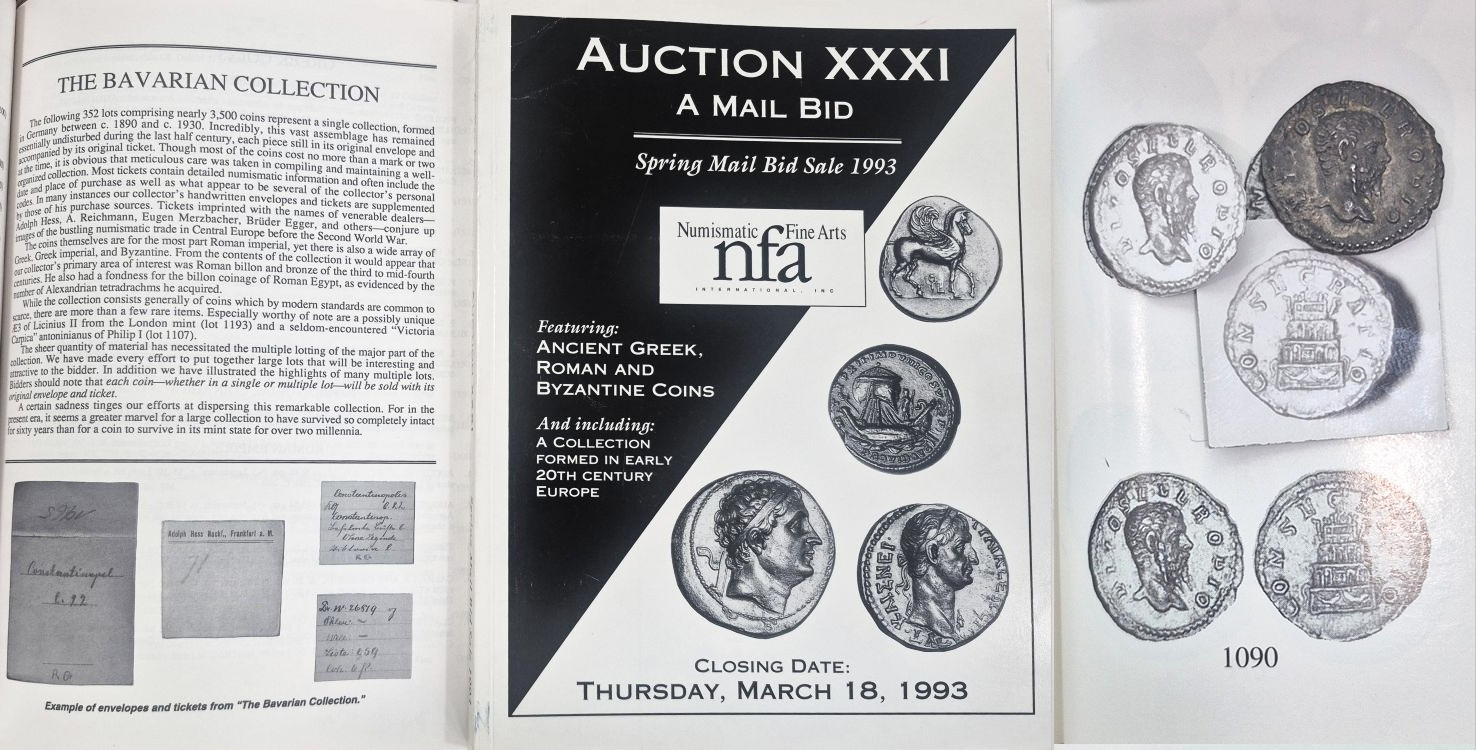
Notes: Above, my copies of NFA XXXI (one ex Kammerer Library), open to the intro essay. (Click to enlarge, it should be mostly readably, or go to the Gallica copy). My coin came with a tag closely matching the one photographed, but did not have any envelopes.
It also came with photos matching the catalog (shown in both my collages above). They aren’t cutouts from the catalog (which collectors also used to keep before the digital age), but actual photographs. The reverse is identical to the catalog photo, but the shaddows have not yet been cropped. I have a few photos like these accompanying coins from 1980s-1990s catalogs. Was it an occasional custom to include them, or something that collectors would request back then?
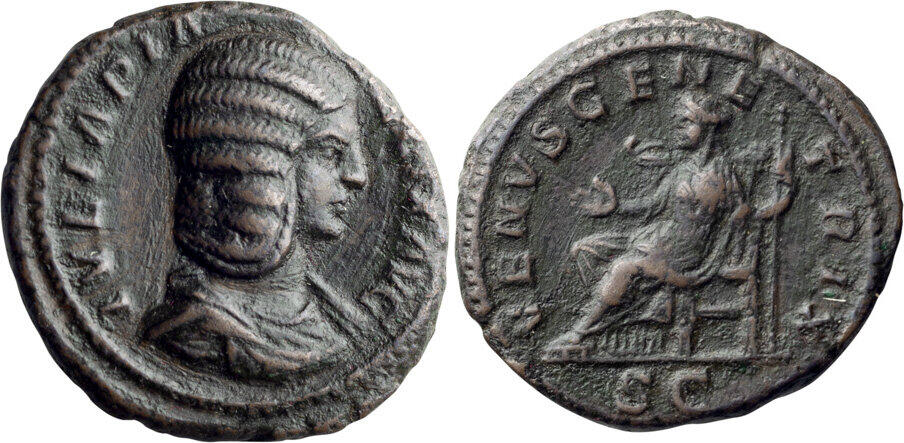
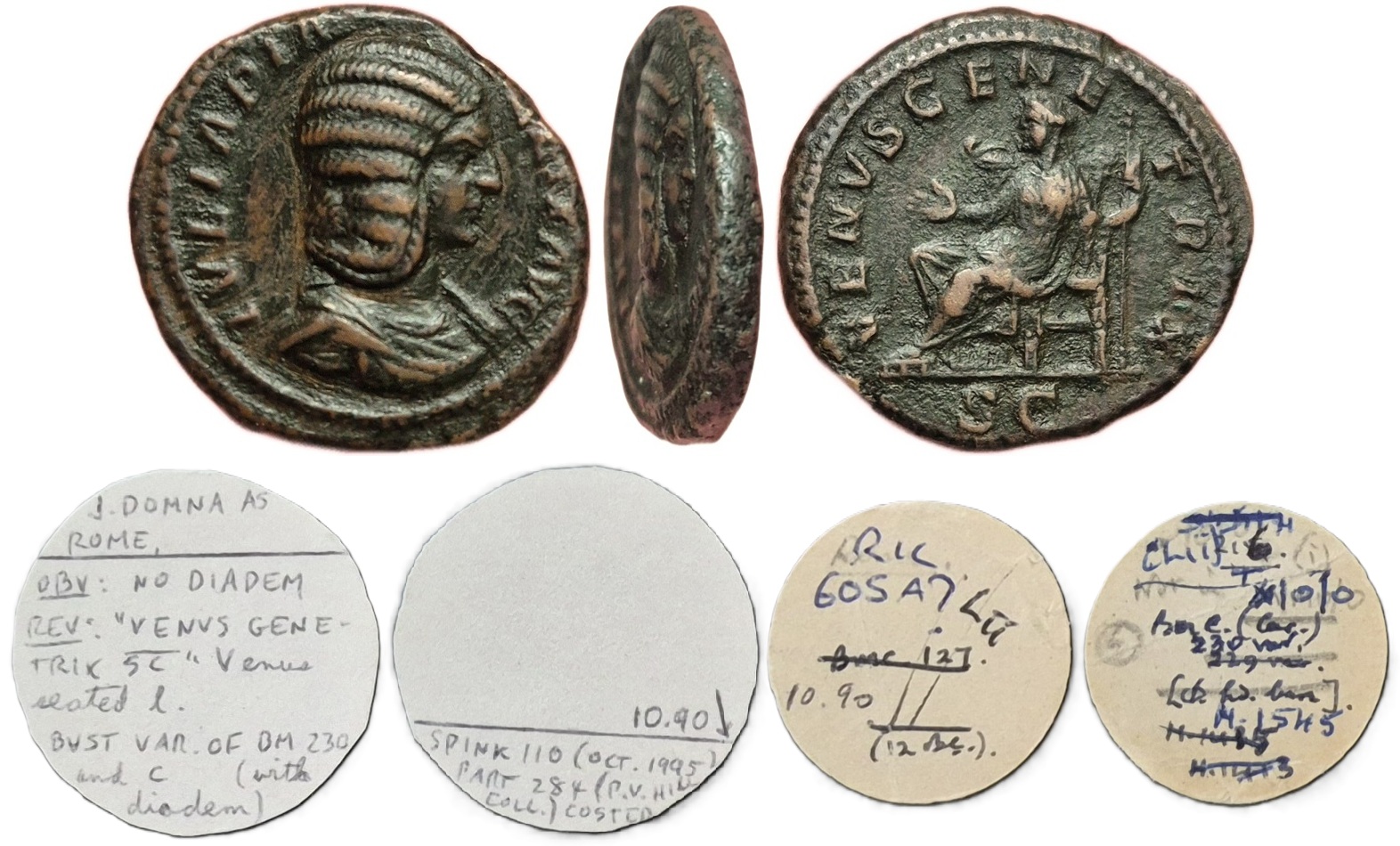
Julia Domna AE As (26mm, 10.90g), Rome, 215 CE. IVLIA PIA FELIX / VENVS GENETRIX. (RIC 605, but variant of portrait without diadem.)
(Photo Credit: HJB.) Collection History:
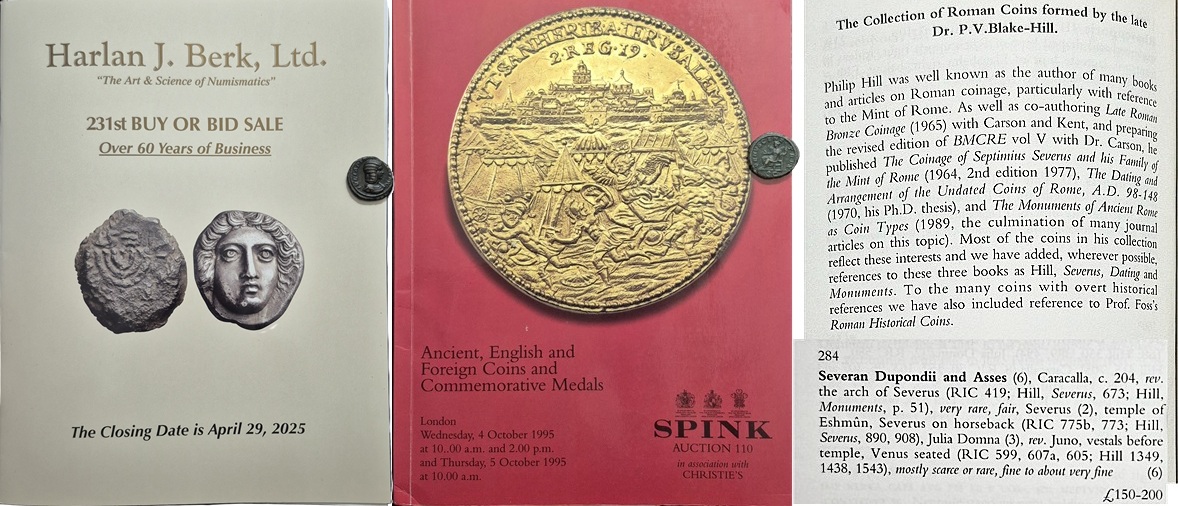
– Philip V. Hill (1917-1995) Collection, w/ tray tag [Spink 110 (4 Oct 1995), 284 (part, 6th of 6)];
– Curtis Clay Collection, w/ tray tag [Part VII, HJB BBS 231 (29 Apr 2025), 90 ; Berk’s coin-in-hand video].
Publication History:
– BMC 230-note (this coin cited), in Carson & Hill, eds. (1975: p. 473), British Museum Catalogue, Coins of the Roman Empire V: Pertinax to Elagabalus;
– Hill 1545 (this coin cited), in Hill (1964/1977), The Coinage of Septimius Severus and His Family of the Mint of Rome, A.D. 193-217.
See also: Lusnia (1995: 136), citing Hill 1545 in note 71 (corr., should be in note 72?).
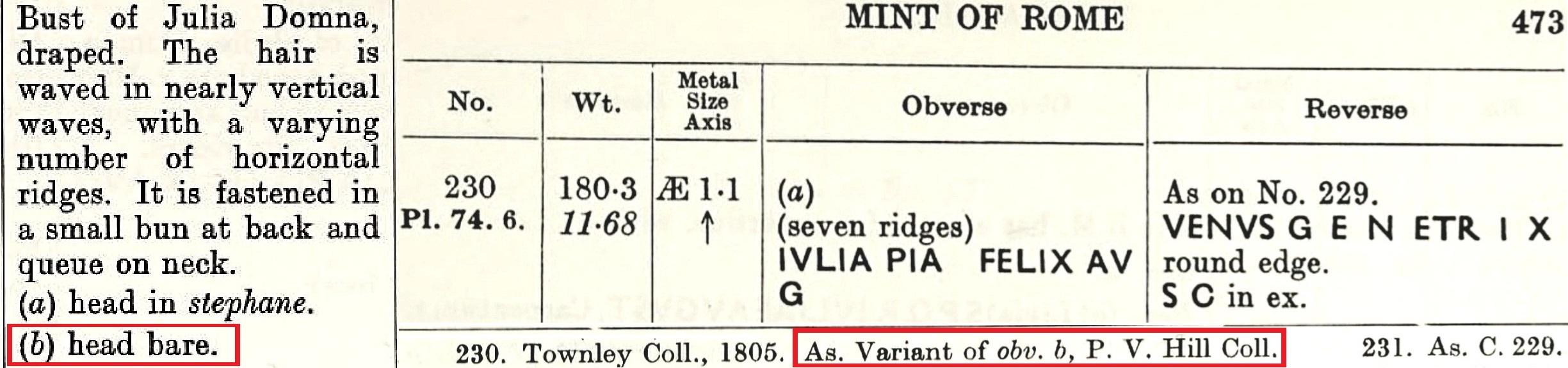
Notes: Uncommon variety, Domna’s portrait is bare-headed rather than wearing the usual diadem or stephane (cf. BMC 230, RIC 605). Based on Julia Domna Venus Genetrix AE Asses recorded in Acsearch and Coryssa, I believe ~25% of have the portrait sans stephane (all struck from one obv. die). Though Hill was only aware of this example (c. 1960s-1970s, having missed Münzhandlung Basel 8 [1937], Lot 880), I’m aware of ~10 others in commerce since 2010.
Remarkably, just 3 months before acquiring it, Curtis Clay cited this very coin as a reference in HJB 86 (11 Jul 1995), Lot 1071 (later CNG ex Martin Armstrong): “BMC 230-note (P.V. Hill Collection)”!
ROMAN IMPERIAL, PART THREE: CRISIS [top]:
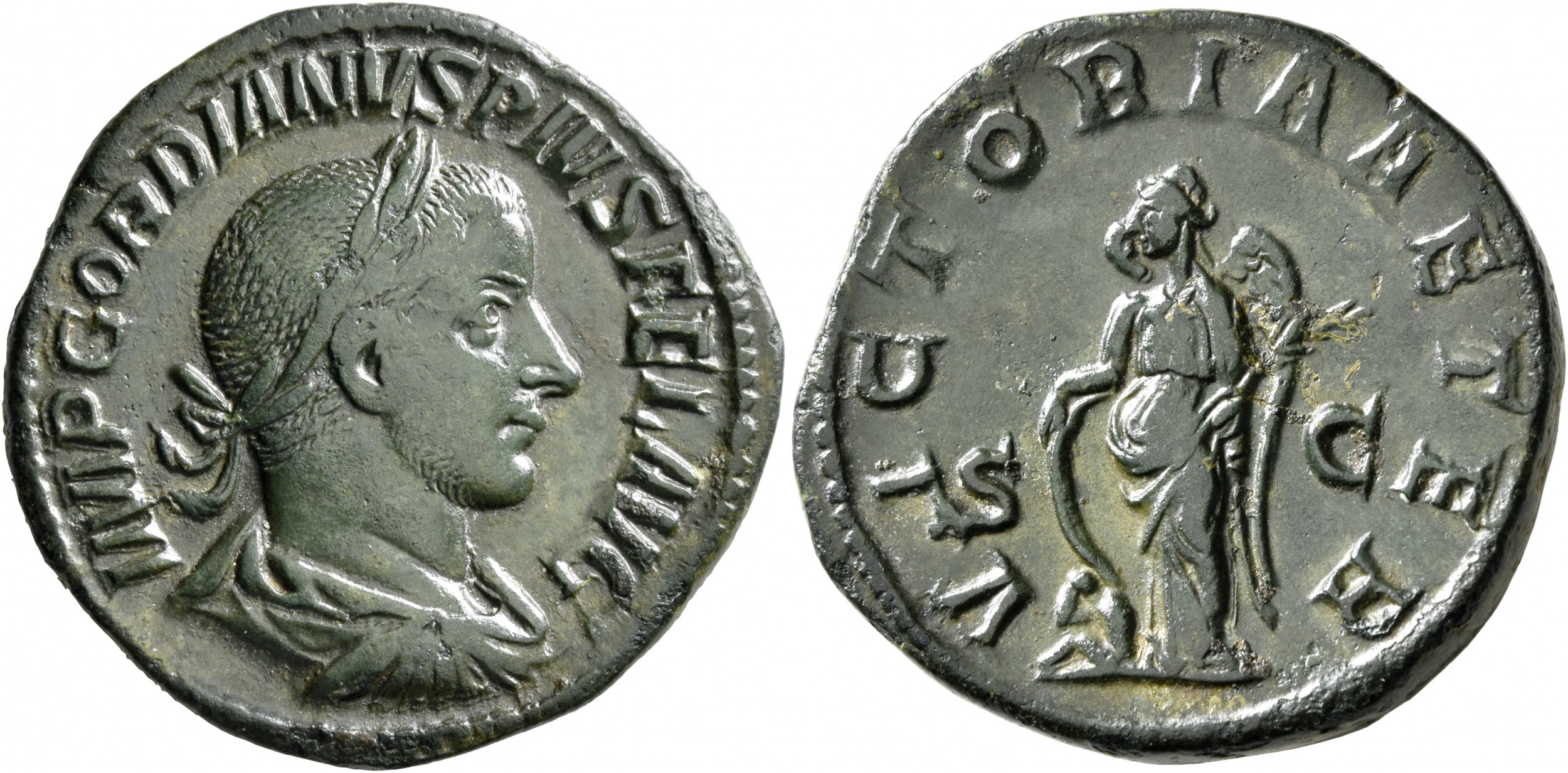
Gordian III AE Sestertius (31mm, 21.72g), Rome, 244 CE. Victory & Captive. (RIC 337a)
(Photo Credit: Leu.) Collection History:
– Collezione Giuseppe Mazzini (1883-1961);
– George His (1927-2021) Collection [CNG MBS 69 (8 Jun 2005), 1465];
– Sammlung Dipl. Ing. Adrian Lang [Leu 12 (15 May 2022), 1386].
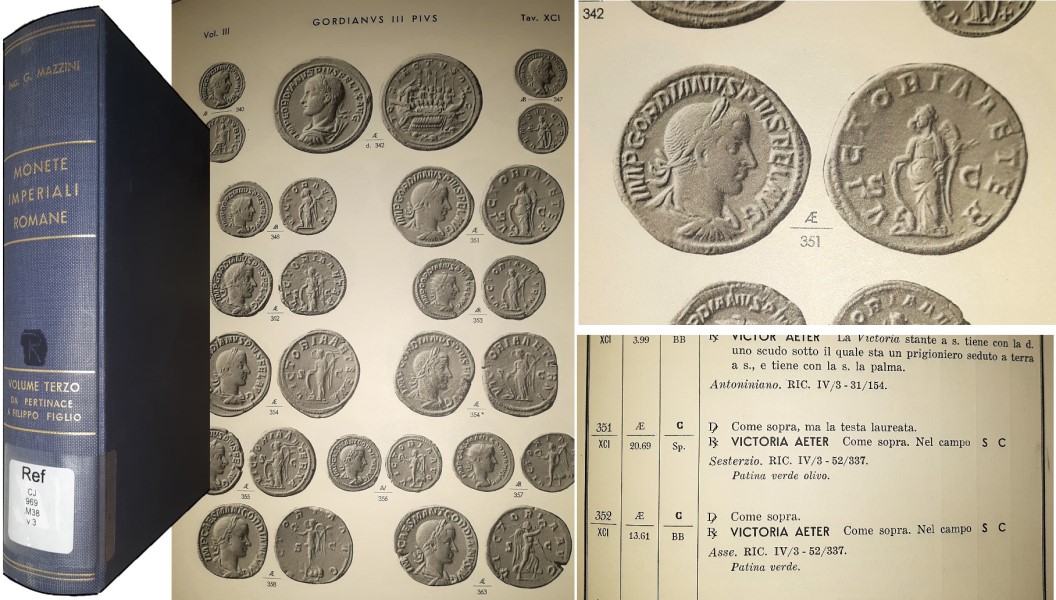
Publication Hist.:
– Mazzini 351 (this coin illustrated), in M. Ratto (1957), Monete Romani Imperiali, vol. III, Pl. XCI;
– Banti 105 (this coin illustrated on p. 331), in (1983) Il Grandi Bronzi, v. IV.2.
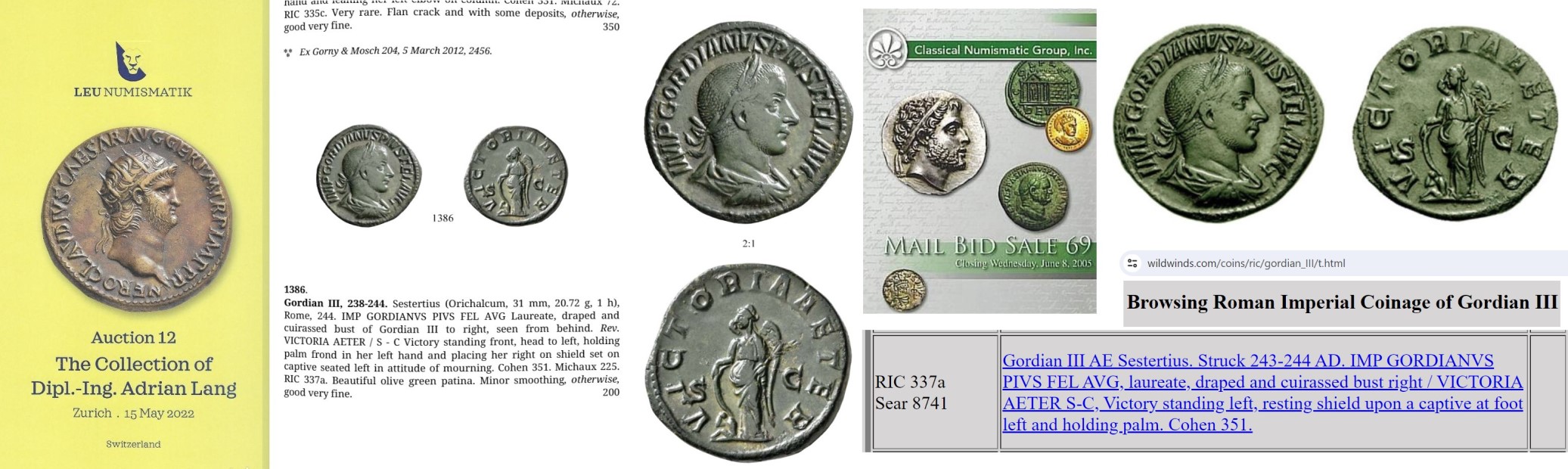
See Also: Wildwinds, Gordian III page, RIC 337a (this coin illustrated); see also Sear 8741 page.
Notes: This coin on “Barbarians, Captives & Enemies” page; video & additional provenance background on blogpost (15 Jul 2022).
Gordian III & Philip AR Antoniniani. c. 243-249 CE.
(Photo Credit: CNG.) Collection History:
– Kenneth Bressett (1928 – ) Collection [CNG Keystone Auction 6 (11 Mar 2022), 3231 & 3244 ; acq. Boston, 1950];
– Joseph Powers [Boston Numismatic Society ; prob. acq. Seaby, 1940s];
– Dorchester Hoard (1936) [IRBCH 470].
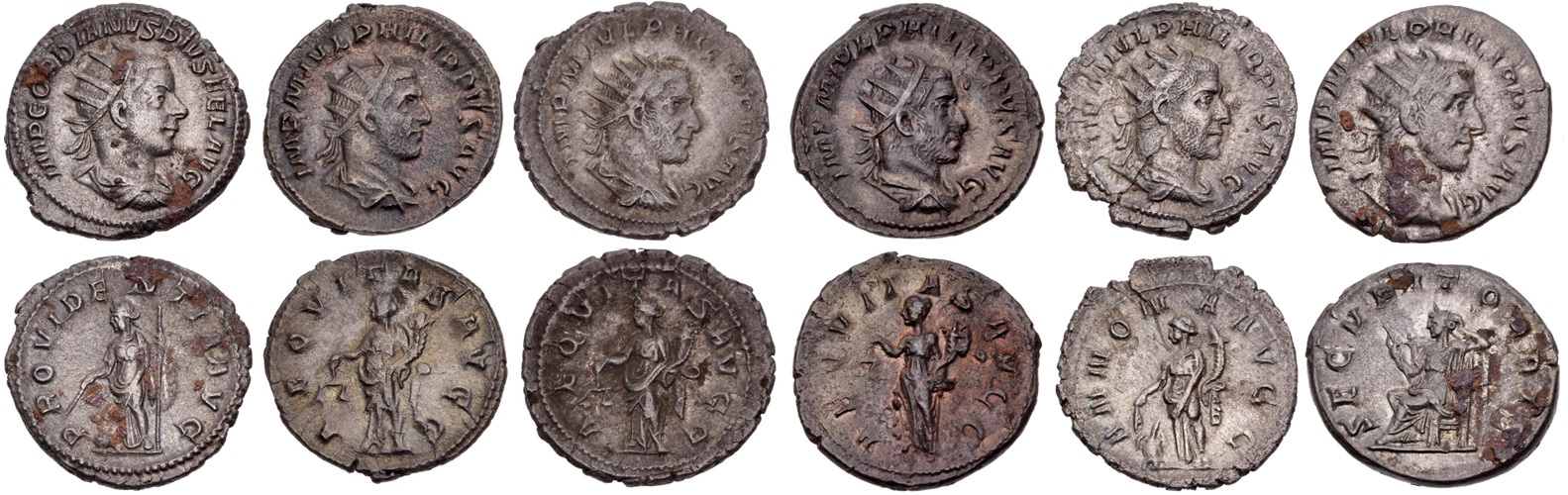
Notes: “The Great Dorchester Hoard of 1936” (Mattingly, NC 1939), one of the largest & most important hoards ever found in Britain (>22,000 total coins, 20,748 identified). Although fully tabulated by Mattingly, my specimens are of common types not individually cited: Gordian III (Cohen 299, 128 specimens); Philip I (Cohen 9 X3, 526 specs.), (Cohen 25, 411 specs.), (Cohen 215, 167 specs.).
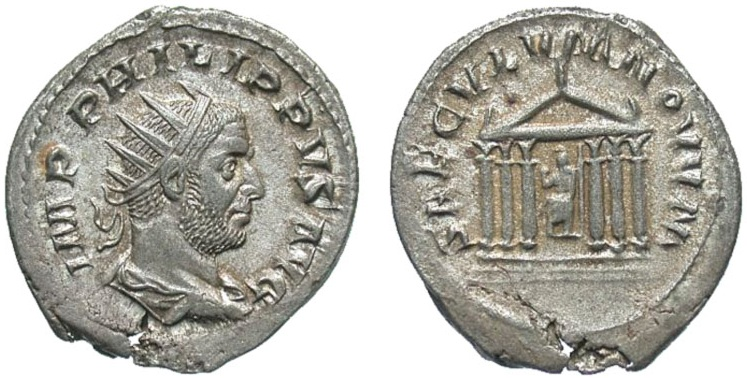
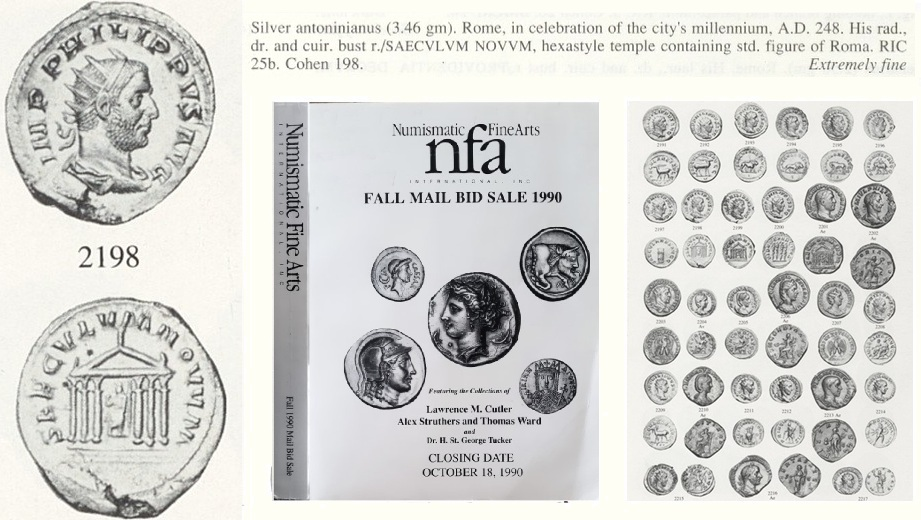
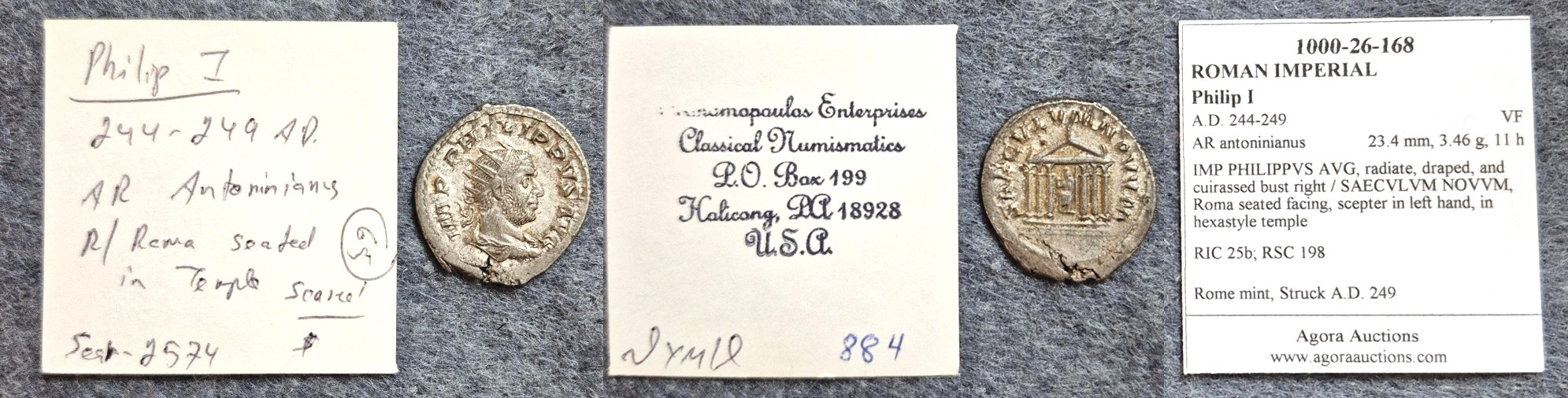
Philip I AR Antoninianus (23mm, 3.46g). Ludi Saeculares, Millenium Games Commemorative. Temple of Venus & Roma. (RIC 25b)
(Photo Credit: Agora Auctions.) Sale History:
– Ex NFA Fall 1990 MBS;
– Ex Agora Auction 26 (10 Feb 2015), Lot 168;
– Ex Economopoulos Enterprises (n.d.), with tag (Nick Economopoulos, Holicong, PA).
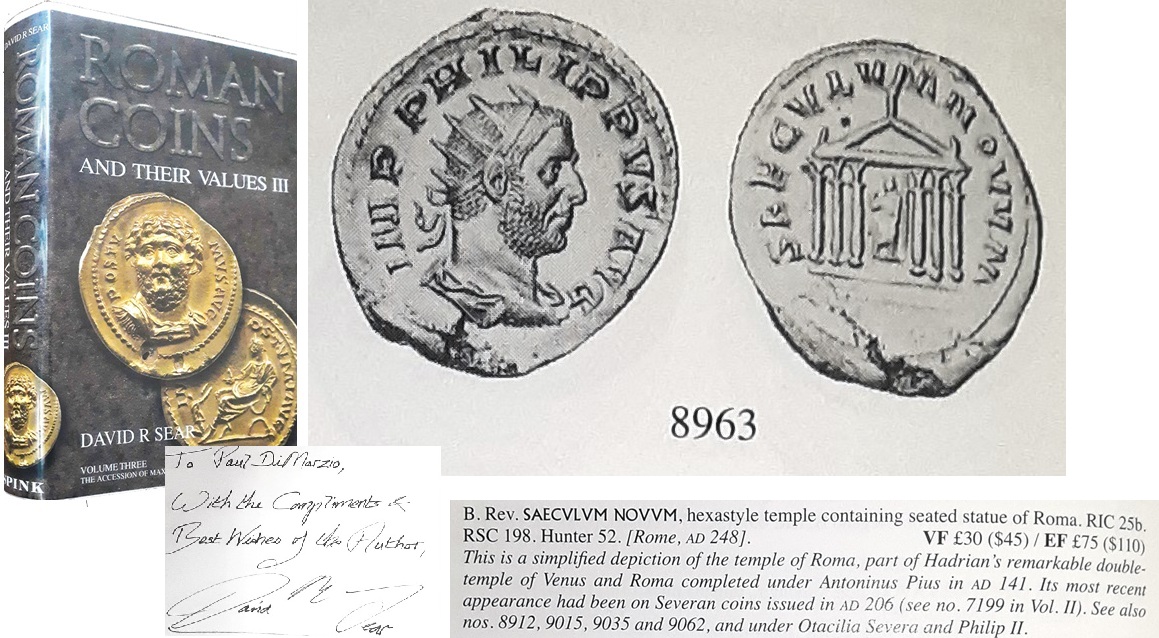
Publication:
– SRCV 8963 (this coin illustrated), in: Sear, David R. (2005) Roman Coins and Their Values, Volume III: The Third Century Crisis and Recovery.
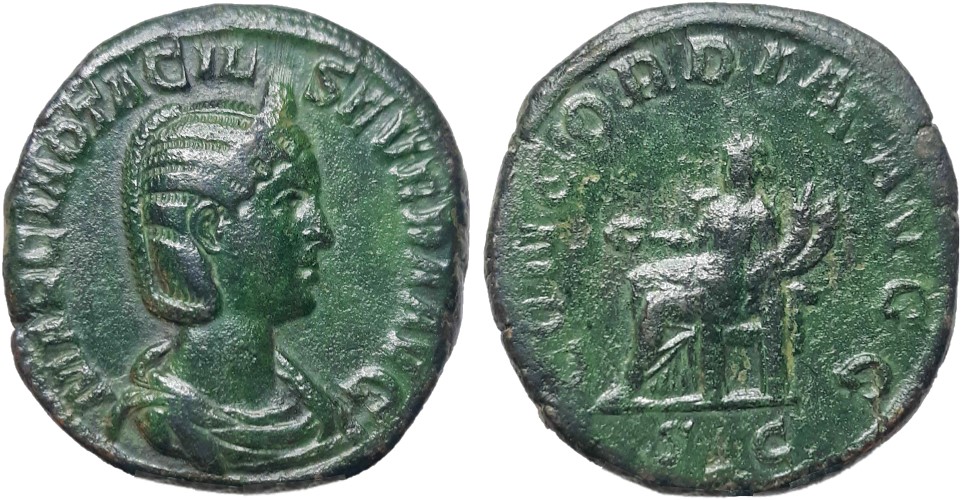
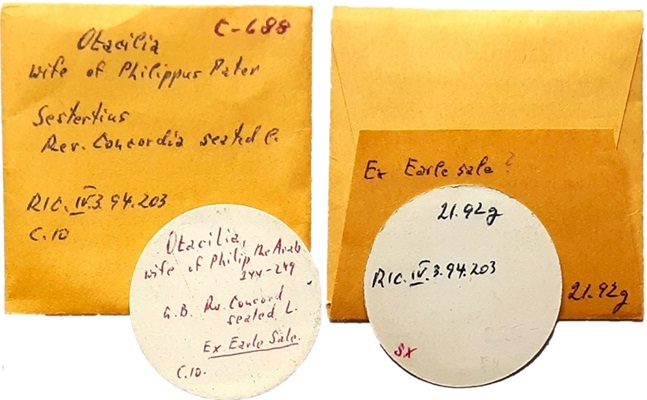
Otacilia AE Sestertius (30mm, 21.92g), Rome, 245-7 CE. Concordia seated. (RIC 203a)
(Photo Credit: CJJ.) Collection History:
– Colin E. King (1862-1921) Collection [Chapman Brothers (5 Apr 1892), 377 (obv. illustrated on Pl. III), sold for $1];
– George H. Earle, Jr. (1856-1928) Collection [Henry Chapman “Earle Sale” (25 Jun 1912), 703 (not ill.), purchased by “HY” (Henry Chapman?) for $1.80 over “Black” (Harry E. Montgomery), per annotated copy];
– Mark M. Salton-Schlessinger (1914-2005) & Lottie Salton (1924-2020) Collection, with their tag & envelope [Künker 377, Salton Collection Part IV (20 Oct 2022), 5990].
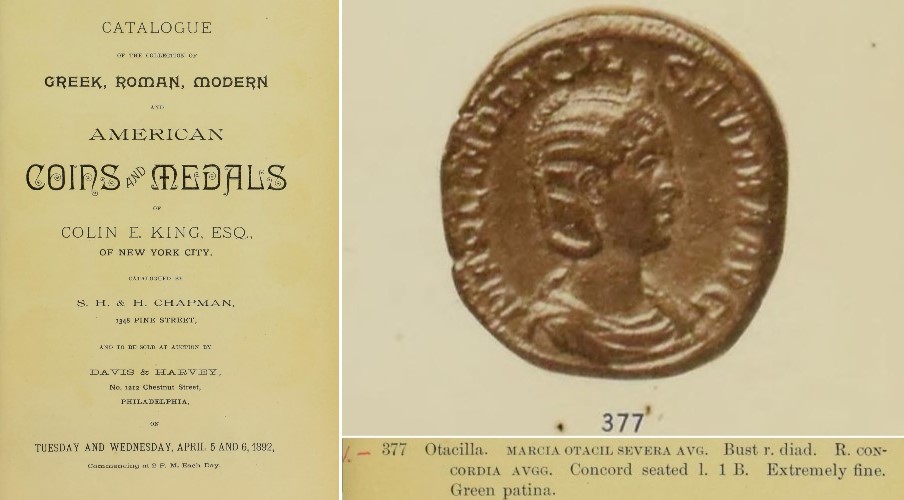
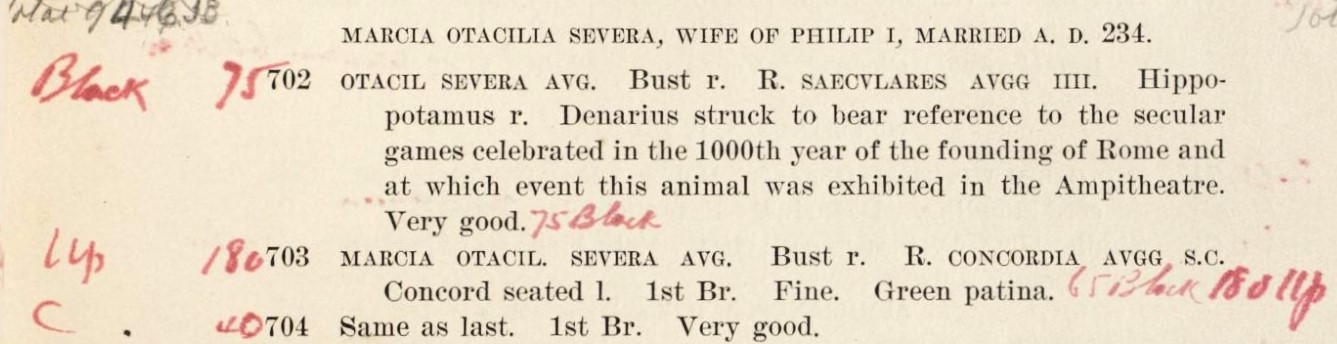
Note: David Fanning (2020: pp. 271-2) described Chapman’s Earle sale as the single most important early American ancient coin auction catalog (with the King sale ranked No. 7). Both images above are from Dan Hamelberg’s hand-named & priced copies (linked above, via NNP-ANS). In Earle 1912, the “HY” was written more clearly on earlier lots, for Henry Chapman acting as agent for clients, I assume. “Black” (underbidder) is a code (no. 112, H.E. Montgomery in the Bass-Hamelberg annotated Earle; codes changed: Otis Balcom was “Black” in Hamelberg’s annotated King). Sadly, the buyer name in 1892 is cropped from ANS’ image, but it was presumably Earle (named as buyer for many others).
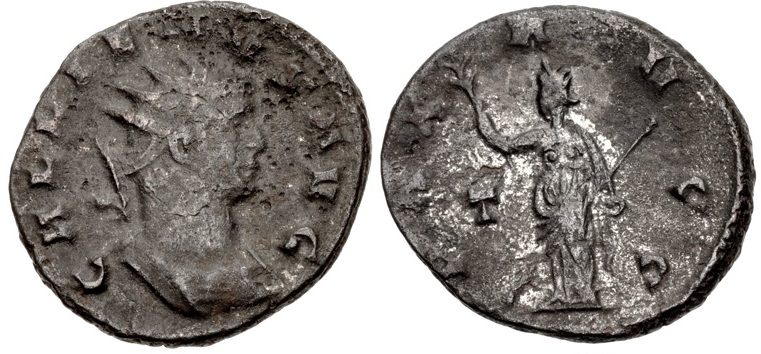
Gallienus Antoninianus (20mm, 3.59g, 12h), Rome (6th issue, 3rd officina), 260-1 CE. PAX AVGG, to left: T. (Mule/hybrid w/ Valerian rev.)
(Photo Credit: CNG.) Collection History:
– Nicholas M. McQ. Holmes (1949-) Collection [CNG e-Auction 442 (17 Apr 2019), 128a ; bought from C. J. Martin (Coins) Ltd., 1987];
– Normanby, Lincolnshire Hoard (1985) [IRBCH 854], No. 59.
Publication Hist.:
– Normanby 59 (this coin illustrated on Pl. 8, described on p. 166), in: R. Bland & A. Burnett (1988), The Normanby Hoard and Other Roman Coin Hoards [CHRB VIII], London: BM Press;
– reprinted by Spink (Bland et al., 2018) in: The Cunetio & Normanby Hoards; with notes to aid identification by Sam Moorehead.
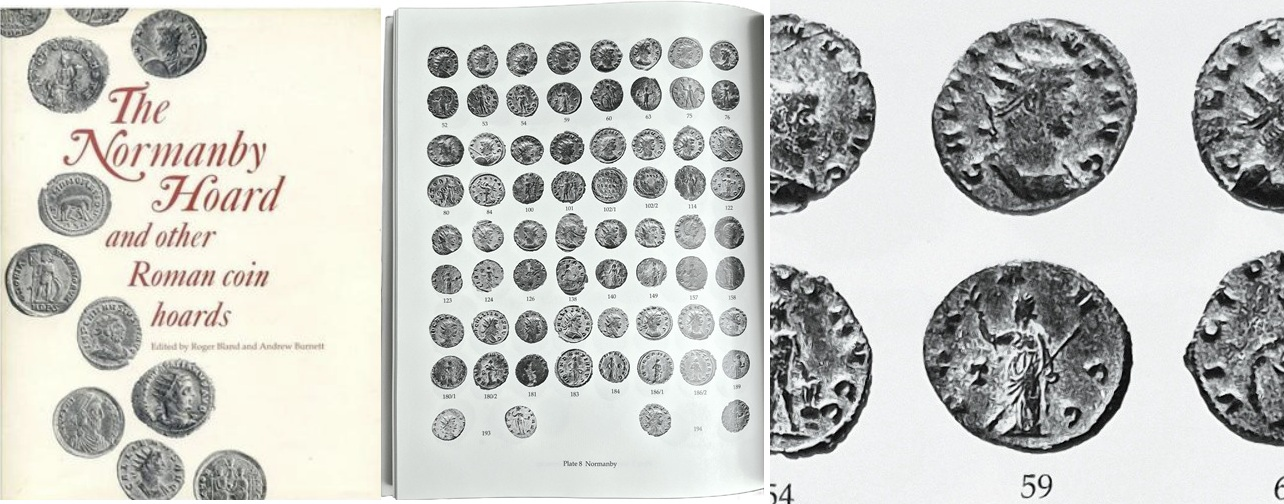
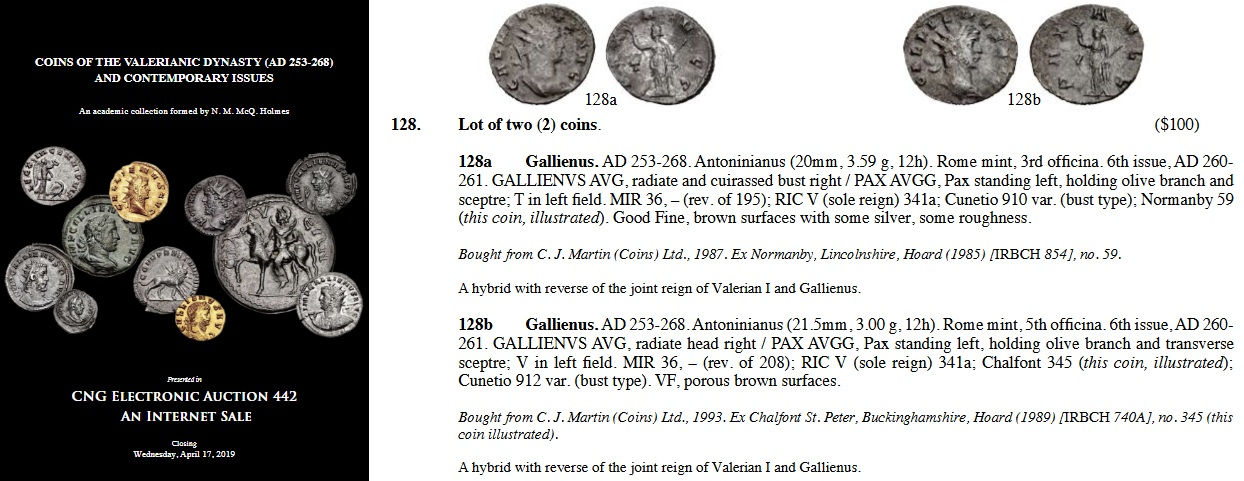
Notes: A hybrid type, with the sole-reign obverse of Gallienus & joint-reign reverse of Valerian (AVGG). A second, similar coin of this type was in the Holmes Collection (128b), now also my coll., differing in Gallienus bust style and with “V” in the left rev. field rather than “T.”
Gallienus Antoninianus (21.5mm, 3.00g, 12h), Rome (6th issue, 5th officina), 260-1 CE. PAX AVGG, to left: V. (Mule/hybrid.)
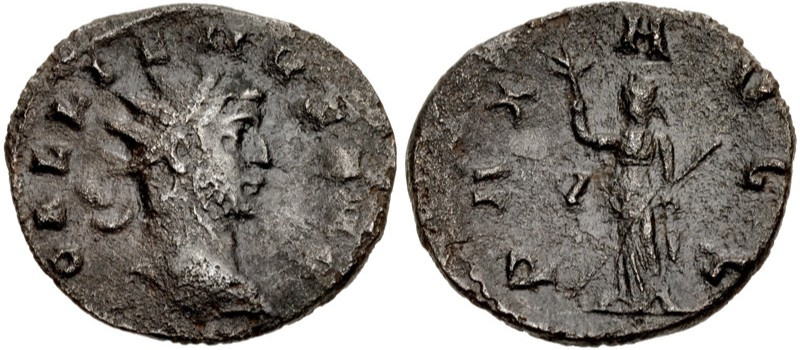
(Photo Credit: CNG.) Collection History:
– Nicholas M. McQ. Holmes (1949-) Collection [CNG e-Auction 442 (17 Apr 2019), 128b ; bought from C. J. Martin (Coins) Ltd., 1993, ex Glendining’s (7 Jul 1993) sale of the hoard];
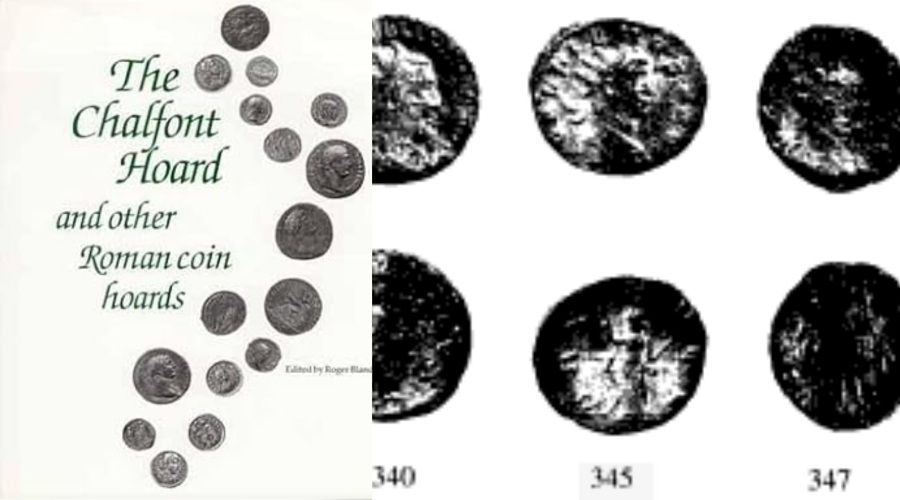
– Ex Chalfont St. Peter, Buckinghamshire Hoard (1989) [IRBCH 704a], No. 345.
Publication Hist.:
– Chalfont 345 (this coin illustrated on Pl. 12, described on p. 179), in: R. Bland, ed. (1992), The Chalfont Hoard and Other Roman Coin Hoards [CHRB VIII], London: BM Press
I don’t own a copy of CHRB IX yet, but here is a Google Books “snippet” search showing a very grainy image of this coin on plate 12:
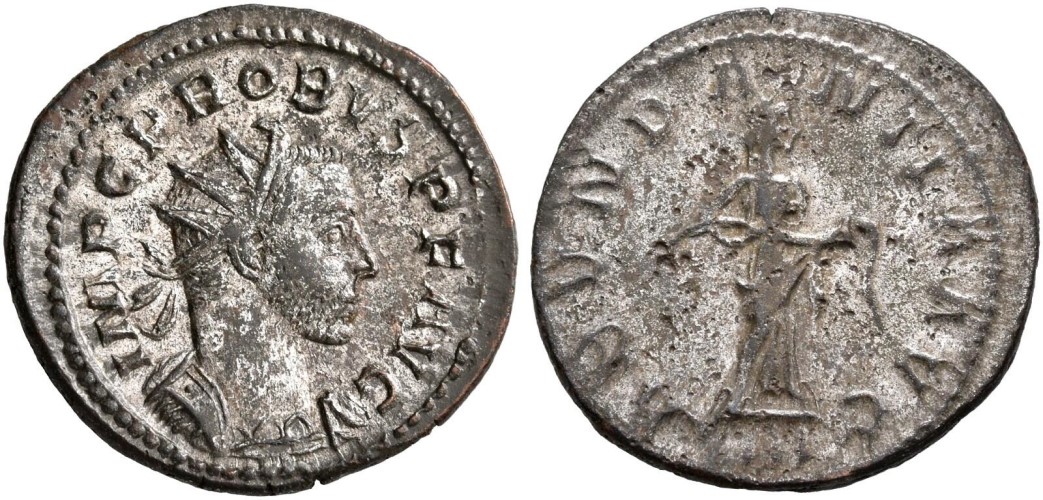
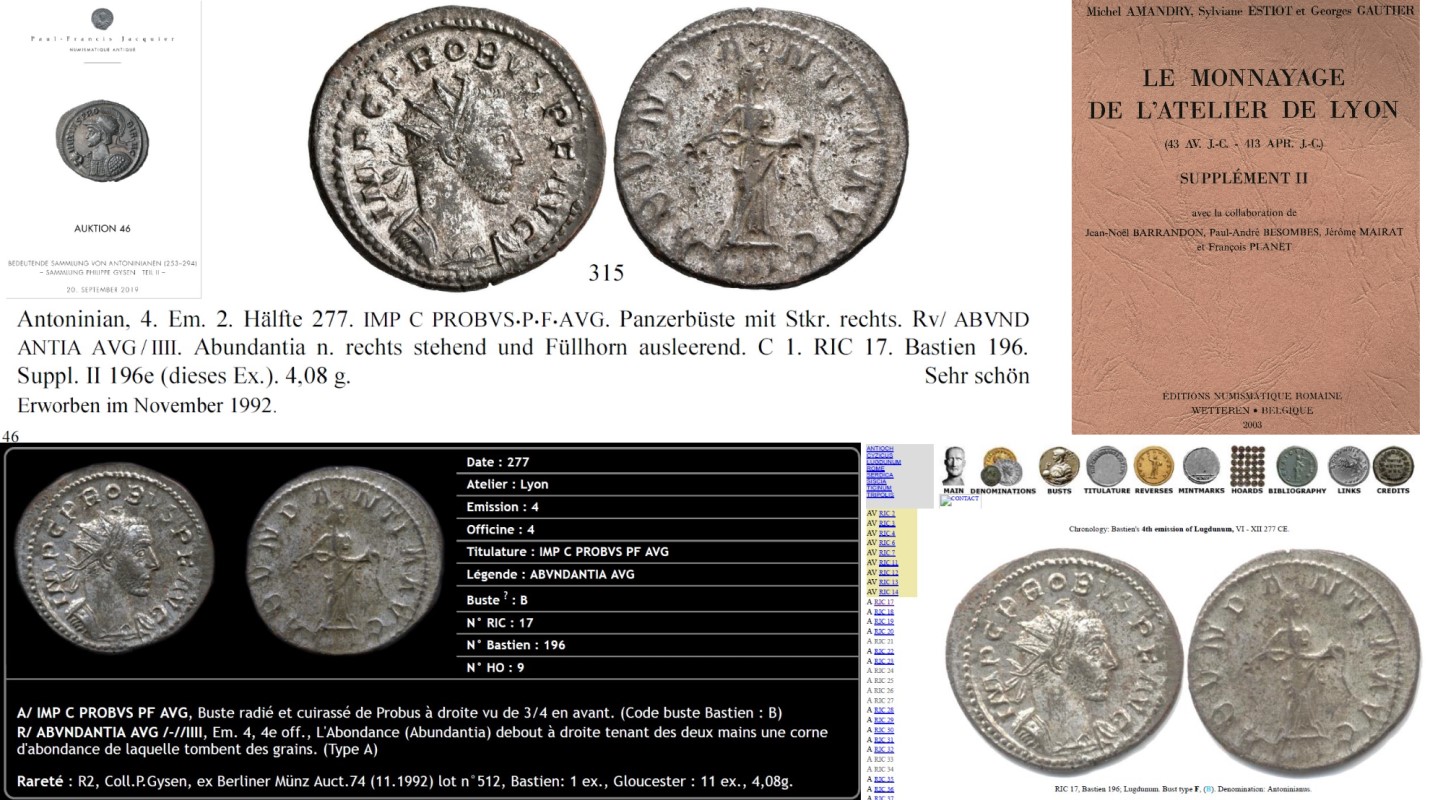
Probus Billon Antoninianus (22mm, 4.08g), Lugdunum (4th emission, 4th officina), late 277 CE. Abundantia.
(Photo Credit: Jacquier.) Collection History:
– Philippe Gysen (1950-2019) Collection, Inv. #5 [Jacquier 46 (Slg. Gysen, Part II; 20 Sep 2019), 315; acq. Berliner Münzauktion 74 (31 Oct 1992), Lot 512].
Publication Hist.:
– Bastien Suppl. II 196-e (this coin illustrated), in Amandry, Estiot & Gautier (2003), Le Monnayage de L’Atelier de Lyon, Supplement II;
– Hiland & Oliva 9 (this coin illustrated), in Le Règne de l’Empereur Probus, Histoire et Numismatique, p. 79.
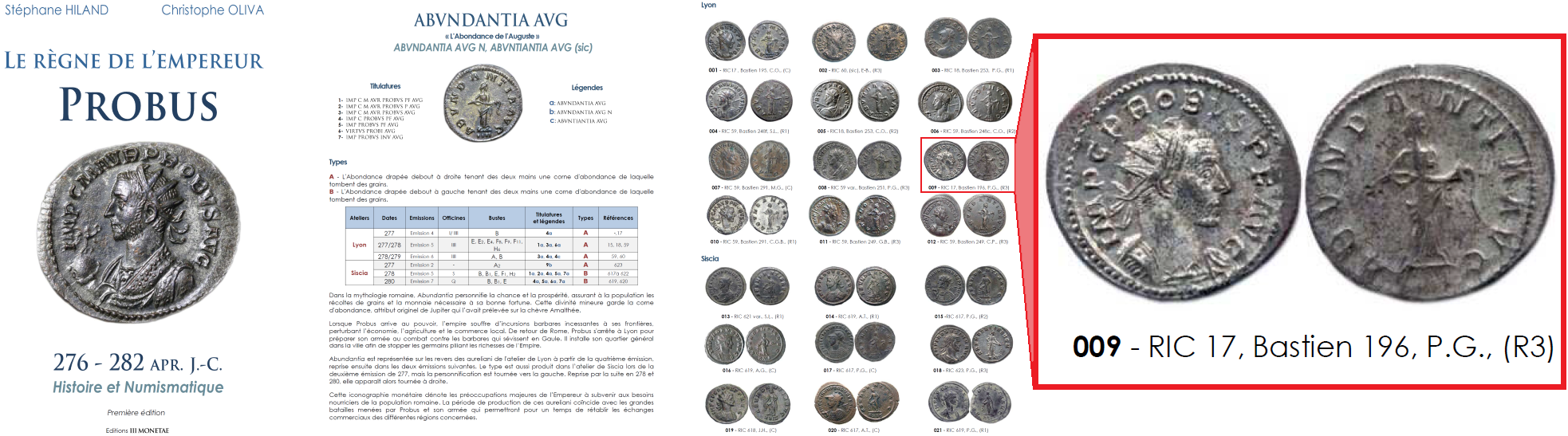
See Also: Probvs.net RIC 17 (ex. 1 of 3, this coin illustrated online);
– Probuscoins.fr Coin ID 555 (this coin illustrated online).
Notes: As Grzegorz Kryszczuk kindly informed me, this coin was No. 5 in Gysen’s inventory, making it one of his first coins (acq. 1992).
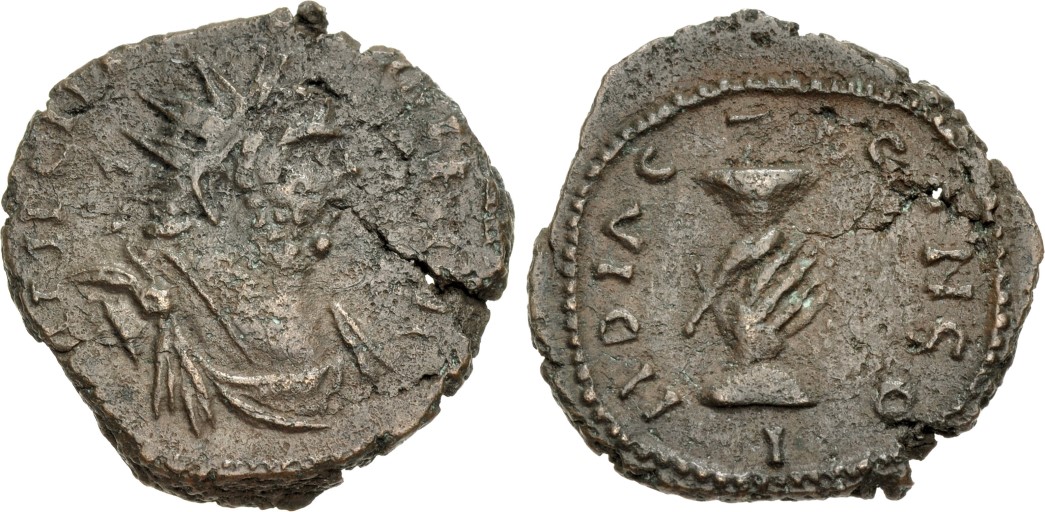
Carausius AE Antoninianus (21mm, 4.67g, 3h), Uncertain mint, c. 286-293 CE. Clasped hands, CONCO I IIDIAC – (garbled).
(Photo Credit: CNG.) Collection History:
– Malcolm Lyne (1943-2023) Collection [CNG EA 573 (23 Oct 2024), 745];
– W.C. Boyd (1841-1906) Collection with handwritten tray tag [Baldwin’s 42 (2005), 674 (part of 17, illustrated on p. 73)];
– acq. from Lincoln (London), Feb. 1903.

Publication Hist.:
– Lyne, Malcolm (2009), “The C and L Mints of Carausius and Allectus, AD 287-296,” Spink Numismatic Circular vol. CXVII, issue 1 (Mar 2009): pp. 5-6 (this coin illustrated);
– Webb 847 (probably this coin [“Lincoln”], cited in error [CONCORDIA M]), in Percy Webb (1907), “The Coinage of Carausius,” Numismatic Chronicle 7: p. 337 & (1908) The Reign and Coinage of Carausius, p. 199 (Spink reprint) [see prov. note below].
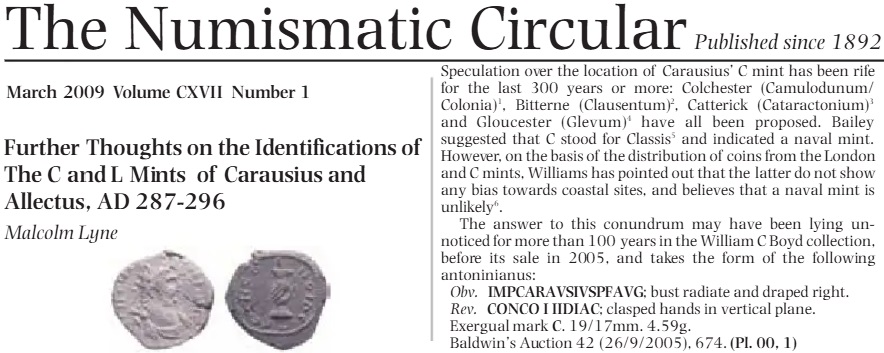
Provenance Note: Boyd’s tag described this coin as Cohen 34 (CONCORDIA M), which corresponds to Webb 847. (Interestingly, he nonetheless he transcribed the garbled legend quite accurately!) Webb cites one of two specimens to Lincoln, very likely this one, sold only a few years earlier to Boyd. (Nicely illustrating various ways original collector tag may help recover lost object-biography.)
Substantive Note: This coin was the featured topic of Lyne’s 2009 SNC article. He believed it might resolve a great mystery in Romano-British coinage, arguing the “C” mintmark represented Classis naval fleet. (To my knowledge, the theory has not caught on. What will the forthcoming RIC V.5 say?)
ROMAN IMPERIAL, PART FOUR: LATE ROMAN [top]:
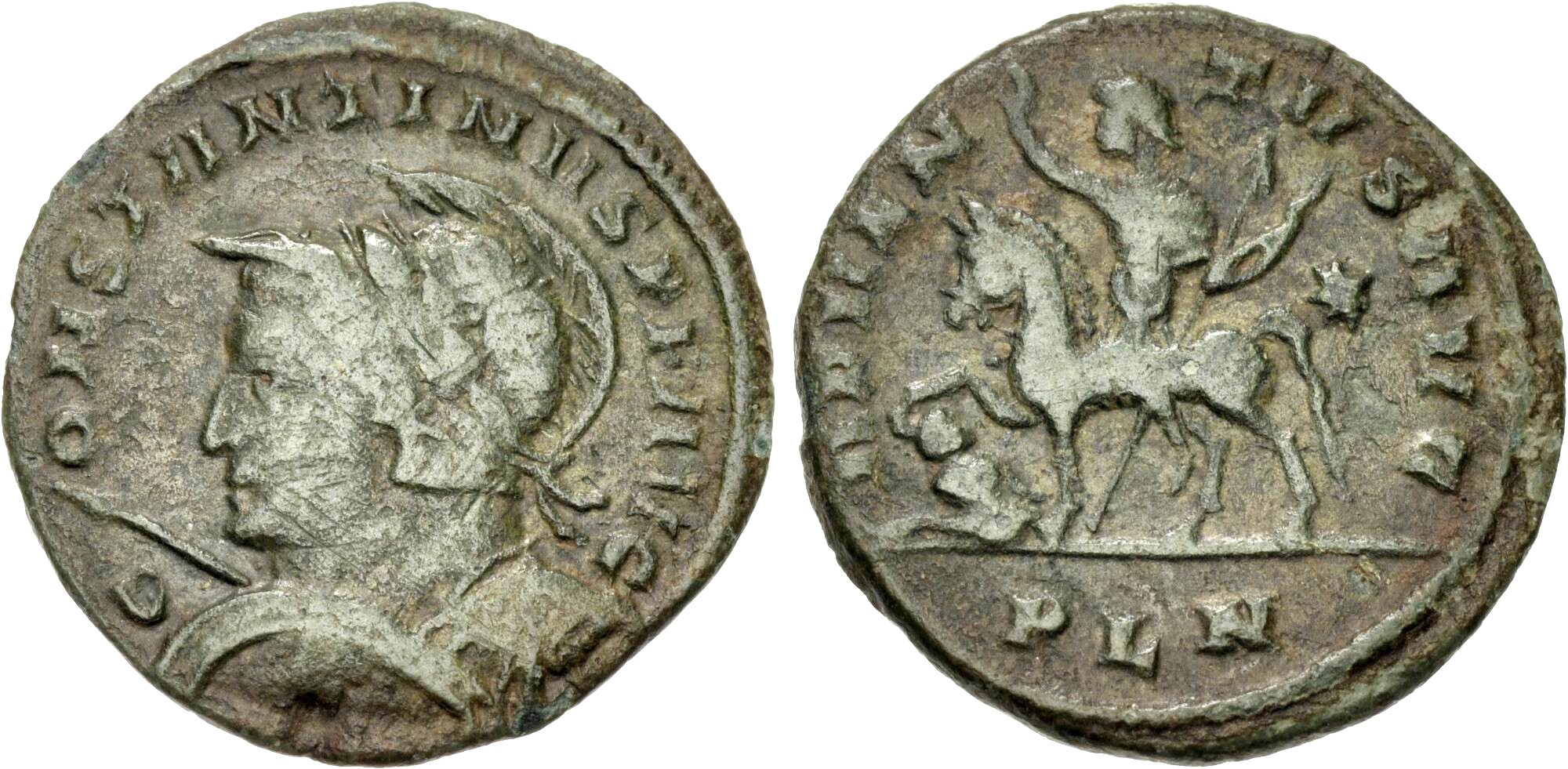
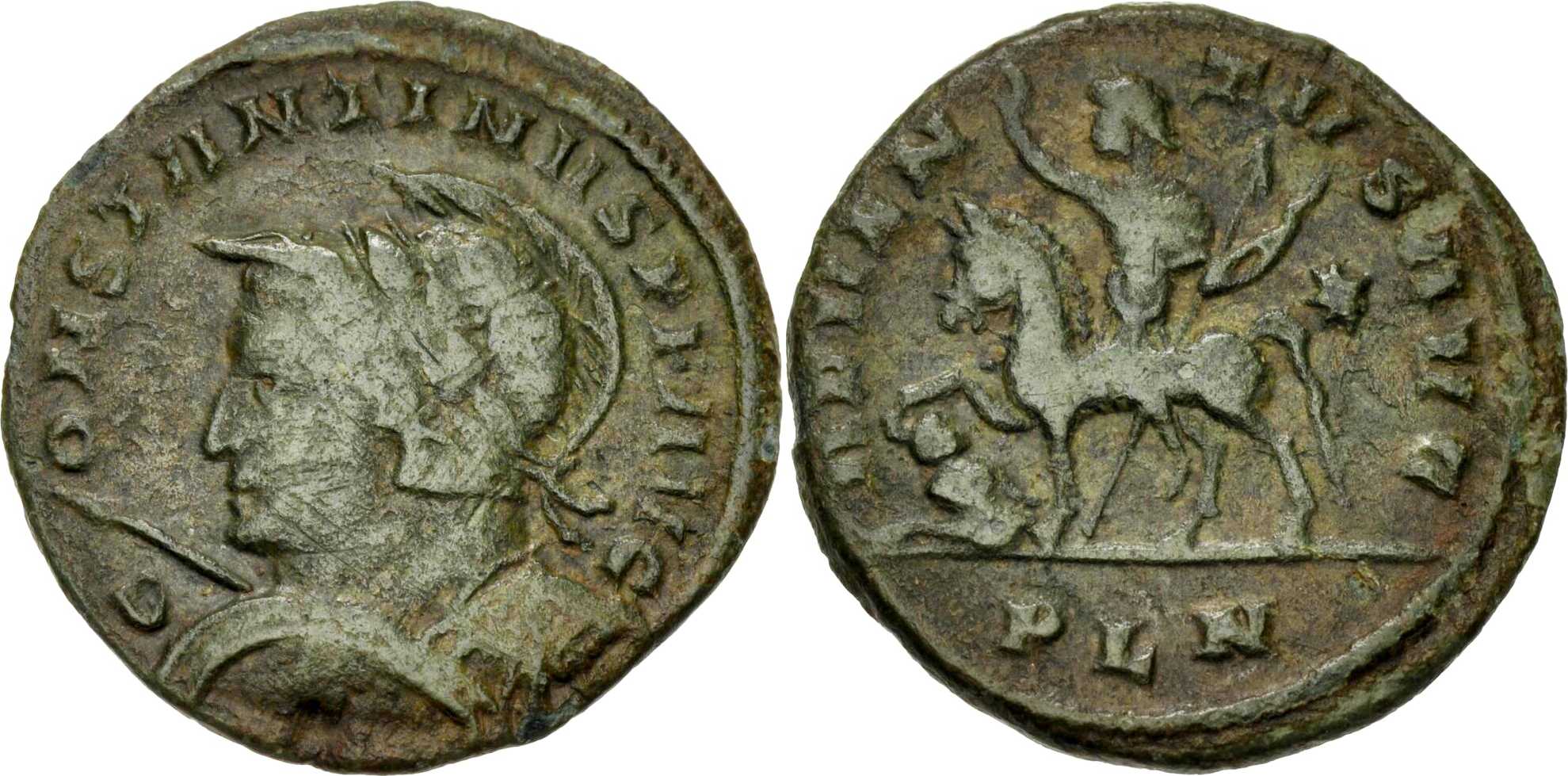
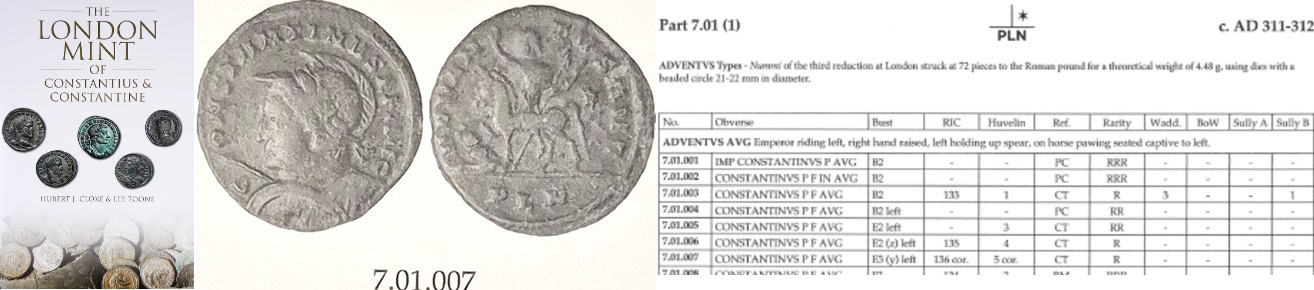
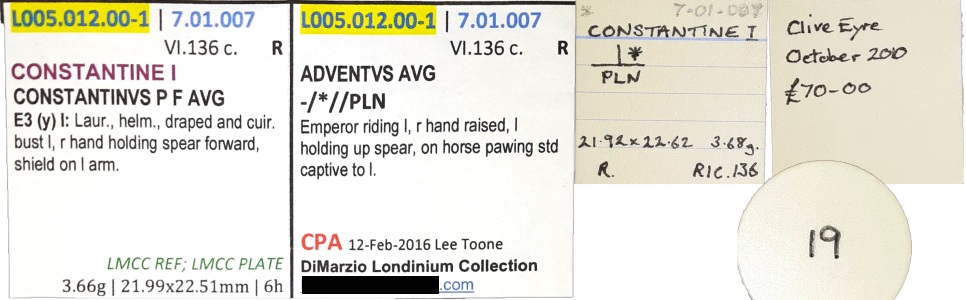
Constantine I AE Follis (22mm, 3.66g), London, 311-2 CE. Emperor on horseback. (RIC 136, corr. or var.)
Crispus AE Follis (19.5mm, 3.14 g), London, c. 320 CE. Captives & standard. (RIC 188)
(Photo Credit: CNG [edited].) Collection History:
– Paul DiMarzio (1962-) Londinium Collection, w/ tag [CNG EA 525 (19 Oct 2022), 1389 ; Hookmoor FPL 1 (Feb 2016), 12];
– Lee Toone (1958-) Collection, w/ tag [Clive Eyre, October 2010].
Publication History:
– CT 7.01.007 (this coin illustrated on p. 161 & described on p. 160) in: H. Cloke & L. Toone (2015), The London Mint of Constantius and Constantine.
See Also: Lech Stepniewski (2004 ff.),“Not In RIC,” CORRIGENDA Vol. VI, p. 134, Lond. 136 (this coin illustrated online).

(Photo Credit: CNG [edited].) Collection History:
– Paul DiMarzio (1962-) Londinium Collection, w/ tag [CNG EA 516 (18 May 2022), 631 ; acq. L. Toone, 28 May 2018];
– Lee Toone (1958-) Collection, w/ tag [DG Coins & Antiquities (“Dei Gratia,” Dave Shelley) at the York Coin Fair, 15 Jan 2010].
Publication History:
– CT 9.02.016 (this coin illustrated) in: H. Cloke & L. Toone (2015), The London Mint of Constantius and Constantine;
– Marsden (2024): Slide 10 (this coin illustrated after Cloke & Toone) in: “Tale of Three Cities,” paper presented at the Britannia Nummaria 2024 Conference (16 Oct).
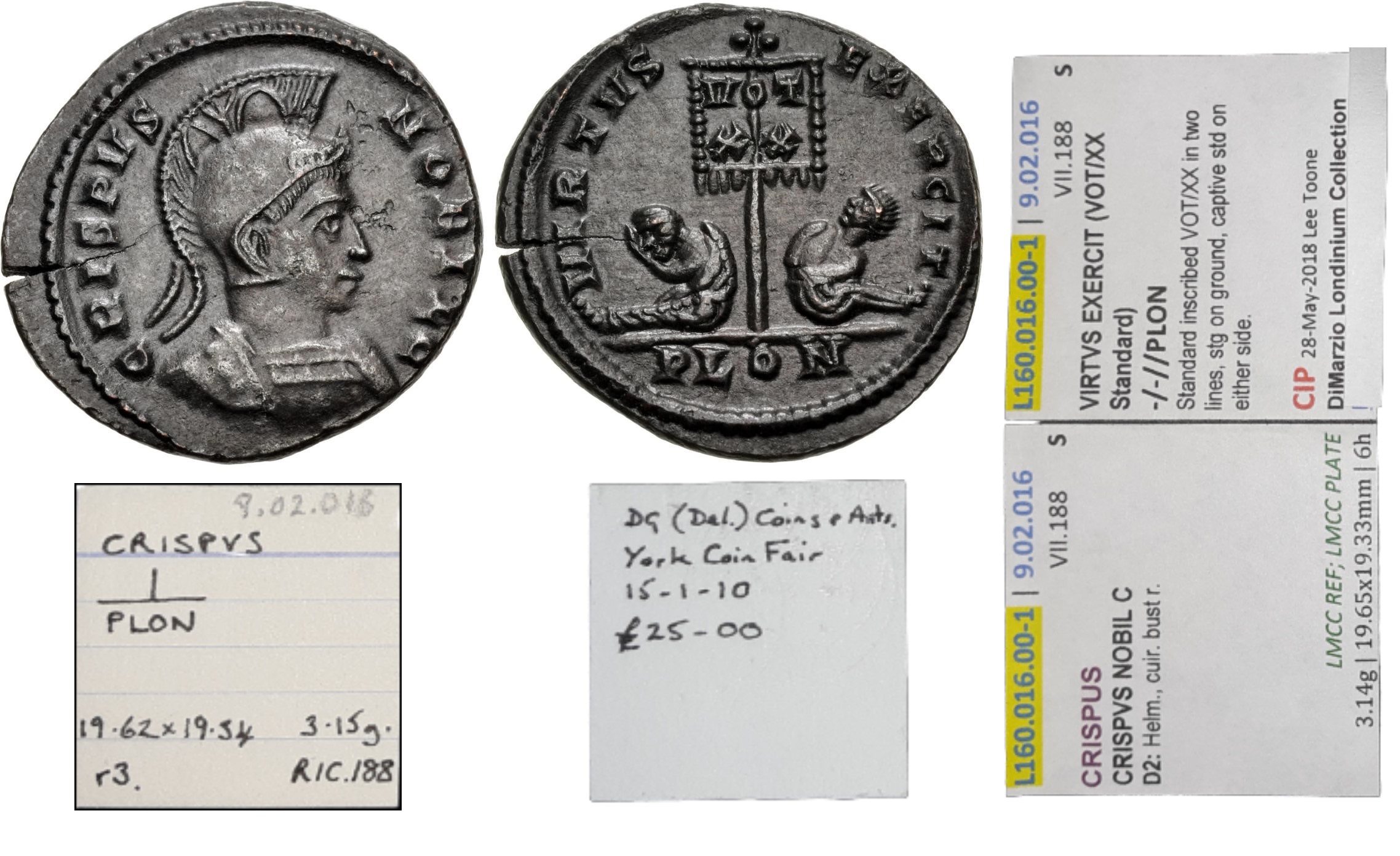
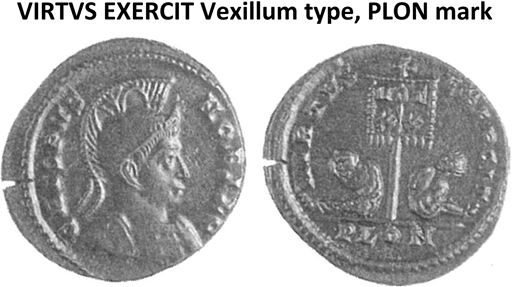
Notes: H. Cloke or L. Toone colls. were not distinguished in book or by CNG (“Authors’ collections” & “CT Collections“). Differences between Toone’s priv. coll. tags & his Hookmoor dealer tags ill.: see BNS’ bio page (to PDF) or “Main List” via BNS “Coin Tickets” page.
Speculative, but I suspect also ex Langtoft B Hoard, 2000 (additional info on file, educated guess).
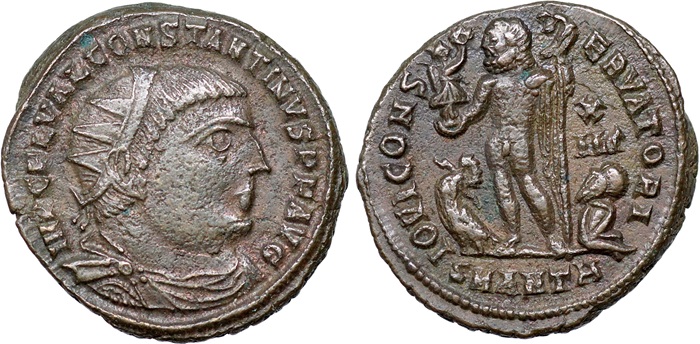
Constantine I AE3 Follis (19mm, 3.7g), Antioch, c. 321-3 CE. Radiate / Jupiter, captive. (RIC 34)
Licinius II AE3 Follis (20mm, 3.6g), Antioch, c. 317-320 CE. Holding mappa / Jupiter, captive. (RIC 29)
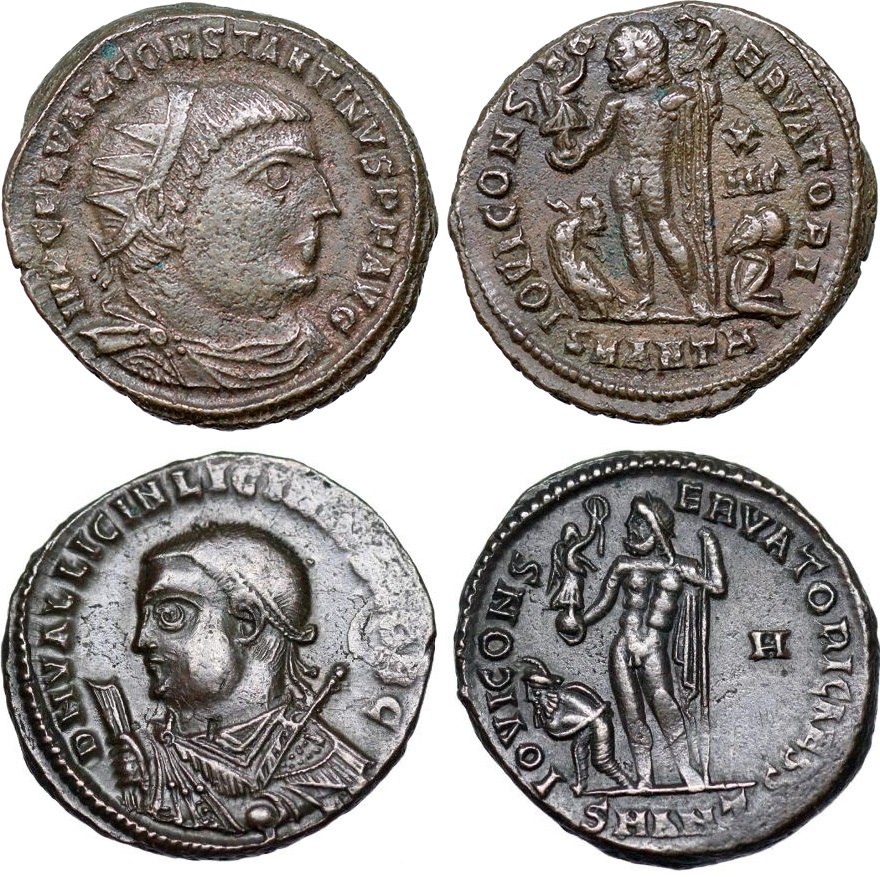
(Photo Credits: Victor Clark [ed./reduced].) Collection History:
– Giovanni Dattari (1853-1923) Collection of Late Roman Bronzes [both ex Victor’s Imperial Coins (Victor Clark, VCoins) ; Constantine: SKU: R6407 (3 Aug 2024), ex CNG EA 473 (29 Jul 2020), 367 (part) ; Licinius: SKU: R5046 (6 Feb 2021), ex CNG EA 470 (17 Jun 2020), 641 (part)].
Digital Plate Coins: Constantine the Great Coins (V. Clark, c. 2005-):
– Constantine I: “Assorted Reverse Types [p. 2],” RIC VII Antioch 34 (this coin illustrated online);
– Licinius II: “Licinius II A.D. 317-324,” RIC VII Antioch 29 (this coin illustrated online).

Substantive Notes: Also see these coins (Constantine & Licinius) on my “Barbarians, Captives, and Enemies (BCE Collection)” page. Re: Constantine’s rev. type (episemon vs. gamma) & other comments, follow title links above.
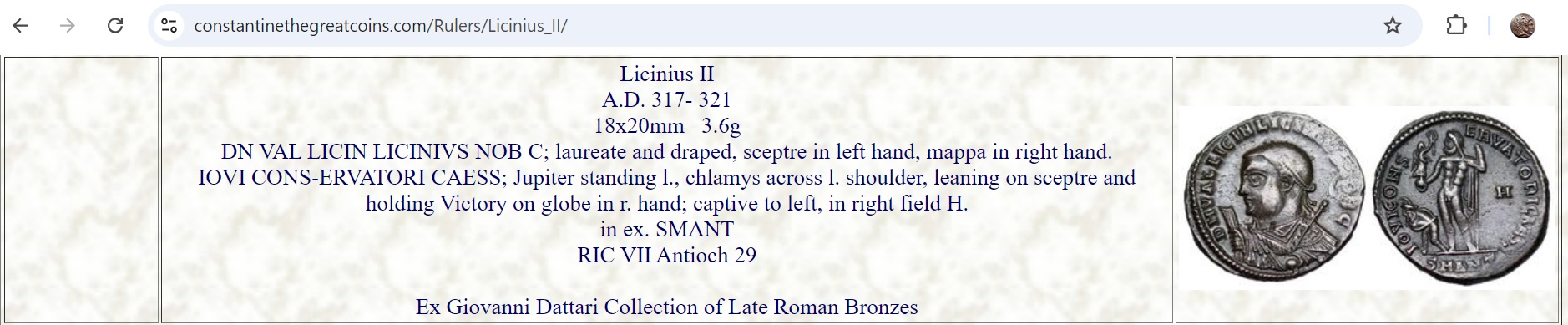
Prov. Notes: Dattari is best known as a scholar-collector of Roman Egypt but he also collected nearly 20,000 4th cent. Imperial coins (in 1910, he donated >5K to KBR [Stroobants 2018]; in 1912, his & Lambros‘ antiquities colls. were famously auctioned [BnF-Gallica] by Jacob Hirsch.). Starting in 2017, just as Naville (London) began dispersing a parcel of 1,000s of his Alexandrian, another large parcel was dispersed by Jesús Vico (Madrid) & CNG (USA), this one containing LRBCs.
Constantine I & sons AE3/AE4 Folles (eleven total). c. 320-337 CE.
(Photo Credit: CNG.) Collection History:
– Kenneth Bressett (1928 – ) Collection [CNG Keystone Auction 6 (11 Mar 2022), 3335, 3336, 3351, 3352, 3361, 3365];
– Lincoln W. Higgie, III (1938-) Collection;
– Lincoln Higgie Hoard (1967, Turkey).
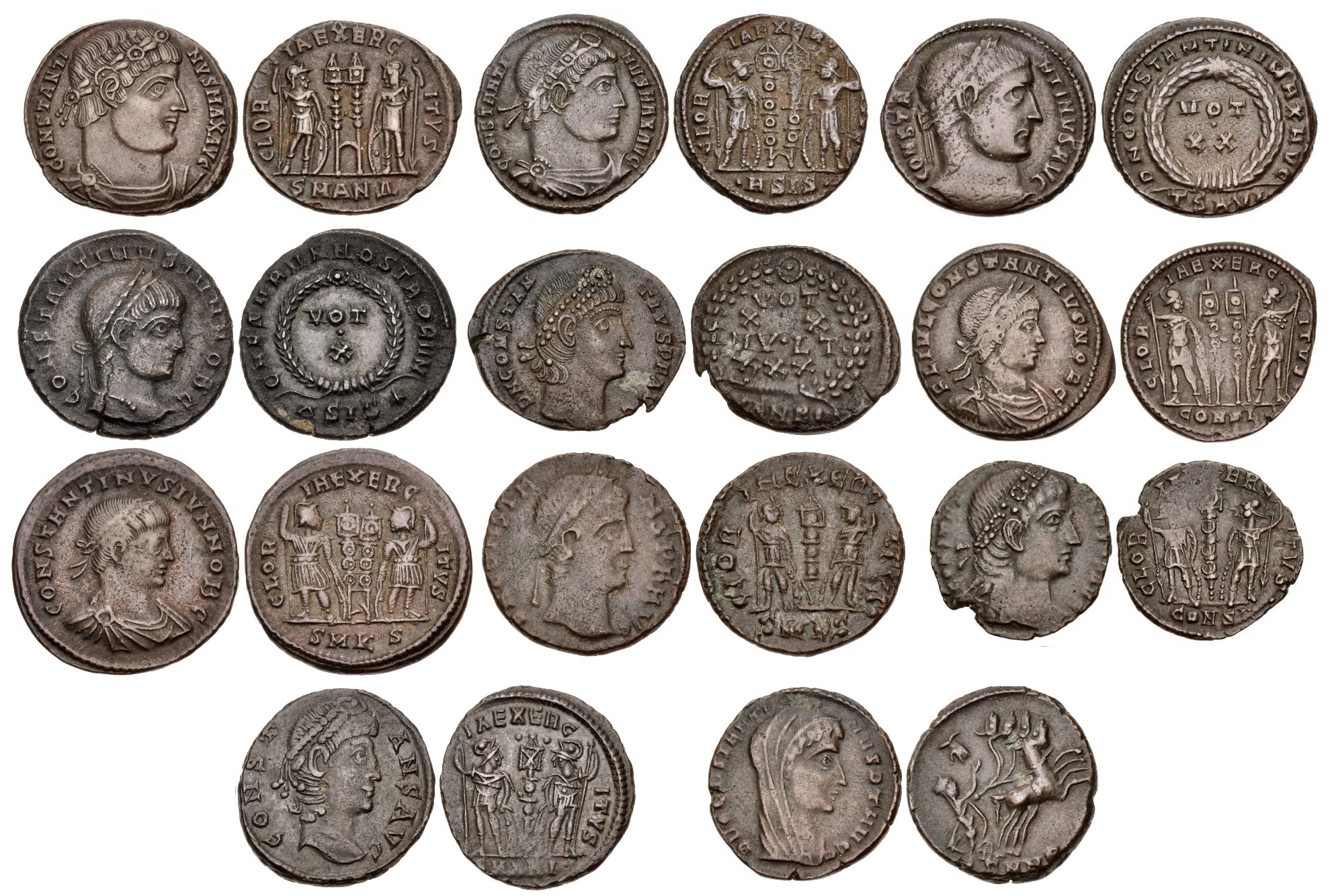
Notes: The “Lincoln Higgie Hoard” was “discovered in Turkey by Lincoln W. Higgie, III, in 1967 and sold intact to Ken Bressett.” It contained about 40 VRBS ROMA AEs, plus a couple dozen Constantine I and II. Characteristic of the era, no publications or other reports of the hoard seem to have been made (nor does one imagine cultural property and export permits were considered a major concern).
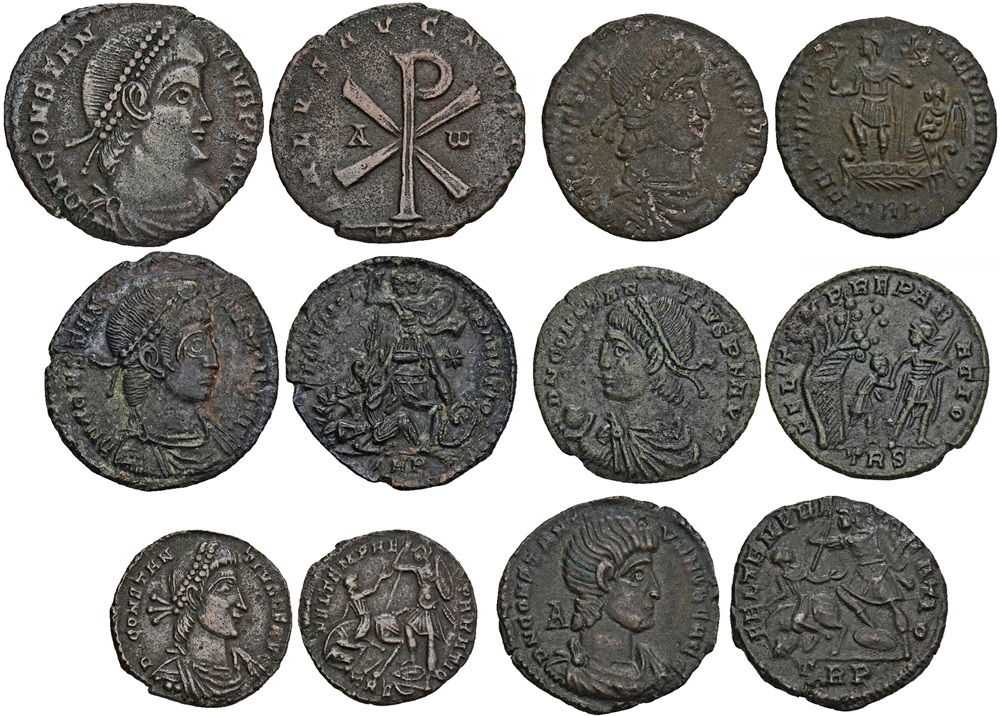
Constantius II AE2 Maiorinae & AE3 Folles (six total, one Constantius Gallus). Trier mint, c. 350-361 CE.
(Photo Credits: Künker, Boersema [coins, edited] & Lang, CJJ [book].) Collection & Publicationn History:
– Carl-Friedrich Zschucke (1938-2023) Collection [Künker 435 (18 Nov 2025), Lot 9664].
– Zschucke 58-1(3) (this coin illustrated on Plate XI), in: Zschucke, C.F. 1997. Die römische Münzstätte Trier (von der Münzreform der Bronzeprägung unter Constans und Constantius II. 346/348 n. Chr. bis zu ihrer Schließung im 5. Jh. (3rd edition [1982/1988].)
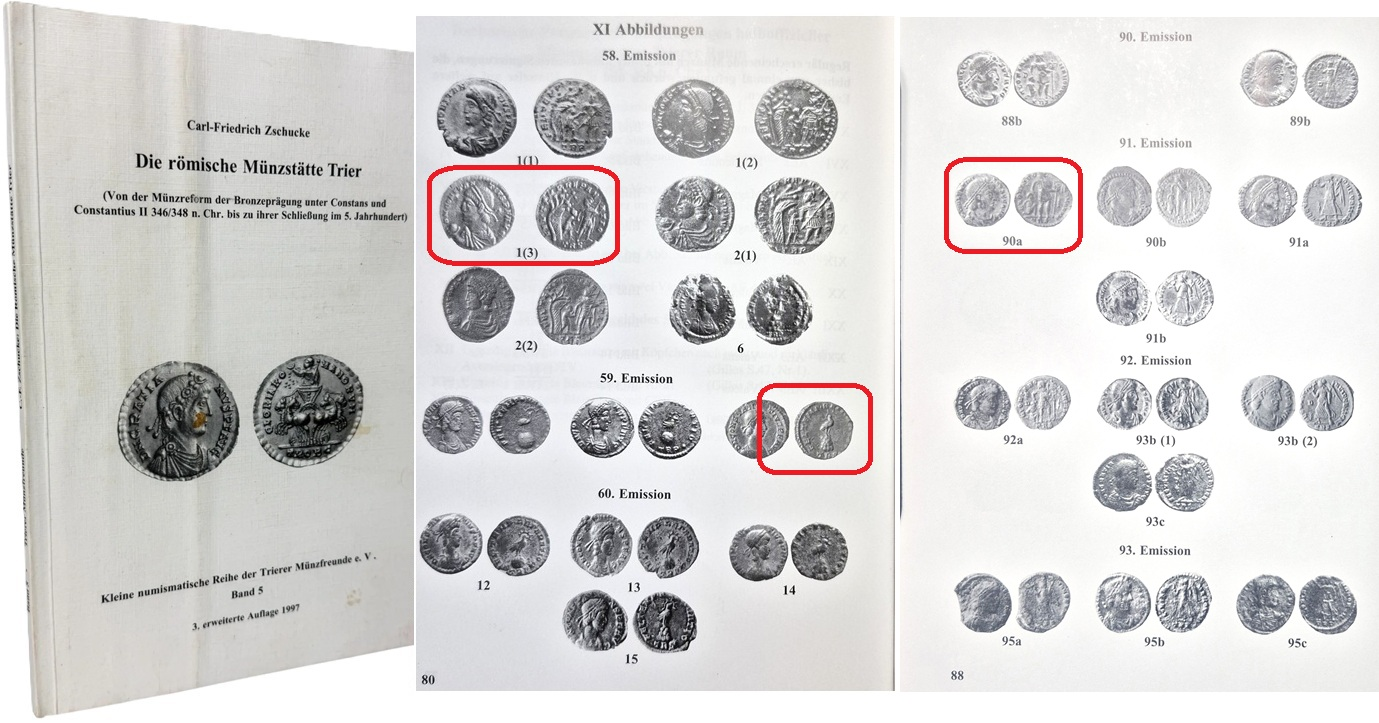
Notes: Zschucke was known as a preeminent collector and scholar of the late Roman coinage at Trier, publishing several books on the mint (among other numismatic topics). Of nine ex-Zschucke coins in my collection, three are plated in his (1997) Die Römische Münzstätte Trier (Von der Münzreform der Bronzeprägung unter Constans und Constantius II 346/348 n. Chr. bis zu ihrer Schließung im 5. Jahrhundert).
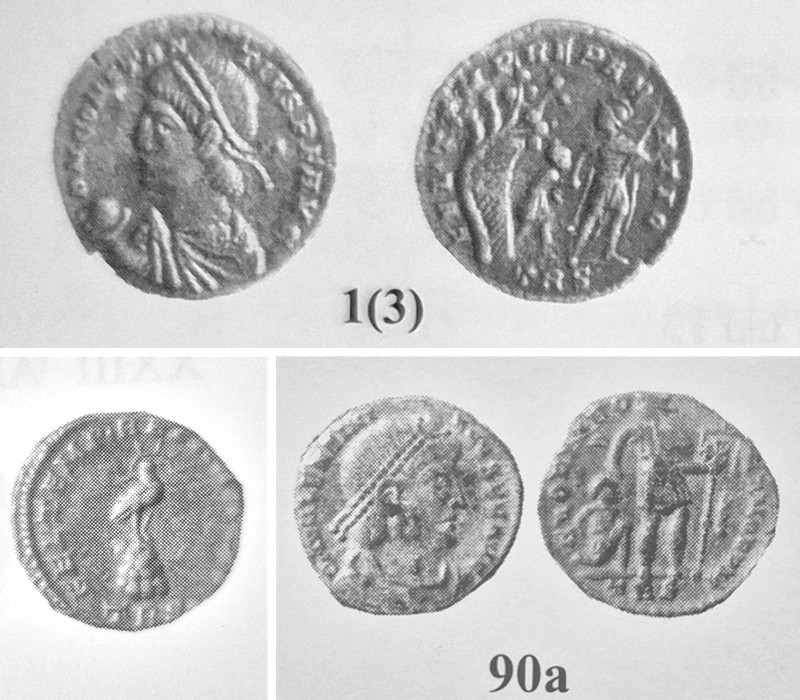
I bought six coins of Constantius II in a group lot from Künker 435. The other three (Constans, Valentianian, and an Arcadius not shown here) came from Gert Boersema, a Dutch dealer who had bought some of the larger group lots. Two of those were also illustrated in the book above.
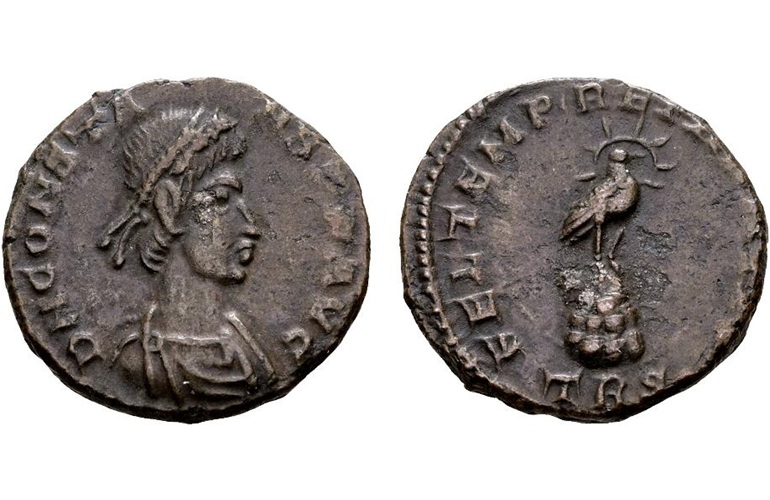
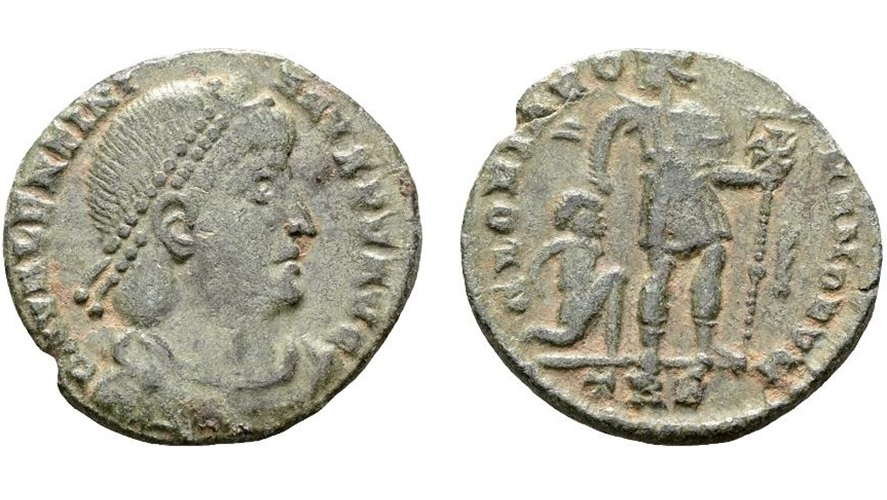
The Constans (Phoenix-on-rocks rev.), however, was illustrated with the wrong obverse photo. There are two previous editions of the book (the first, 1982); I wonder if that reverse was a new addition (and if any of my others appeared in earlier eds.).
Notes:
RBW-Schaefer-Russo (return to Uncia, Sextans, Semis, Quadrans): In my library of offprints, I have a 2005 piece of correspondence written by RBW (to a noted German scholar) in which he ranks the relative strength of various collections of Republican AE (with perhaps excessive modesty): “…for private, I would put Roberto Russo first, several Italian collectors next, and my own some ways down. And Dick Schaefer would have been number 2 if he had not sold.”
Although well underway, Andrew McCabe’s collection was still at an earlier phase (see his intro to NAC 152: pp. 10-13). Twenty years later, McCabe would surely stand alongside Russo, RBW, and Goodman/Schaefer as the finest collections of Republic bronzes in recent memory. (I would be far from qualified to suggest a rank-order.)
Of the 5 ex-RBW bronzes in my collection, one was ex Russo and two from the Goodman/Schaefer collection, one of which later joined the McCabe Collection. (The Russo coin & one other were later in R.W. Hoge’s collection.)
When I think of the most interesting & important recent Roman AE collections, the four that always come to mind are RBW, Schaefer (Goodman), Russo, and McCabe. Unsurprisingly, the interconnections between them are dense — both among their coins and their many publications. As it is with written scholarship, no important collection is formed without the contribution of other important collectors.
Knobloch-Yale (return to Lentulus Quinarius): Around 1963, during Ted Buttrey’s tenure as curator (1954-1964), Yale apparently sold a number of Roman coin duplicates to Fred Knobloch, who sold them as ex “Eastern Museum” circa Jan and Mar 1964, perhaps in special lists or buy-bid sales (they do not appear in his regularly numbered FPL 24 of Jan. 1964, but Knobloch also published special lists outside his usual sequence of numbers).
This information is recorded in the provenances of the Robert W. Hoge (1947-) Collection, a portion of which were sold by Nomos AG at Obolos 34 (10 Nov 2024). About 10 coins were listed as ex Yale via Knobloch. Hoge’s tags record their purchase from Knobloch in January and March (at least) of 1964. Based on my coin’s tags and envelopes, he may have bought some or all of them from Dan Brown (from whom he bought many Republican coins c. 1961-1966). (Mine, above, reads “Knobl. 64.1 #55”; another, “Knobloch 1964 #54,” no mention of Brown [external: reddit]. See also: Hoge provenance discussion, Sulla’s Blog [30 May 2025], incl. another Yale coin labeled “FSK BB 64-3 / E. Museum,” envelope in Dan Brown’s hand).
Yale is one of the oldest and most important institutional collections in the United States (formerly at Yale Library, now Yale Art Gallery). In 2012, Metcalf wrote that “while the collection does not enjoy its nineteenth-century primacy (this figure is now eclipsed by the national collection and by the American Numismatic Society) it is beyond doubt the largest collection of any American university” (to PDF from INC).
Numerous detailed catalogs of the holdings, including Roman Republican coins, have been published since the mid-19th century (esp. Fisk Brewer 1860.1 [Jul] & 1860.2 [Oct]; Henry Champion 1863; Jonathan Edwards 1880), including new acquisitions reported in the Yale University Library Gazette (via JSTOR), all of which can be checked against the current online catalog by searching the donor names.
Yale has held the exact same types as the Hoge coins since the 19th century, but those examples all remain in the current holdings. Of 20 acquisition reports of coins 1939-1964, only one contained ancient coins that cannot be found in the current current catalog: the Edward Ingraham II (1887-1972, graduated 1910) donation, recorded in Yale’s “Recent Acquisitions” in July 1963, consisting of “Fifty-one ancient and modern coins and medals.” (He was president [1927-1954] of the E. Ingraham Company founded by his great-grandfather, clockmaker Elias Ingraham, and president of American Clock and Watch Museum. The family papers were donated to Yale in 1973, apparently now mostly at U. Conn. [incl. bio].) About 21 other objects (masks, sketches, paintings) donated by Ingraham remain in Yale’s collection, but no coins (meaning they were deaccessioned at some point).
Unfortunately, I have yet to find any itemized record of Ingraham’s 51 coins, but based on the circumstantial evidence (date, number of coins, their apparent deaccession, absence of other candidates), I suspect that they were sold as duplicates by Ted Buttrey and to Knobloch in 1963, from whom Dan Brown and Hoge bought them in early 1964.
Incidentally, there have been some notable numismatic thefts from Yale, including a famous 1787 Brasher Dubloon stolen in 1964 (returned and sold a few years later), and a number of Roman Republican coins (incl. six from Yale’s Dura-Europos excavation, 1928-1937), stolen from Yale at an unknown point, but discovered when cataloged for sale at CNG’s canceled Keystone Auction 3 (“The university did deaccession duplicate coins from its collections over a period of time during the mid-20th century, but Yale believes that the coins in the Keystone sale were not part of their formal deaccessioning.”)
Adams-RBW Provenance (return): For more on the Adams Coll., see Provenance Glossary. I believe Charles Francis Adams acquired this coin from Sotheby’s sale of John Lindsay Collection (14 Aug 1867), 526 (part), but still need to verify it w/ one of the libraries (KBR or MHS) that holds a named copy of the sale (his agent, Joseph Curt, did buy coins there).
At the Stack’s JQA-MHS sale, this was coin no. 3 of 3 in Lot 496. Though not illustrated, the other 2 coins were also sold at RBW Part II (NAC 63, Lot 98 & Lot 99 — RBW 1322 & 1323, respectively, shown below). Additionally, the collection catalog, handwritten by Henry Adams in 1913, confirms the identical weight (26 grains). The neighboring lots were acquired by RBW’s main competitor at the sale, John A Sawhill (donated a few years later to James Madison University, but shortly sold — once again at Stack’s!). (As one can see from my catalog library, Alex Malloy was also a major buyer, apparently at both Stack’s sales — the 1971 JQA-MHS and the 1979 JAS-JMU sales!)
Hall-Trau Provenance (return): Curiously, unpublished until 2007. This coin/type not in BMCRE or RIC (1st ed.), as one would expected, since Mattingly thoroughly referenced Hall’s other coins (many later appearing in the same Glendining sale). Conceivably, BMC 588–note & RIC 470 might refer to this coin, but that one seems to be another coin in Hall II, 1204.2 (“cf. C. 70, BMC – p. 113*,” the asterisk meaning “this coin”). (The BMC II Addenda [bottom of p. 426] also notes the only other specimen of this type then known then, published in 1907 from Budapest. A couple others have recently appeared in trade and the BMC accessioned a specimen in 1958.)
Hall prob. added the present coin too late for BMCRE II (1930) & RIC III (1926). The most likely candidate is Trau 561 (Hess, 1935), described there as a C. 70 but with Concordia “Sitz.” (C. 70 is standing, CONCOR AVG.) (Glendining lists >19 of Hall’s coins as ex-Trau, no doubt among others.) Neither catalog illustrated it, which might explain how this type eluded proper publication before RIC II.1 (263) in 2007, using Hall’s plaster cast held at Ashmolean (Oxford).
Clay-Kraay Notes (return to Vesp. Dupondius; to Antoninus Pius Sestertius):
Curtis Clay’s friend/colleague Colin Kraay (1918-1982) was a long-time keeper of coins (from 1948, and “the” Keeper, 1975-82) at Heberden Coin Room of Ashmolean Museum (Oxford).
Vespasian Cast: Kraay published extensively on Vespasian bronzes & other Flavian coinage, so he would’ve known the museum’s plaster cast of H. Platt Hall’s Vespasian Dupondius. (But at least 25 years before it came to Clay’s possession or appeared in the plates of RIC II.3.)
Antoninus Pius “Kraay Overstrike”: After Kraay’s death, Clay coined the phrase “Kraay Overstrikes,” based on their personal conversations (2008, JAN v. 1.2-2). When Roman Imperial coins shows signs of one reverse being struck over a contemporary reverse type, Kraay & Clay take this as evidence for the simultaneous (rather, alternating) striking of two reverse types in combination with a single obverse die.
Thus, the present Sestertius shows evidence that this obverse die of Antoninus Pius (placed on the anvil) was paired not only with it “over-type” (congiaria scene on the reverse), but also with the “under-type” (GENIO SENATVS). It was struck first with the GENIO SENVATVS reverse die. Then, instead of being replaced by a fresh blank on top of the anvil as it should have been, it was struck a second time, now with the congiaria scene.
Not only do “Kraay Overstrikes” gives us information about the timing and sequence of types produced, they may also offer clues to the practical details of Roman Imperial coin production at this time. (In this case, we might imagine a four-man team: two holding different reverse dies, alternating them over the anvil as a third replaces the blank flans [or not!] and the fourth strikes with a hammer.)
Salton Collection & Hesperia Provenance (return): As is clear from the 2022-3 sales of the Salton Collection — especially in comparison with his fixed price & auction catalogs from the 1950s-1960s — Mark Salton did not always sharply distinguish between “collection” and “inventory” (if at all). So, it can be hard to say for sure exactly how he saw the coins he sold.
I suspect he bought this coin from Vladimir Clain-Stefanelli & Robert Hecht in 1951. Salton acquired at least one other coin from Hesperia in 1951 (then in Baltimore) — a Theophilus Semissis, probably Lot 32 from the inaugural pricelist. The same list describes two Vespasian AE Asses of this scarce type, Cohen 244 (IVDEA, not IVDAEA). None of these lots are illustrated. But, given the rarity of Cohen 244, and Salton’s known business with them at the time and possibly in this list, it seems very likely this is one of the two coins, probably the lesser specimen described as “G” for “Good” condition (which, of course, is anything but!). A few more notes here, and details in the Provenance Glossary for Clain-Stefanelli (yet to add my full Salton notes).
Zeno-Clay-et al. Notes (return):
Provenances Notes: Austria, Zeno, Clay. I suspect Clay found several things notable about this coin. He spent his early career in Vienna (Zeno himself was a foreigner in Vienna when he served in the court of Holy Roman Emperor Charles VI) and was familiar with the practice of Austrian monasteries holding ancient coin collections. I assume Clay knew Robert Göbl (1919-1997), the great Viennese numismatist who cataloged the Zeno sales & commented of this coin, “Der Revers ist auf GENIO SENATVS überprägt.”
Additional Notes: Respectability & Disrepute. I find it fascinating that this coin’s ownership history represents the extremes of the “hierarchy of respectability” in numismatic provenance. First, it was part of one of the earliest documented and most distinguished private collections (Apostolo Zeno’s). Second, it was sold by a notorious eBay dealer (“Silenos”) surrounded by accusations of smuggling, organized crime & Bulgarian public corruption, Interpol warrants, and at least one murder mystery (see e.g., Campbell 2013).
Remarkably, this coin was probably also among those that Nazis seized from St. Florian and kept at the Altaussee salt mines, where they were recovered by the Allied “Monuments Men,” warehoused, then repatriated to the monastery. (The monastery sold them via Göbl and Dorotheum a few years later.) Hitler was photographed with his entourage at St. Florian on 4 Apr 1943 (see, e.g., Schwarz 2018: p. 141).
Elberling-Clay Notes (return): As I commented in my Elberling bio, his work had a major impact (being thoroughly referenced in Cohen), but was sadly soon forgotten. Later authors, using Cohen’s 2nd ed. — apparently unaware of Elberling’s remarkable 10 part catalog illustrated w/ 24 detailed plates by Conrad Rosbach (1817-1885) — expressed varying degrees of disbelief about the accuracy of this coin’s description. The original illustration would’ve erased those doubts, had they seen it.
The recovery of this lost provenance is thanks to the careful research of Curtis Clay. He acquired it from NAC in 1999, where it was cataloged it with no provenance whatsoever.
It was the only known specimen for nearly 150 years, until a second came to market in 2012 and 2013, acquired by Charles Schotman (but see also the possible 1906-1908 sales cited above & directly below in the Elberling-Stiavelli note). In 2014, Clay commented on the Elberling and Schotman examples without recognizing he already owned the former: “the only other specimen recorded seems to be that of Dr. Elberling, published by him with a drawing of the reverse in 1864, then taken over by Cohen 929 in his second edition, and repeated from Cohen by RIC 753, BMC 1651 note, and Strack p. 347, no. +83.”
A year later, he wrote that he “had forgotten that I myself have a nice specimen of the same coin … but not yet written up! And a nice surprise: my specimen … seems to be the actual Elberling coin that I mentioned … judging from the accurate drawing of the reverse in Elberling’s catalogue!”
For many years Clay has been one of the only professional catalogers to cite Elberling when Cohen referenced him. Though Cohen (1882) remains a standard reference and relies heavily on Elberling, the latter was very rare and inaccessible until quite recently. Now, fortunately, most of the articles were digitized and published online (see my Elberling Bibliography for Parts III – XI).
No more than a handful of numismatists could have had his original articles with the all-important plates. One of them was Clay (perhaps in the Berk Library?). (The BCD Library had only 3 of 10 parts, but not this one.) Many of the most distinguished scholars of Roman Imperial Coinage have failed to confirm Elberling’s descriptions in their own work (for this coin, Strack; elsewhere, Mattingly and others). How many other collectors (or dealers), I wonder, would have followed up on Cohen’s 1882 reference and been able to find it? Very few, I suspect. It is only fitting that the coin spent 25 years in his collection.
Update: The Clay Collection has now unveiled a second lost-Elberling coin! See HJB 233, Lot 76 (unique Caracalla Dupondius = Cohen 675).
Elberling, Hobler (return): This coin was presumed unique (or thought fictitious) for 150 years after its 1864/5 publication, in which Elberling commented that it was so rare that not even Hobler had one. Remarkably, though, Elberling was mistaken: Francis Hobler (1796-1869) recorded one from his collection in Records of Roman History, from Cnæus Pompeius to Tiberius Constantinus, as Exhibited on the Roman Coins (1860, vol. II, p. 440: Nr. 930 [on Archive]). Others of Elberling’s coins had also once been Hobler’s (some having their provenances lost and recovered already in Elberling’s time).
The only reason to doubt that this coin is Hobler’s is the exceptionally heavy weight he reported: 486 grains (31.5 grams). Such a weight, though, is unlikely. Fewer than 1-in-160 (0.6%) Antoninus Pius Sestertii are that heavy (~40 in 6,800) in auction records. (The ANS has 6 [1.5%] of >400 Sestertii from Antoninus Pius’s reign in their digital collection.)
Instead, “486 grains” was likely misread or mis-transcribed from “426 grains” (27.60 grams), precisely the weight of Elberling’s coin. (Looking at mid-19th cent. English coin tags, 2s and 8s are actually quite easily mistaken.)
This was probably the second coin in Lot 523 of the Sotheby’s 4 Jul 1859 Hobler sale (where Rollin, one of Elberling’s dealers, was a major buyer).
In the same article, Elberling described his and Hobler’s Marcus Aurelius Sestertii as likely being one and the same specimen (“die meinige und die Hobler’sche Münze … ein und dasselbe Exemplar sind”), based on its having been described only in their two catalogs (Elberling 1864/5: p. 173, Nr. 18), a circumstance that also applies to the present coin. Thus, had Elberling noticed Hobler’s description of this coin, I suspect he’d have reached the same conclusion.
(The only other place I can recall seeing ex Hobler listed is the H.P. Hall collection, whose second catalog noted 6 or “probably” 7, but not this one. One Hadrian Sestertius, ex Hobler, then Mackerell, and Hall 1384, appeared in 1983 at Ponterio 11, lot 46.)
After Elberling: Majer, “Stiavelli” et al. (return): Cited above are several sales (1906-1908, incl. Santamaria’s sale of Prof. Carlo Stiavelli [1863-1905] & un autre Collectionneur Distingué) describing a coin of the same type. Based on its rarity, their closer proximity to the Elberling Collection’s dispersal by Rollin et Feuardent (c. 1870s or later), and other contextual clues, I believe they also describe this coin. Unfortunately, none provide weight, illustration, or detailed descriptions.
The other known specimen (in the Charles Schotman coll., see Elberling-Clay note) made its first public appearance in 2012. That one is in extraordinary condition, while the 1906-8 catalogs describe a coin that is only “Very Fine” (Spink) or “Molto Bello” (Majer), much more fitting for the Elberling specimen.
(Santamaria described this coin and one other Antoninus Pius Sestertius with a single grade for the pair, as “Beau.” In fact, the same pair of Sestertii, the other a Cohen 856, apparently traveled together from Spink to Santamaria and on to Majer. Spink and Majer graded that one similarly as well, calling it only “Fine” or “Bello,” which explains Santamaria’s reduced “group grade.”)
Although usually called the “Stiavelli sale” (Carlo Stiavelli, 1863-1905), some coins in Santamaria Auction 1 were purchased after his death, which Italian historian Vivoli (2015/16: p. 33) dates to 27 Jul 1905. (In general, there is little bio. info. re: Stiavelli. See my bio.)
Sadly, the catalog does not distinguish between the consignors, but coins bought in 1906 and 1907 must have belonged to “un autre Collectionneur Distingué,” incl. the Elberling Antoninus, which was presumably the same one listed in Spink’s Jan 1906 Numismatic Circular (six months after Stiavelli’s death, per Vivoli 2016 [2015]).
The Collectionneur Distingué appears to have recently bought at least one other coin from Spink, that one in 1907 (Santamaria 1 [“Stiavelli” sale], 116 = Delbecke 37/pl. I-31 corr., bt. Spink = Triton XXV, 41 corr.).
(See following note re: other Elberling coins in private collections/sales.)
Other Elberling coins in commerce or private collections (cont. from “After Elberling…“):
Of three other Elberling coins with known 20th century sales, at least one other was sold by Spink (Sep-Oct 1923), current disposition unknown.
Another was sold by Seaby in 1951, a Caracalla Dupondius (Berk 233, Lot 76) that, like my coin, was also rediscovered by Curtis Clay!
A third is Elberling’s Augustus Heifer Aureus, sold at Feuardent 1921 and Bourgey 1957 (Rambach & Walker 2012, nr. 6.2).
Archer Huntington had a Spanish-mint Augustus Aureus (NAC 67, 109), acquisition unrecorded (as with almost all Huntington coins).
Those with only 21st cent. sales: Several other Elberling coins were deaccessioned from the Dutch Cabinet (c. 2010s?), having been there since the 19th century. They incl. several Constantinian (Victor Clark coll.) & a Julius Caesar Denarius sold by Heritage Europe (who refunded their buyer & relisted the coin after tragically losing the beautiful 19th century holder; luckily, at least one side was photographed for the first listing).
These are the only examples outside museums of which I’m aware, but surely others will be rediscovered in the years and decades to come, now that high quality images of Elberling’s plates are available online.
Note, Thomas-Neve (return): The Pinkerton “Britannia” was in the Neve Collection, then the Thomas Collection. Between Neve and Thomas, though, it may have passed through Trattle’s collection and/or Young’s hand (probably as dealer rather than collector).
There are several ways Thomas could have acquired Neve’s Pinkerton “Britannia”:
Most likely, I think, is from the Trattle Sale (1832), which boasted a large parcel from Neve’s Collection of Roman Brass. Thomas acquired other coins from the sale (e.g., 1465 & 2633), for which the buyer is listed as coin dealer Matthew Young (1770-1838), who presumably acted as Thomas’s agent. (Matthew Young and father Henry were leading coins dealers in early 19th century London.) Young is also listed as the buyer for an Antoninus Pius Britannia in Trattle’s Lot 1314.
Sotheby’s, though, also held a previous sale of the “Neave” Collection of Roman Brass (1830; different spelling, same person). It’s unclear if Trattle purchased his Neve coins from this 1830 sale, or directly from Neve. Of course, Thomas also might’ve bought the coin directly from Neve, as both were well-known London collectors.
Finally, Sotheby sold the estate of Matthew Young (Thomas’s agent for the Trattle-Neave sale and buyer of Trattle’s “Britannia”) over nine sales, 1839-1841, including coins of this type (though I doubt this one; I don’t think Thomas was still actively buying).
Three auction possibilities in 1830 (less likely), 1832 (most likely), and 1839 (less likely):
– “Neave” sale [Sotheby’s (13 Jul 1830), Lot 54 (first of four coins): “Antoninus Pius, reverse Britannia,” but prob. a Sestertius, coming from a group of “Large Brass” w/ a Caracalla “Middle Brass”];
– Marmaduke Trattle (1751-1832) sale, incl. “Neve Collection” Roman Brass [Sotheby’s (30 May – 4 Jul 1832), Lot 1314 (part of): Middle Brass, “A. Pius … ‘Britannia’ seated on a rock,” sold to Young];
– Matthew Young (1770-1838), Part IV [Sotheby’s (27 Feb 1840), Lots 899 & 900 (eight Antoninus Second Brass, “figure of Britannia”)] & Part VIII [Sotheby’s (3 Nov 1841), Lot 168 (part, Middle Brass, “A. Pius, with Britannia, poor“)].
Changes (return to top): 27 Mar 2024 (created, twelve coins by day’s end) ; 16 Jun 2024 (up to 16 coins, most recent: two Antoninus Pius Sestertii ex Curtis Clay, one prev. Apostolo Zeno, the other Elberling) ; 17 Jun 2024 (Probus ex Gysen, adding Mazzini to Gordian III) ; 1 Jul 2024 (Otacilia ex Salton-Earle) ; 4 Sep 2024 (Carisius ex Este) ; 29 Sep-1 Oct 2024 (Constantine DiMarzio & Dattari, Bressett Dorchester & Higgie) ; 22 Jan 2025 (Crawford 50-3 ex RBW, Hoge, JHU, Helbig) ; 27 Jan 2025 (Carausius ex Lyne, Boyd); 9 Jul 2025 (possible Stiavelli sale of Elberling-Antoninus, Mardsen publication of Crispus) ; 21 Jul 2025 (Julia Domna ex Clay & Hill, Crawford 41/6e ex Russo, RBW, Hoge) ; 25 Aug – 2 Sep 2025 (LENT. Quinarius ex Hoge & Yale, Pomponius Molo Quadrans ex McCabe, Gallienus Hybrid ex Holmes, Antoninus Pius Britannia ex Pinkerton); 17 Nov 2025 (Hobler 1860 publication & 1859 sale added to Elberling-Antoninus); 10 Dec 2025 (Constantius II Trier AEs ex Zschucke & Philip I RCV “plate coin”); 29 Dec 2025 (Div. Aug. Sest., ex Bartlett, ANS & CNG Keystone 4); 15 Feb 2026 (Marcus Aurelius Sestertius ex Voirol, Waldeck); 21 Mar 2026 (signed RIC II.1 / Vesp. Dup.) ; 21 Apr 2026 (Constans & Valentinian added to Zschucke entry).