
Roman Egypt [40+ Coins]
Created: 13 Jun 2023 ; Last Updated: 29 Jul [Change Log]
(Recent: Sev Alex Tyche, Alex-Ares, Nero ex Luxor, Alex-Mamaea [“Roman style”], Commodus, Trajan, Gordian III Caesar)
Other Pages in this Series:
- Return to: The “Top Shelf”: Object Biography, Plate Coins & Provenance Glossary
- Return to: Page I (Greek, West: Celts through Central Greece)
- Return to: Page II (Greek, East: Asia Minor, Persia & Jewish Coinage)
- Return to: Page III (Roman Provincial: Eurasia)
- Continue to: Page V (Roman Republican & Imperial)
- Continue to: Page VI (Byzantine & Contemporaries)
See also:
- 20th Century Sales of Alexandrian Coins Online (my annotated bibliography w/ links to important auction catalogs & collections available online, meant for provenance research & finding specimens for study that don’t appear in indexes like ACSearch, Coinarchives, or Sixbid Archive)
Contents of This Page:
First Centuries (Ptolemaic & Julio-Claudian): Cleopatra [1]; Nero [1];
Second Century (Adoptive Rulers): Trajan [3]; Hadrian [6]; Aelius [1]; Antoninus Pius [3]; L. Verus [1]; Commodus [3];
Third Century (Severan Dynasty & Crisis): Severus Alexander [4]; Sev. Alex. & J. Mamaea [1]; Julia Mamaea [1]; Maximinus [3]; Maximus [1]; Gordian III [3]; Philip I [1];
Third Century (Recovery): Gallienus [1]; Tacitus [1]; Claudius II [2+]; Numerian [1]; Carinus [1]; Maximian [1].

 should load fully to left (Maximian/Hercules), if not zoom in & out
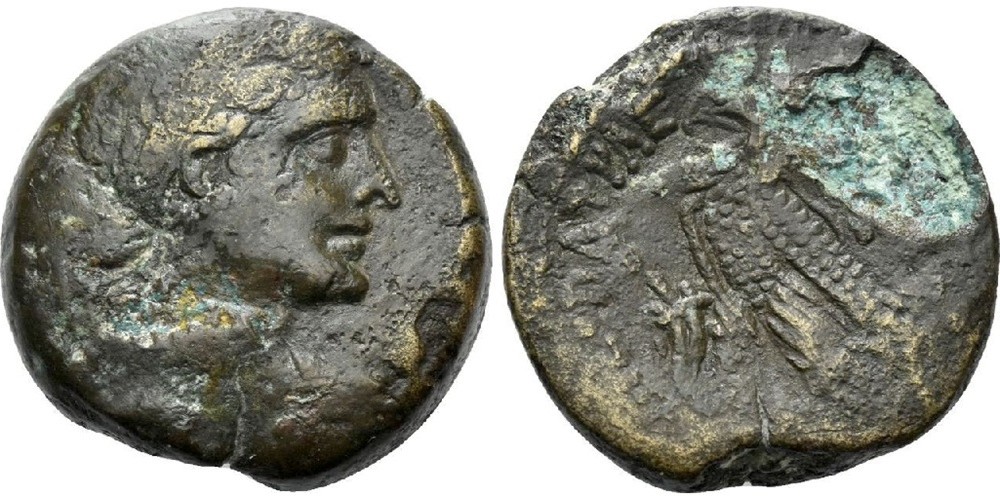
Egypt, Cleopatra VII AE Diobol-80 Drachmae (27mm, 19.01g, 12h), Alexandria, c. 47-40 BCE. Diademed portrait / Eagle.
[this coin also shown on Greek East page & (much more detailed) blog post]
(Photo credit: Naville) Collection Hist.:
– Found in 1880 excavation of “standing obelisk,” Caesareum in Alexandria (“Cleopatra’s Needle”);
– Henry H. Gorringe (1841-1885) Collection;
– heirs by descent, 1885-2015 [Kaminski (28 Nov 2015), part of 2106];
– Dr. Briggs Bralliar Collection [Naville 94 (23 Feb 2025), 236].
Institutional Hist:
– Worcester Art Museum Loan (“in storage,” 1915-2015);
– Various exhibitions in USA (1880-4), incl.: ANS [ANAS] exhibits/loan (NYC, c. Dec. 1880, Apr 1882 – Mar 1883); Am. Philosophical Soc. (Philadelphia, 1881); Nat. Academy of Design, Pedestal Fund (NYC, 1883/4); possibly 1883 (?) Detroit Art Loan (coins not among his 39 entries in 1883 catalog, but see Peck 2005, BDIA: p. 6, “coins”).
Publication (selected):
– Gorringe p. 72/3 (this coin illustrated, obverse only) in H. Gorringe (1882), Egyptian Obelisks (my copy signed by author & inscribed to Chas Colné [1832-1924]);
– Crawford, Appendix I: Foundation Deposits (this find & the four coins referenced), in Michael Crawford (2003), “Thesauri, Hoards and Votive Deposits.”

Exhibition Reports (selected):
– 1883 Art Loan Cat. No. 535 (group of 3 cited, prob. incl. this coin), on p. 149 in Catalogue of the Pedestal Fund art loan exhibition at the National Academy of Design…December 1883;
– March 1883 Exhibition (one of 13 Ptolemaic AEs found in excavation), by Gaston Feuardent at American Numismatic and Archaeological Society (now ANS), as reported by W. Poillon (1883) Proceedings of the ANAS v. 25: pp. 21-24;
– G.L. Feuardent (12 Feb 1882: p. 2), New York Times, “Coins near the Obelisk: What Commander Gorringe Found near the Shaft,” publishing his letter to Gorringe (citing the same “Thirteen coins struck during the reigns of the various Ptolemies–300 B.C.-30 B.C.”).
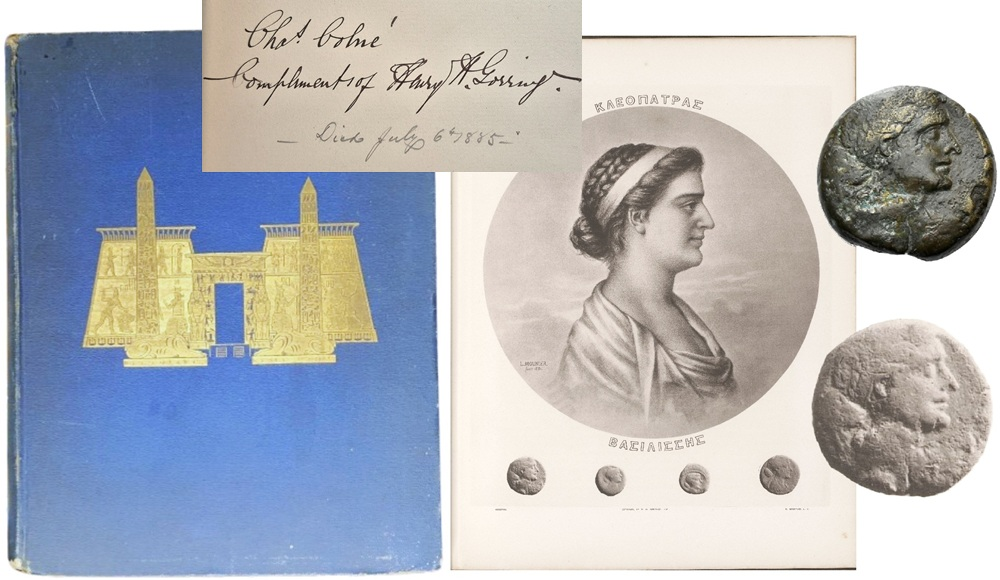
Biblio Notes: Above is my autographed “association copy” of Gorringe’s 1882 classic, Egyptian Obelisks, inscribed to Charles Colné (1832-1924), who also served in the Mississippi River Valley during the Civil War (Lincoln’s messenger & Union Army Paymaster). As military officers, engineers & statesmen, their careers overlapped repeatedly (e.g., also in de Lesseps’s French Panama Canal Project & Bartholdi’s Statue of Liberty).
Still an important reference on the history of obelisks and the transport of monuments (and cultural record of 19th cent. Egyptomania), the book merits a longer post. Gorringe planned ahead and, with W.H. Vanderbilt’s funding, spared no expense in documenting the project. He commissioned distinguished experts (e.g., Feuardent) and brought notable artists and photographers to Egypt, extravagantly illustrating the book as historical record. (With interior dimensions of 26.5 x 35.5 cm [exterior ~30 x 37], the book itself is monumental!) Among Gorringe’s entourage was Edward Bierstadt (1824-1906), important photographer & innovator of the “Artotype” (of which the photos remain well-known exemplars). The ancient coin photos were among the first to appear in books.
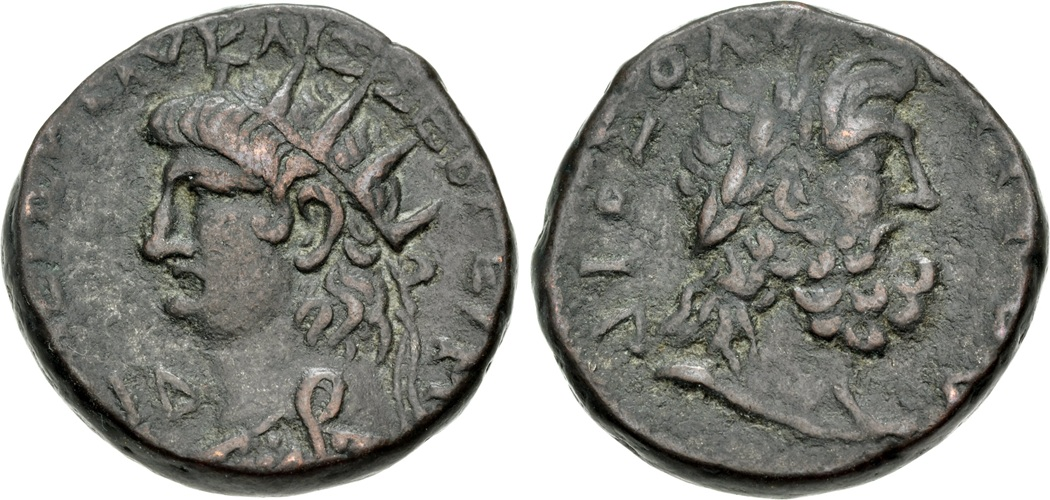
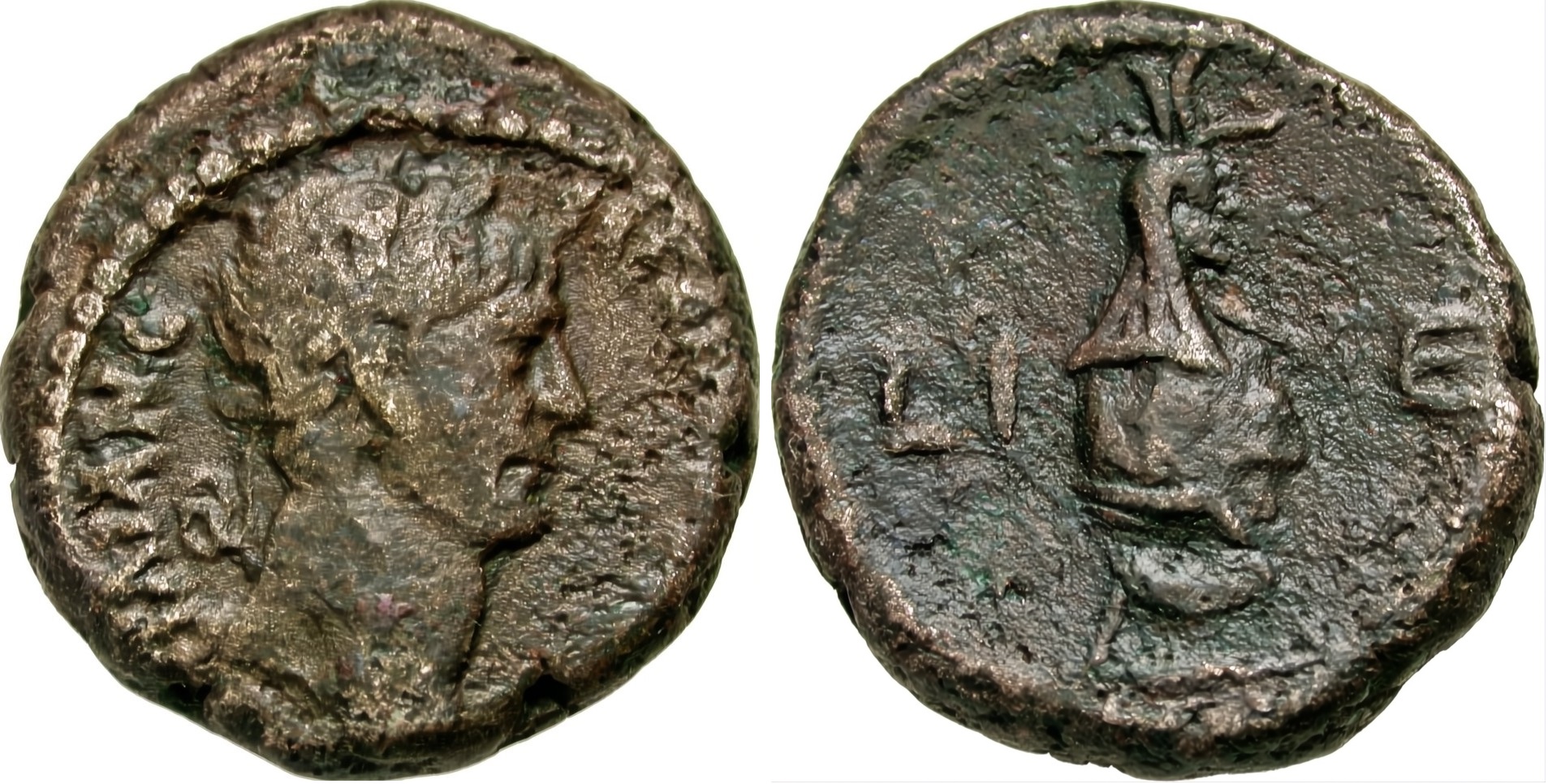
Nero AR Tetradrachm (24mm, 13.24g, 12h), dated 67/8 CE. ΔΙΟΣ ΟΛVΜΠΙΟV, Zeus Olympios, L IΔ (Year 14). Contemporary imitation.
(Photo credit: CNG.) Collection History:
Dr. Thomas E. Beniak Collection, w/ collector tag [CNG EA 585 (16 Apr 2025), 524; bt. Nilus Coins, 18 Jan 2003];
Giovanni Dattari (1853-1923) Collection;
Ex “Egypt. Uknown Site, 1912” Hoard (Savio 2015: p. 40, n. 141 = Christiansen [1985: pp. 97-8] Coin Hoards VII A38 [CHRE 7780]; see note);
(reportedly) Ex E.T. Newell (1886-1941),
(reportedly) Ex Luxor Hoard, March 1908 (Christiansen [1985: pp. 97-8] Coin Hoards VII A41 [CHRE 7783]; see note).
Published: Dattari-Savio Pl. 319, 15 (this coin illustrated), in A. Savio (1999/2007) Catalogo completo della collezione Dattari – Numi Augg. Alexandrini.
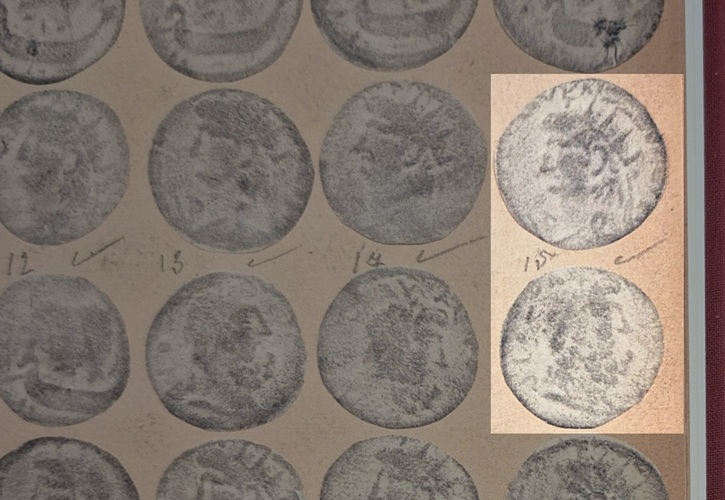
Note: Although I have not seen the argument made, Newell’s 1908 “Luxor Hoard” and Dattari’s c. 1912 “Egypt, Unknown Site” Hoard are, in all likelihood, the same.
They are the only two known sources for the distinctive contemporary forgeries of Nero and Hadrian Tetradrachms (probably both produced around the 130s), share many die-links, and are indistinguishable in condition. Incomplete reporting has caused them to be confused in the literature. But Dattari and Newell were in very frequent contact about hoards in Egypt, sharing both information and dividing the finds between them. The most likely scenario is that Newell acq. the hoard in 1908, kept the 76 coins now at ANS (published by Metcalf [1976, RBN; PDF]), and sold at least 300+ to Dattari when they next met. (Dattari wrote to Milne about the hoard in 1912, per Christiansen.)
Of the examples on the market since the 1970s (when Dattari’s collection was finally dispersed), many are illustrated in Dattari’s pencil rubbings, but not all. The remainder may have been duplicates that Dattari chose to sell rather than collect. (He actually sold many more coins than he kept.)
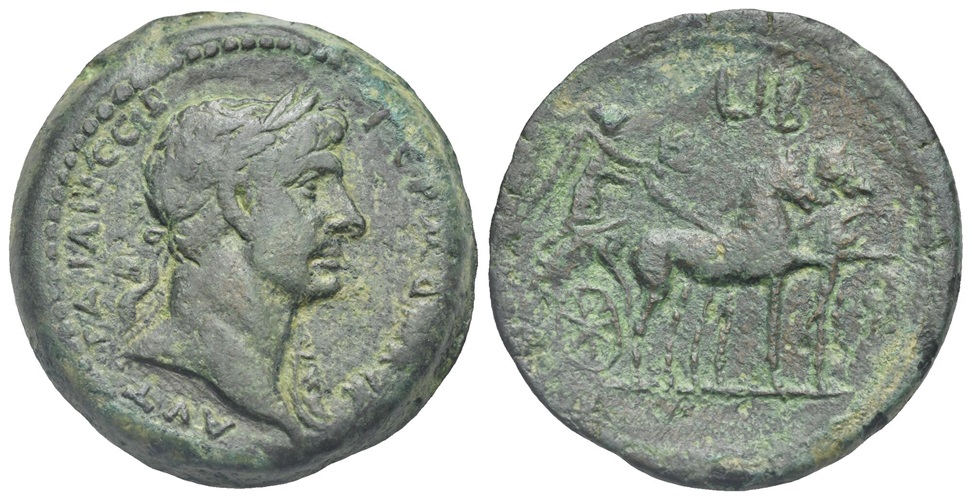
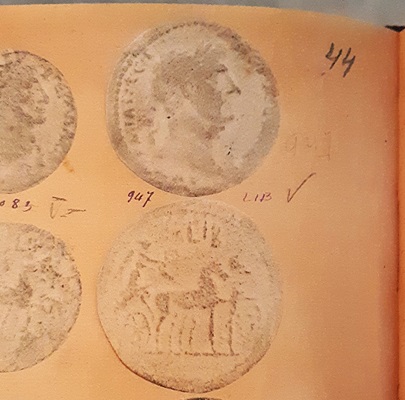
Trajan AE Drachm (35mm, 27.35g), 108/9 CE. Nike in biga, L IB (Year 12).
(Photo credit: Astarte.) Collection History:
Giovanni Dattari (1853-1923) Collection;
Riccardo Sarti Collection (Milan);
Giovanni Maria Staffieri (1944-) Collection [Astarte XXIII (28-29 Oct 2024), 302; acq. Oct. 1984 from Sarti].
Published: Figari-Mosconi 150 (this coin illustrated), in Giuseppe Figari & Massimo Mosconi (2017) Duemila Monete della Collezione Dattari;
Dattari-Savio 947 (this coin illustrated), in A. Savio (1999/2007) Catalogo completo della collezione Dattari – Numi Augg. Alexandrini.
See also: Dattari (1901) Numi Augg. Alexandrini, v. 1, No. 947 (this coin cited on p. 61);
Vogt I (1924), Alexandrinischen: p. 29 (this coin cited).
RPC III 4308.3, ex. 12 (this coin illustrated online as primary image).
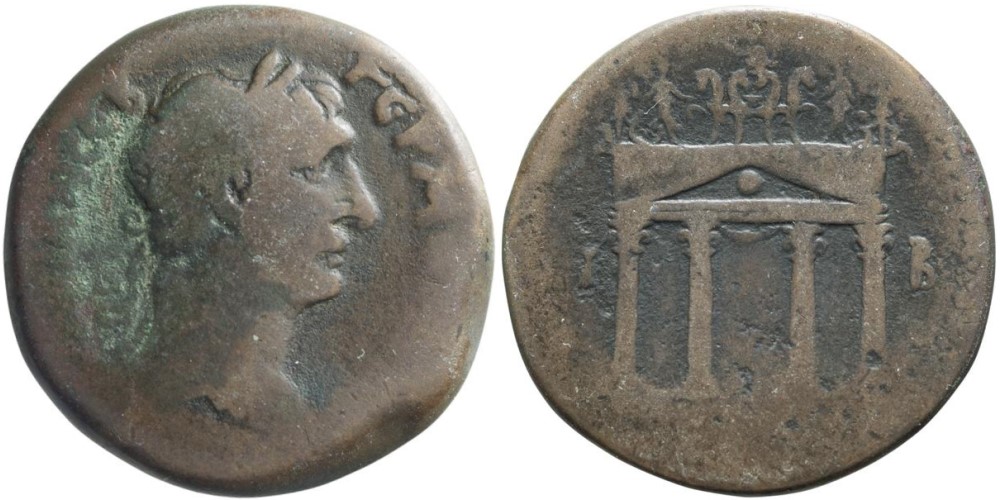
Trajan AE Drachm (34mm, 27.00g), 108/9 CE. Propylaeum (ΒΑΛΑΝΗΟΥ?), L ΙB (Year 12).
(Photo credit: CJJ.) Collection History:
Johns Hopkins University / “Garrett” Collection No. 83.92 (C. Carlson, curator*) [Part III, NFA & Bank Leu, 29 Mar 1985, 484i (part, 3 of 11)];
Kerry K. Wetterstrom Collection, Part I, w/ various tags [CNA 12 (26 Sep 1990), 53];
HJB BBS 225 (20 Nov 2023), 507 [superb unnamed coll. of architectural types].
Published: Kampmann & Ganschow: 27.205 (this coin illustrated);
RPC III 4287.3, ex. 5 (this coin illustrated online);
RPC III 4337.2, ex. 2 (this coin in error, corr. online [Archived], poss. in print vol. III?).
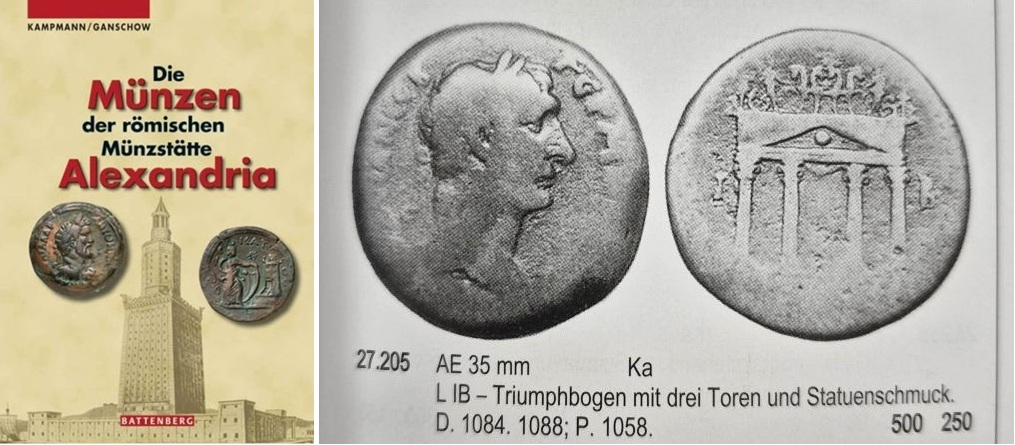
Notes (Substantive): Fascinating & controversial rarity: Different from the anepigraphic arcade-style “Triumphal Arch,” also struck by Trajan that year (RPC III 4337.2), and from Domitian to Hadrian (Kleiner 1989). RPC suggests ΒΑΛAΝΗΟΥ (here, off-flan, see RPC 4287.2.4) is for the Thermae Traiani in Rome, Trajan’s bath complex dedicated that year (RPC 4287.1; the genitive form [for ΒΑΛAΝEION?] is a mystery no matter what).
I also wonder if it’s related to Trajan’s unique RY 12 Nymphaeum type (RPC III 4317 = RPC III Online 4317.1, -.2 & -.3; Vogt I: 76; Staffieri, 2014,QT 43: 255-264).
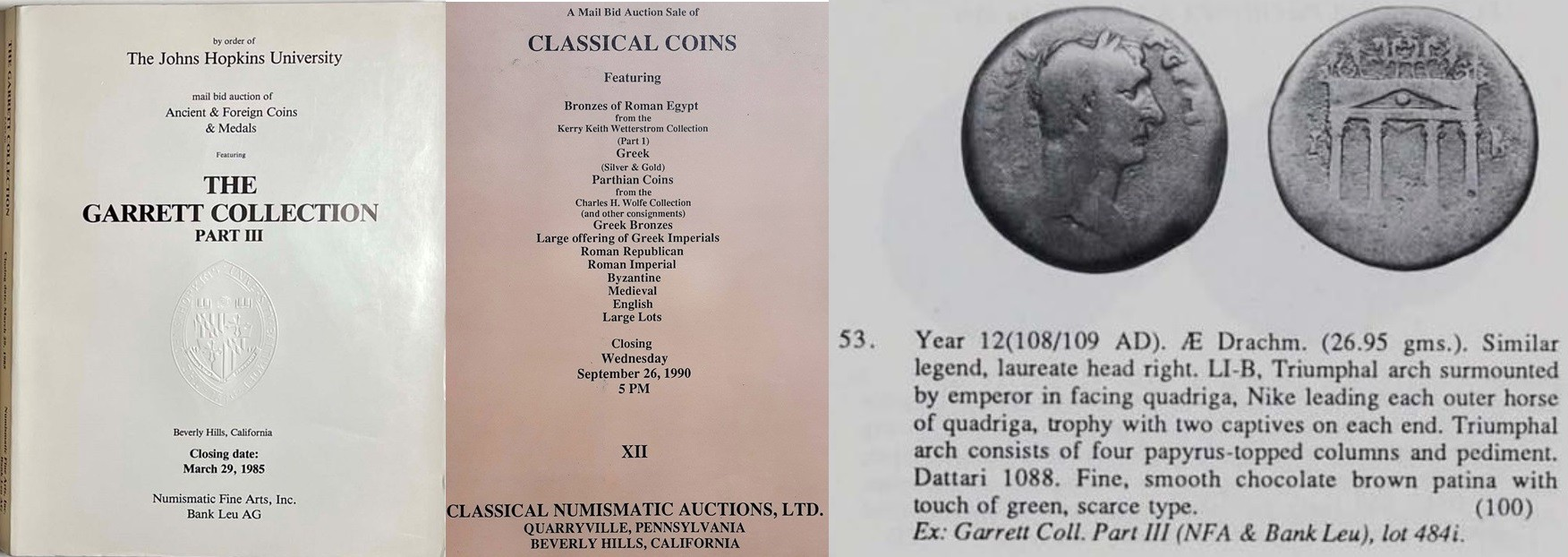
* Provenance Note: Certain coins from the joint NFA-Leu Johns Hopkins sales are only from the “Garrett Collection” in the abstract sense, esp. the Alexandrian AEs, added c. 1960s-70s by curator Carl Carlson (obit: The Celator 16.4 [Apr 02]: p. 32), who published & corresponded about them with K. Wetterstrom (who later bought this coin & others). Their “accession numbers” (“83…”) must actually refer to their 1983 deaccession. (See, e.g., ASW [incidentally, JHU grad.] in Nomos 24, 336.)
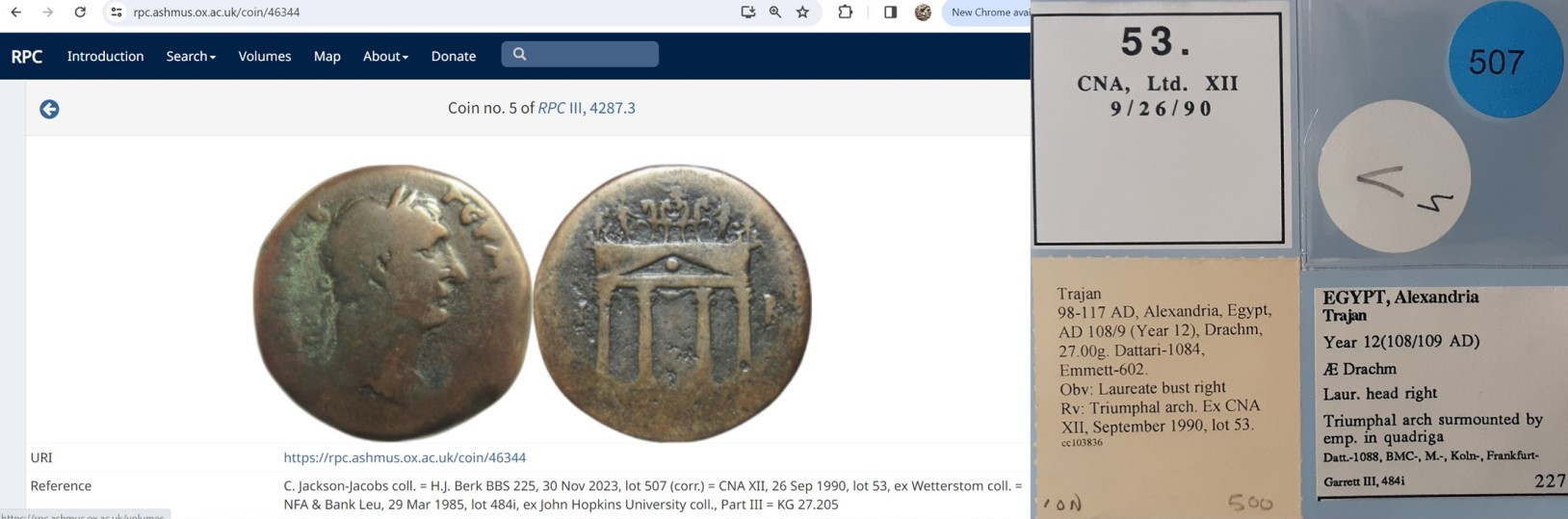
Or larger-file collage: on Imgur (external)
Trajan Billon Tetradrachm (24mm, 11.80g), 111/2 CE. Canopus, L IE (Year 15).
(Photo credit: Agora Auction 100.) Collection History:
Robert L. Grover (1910-1998) Collection;
Art Institute of Chicago (reference / accession number 1979.1203), with tag;
Ex Gemini XIII (Harlan J. Berk, cat. by Curtis Clay; 6 Apr 2017), Lot 451 (part of, not illustrated).
Tag notes: The manila tag below is from the Art Institute of Chicago, the penciled portions having been added by AIC staff (including the accession no. at the top right, beginning with the year of donation). The blue ink notes on the right side are in cataloger Curtis Clay‘s hand (as he confirmed in a 2021 CT comment). Tags for two other ex-AIC/Grover Tetradrachms (all acq. from different sellers who broke up the Gemini groups) are pictured below; yet another has an Aiello collection tag but lacks the AIC’s.
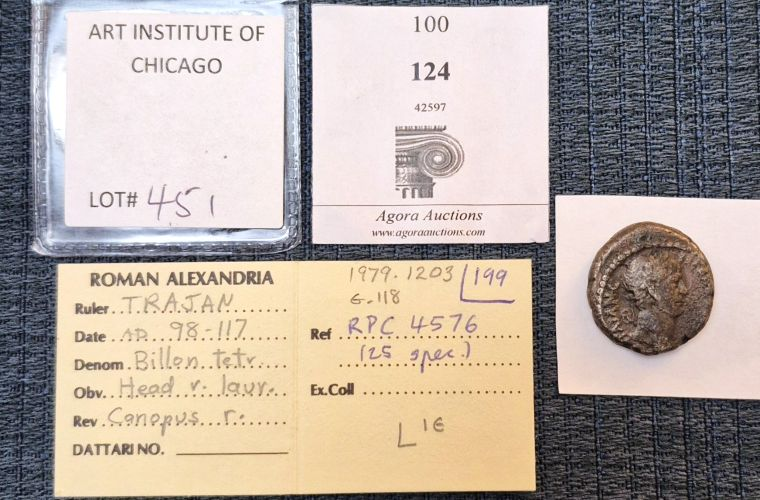
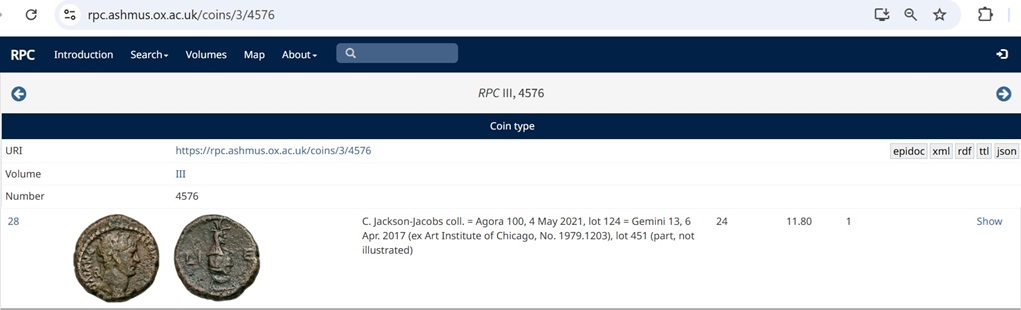
Published Online: RPC III 4756, ex. 28 (this coin illustrated online).
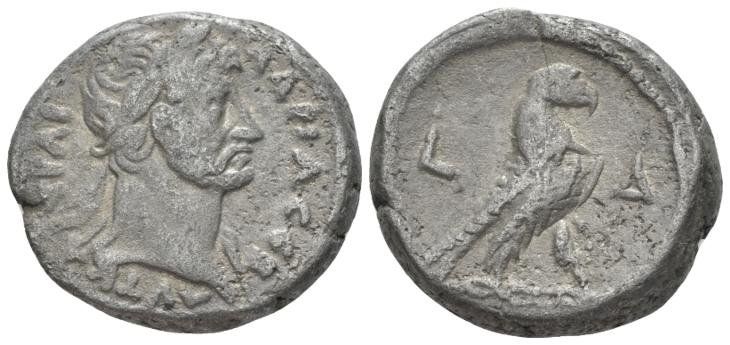
Hadrian Billon Tetradrachm (24.5mm, 13.35g), 119/20 CE. Eagle, L Δ (Year 4).
(Photo credit: Naville.) Collection History:
Giovanni Dattari (1853-1923) Collection [Naville 64 (21 Mar 2021), 337].
Published: Dattari-Savio (2007) Catalogo completo della collezione Dattari – Numi Augg. Alexandrini, No. 1558 (this coin illustrated).
Cited: Dattari (1901) Numi Augg. Alexandrini, v. 1, No. 1558 (this coin cited on p. 99);
Milne, J.G., 1917, “The Alexandrian Coinage of the Early Years of Hadrian,” Numismatic Chronicle vol. 17: p. 50, no. 48, 4th example (this coin cited);
Vogt II (1924), Alexandrinischen: p. 43 (this coin cited);
Geissen 778 (this coin cited on p. 26, “Datt. 1558”) in Angelo Geissen (1977), Katalog Alexandrinischer Kaisermünzen, Köln, vol. II.
See also: RPC III 5200, example 12 (this coin illustrated online).

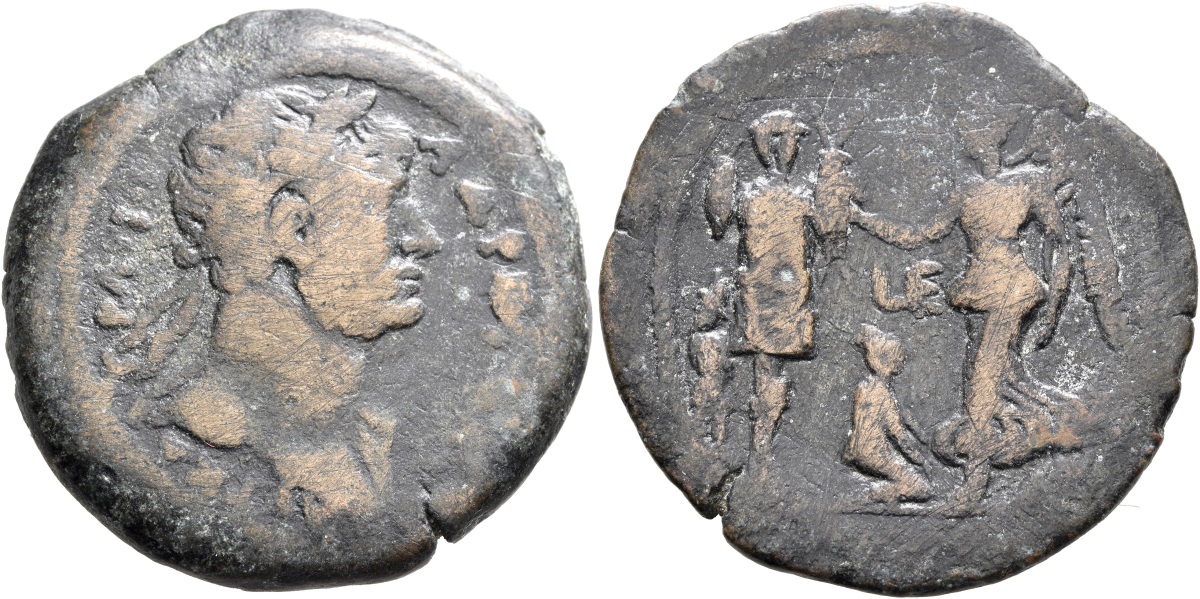
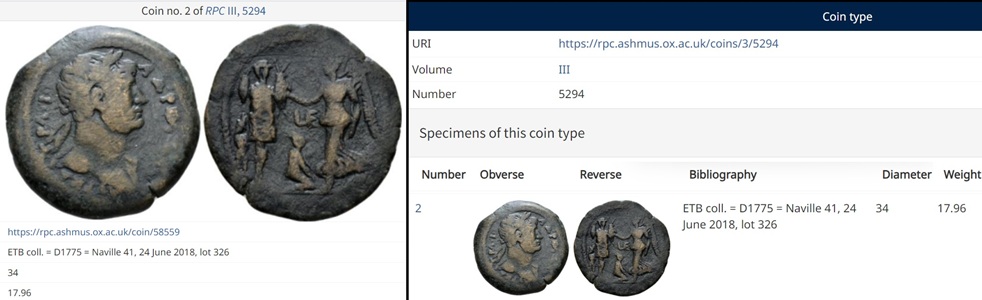
Hadrian AE Drachm (34mm, 18.00g), 120/1 CE. Nike & trophy, 2 captives, L E (Year 5).
(Photo credit: Leu.) Collection History:
Giovanni Dattari (1853-1923) Collection [Naville 41 (24 Jun 2018), 326];
Eric ten Brink Collection [Leu e-26 (10 Jul 2023), 2797].
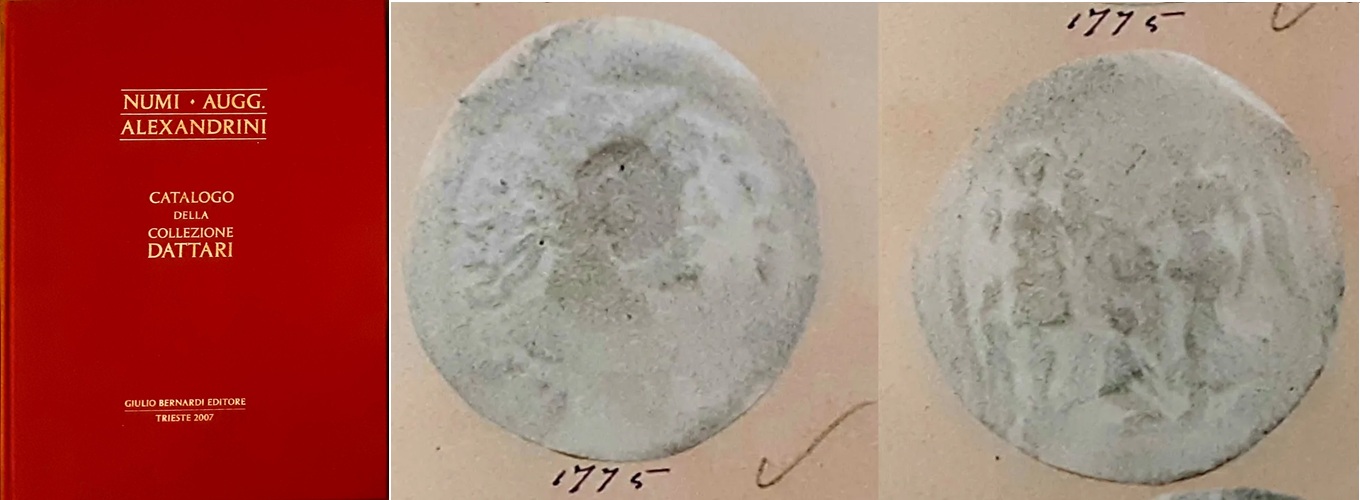
Published: Dattari-Savio (2007) Catalogo completo della collezione Dattari – Numi Augg. Alexandrini, No. 1775 (this coin illustrated).
Cited: Dattari (1901) Numi Augg. Alexandrini, v. 1, No. 1775 (this coin cited on p. 113);
Emmett (2001), Alexandrian Coins, E 1007.5 (this coin cited on p. 240, only example).
Vogt II (1924), Alexandrinischen: p. 44 (this coin cited).
Also: RPC III 5294, ex. 2 (this coin illustrated online, I haven’t checked a hard copy yet).
Notes: Hadrian’s “captives coinage” is remarkably rare. There are none for Imperial coins (just a few ambiguous images, probably not “captives”). For Provincials, only a pair of Alexandrian Drachms (RY 5) & Tetradrachms (RY 6), totaling only about 14 known specimens, 8 in museums. (This coin’s previous owner, ETB, owned four! That’s two-thirds of all Hadrian captives coins know to exist in private collections.)
Hadrian AE Drachm (36mm, 24.49g), 121/2 CE. Euthenia, L ς (Year 6).
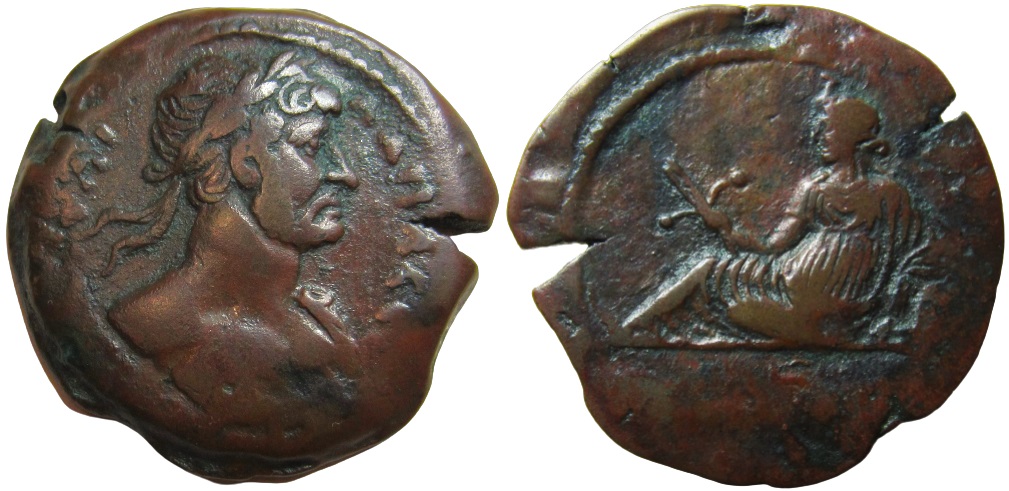
(Photo credit: Kuenker.) Collection History:
Giovanni Dattari (1853-1923) Collection;
Anonymous German collection, formed late 1960s-1970s [Kunker 389 (23 Jun 2023), 2026; Peus 283 (14 May 1974), 213 (corr.)].
Published: Dattari (1901) Numi Augg. Alexandrini, No. 1703 (this coin illustrated in vol. 2, Tav. II, described in vol. 1, p. 118);
Dattari-Savio (2007) Catalogo completo della collezione Dattari – Numi Augg. Alexandrini, No. 1703 (this coin illustrated on Pl. 81);
Figari-Mosconi (2017) Duemila Monete della Collezione Dattari, No. 312 (this coin illustrated).
See Also: RPC III 5253, ex. 9 (this coin illustrated online);
Vogt II (1924), Alexandrinischen: p. 45 (this coin cited).
Notes: An interesting bust of Hadrian with prominent shoulder & chest. I’m not entirely sure it should be considered the same bust type as others of RPC 5253. I haven’t found another in this style for Hadrian, although it was used widely on Drachms of Trajan, Antoninus, and Antinous.
Interestingly, Peus Auction 283 got the description & Dattari number wrong, errors duplicated by the collector’s tag.


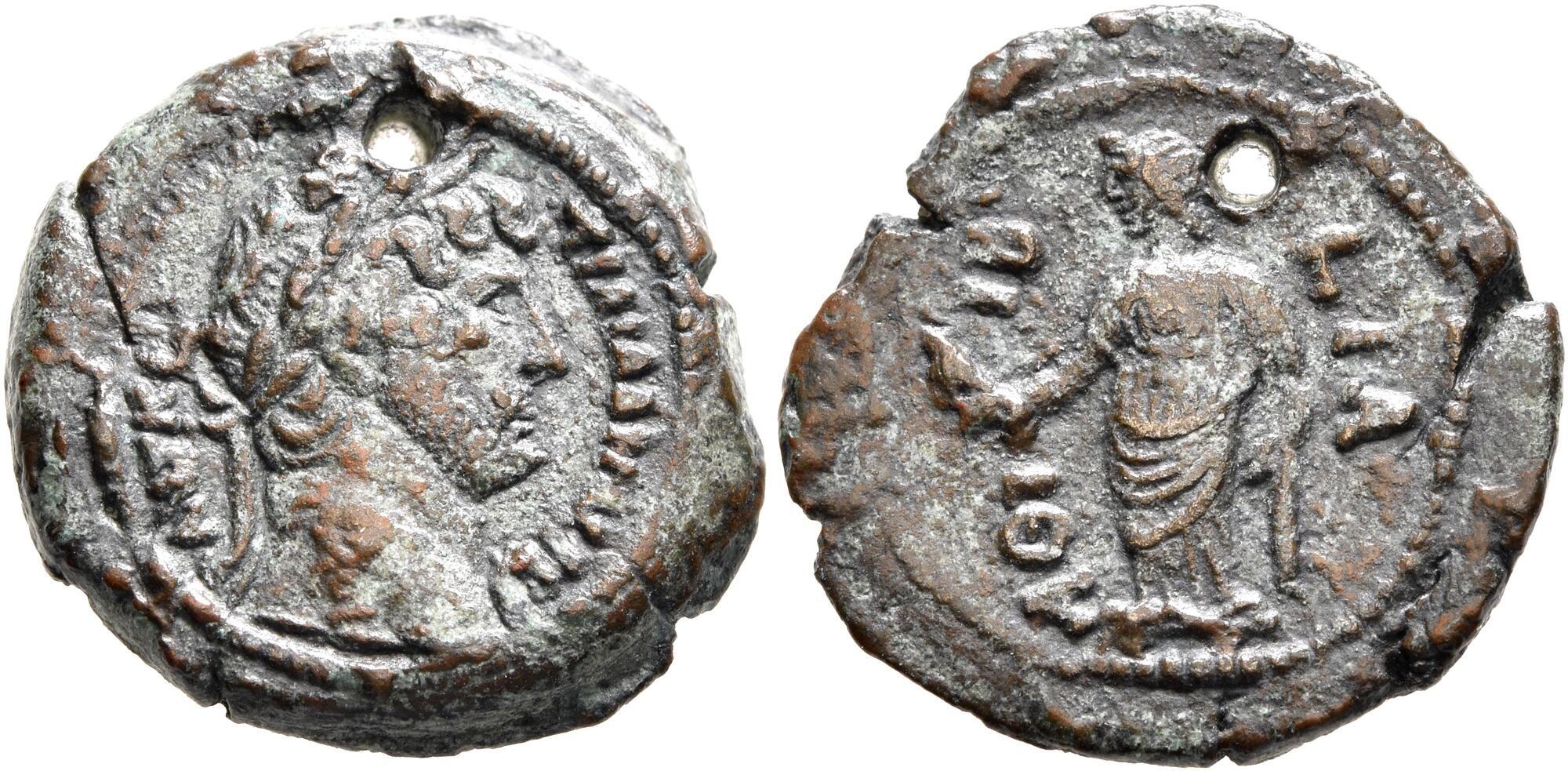
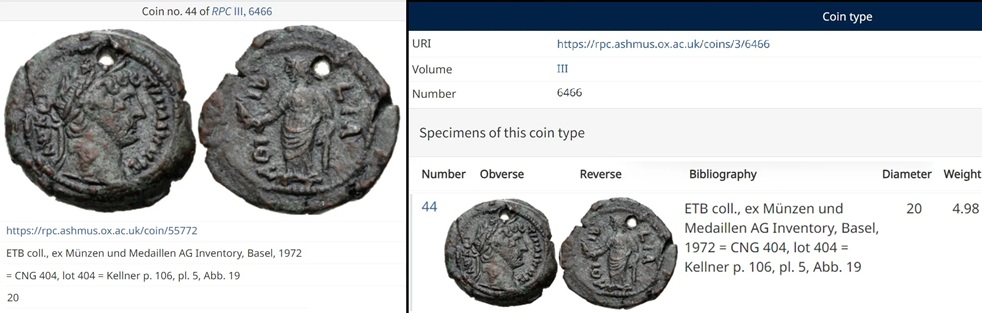
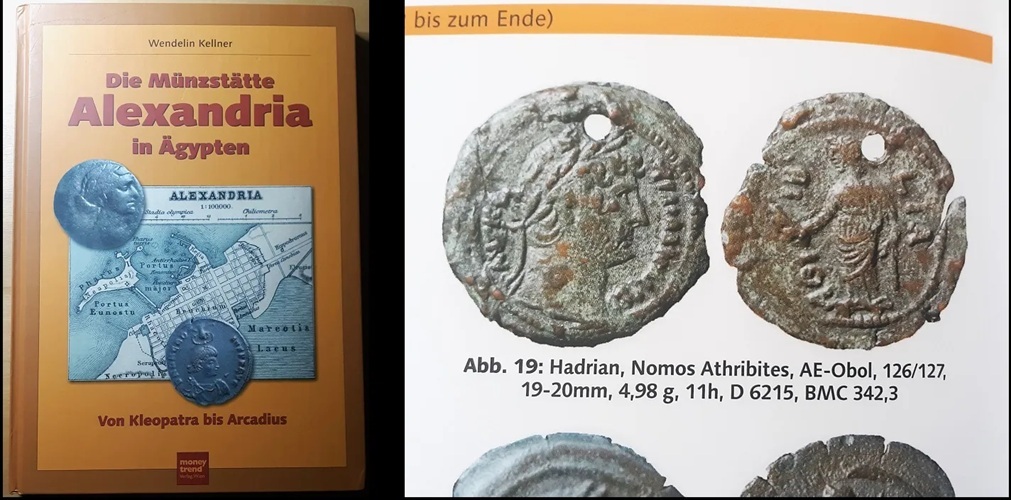
Hadrian AE Obol (20mm., 4.99g), 126/7 CE. Chuit-Hathor, LIA (Year 11), Athribite Nome.
(Photo credit: Leu.) Collection History:
AK Collection [acq. Münzen und Medaillen AG 1972; Triton XVIII (6 Jan 2015), 983, K46 (part of 48)];
Eric ten Brink Collection [CNG EA 404 (23 Aug 2017), 404; Leu e-26 (10 Jul 2023), 2967].
Published: Wendelin Kellner (2009) Die Münzstätte Alexandria in Ägypten, p. 106, 19 (this coin illustrated);
Kellner, “Die Muenzstaette Alexandria in Aegypten – 5. Teil: Hadrianus (bis zum Jarh 11),” MoneyTrend (10/2003), pp. 166-170: p. 168, Abb. 19 (this coin illustrated).
Also: RPC III 6466, ex. 44 (this coin illustrated online).
Notes: It’s rare to find Alexandrian Obols so little circulated. Unusually crisp rendering of Hadrian & Chuit-Hathor (patron deity of town of Athribis & Athribite Nome). Pierced carefully to avoid legends & devices. (Maybe for the same use as the pierced Antoninus Drachm below?)
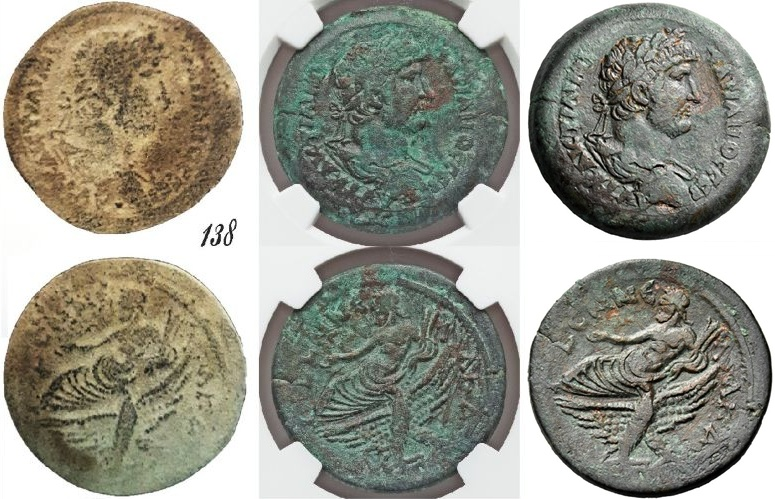
Hadrian AE Drachm (35mm, 25.75g), 134/5 CE. Zeus & Eagle, L ЄNNЄ AKΔ (Year 19).
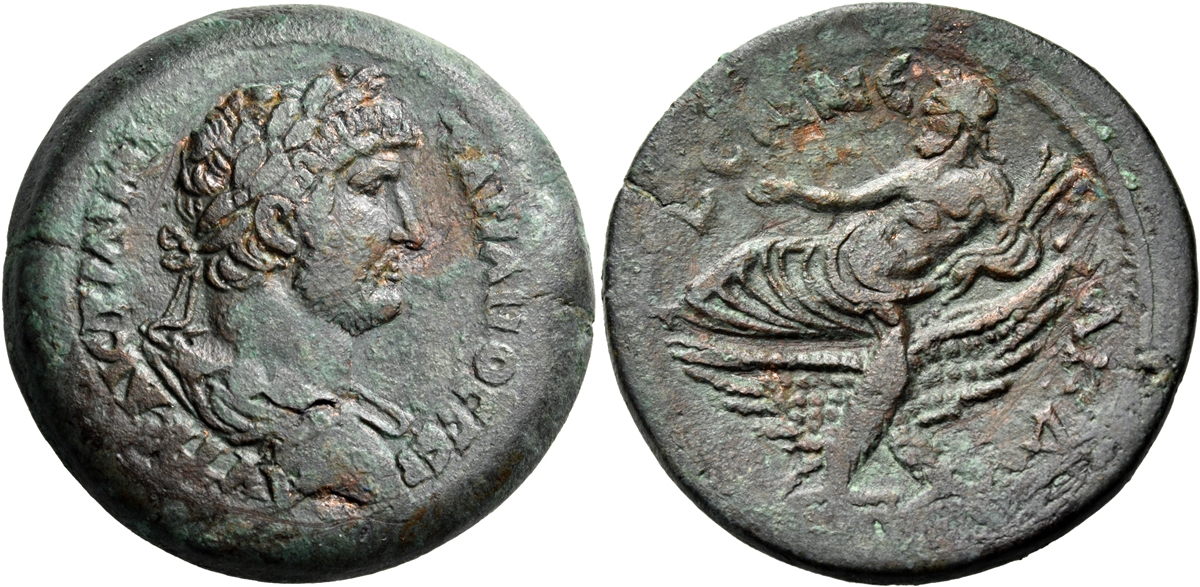
(Photo credit: Nomos AG.) Collection History:
Giovanni Dattari (1853-1923) Collection;
Jean-Pierre Righetti Collection of Alexandrian [Nomos 24 (22 May 2022), 299];
Published: Dattari-Savio (2007) Catalogo completo della collezione Dattari – Numi Augg. Alexandrini, Supplement Pl. 12, No. 138 (this coin illustrated).
See Also: RPC Online III 6058, example 3 (“digital plate coin”);
Ex NGC Choice VF 4/5 – 2/5, scratches [4285761-012], since removed & professionally cleaned by J.P.R. [acq. Heritage 231947 (22 Nov 2019), Lot 63128].

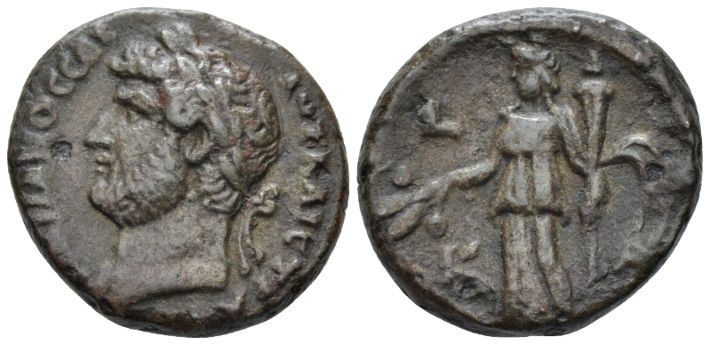
Hadrian Billon Tetradrachm (24.5mm., 12.06g), 136/7 CE. Demeter, L K-A (Year 21).
(Photo credit: Naville.) Collection History:
Elvira Clain-Stefanelli (1914-2001) Collection [Naville 36 (2 Dec 2017), 316];
M.N. Collection.
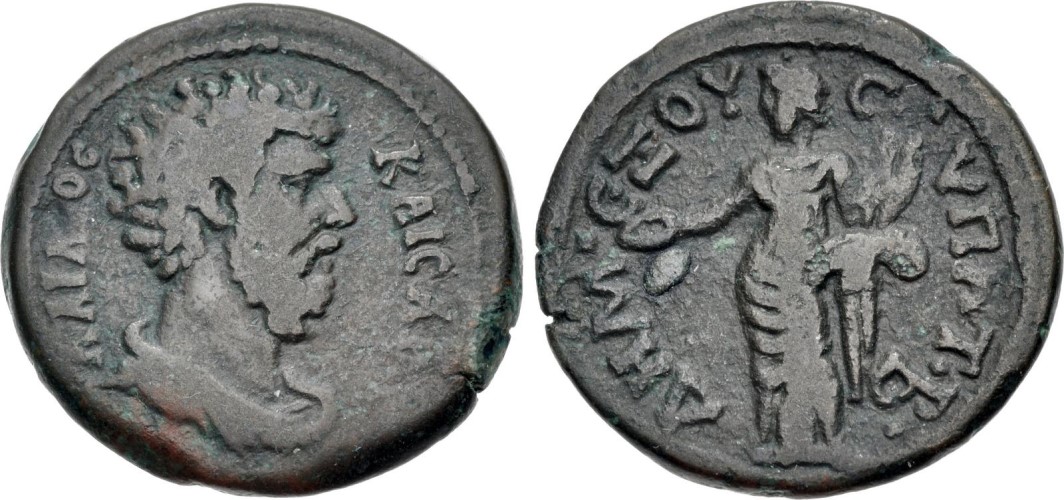
Aelius AE Diobol (25mm, 8.73g), 136/7 CE. Euthenia (RY 21 of Hadrian).
(Photo credit: CNG.) Collection History:
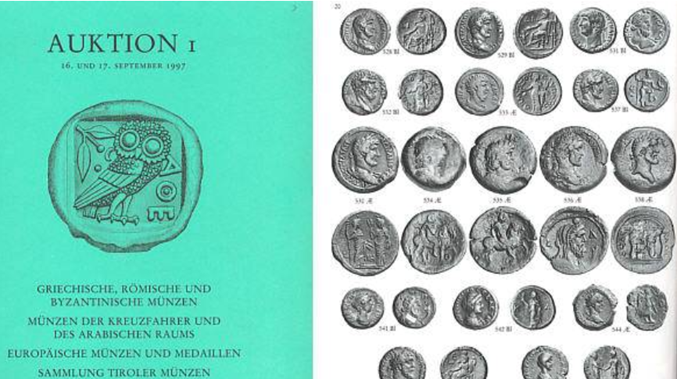
Giovanni Dattari (1853-1923) Collection [Kunst und Münzen FPL 42 (1980), 78 ; Münzen und Medaillen GmbH Auktion I (16 Sep 1997)];
Rocky Mountain Collection of Alexandrian [CNG EA 484 (27 Jan 2021), 582 (& later sales) ; acq. William M. Rosenblum].
Published: Dattari-Savio (2007) Catalogo completo della collezione Dattari – Numi Augg. Alexandrini, No. 7999 (this coin illustrated);
Figari-Mosconi (2017) Duemila Monete della Collezione Dattari, No. 424 (this coin illustrated);
RPC III 6242, ex. 33 (this coin cited, illustrated online).
Note: Interesting rev. legend: “ΔΕΜ(APXIKHC) ΕΞΟVC(IAC) ΥΠΑΤ(OC) (TO) Β = Tribunicia Potestas Consul for (the) Second Year” (Emmett 2001: p. 282). The only Alexandrian coin dated to a Consulship in the style of Roman Imperial Coinage.
Note also the unusual object in the field below the patera. It appears on no other specimen & is difficult to interpret as an intentional part of the design.

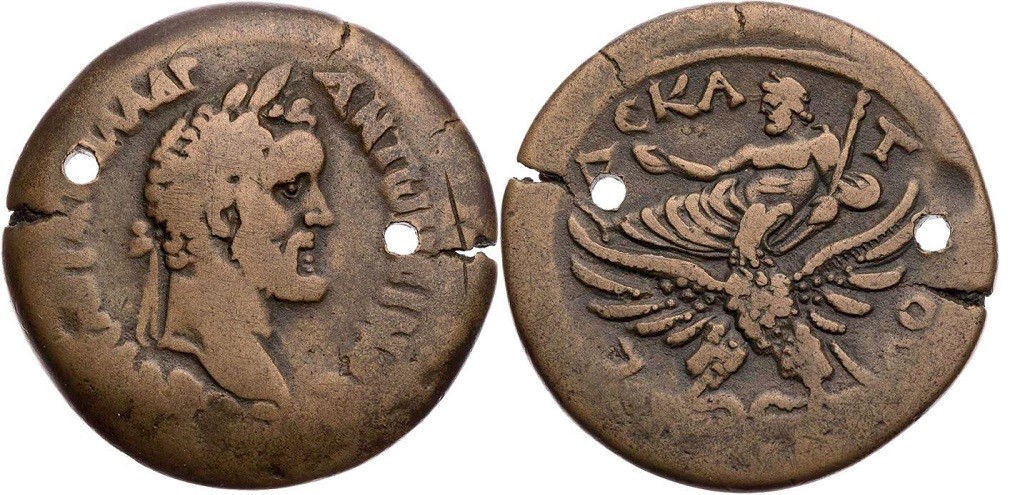
Antoninus Pius AE Drachm (35mm, 22.25g), 146/7 CE. Zeus & Eagle, L ΔƐΚΑΤΟV (Year 10).
(Photo credit: Kölner.) Collection History:
Hans Steger (1875-1937) Collection [Münzhandlung Basel, Auktion 6 (1936), 725 (not ill.)];
August Voirol (1884-1967);
Frank Sternberg (1912-1994) (Collection?);
AK Collection [acq. Sternberg 1985; Triton XIX (4 Jan 2016), 448 (part)];
Kölner Auktion 117 (28 Oct 2022) [PDF Catalog], Lot 220 [selection of 40 well-provenanced Alexandrian].
Published: Wendelin Kellner (2009) Die Münzstätte Alexandria in Ägypten, Teil 7, No. 26 (this coin illustrated);
Kellner, “Die Muenzstatte Alexandria in Aegypten – 7. Teil: Antoninus Pius (bis zum Jahr 10),” MoneyTrend (12/2003), pp. 162-167: p. 165, Abb. 26 (this coin illustrated).
See also: RPC IV.4, 1010, ex. 75 (illustrated online).

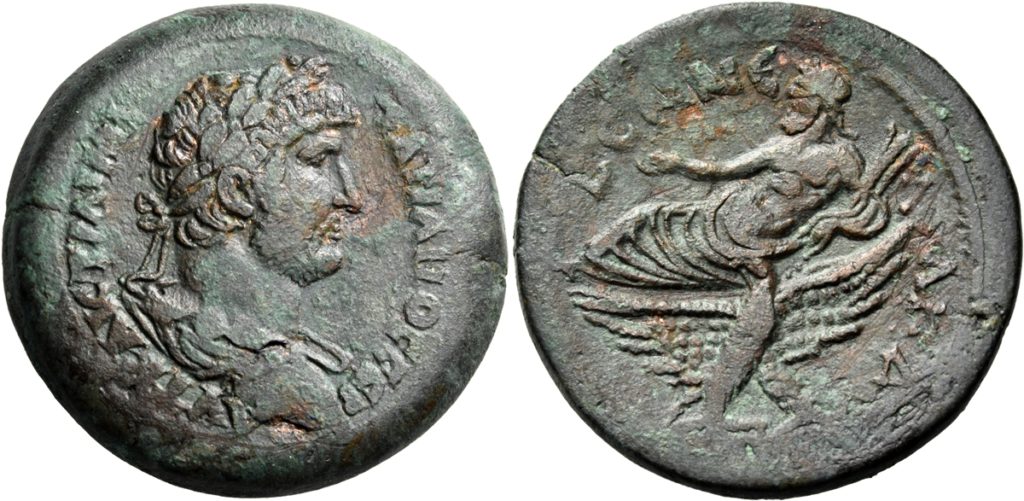
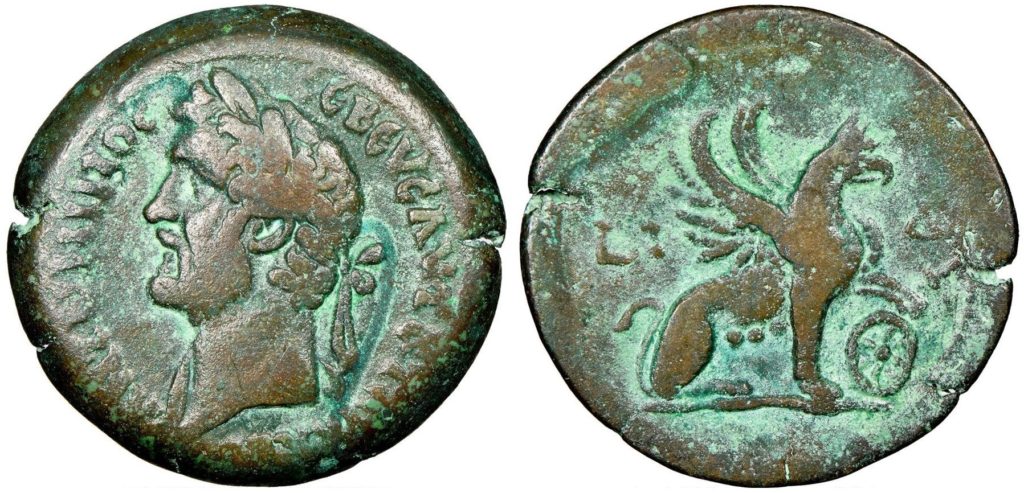
Antoninus Pius AE Drachm (34mm, 23.79g), 150/1 CE. Nemesis as Griffin, L ΙΔ (Year 14).
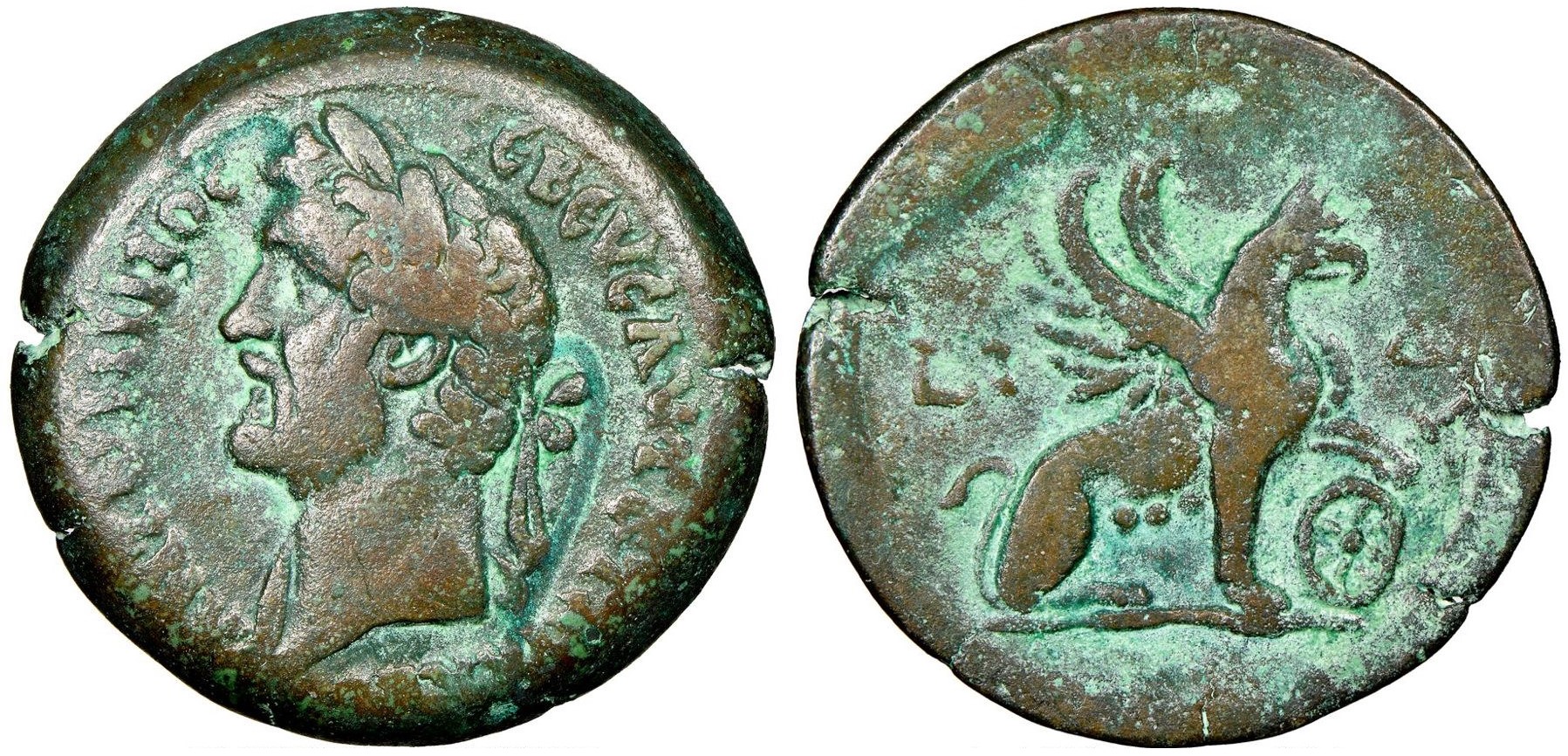
(Photo credit: Heritage/NGC) Collection History:
Virginia Ruzicka (1915-1984) Collection [Malter 28 (8 Dec, 1984), 460];
Kerry K. Wetterstrom Collection, Part I [CNA 12 (26 Sep 1990), 213];
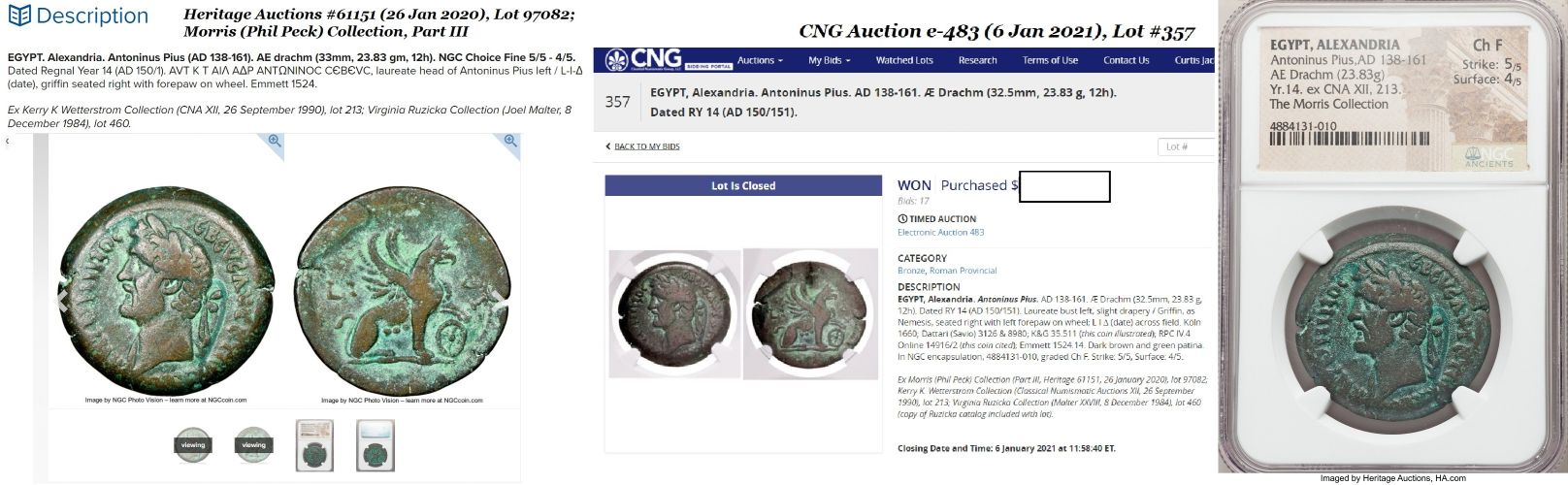
Phil Peck / “Morris” Collection [Heritage 61151 (26 Jan 2020), 97082];
Al Kowsky [AWK] Collection [CNG e 483 (6 Jan 2021), 357].
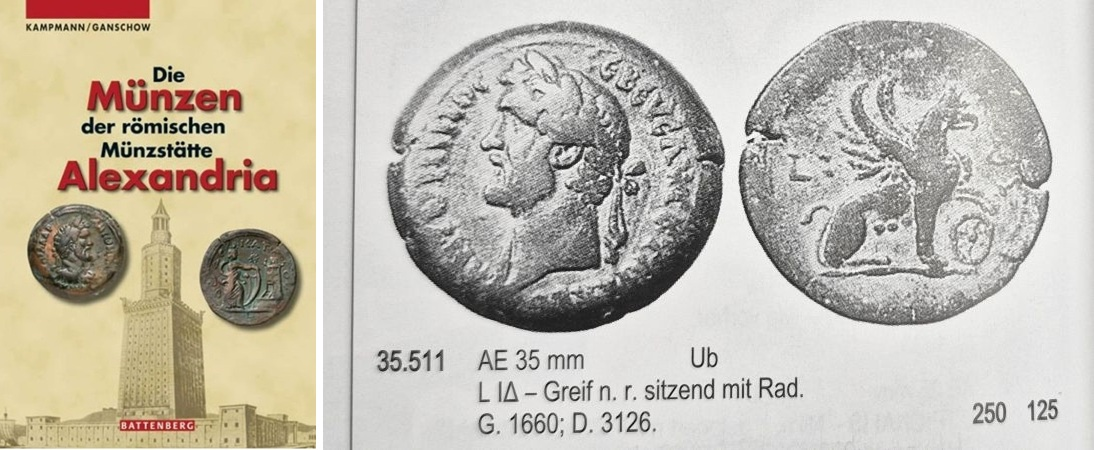
Published:
Kampmann & Ganschow: 35.511 (this coin illustrated);
RPC IV.4 (Temp.) 14916, ex. 2 (this coin illustrated online).
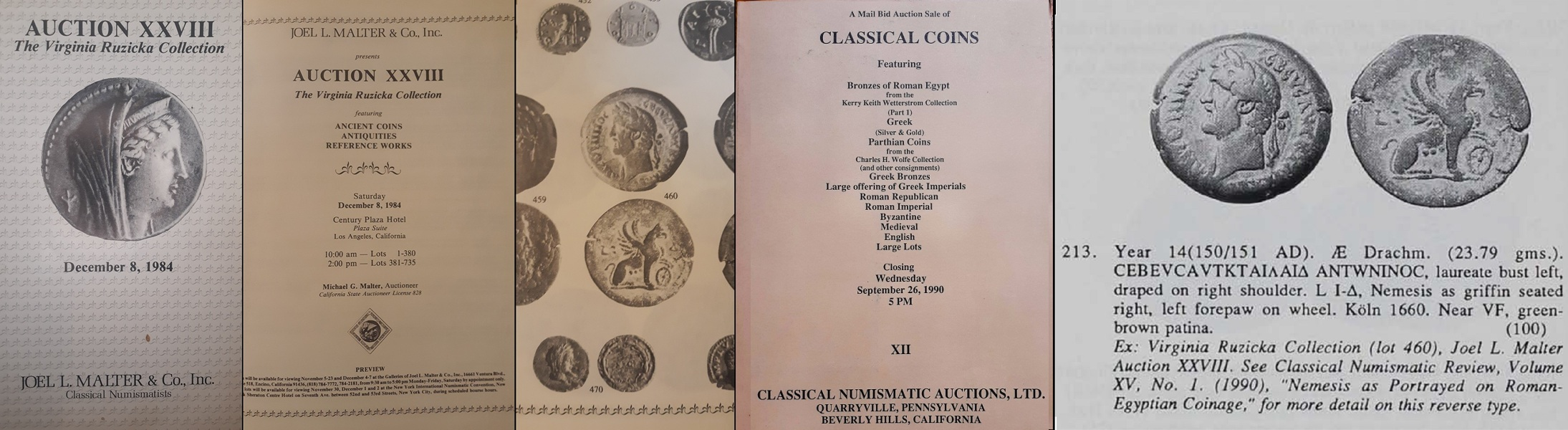
I have two copies of the Ruzicka catalog, one ex S&S Library (Chicago), and the one shown above, ex library of Al Kowsky, which he had bought to accompany this coin. It was included with the coin when I bought it.
click here for this page’s full banner image (larger image for zooming in)

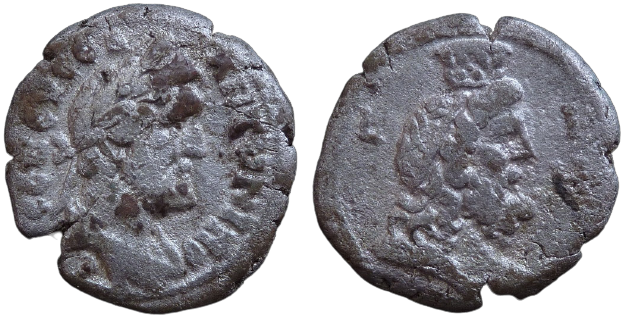
Antoninus Pius Billon Tetradrachm (23mm, 12.6g), 154/5 CE. Sarapis, L IH (Year 18).
(Photo credit: zumbly/Minotaur [ed.]) Collection History:
Giovanni Dattari (1853-1923) Collection;
Robert L. Grover (1910-1998) Collection, w/ his round tray tag;
Art Institute of Chicago (reference / accession number 1981.460), with tag;
Ex Gemini XIII (Harlan J. Berk, cat. by Curtis Clay; 6 Apr 2017), Lot 460 (part of, not illustrated);
Zumbly Collection [Minotaur Coins, Singapore].
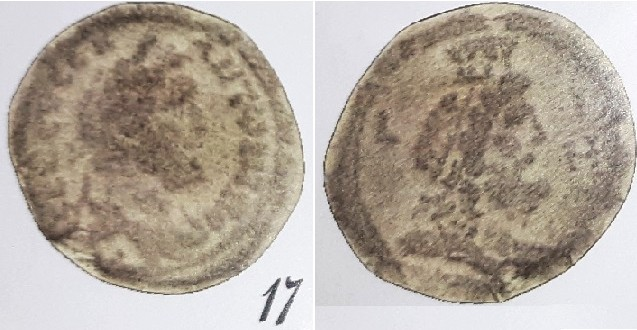
Published: Dattari-Savio (2007) Catalogo completo della collezione Dattari – Numi Augg. Alexandrini, Supplement, Pl. 14, No. 17 (this coin illustrated).
See also: RPC IV.4 1658 (this coin cited in refs.) & ex. 5 (illustrated online).
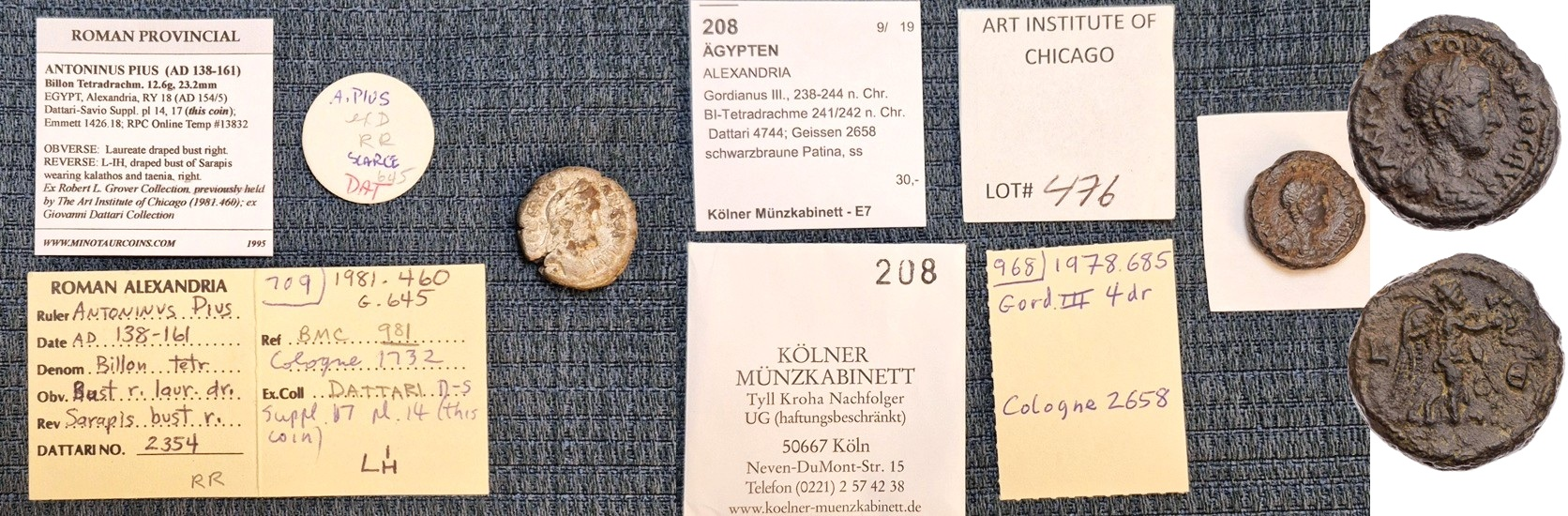
Tag notes: This coin shown above with its old dealer/collector/museum tags, and those of a Gordian III Alexandrian Tetradrachm, also ex Robert L. Grover & Art Institute of Chicago (acc. no. 1978.685), which I bought from Kolner e-Auction 7. (See also the ex-Grover/AIC Trajan Tetradrachm above.)
The manila tags are from the Art Institute of Chicago, the penciled portions having been added by AIC staff. The blue ink notes on the right side are in cataloger Curtis Clay‘s hand (as he confirmed in a 2021 CT comment). Something must’ve gone wrong with the Gordian III’s museum tag, since only a blank manila tag with Curtis Clay’s notes are present (this time the acc. no. is in his hand).
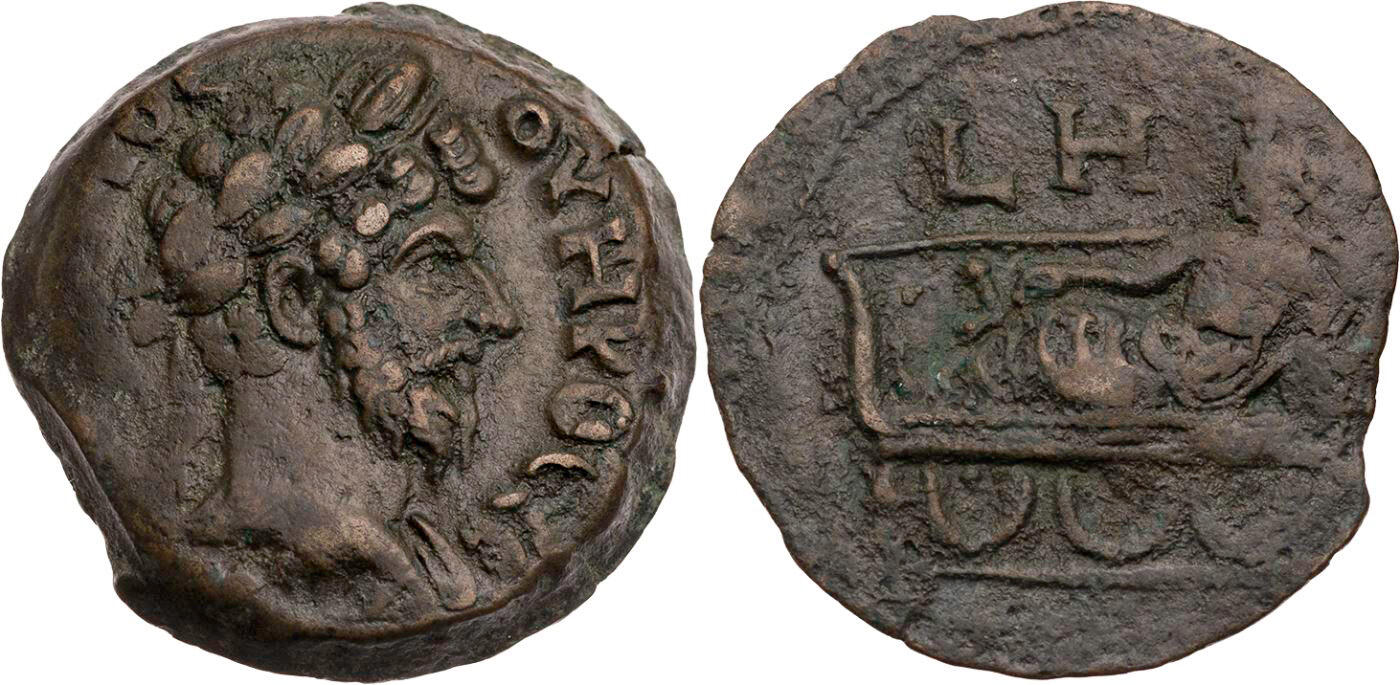
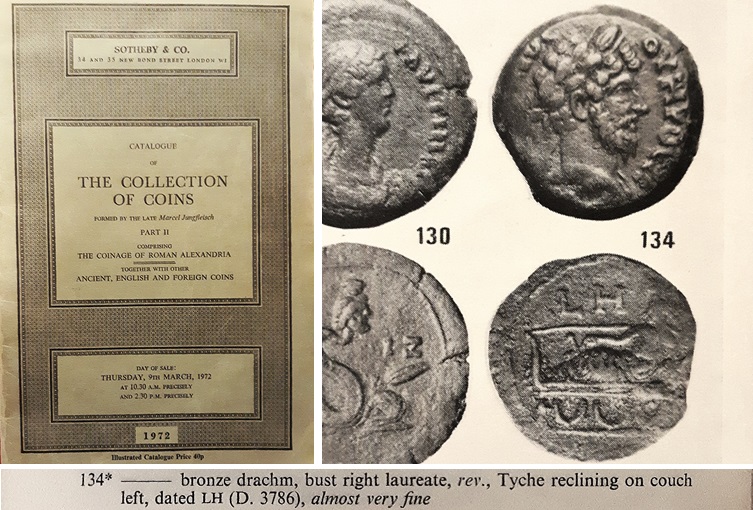
Lucius Verus AE Drachm (31mm, 18.15g, 12h), 167/8 CE. Tyche on Lectisternium, L H (Year 8).
COIN LOST IN TRANSIT (current disposition unknown, see also Dattari 4613, below)
(Photo credit: Kolner.) Collection History:
Marcel Jungfleisch (1879-1958) Collection, Part II [Sotheby’s, 9 Mar 1972, Lot 134 (illustrated)].
Sammlung Dr. Victor Wishnevsky, Teil III [Kölner Münzkabinett Auction 122 (4 Oct 2024), 578; acq. Sotheby’s, 28 Sep 1973, 99].
Published Online:
RPC IV.4 3092, ex. 15 (this coin).
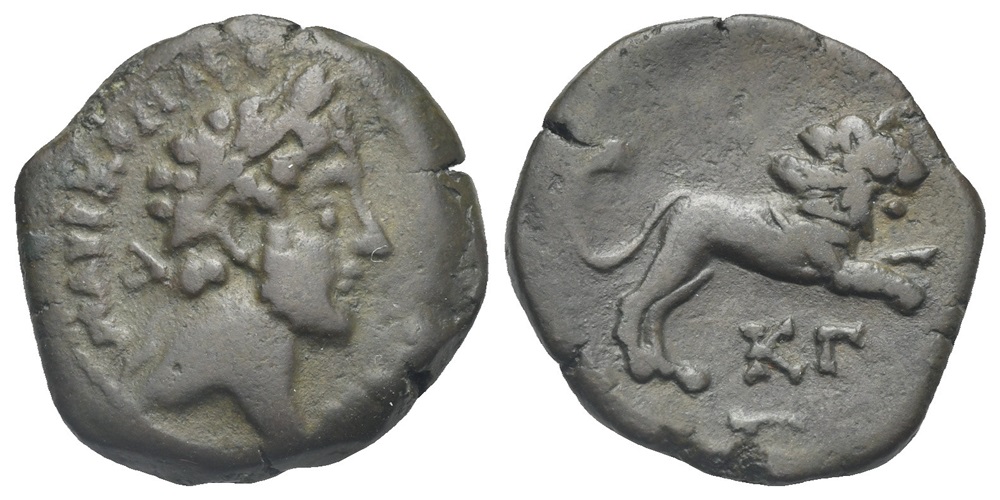
Commodus AE Diobol (22mm, 8.51g), 182/3 CE. Lion, L KΓ (Year 23, of Marcus Aurelius [posthumous]).
(Photo credit: Astarte.) Collection History:
Giovanni Dattari (1853-1923) Collection;
Slg. Öhrl [Heidelberger Münzhandlung Grün Auktion 20 (22 May 1997), lot 41];
Giovanni Maria Staffieri (1944-) Collection [Astarte XXIII (28-29 Oct 2024), 447].
Publication History: Dattari (1901) Numi Augg. Alexandrini, No. 3963 (this coin illustrated in vol. 2, Tav. XXXII [reverse], described in vol. 1, p. 268);
Dattari-Savio (2007) Catalogo completo della collezione Dattari – Numi Augg. Alexandrini, No. 9675 (this coin illustrated);
Figari-Mosconi (2017) Duemila Monete della Collezione Dattari, No. 953 (this coin illustrated);
RPC IV.4 3420, ex 2 (this coin illustrated).
See also: Kellner (2009) Die Münzstätte Alexandria in Ägypten, p. 116 (this coin cited as Dattari 3963, corr.; see Notes below);
Schwartz & Schwartz (1979), “Engraved Gems in the Collection…,” ANS Museum Notes 24 (this coin cited on p. 162, note 38: “Dattari, nos. 3130, 3595, 3963”).
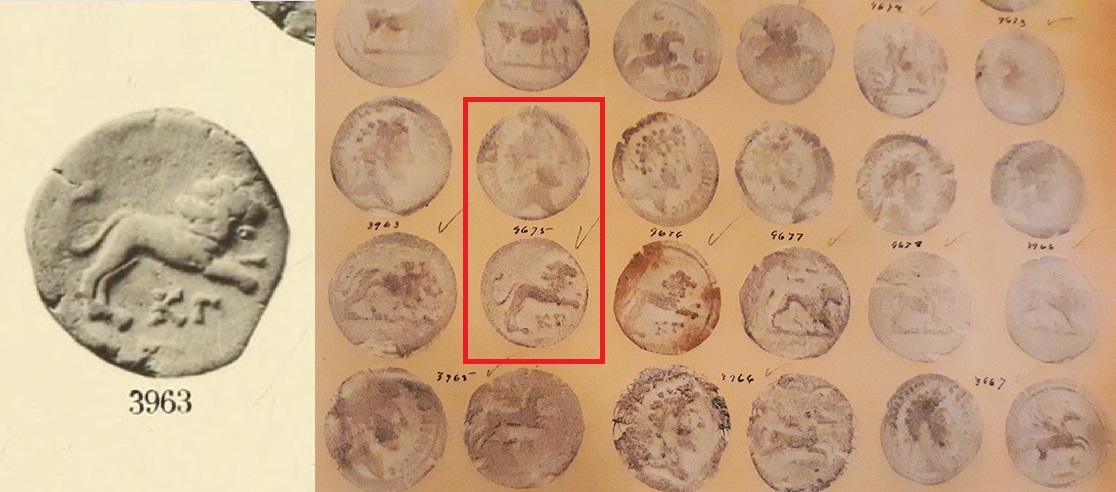
Notes: Dattari Collection numbers usually match between his 1901 catalog and the 1999/2007 Savio publications of the Dattari collection pencil rubbings — but not always. Rarely, the same coin is numbered differently. Mine is Dattari (1901) 3963 = Savio (1999/2007) 9675. The Savio 3963 coin was in the “AK Collection,” erroneously labeled “Dattari 3963” in Kellner (p. 116, Figure 14; see Wildwinds: photo, text; Triton XX, Lot 622 [part, rev. visible]).

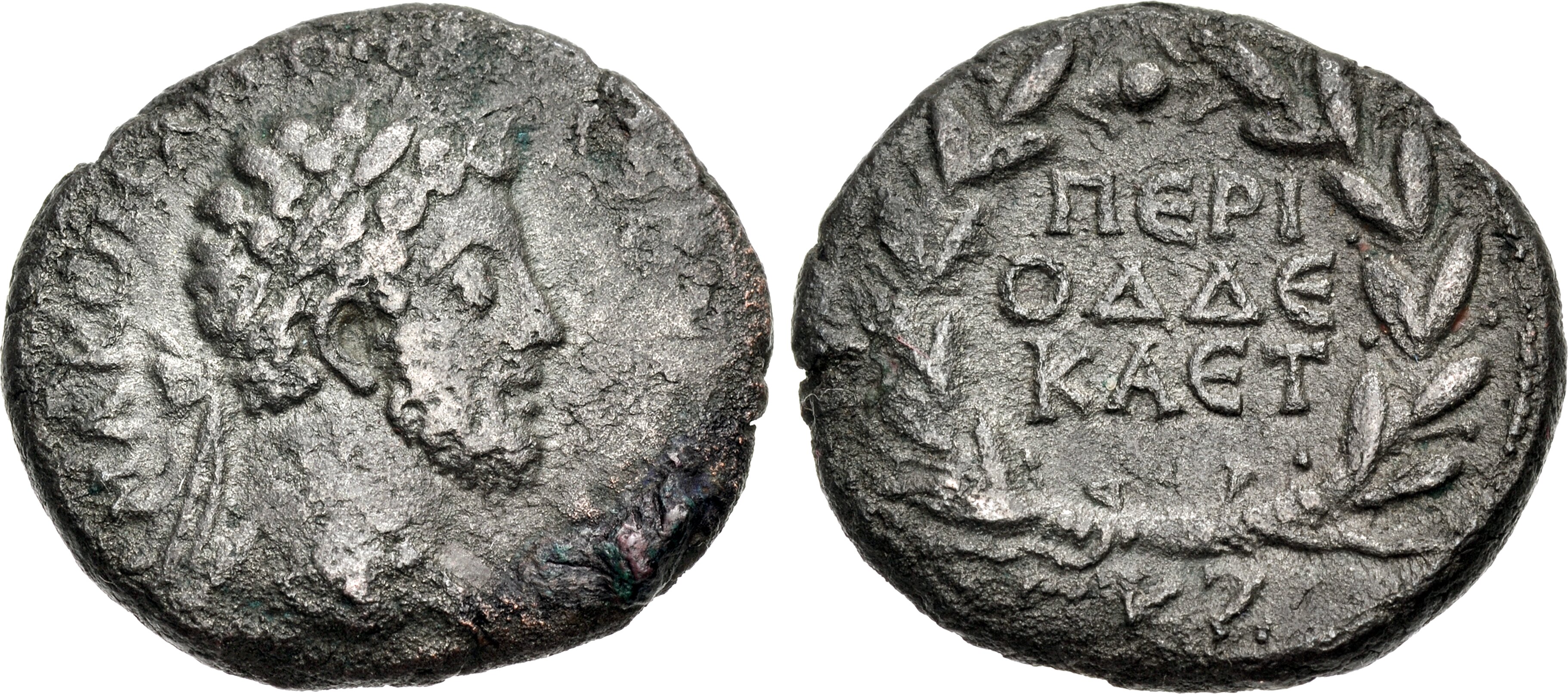
Commodus Billon Tetradrachm (25mm, 10.94g), 186/7 CE. Wreath & inscription, L KZ (Year 27).
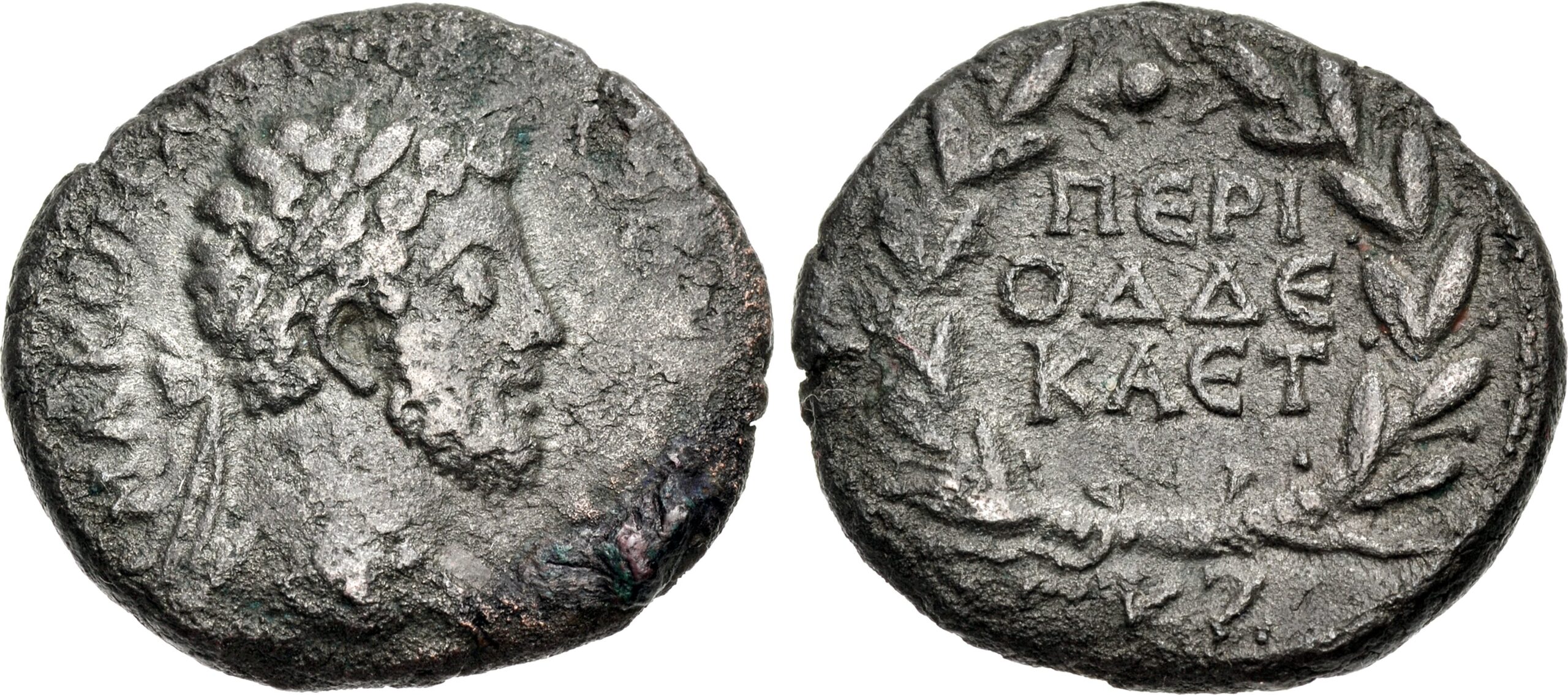
(Photo credit: CNG.) Collection History:
Dr. Thomas E. Beniak Collection, w/ collector tag [CNG EA 566 (21 Feb 2024), 374, corr. (see note below) ; acq. Beast Coins, 27 Jul 2009, w/ tag #C0230];
Keith Emmett Collection, w/ collector tag [cataloged by Zach “Beast” Beasley (n.d., ca. Summer 2008) ; acq. Frank S. Robinson, Sep 1994];
John Aiello Collection [duplicates, Alex G. Malloy XIV (2 Jul 1979), 386].
Published: James W. Curtis (1990) Tetradrachms of Roman Egypt [Durst Expanded Reprint], Supplement “C”: p. 307, No. 386 (this coin illustrated from Aiello sale, Malloy XIV).
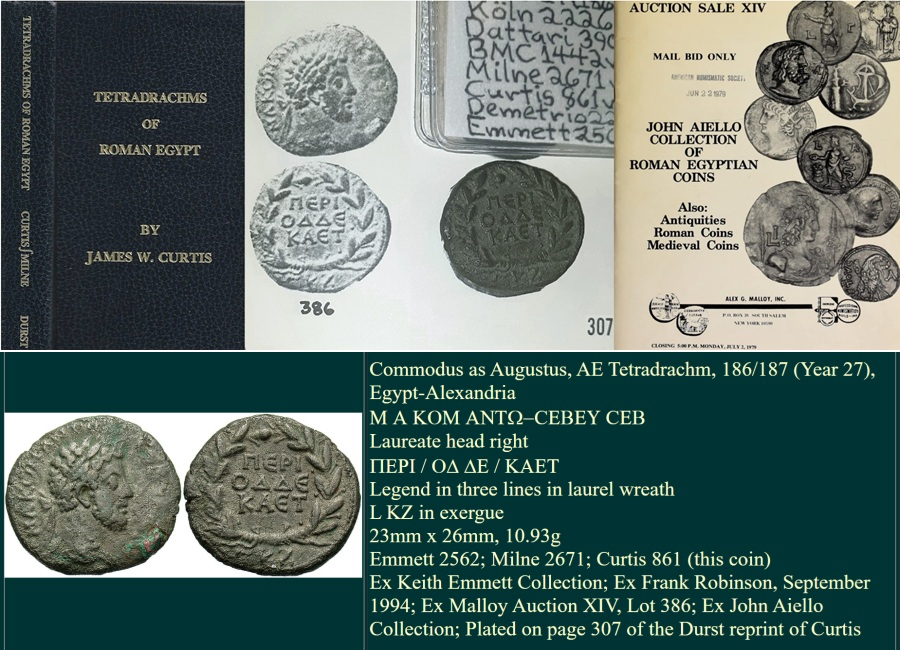
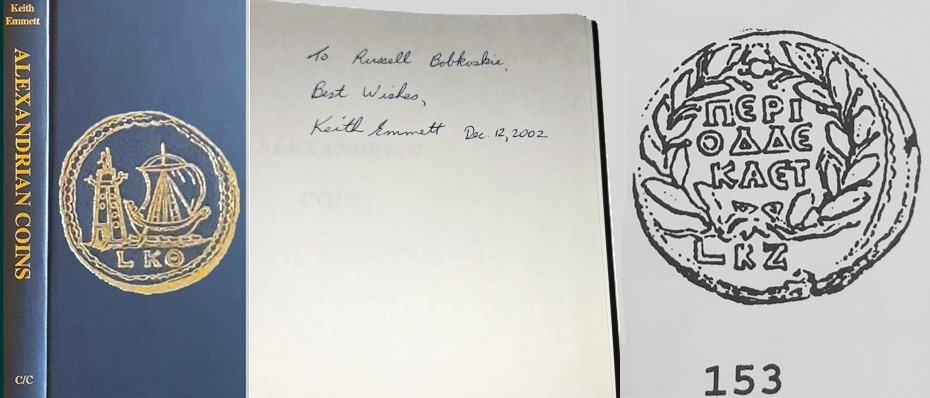
See also: . Given that this coin was in Keith Emmett’s collection, one could be forgiven for suspecting that it was the model for the line drawing in his book (2001, Alexandrian Coins, Type 2562 & Pl. 8: 153). However, it actually comes from Feuardent’s (1870) catalog of the Demetrio collection, now at the BnF. My signed copy, inscribed to the collector Russell Bobkoskie (1941-2021), from whose library I acquired several Alexandrian books:
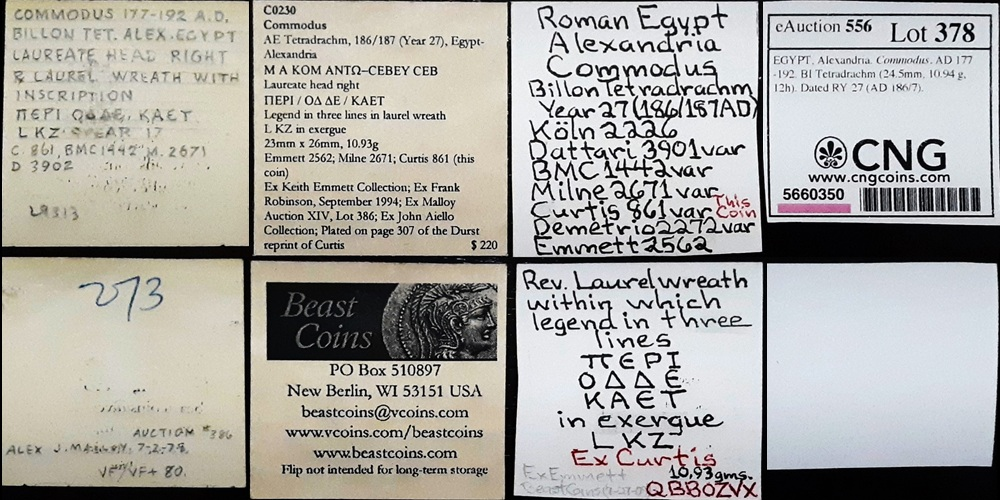
Note (Prov.): Incorrectly identified as ex Col. James Curtis Collection (No. 861) by CNG (I bid knowingly), in Beasley’s Emmett catalog (“Curtis 861 (this coin)”), and on Beniak’s tag. Emmett, however, had recorded it correctly on his tag! Coins in the 1990 Durst reprint are often mistakenly assumed to be from Curtis’ collection; most are not. See also Note: Curtis tags.
Notes (Substantive): Emmett 2562 (for type), ΠΕΡΙΟΔ ΔΕΚΑΕΤ in wreath, a unique spelling issued only for Commodus’ Vota Decennalia which, Head (1911: 861) writes, was “commemorated by the placing of a palm in the field of the rev.” (RY 27 is from start of M. Aurelius’ reign.) Several rulers have similar reverses, but none spelled in this way (e.g., ΠΕΡΙΟΔOC ΔΕΚΑTH).

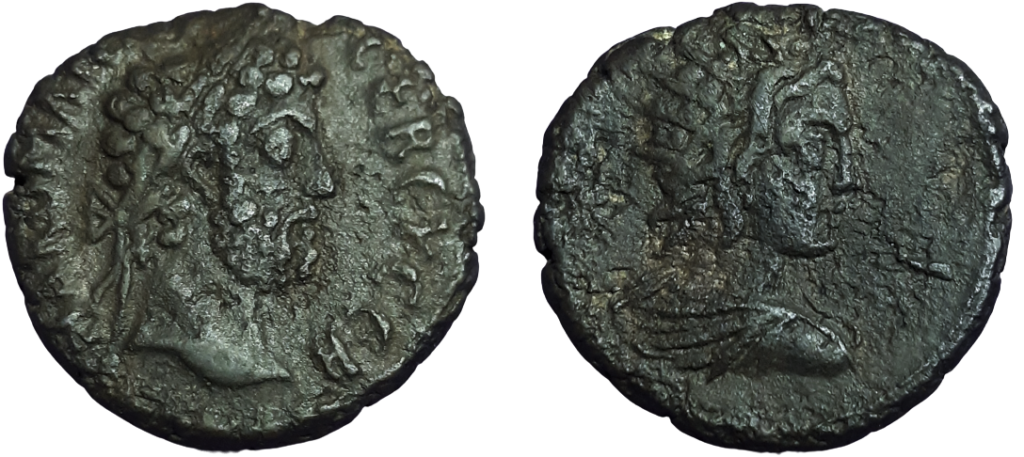
Commodus Billon Tetradrachm (24mm, 10.70g), 189/90 CE. Helios, L Λ (Year 30).

(Photo credit: C.J.J..) Collection History:
Giovanni Dattari (1853-1923) Collection [Naville 51 (21 Jul 2019), 365].
Published: Dattari-Savio (2007) Catalogo completo della collezione Dattari – Numi Augg. Alexandrini, No. 9612 (this coin illustrated).
Also: RPC IV.4 3550 (this coin cited in refs.), example 25 (this coin illustrated online).

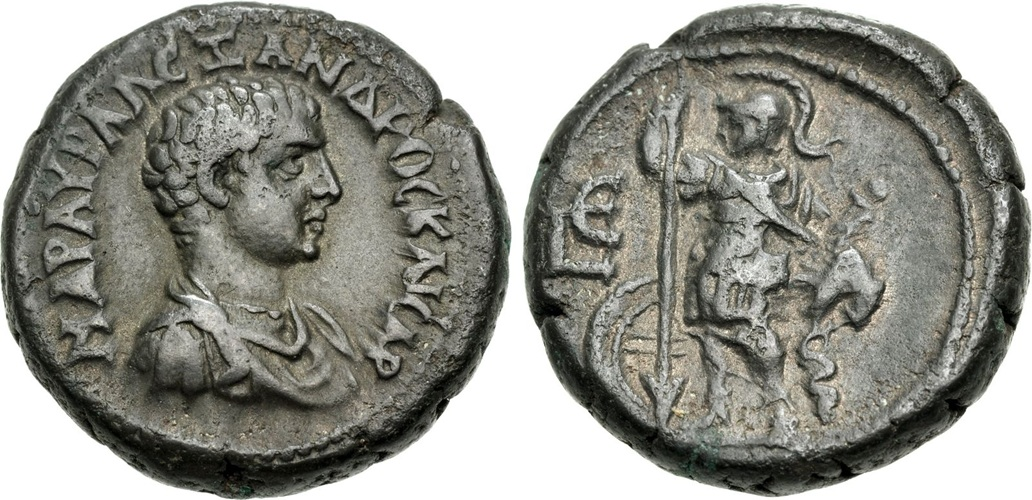
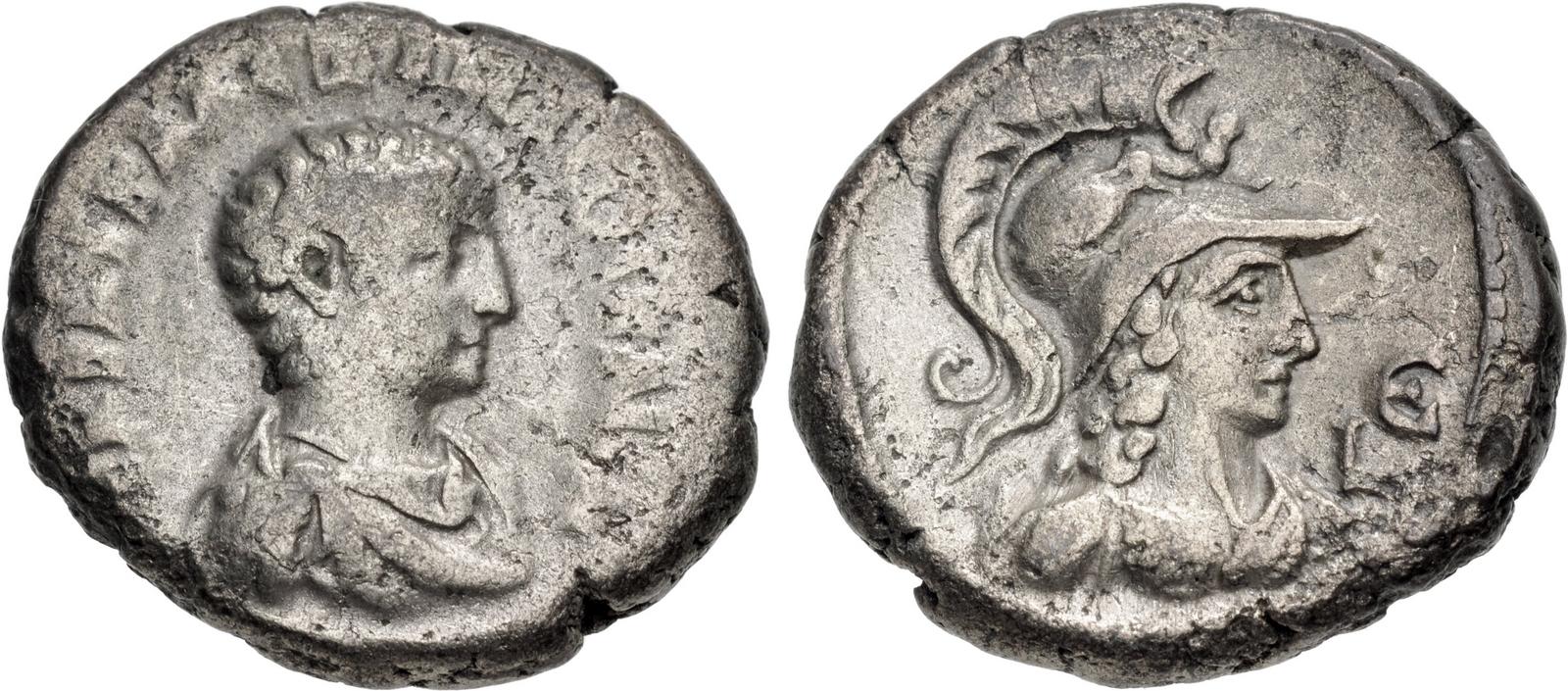
Severus Alexander, as Caesar, Billon Tetradrachm (24mm, 14.40g), 221/2 CE. Ares, L Є (Year 5, Elagabalus).
(Photo credit: CNG.) Collection History:
Dr. R. Craig Kammerer (1943-2024) Collection [CNG EA 599 (12 Nov 2025), 572];
Malter Auction 1 (9 Nov 1973), Lot 285 [more about this catalog on “Catalog Favorites”];
Giovanni Dattari (1853-1923) Collection.
Published: Dattari-Savio (1999/2007) Catalogo completo della collezione Dattari – Numi Augg. Alexandrini, Plate 228, No. 4239-O (this coin illustrated, see ref. note).
See Also: RPC VI (Temp.) 10212, ex 24 (this coin illustrated online as primary example).
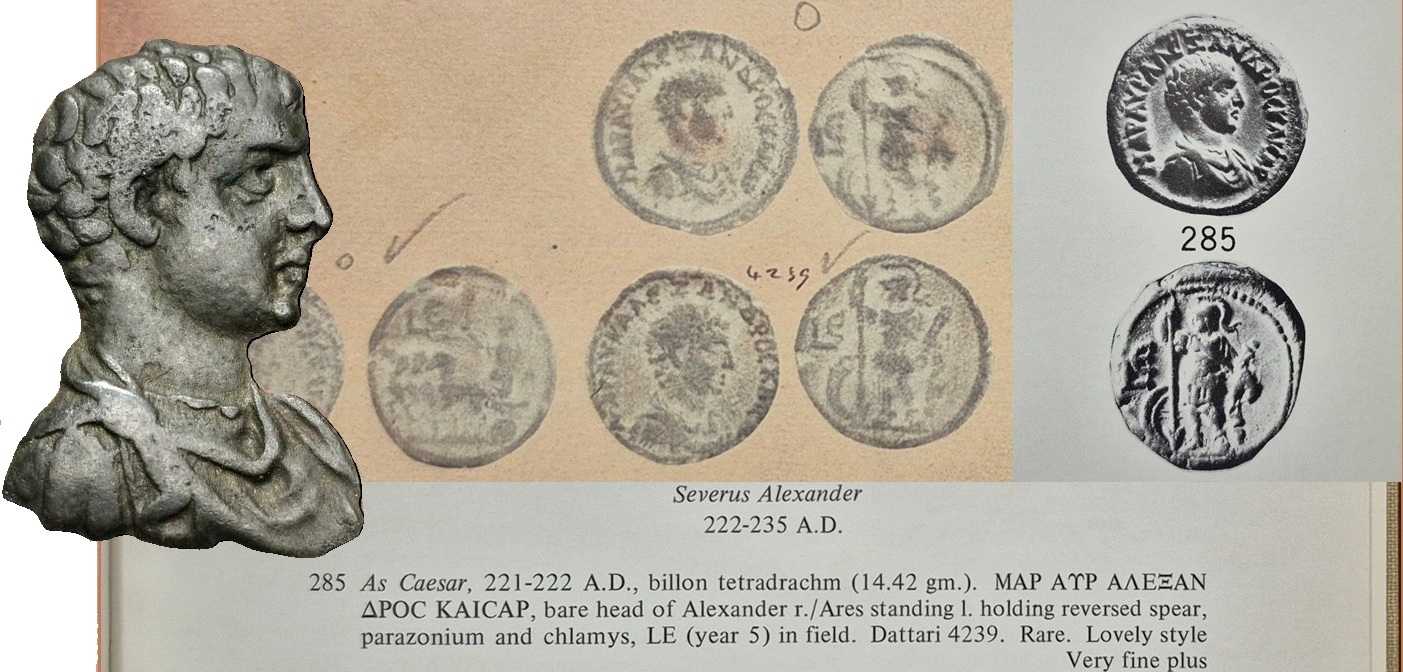
Reference Notes: Though it appears on Pl. 228 of Savio’s (1999/2007) volume illustrating Dattari’s pencil rubbings of plaster casts made from his collection, this coin doesn’t have a number. Thus RPC labeled it “DS plate 228, coin above 4239” (my emphasis). Since it’s accompanied by a small circle, I recorded it as “4239-O.”
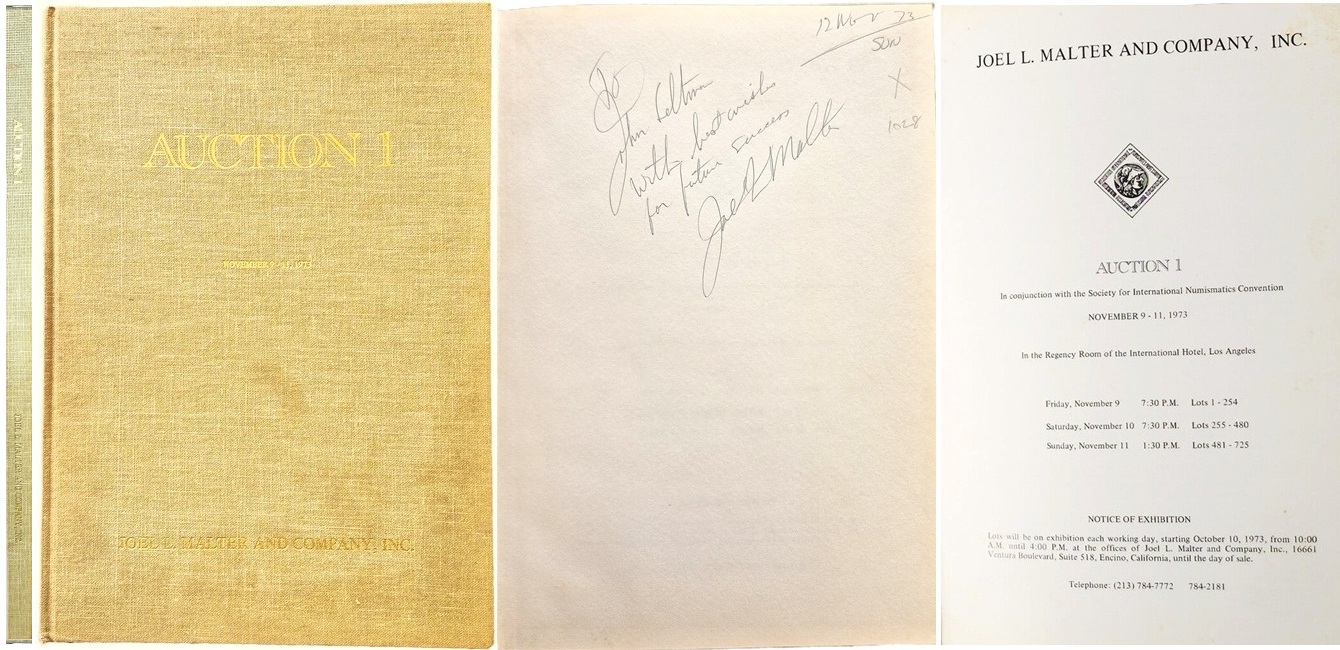
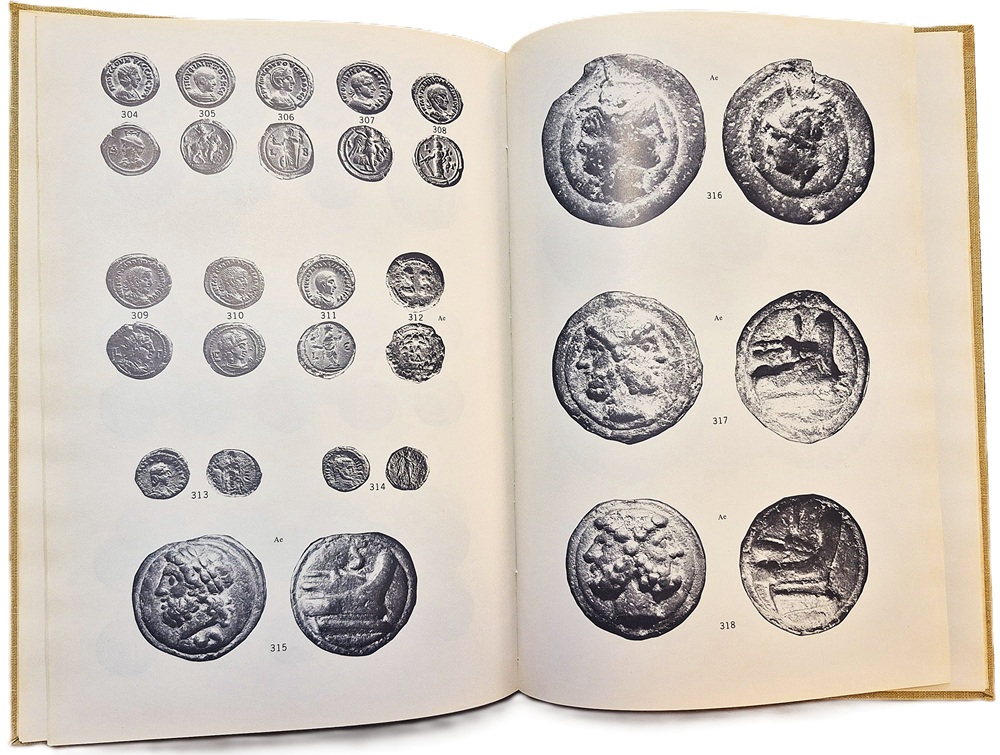
Provenance & Biblio Note: This coin is a member of my favorite subcollection: “Plate Coins” with “Association Copies.” I have a hardcover copy of Malter Auction 1 (held at the 1973 Society for International Numismatics Convention in Los Angeles) ex ANS Library duplicates, signed by Joel Malter (1931-2006) & inscribed the day after the auction to Arthur John Seltman: “Best wishes for future success.” (Son of C.T. Seltman & grandson of E.J. Seltman, he had just begun a new business, Ancient Coins [Staten Island, NY]).
Craig Kammerer (1943-2024) bought this coin (Lot 285), likely attending the live auction. Kammerer wrote a brief 2004 article in The Asylum about the ancient coin scene in 1970s Los Angeles (much of it centered around UCLA, where I studied many years later), including several paragraphs on Malter.
Below (note): The “Addressed FPL Game” (anyone else know this one?).
Severus Alexander, as Caesar, Billon Tetradrachm (25mm, 12.12g), 221/2 CE. Athena, L Є (Year 5, Elagabalus).
(Photo credit: CNG.) Collection History:
Dr. Thomas E. Beniak Collection [CNG EA 558 (20 Mar 2024), 507];
ex Bill Kalmbach [Nilus Coins, 1 Oct 2009, from his Collection?];
NFA Fall MBS 1990 (18 Oct 1990), 2443.
Published: SRCV 8108 (this coin illustrated), in: Sear, David R. (2002) Roman Coins and Their Values, Volume II: The Accession of Nerva to the Overthrow of the Severan Dynasty.
See Also: RPC VI (Temp.) 10213, ex 24 (this coin illustrated).
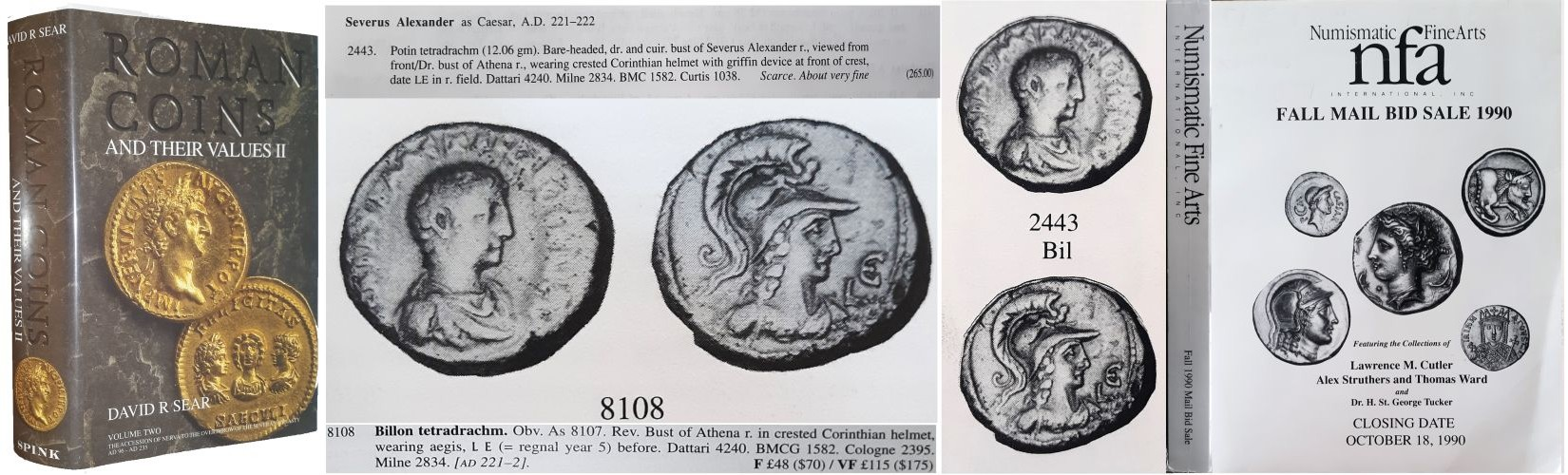
Note: As always, click to enlarge; also, there’s a higher resolution collage on Imgur.
Provenance Notes: The book by is autographed by David Sear (1942-) & inscribed to collector Paul DiMarzio (1962-). My NFA Fall 1990 MBS is ex-Library of Craig Kammerer (1943-2025), whose Severus Alexander Ares Tetradrachm appears above.


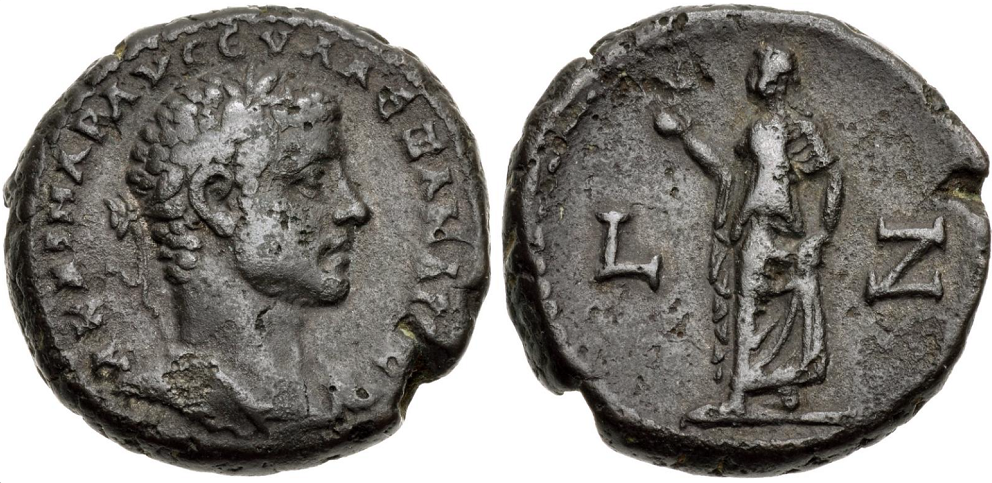
Severus Alexander Billon Tetradrachm (24mm, 12.44g), 227/8 CE. Elpis, L Z (Year 7).
(Photo credit: CNG) Collection History:
Giovanni Dattari (1853-1923) Collection;
Rocky Mountain Collection of Alexandrian [CNG EA 505 (1 Dec 2021), 361 (corr., unrecognized as Dattari specimen, erroneously described as 2nd known); acq. from Harlan Berk (n.d., correctly identified), with unknown dealer tag (n.d., Inv. [?] “779 – HZHQANUSB”)].
Published: Dattari-Savio (2007) Catalogo completo della collezione Dattari – Numi Augg. Alexandrini, No. 12335 / 9892bis (this coin illustrated);
RPC VI Temp 10362 (this coin illustrated online);
Emmett (2001) Alexandrian Coins, 3101 (7), pp. 153 & 254 (this coin cited).


Notes: Unique! The only known Elpis coin of Severus Alexander before Year 10. (There is, however, a matching type for Julia Domna in Year 7 [RPC 10376]).
Years 6 and 7 were particularly turbulent in the reign of Severus Alexander. His wife Orbiana was exiled (her father accused of treason & executed) and, in RY 7, replaced on Alexandrian coinage with Domna. Epagathus instigated rioting in Rome, culminating in the murder of Alexander’s close advisor, Ulpian. (Epagathus was powerful & popular enough that, instead of immediately executing him, Alexander first assigned him to serve as Prefect of Egypt, but instead had him “taken to Crete and executed” [Cassius Dio, Roman History, LXXX: 2.4, Loeb: 481-3].)
There was, in 228, plenty of reason to invoke “Hope” for a better future!
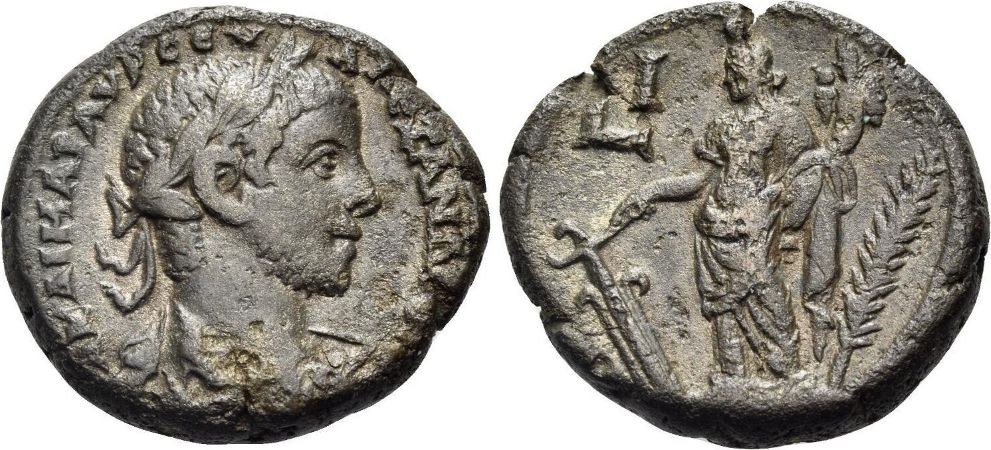
Severus Alexander Billon Tetradrachm (24mm, 11.64g), 230/1 CE. Tyche, L I (Year 10).
(Photo credit: Nomos.) Collection History:
Giovanni Dattari (1853-1923) Collection;
Robert L. Grover (1910-1998) Collection;
Art Institute of Chicago (reference / accession number 1984.1680), now lacking AIC tag [Gemini XIII (6 Apr 2017), 472 (part of, not illustrated)];
John Aiello Collection [Nomos obolos 42 (3 May 2026), 734].
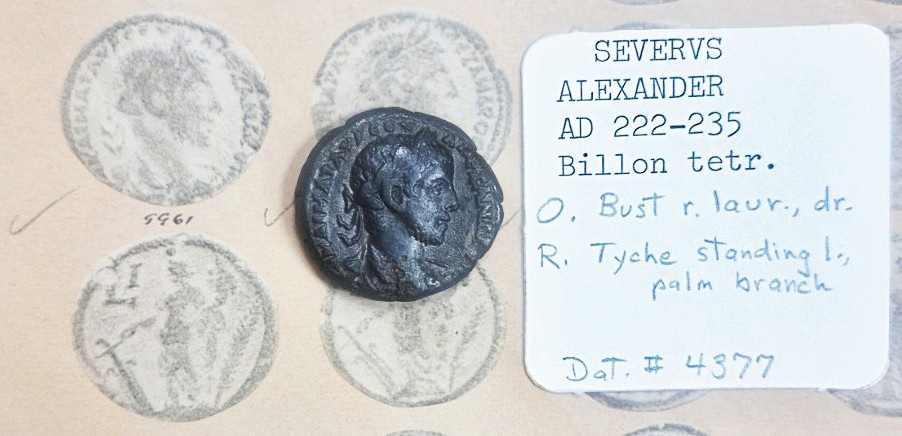
Publication History
Dattari-Savio (2007) Catalogo completo della collezione Dattari – Numi Augg. Alexandrini, No. 9961 (this coin illustrated);
RPC Online VI 10420, ex. 8 (this coin).
Note: The AIC tag is missing, but see other examples above accompanying an Antoninus Pius (shown with a Gordian III & tag) and Trajan Tetradrachm.
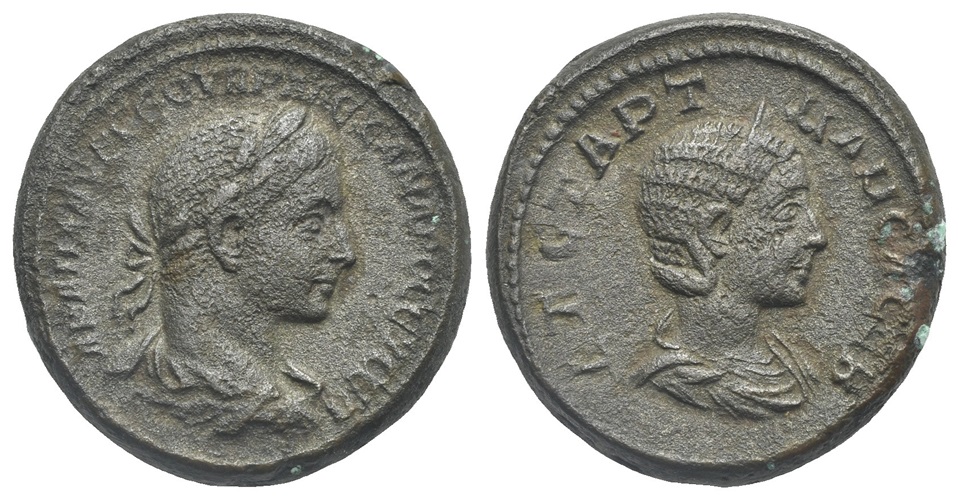
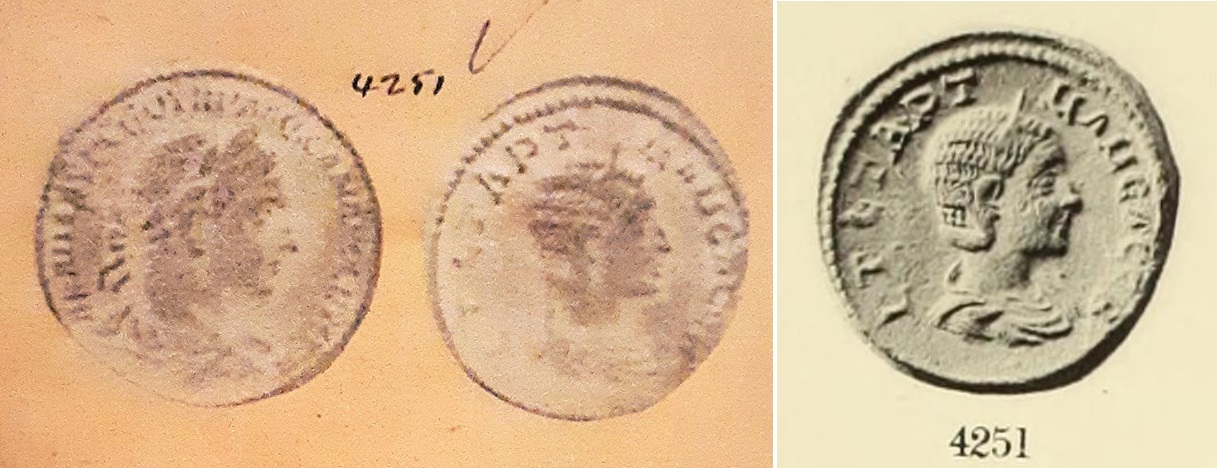
Severus Alexander & Julia Mamaea Billon Tetradrachm (25mm, 14.60g), 224/5 CE. ΤЄΤΑΡΤ (Year 4).
(Photo credit: CNG.) Collection History:
Giovanni Dattari (1853-1923) Collection;
Ex Carlo Fontana (1914-1995) Collection [Finarte 1996, lot 1137];
Ex Lanz Numismatik 154 (11 Jun 2012), lot 414.
Giovanni Maria Staffieri (1944-) Collection [Astarte XXIII (28-29 Oct 2024), 452].
Published: Dattari (1901) Numi Augg. Alexandrini, No. 4251 (this coin illustrated in vol. 2, Tav. V [rev.], described in vol. 1, p. 294);
Dattari-Savio (2007) Catalogo completo della collezione Dattari – Numi Augg. Alexandrini, No. 4251 (this coin illustrated);
Figari-Mosconi (2017) Duemila Monete della Collezione Dattari, No. 1113 (this coin illustrated);
Milne (1933/1982) Catalogue of Alexandrian Coins, p. 152 (this coin cited as “D. v. 4251”);
Geissen 2424 (this coin cited on p. 162, “Datt. 4251, Taf. V (Rs.)”) in Angelo Geissen (1981), Katalog Alexandrinischer Kaisermünzen, Köln, vol. III.
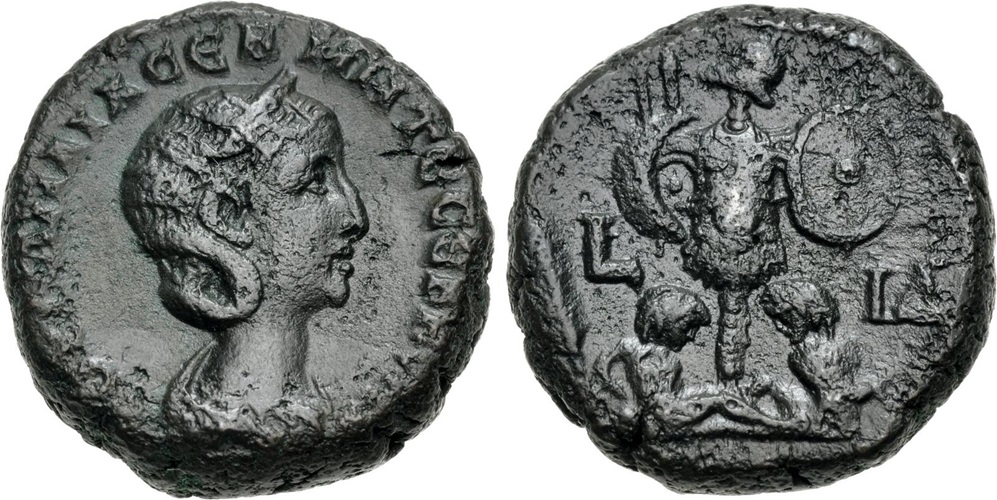
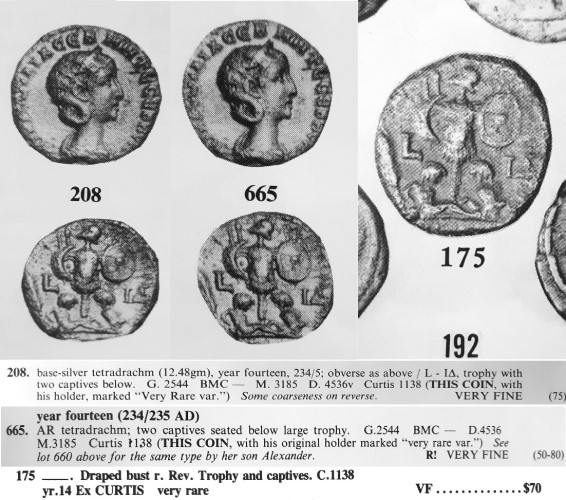
Julia Mamaea Billon Tetradrachm (21mm, 12.49g), 234/5 CE. Trophy & captives, L I∆ (Year 14).
(Photo credit: CNG.) Collection History:
Dr. Thomas E. Beniak Collection [CNG EA 563 (5 Jun 2024), 605; Empire 8 (7 Dec 1987), lot 665 (w/ J. Curtis’ holder, since lost; see Note: Curtis tags)];
Gordon Dickie (1924-2006) Collection [Empire 7 (2 May 1987), lot 208; Olympus FPL 5, Winter 1982/3, 175 (reprinted in Curtis 1990)];
Col. James W. Curtis (1913-1994) Collection, no. 1138 [H. Schulman (17 Jun 1958), 352 (part of 3, not ill.)].
Published: Curtis 1138 (this coin illustrated), in: James W. Curtis (1990) Tetradrachms of Roman Egypt [Durst Expanded Reprint], Supplement “A” (Olympus FPL): p. 192, No. 175;
this coin cited (not illustrated) in: Curtis, James W. (1957 & 1969 editions) Tetradrachms of Roman Egypt;
RPC VI (Temp.) 10656, ex. 11 (this coin illustrated online);
Geissen 2544 (this coin cited on p. 202, “Curtis 1138”) in Angelo Geissen (1981), Katalog Alexandrinischer Kaisermünzen, Köln, vol. III.
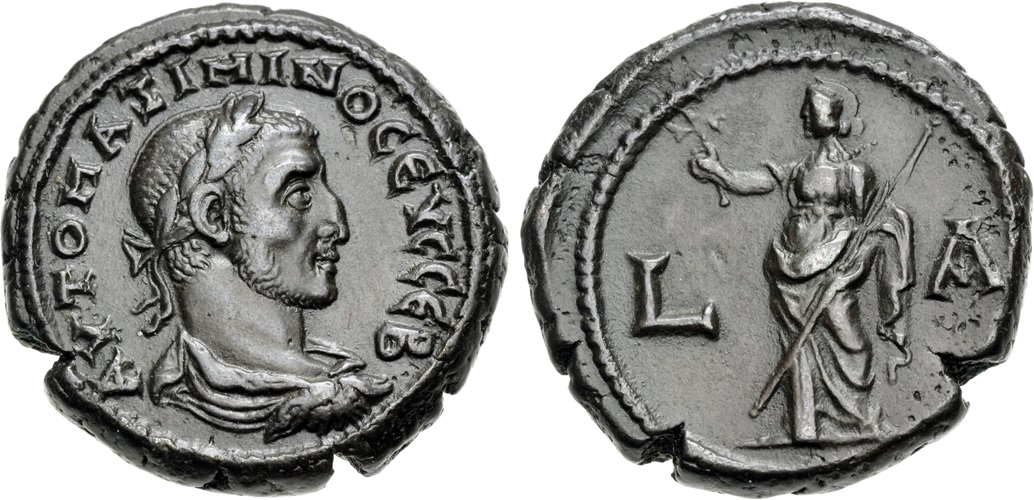
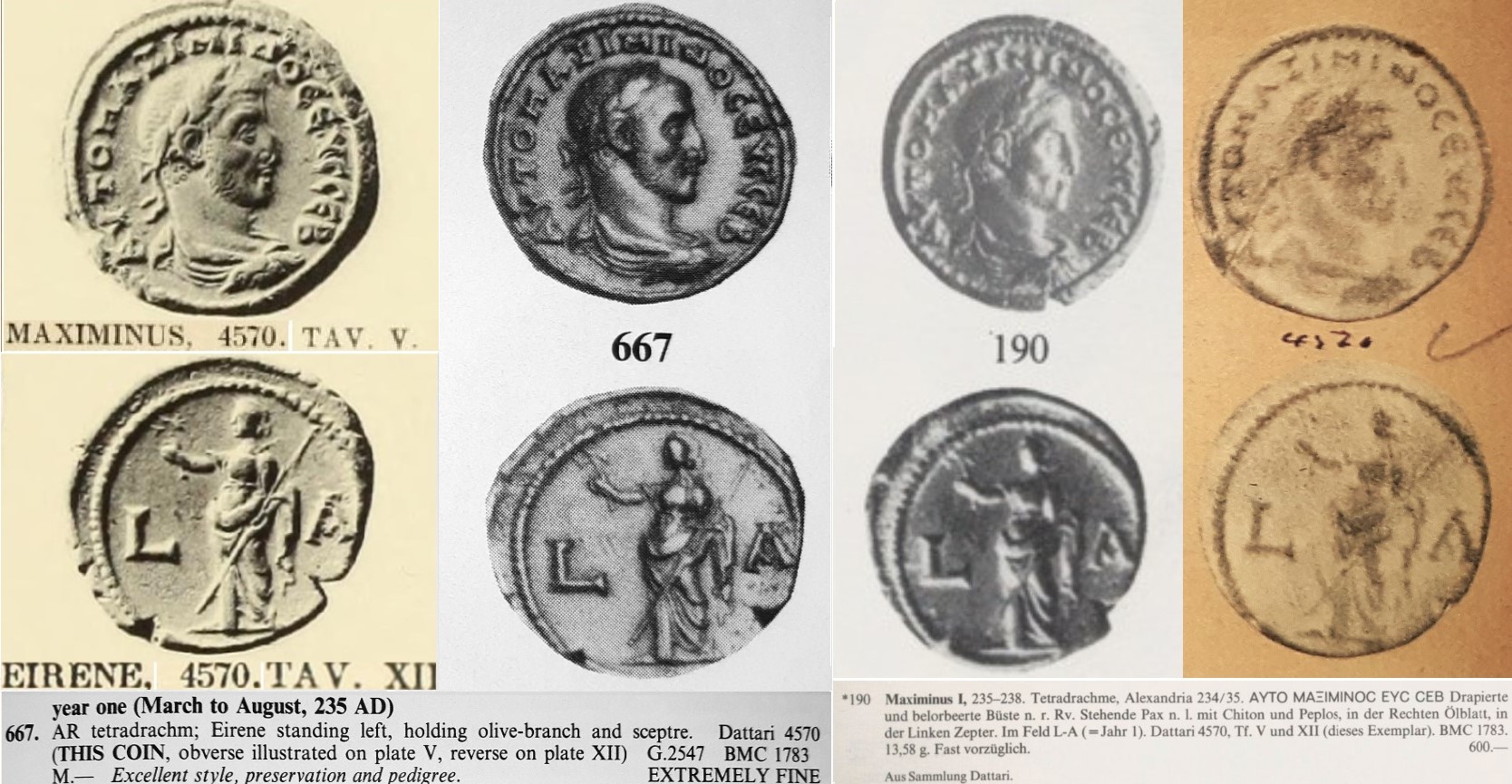
Maximinus Billon Tetradrachm (24mm, 13.60g), 235 CE (Mar – Aug). Eirene, L A (Year 1).
(Photo credit: CNG.) Collection History:
Dr. Thomas E. Beniak Collection, w/ collector tag [CNG EA 565 (3 Jul 2024), Lot 543];
Empire Auction 8 (7 Dec 1987), lot 667, w/ blue collector tag & Dennis Kroh’s original cut-out photos used for the plates;
Hess Auktion 251 (Lucerne, 8 May 1981), lot 190 (p. 29 & pl. VIII);
Harmer-Rooke “Dattari Sale” (27 May 1971), 645 (part, not ill.);
Giovanni Dattari (1853-1923) Collection [published 1901].
Published: Dattari (1901) Numi Augg. Alexandrini, No. 4570 (this coin illustrated in vol. 2, Pl. V [obv.] & Pl. XII [rev.], described in vol. 1, p. 313);
Dattari-Savio (2007) Catalogo completo della collezione Dattari – Numi Augg. Alexandrini, No. 4570 (this coin illustrated on Pl. 245);
Figari-Mosconi (2017) Duemila Monete della Collezione Dattari, No. 1324 (this coin illustrated);
RPC VI (Temp.) 10660, ex. 12 (this coin illustrated).
See also: Vogt II, p. 134 (this coin cited);
Milne, Index: p. 138, Eirene, standing <c1> (this coin cited: “D. xii. 4570”);
Geissen 2547 (this coin cited on p. 202, “Datt. 4570, Taf. V (Vs.) u. XII (Rs.)”) in Angelo Geissen (1981), Katalog Alexandrinischer Kaisermünzen, Köln, vol. III.
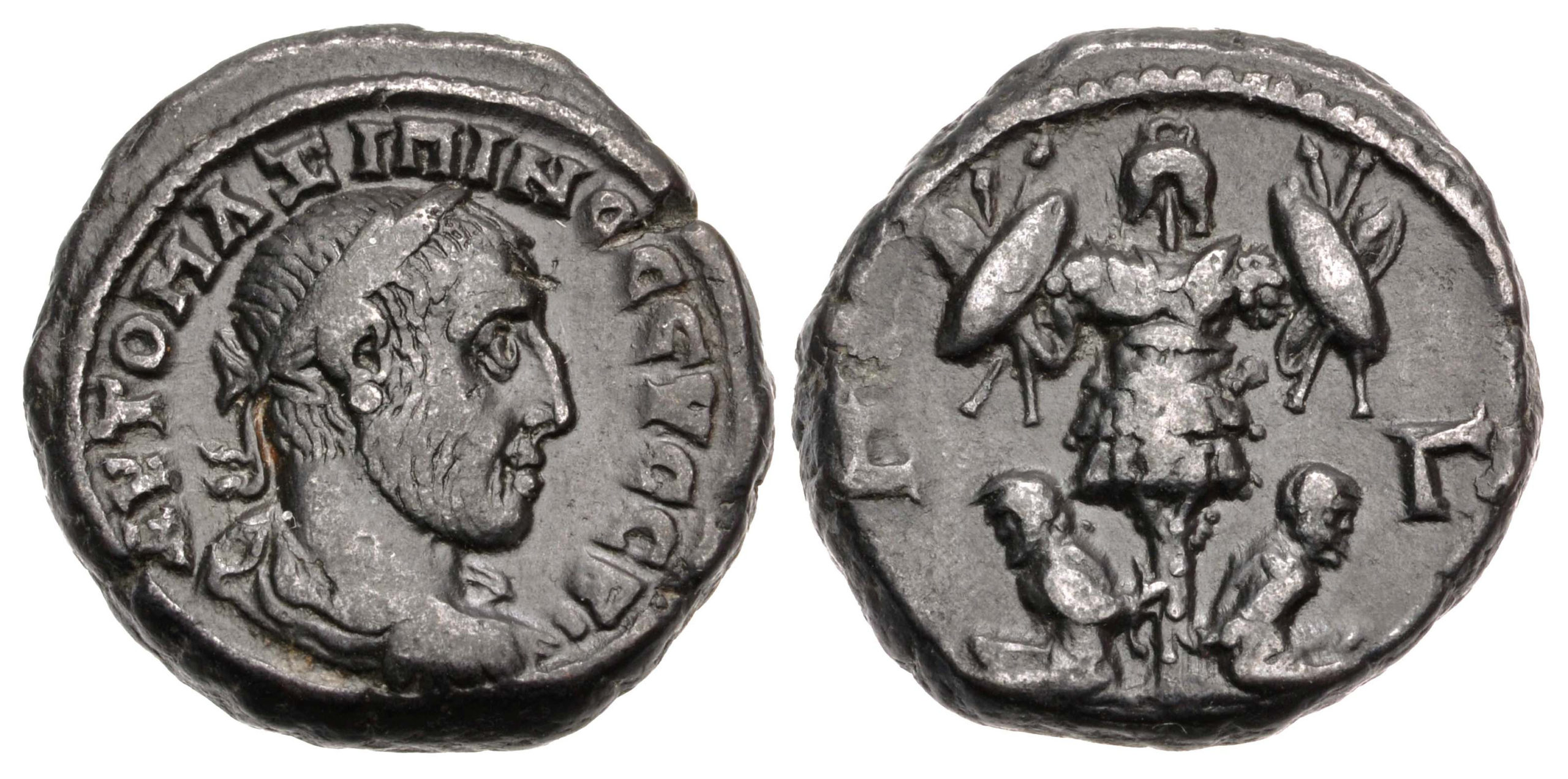
Maximinus Billon Tetradrachm (13.80g, 22mm, 12h), 236/7 CE. Trophy & captives, L Γ (Year 3).
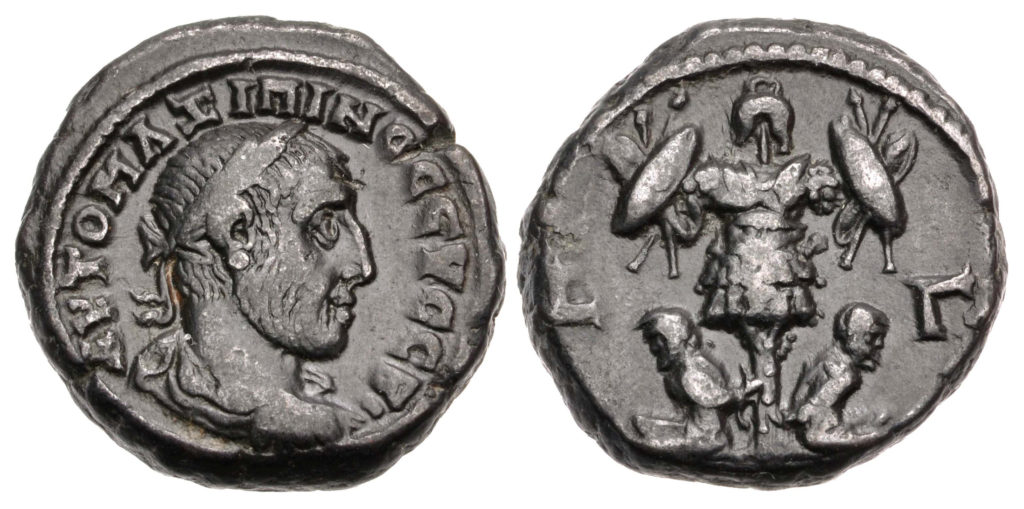
(Photo credit: CNG.) Collection History:
Rocky Mountain Collection of Alexandrian [acq. CNG MBS 79 (17 Sep 2008), 742].
Published Online: RPC VI (Temp) 10711, example 25 (this coin illustrated online);
Notes: The following coin (Dattari 4613) is of the same type, but from different dies.
Coin Project ID = 79000742 [site down? screenshot (“results” view) & PDF (full p.) saved c. 11 Aug 2021].


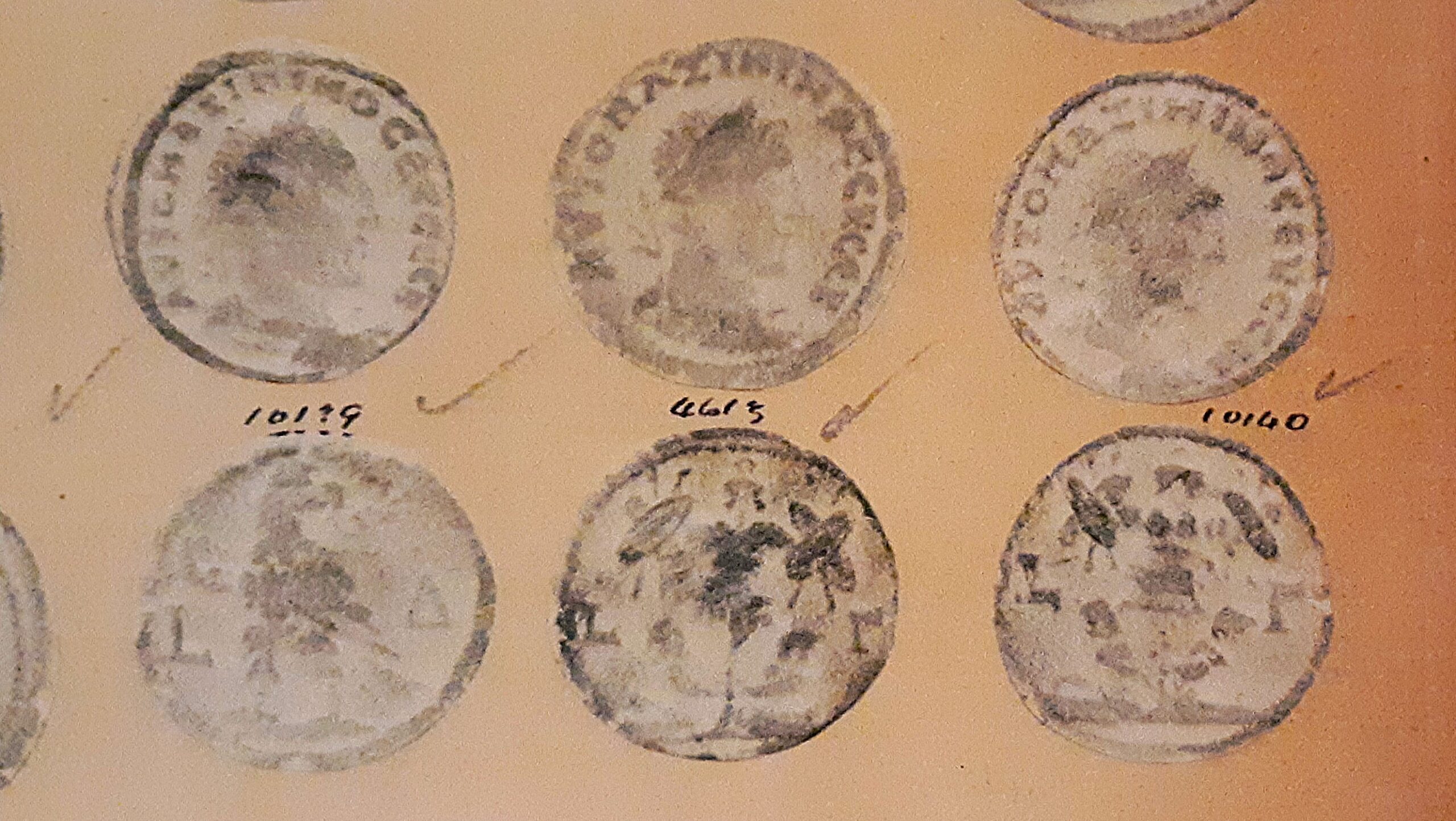
Maximinus Billon Tetradrachm (12.80g, 23mm, 12h), 236/7 CE. Trophy & captives, L Γ (Year 3).
COIN LOST IN TRANSIT (current disposition unknown, see also Jungfleish 134, above)
(Photo credit: Kölner) Collection History:
Giovanni Dattari (1853-1923) Collection;
Sammlung Dr. Victor Wishnevsky, Teil III [Kölner Münzkabinett Auction 122 (4 Oct 2024), 720];
Bayerische Vereinsbank, Münzschätze Lagerliste 6, 1974, Nr. 216.
Published: Dattari-Savio (2007) Catalogo completo della collezione Dattari – Numi Augg. Alexandrini, No. 4613 (this coin illustrated);
Dattari (1901) Numi Augg. Alexandrini, No. 4613 (this coin described in vol. 1, p. 316);
Geissen 2576 (this coin cited on p. 210, “Datt. 4613 (var.?)”) in Angelo Geissen (1981), Katalog Alexandrinischer Kaisermünzen, Köln, vol. III.
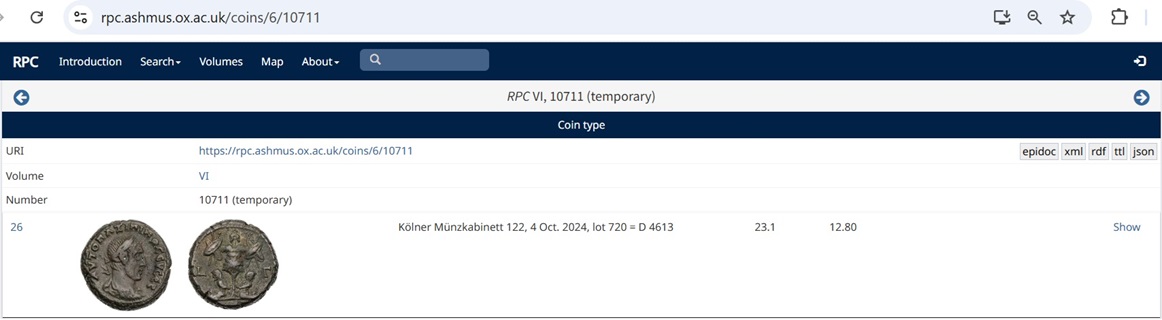
See also: RPC VI (Temp) 10711, ex. 26 (this coin illustrated online & cited in ref. line: “D 4613”).
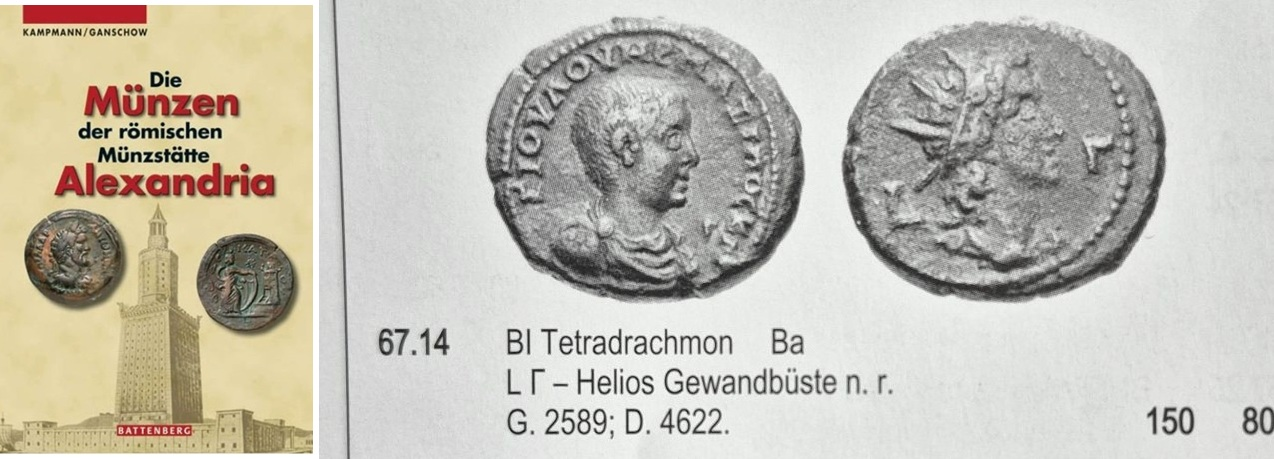
Maximus Billon Tetradrachm (23mm, 13.13g), 236/7 CE. Helios, L Γ (Year 3).
(Photo credit: HJB) Collection History:
Giovanni Dattari (1853-1923) Collection;
Sammlung J.-P. Righetti, Teil I [Münzen und Medaillen GmbH 12 (10 Apr 2003), 638];
Peter Lowrek Collection [HJB 228 (30 Jul 2024), 586, corr. (K&G ref. no.)].
Published:
Dattari-Savio (2007) Catalogo completo della collezione Dattari – Numi Augg. Alexandrini, No. 12382 (this coin illustrated);
Kampmann & Ganschow 67.14 (this coin illustrated, after Righetti – needs verification);
Forthcoming: new Emmett vol. on 3rd cent. Alexandrian (this coin to be cited).
See also:
RPC Online VI (Temp) 10719, ex. 17 (this coin cited from DS);
FAC 89908 (iwaniw, 29 Jul 2013, w/ Curtis Clay, me [Curtis JJ], Roberto [AlfaOmega]), this coin ill. from DS & MM 12.
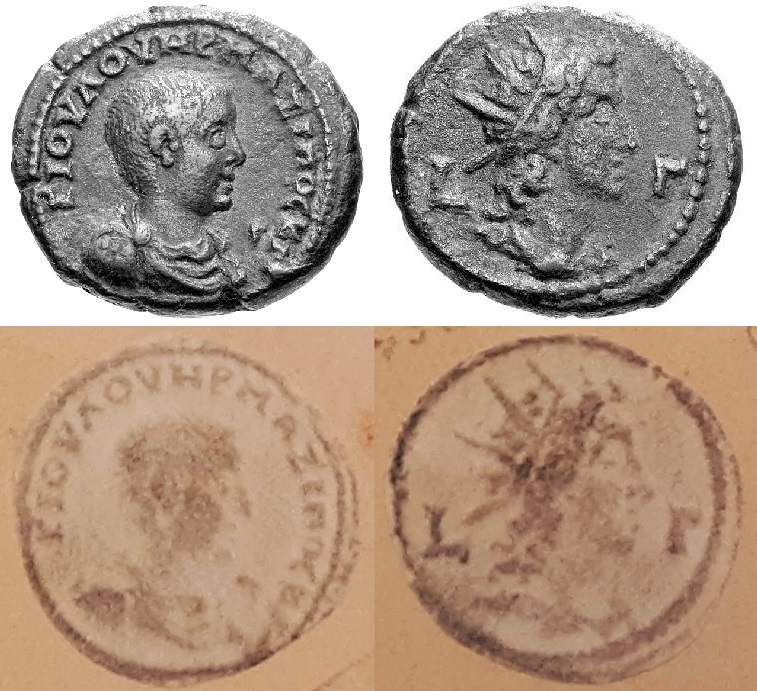
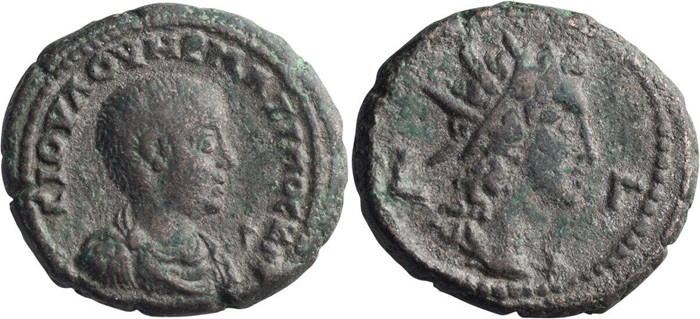
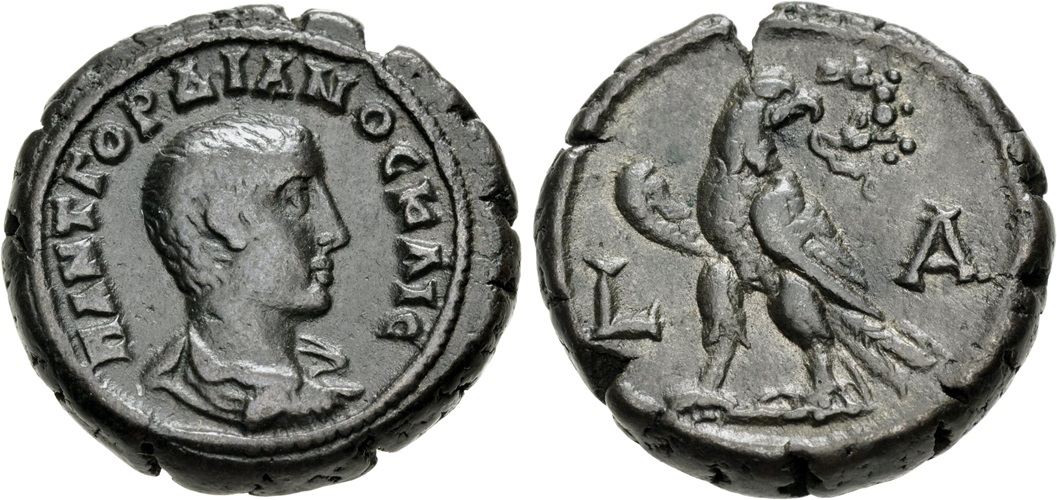
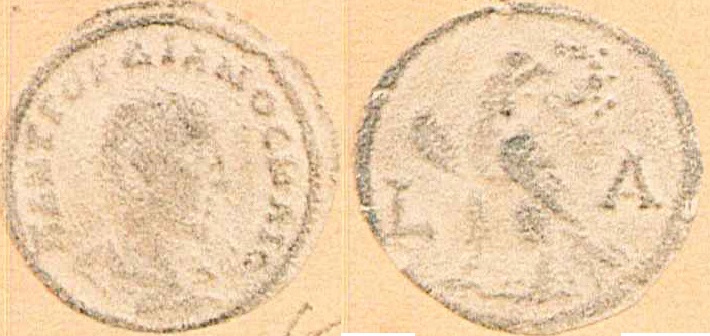
Gordian III Billon Tetradrachm (23mm, 12.82g), 238 CE. Eagle, L A (Year 1, as Caesar under Balbinus & Pupienus).
(Photo credit: CNG.) Collection History:
Dr. Thomas E. Beniak Collection [CNG EA 569 (28 Aug 2024), 515];
Gordon Dickie (1924-2006) Collection [Empire 7 (2 May 1987), 215];
Giovanni Dattari (1853-1923) Collection.
Published: Dattari-Savio (2007) Catalogo completo della collezione Dattari – Numi Augg. Alexandrini, No. 10187 (this coin illustrated).
See also: RPC VII.2 3690, ex. 15 (this coin illustrated online).
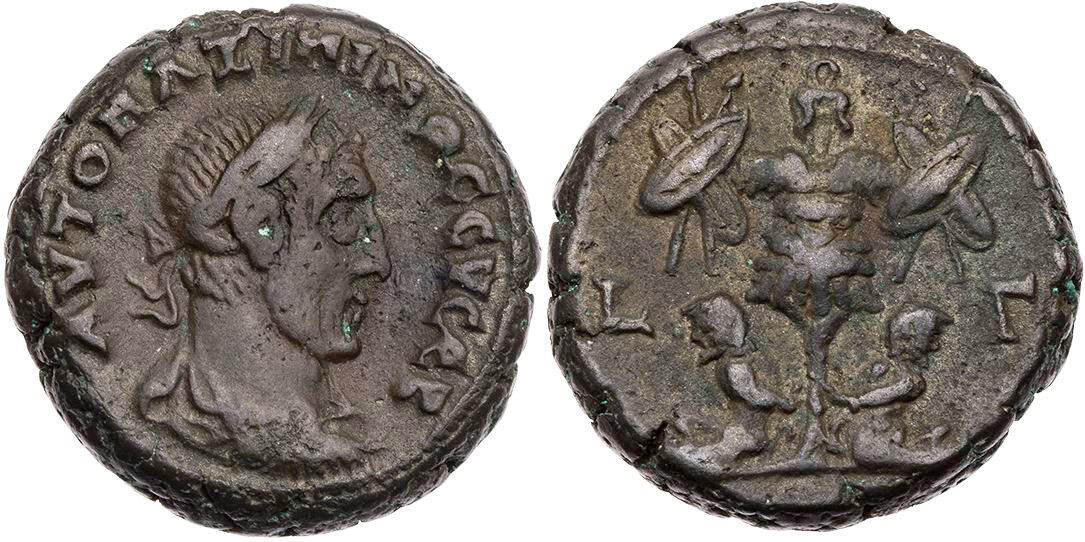
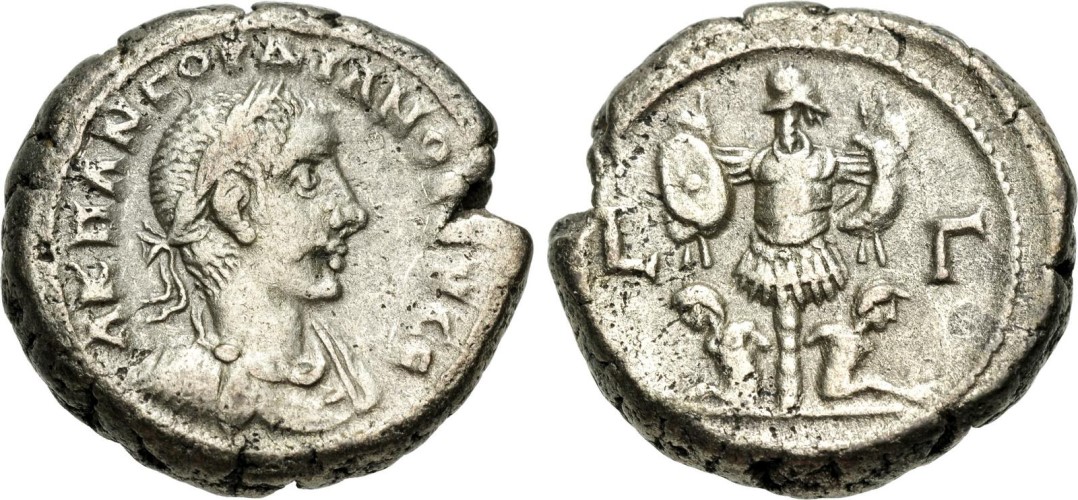
Gordian III Billon Tetradrachm (24mm, 13.97g), 239/240 CE. Trophy & captives, L Γ (Year 3).
(Photo credit: CNG.) Collection History:
Dr. Thomas E. Beniak Collection [CNG EA 560 (17 Apr 2024), 523];
NFA Fall MBS 1990 (18 Oct 1990), 2475.
Published: SRCV 8839 (this coin illustrated), in: Sear, David R. (2005) Roman Coins and Their Values, Volume III: The Third Century Crisis and Recovery;
See also: RPC VII.2 3758, ex. 14 (this coin illustrated online).
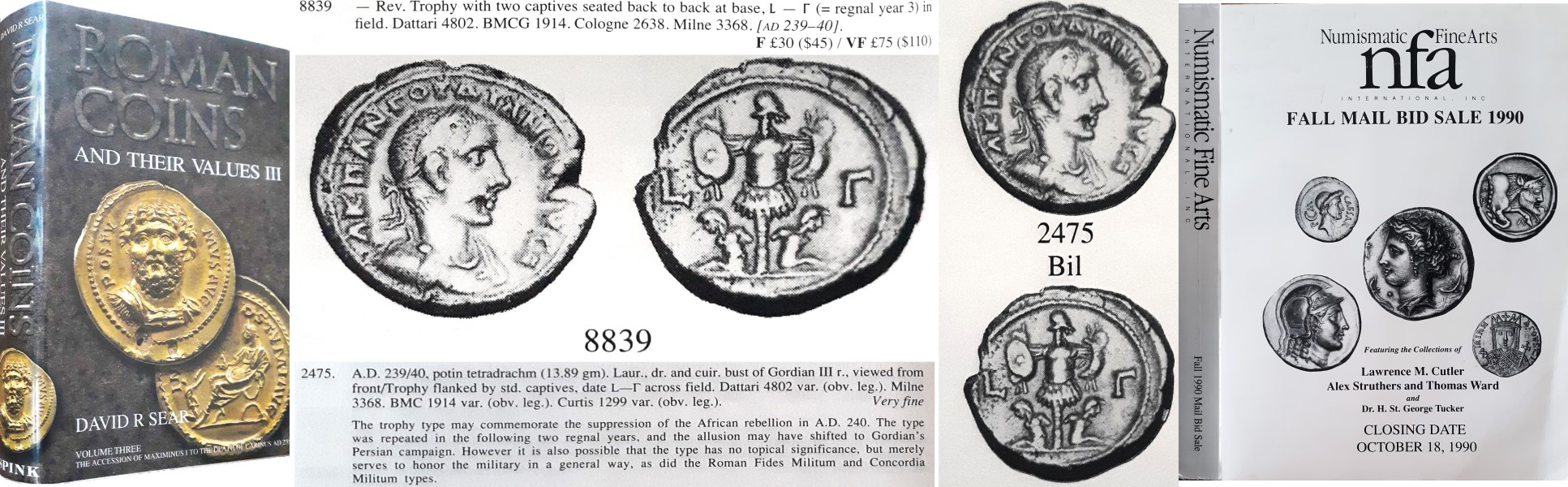
Provenance Notes: Another RCV “plate coin”: Severus Alexander / Athena (above). That one is from vol. two. I have one Roman Imperial plate coin in RCV (No. 8963 = NFA F90, 2198 = Philip I, Temple of Roma). None were recognized by their sellers.
In the 1980s & 90s, David Sear was on NFA’s team of world-class experts, during which he catalogued the Roman coins for the Fall 1990 MBS. Years later, he used many of the same photographs to illustrate his 5-vol. “Millennium Edition” of Roman Coins and Their Values (2000-2014). (Many others were from the Barry Rightman collection.)
Provenance Notes (continued): The book shown above by is autographed by David Sear (1942-) & inscribed to collector Paul DiMarzio (1962-). My NFA Fall 1990 MBS is ex-Library of Craig Kammerer (1943-2025), whose Severus Alexander Ares Tetradrachm appears above.
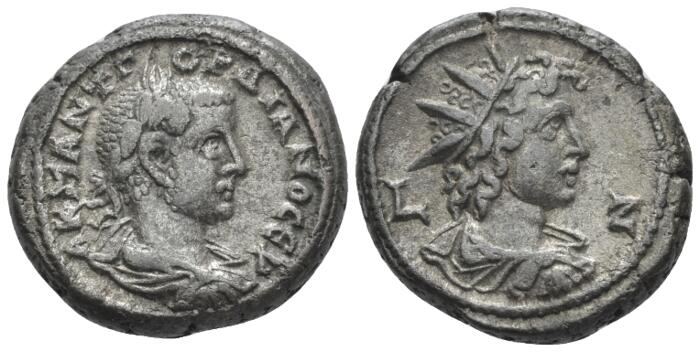
Gordian III Billon Tetradrachm (23mm, 12.35g), 243/4 CE. Helios, L Z (Year 7).
(Photo credit: Naville.) Collection History:
Giovanni Dattari (1853-1923) Collection [Naville 60 (27 Sep 2020), 308].
Published: Dattari-Savio (2007) Catalogo completo della collezione Dattari – Numi Augg. Alexandrini, No. 4731 (this coin illustrated).
Also: RPC (VII, 2) 3874, ex. 8 (this coin illustrated online);
Dattari (1901) Numi Augg. Alexandrini, v. 1, No. 4731, corr. (this coin described on p. 324, misplaced legend break);
Klose & Overbeck (1989) Ägypten zur Römerze, p. 36, No. 97 (this coin cited);
David Sear (2005), Roman Coins and Their Values, Vol III: No. 8858 (this coin cited);
SNG Hunterian, part 2 (2008), p. CCCVIII (this coin cited);
Vogt II (1924), Alexandrinischen, p. 140 (this coin cited).

Note: This obverse legend variant (Γ-OPΔ, rather than ΓO-PΔ) is very rare when paired with this reverse. (It is, however, frequently found on Gordian III’s other Year 7 reverses.) I have seen only one other specimen with the break at Γ-O, from the same die (CNA XVIII [3 Dec 1991], 443, reportedly Col. J. Curtis #1265).
Over a century ago, Milne (1918, “The Shops of the Roman Mint of Alexandria,” JSTOR 370158), hypothesized that variants in Gordian III’s legend breaks represented different workshops. To my knowledge, no one ever took up the question (or even cataloged the variations). However, the new edition of Emmett will reportedly catalog the legend breaks, citing this coin & the Col. Curtis specimen (personal communication, 2023).

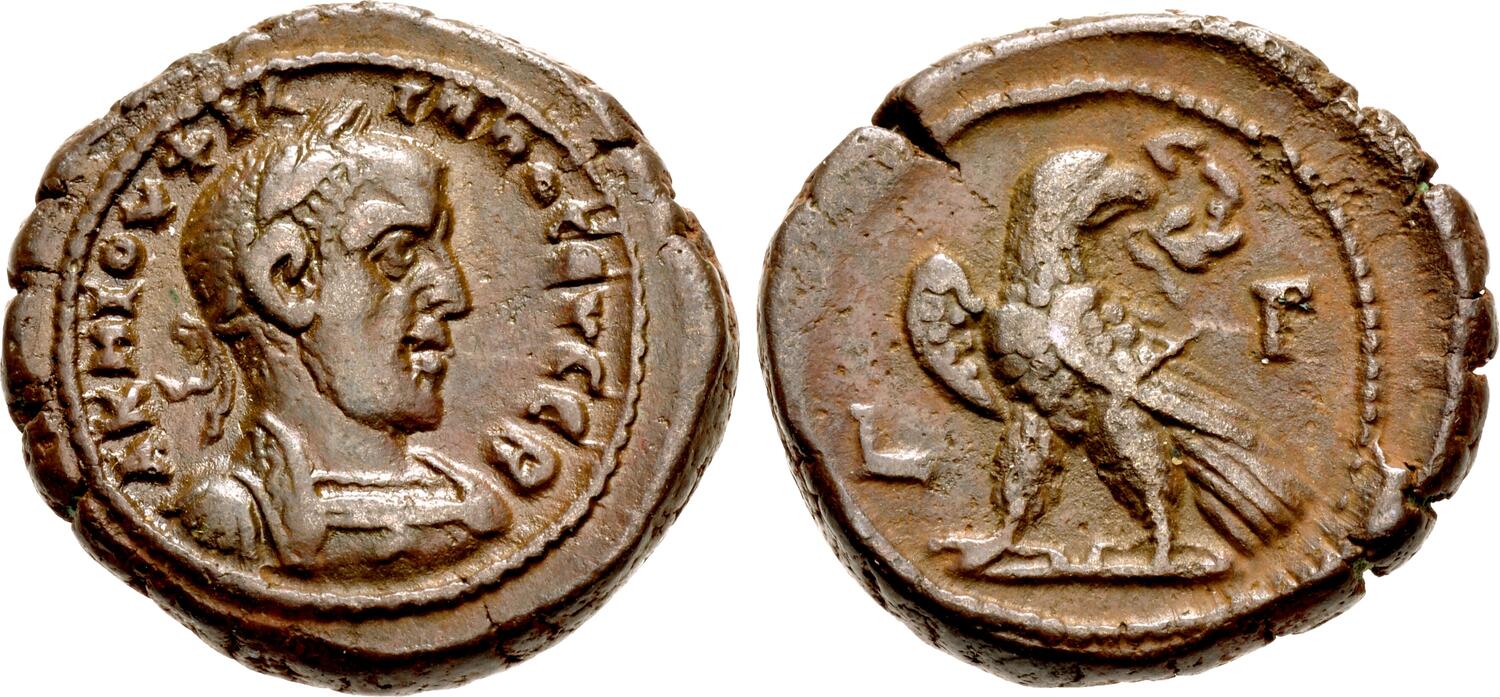
Philip I Potin Tetradrachm (24.5mm., 13.8og), 245/6 CE. Eagle, L Γ (Year 3).
(Photo credit: CNG.) Collection History:
J.S. Wagner [JSW] Collection [CNG EA 169 (25 Jul 2007), 145];
Stein A. Evensen Collection [CNG EA 496 (21 Jul 2021), 365].
See Also: RPC VIII (Temp.) 2796, ex. 38 (this coin illustrated online);
Manfred Miller (2020), Römische Provinzialprägungen (Band II: Ägypten bis Kolchis) [self-published e-book]: pp. 138-139, Abbildung 344 (this coin illustrated).

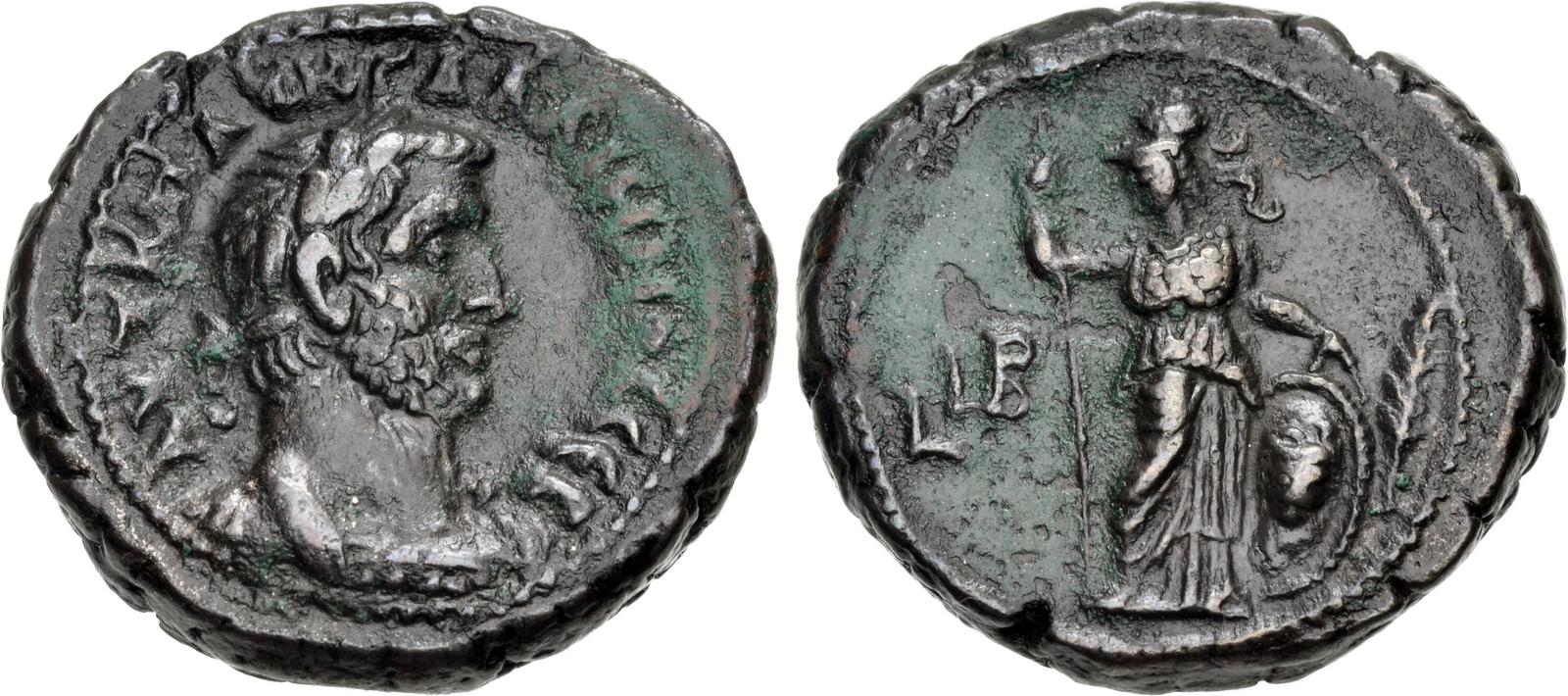
Gallienus Potin Tetradrachm (24mm, 11.26g), 264/5 CE. Athena, LIB (Year 12).
(Photo credit: CNG.) Collection History:
Col. James W. Curtis (1913-1994) Collection, no. 1579 [H. Schulman (17 Jun 1958), 518 (part of 4, not ill.)];
Dr. Thomas E. Beniak Collection [acq. from CNA XV (5 Jun 1991), 418, sold w/ Col. Curtis’ holder, apparently lost in the meantime].
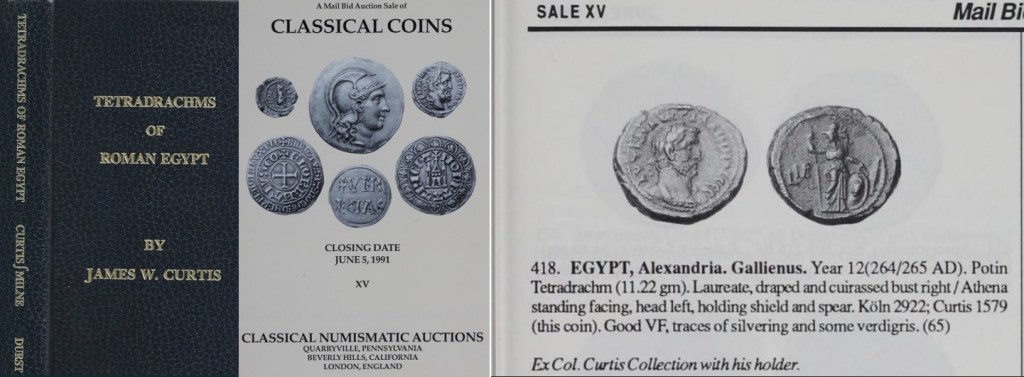
Publication History:
Curtis 1579, this coin cited (not illustrated) in: Curtis, James W. (1957) Tetradrachms of Roman Egypt (and 1969 & 1990 editions) [see also Note: Curtis tags];
Geissen 2922 (this coin cited on p. 318, “Curtis 1578/1579 (wie Datt.)”) in Angelo Geissen (1981), Katalog Alexandrinischer Kaisermünzen, Köln, vol. III;
Bellemere (June 2001), “The allocation of reverse types among the members of the house of Valerian and Gallienus on their coinage for Roman Egypt,” Journal of the Classical & Medieval Numismatic Society, Ser. 2, Vol. 2.2: 57-82 (this coin cited on p. 75, “Curtis 1578-1579”).


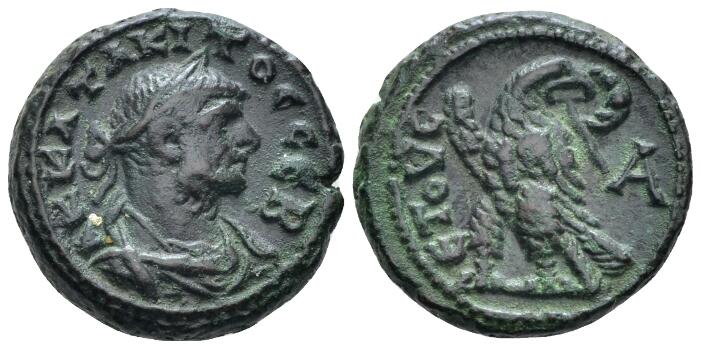
Tacitus Potin Tetradrachm (21mm., 8.84g), 275/6 CE. Eagle, ETOVC A (Year 1).
(Photo credit: Naville.) Collection History:
Elvira Clain-Stefanelli (1914-2001) Collection [Naville 38 (10 Mar 2018), 351].
Claudius II Gothicus Potin Tetradrachm (21mm, 10.91g), 279/80 CE. Homonoia, LB (Year 2).
(Photo credit: C.J.J..) Collection History:
AK Collection [acq. Münzen und Medaillen AG 1969; Triton XXVI (10 Jan 2023), 813 (part), F19].
Published: Wendelin Kellner (2009) Die Münzstätte Alexandria in Ägypten, p. 140, No. 11 (this coin illustrated);
Kellner, “Die Muenzstatte Alexandria in Aegypten. Teil 17: Claudius Gothicus Jahr 2 – Vaballath,” MoneyTrend (2/2005), pp. 148-153: p. 150, Abb. 11 (this coin illustrated);
RPC X (Temp) 75612 (this coin illustrated online).
Coin Notes: Unusually “silvery” in appearance. Is this a high silver-content surface layer? (An edge chip suggests a core of typical base metal.) Or made of some other white metal?
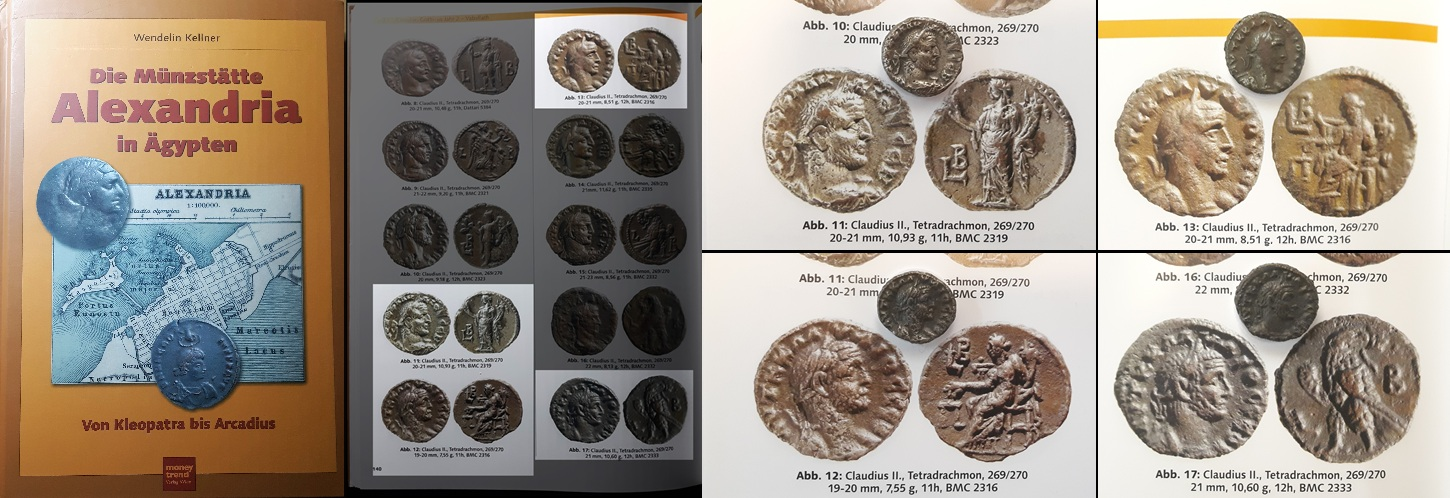
Publication Notes: First of four coins in my collection published on p. 140 of Kellner’s 2009 Alexandria book (p. 150 of his 2005 MT article). (The Poseidon/Neptune reverse, below, was on the next p.; see also Kellner’s Antoninus & Hadrian “plate coins” above.)
continued from above…
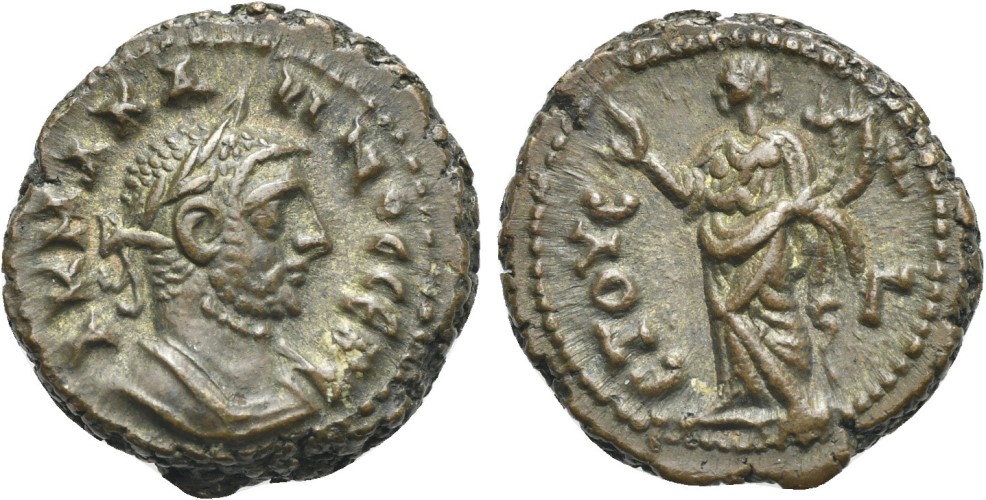
Claudius II Gothicus Tetradrachm (20mm, 7.53g), 279/80 CE. Dikaiosyne, LB (RY 2).
Claudius II Gothicus Tetradrachm (21mm, 8.46g), 279/80 CE. Dikaiosyne, LB (RY 2).
Claudius II Gothicus Tetradrachm (22mm, 10.58g), 279/80 CE. Eagle, LB (RY 2).
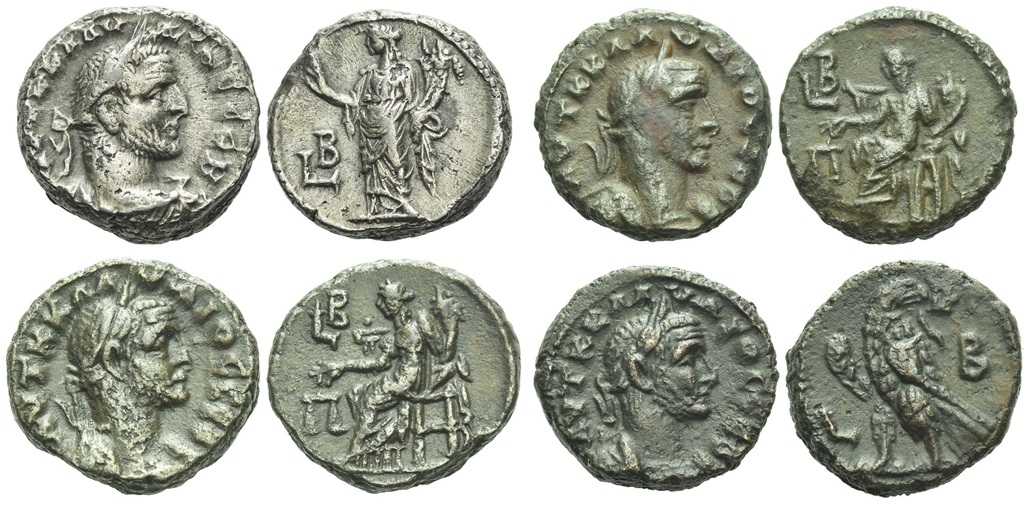
(Photo credit: Naville Numismatics Auction 81 [356, 351, 352, 355; not shown, 347].)
Collection History: AK Collection [acq.: Münzen und Medaillen AG 1969, Pfefferle 2001, Karlsruhe 1968; sold: Triton XXVI (10 Jan 2023), 813 (part), F15, F16, F11].
Published: Wendelin Kellner (2009) Die Münzstätte Alexandria in Ägypten, p. 140, Nos. 12, 13, 17 (these coins illustrated);
Kellner, “Die Muenzstatte Alexandria in Aegypten. Teil 17: Claudius Gothicus Jahr 2 – Vaballath,” MoneyTrend (2/2005), pp. 148-153: p. 150, Abb. 12, 13, 17 (these coins illustrated).
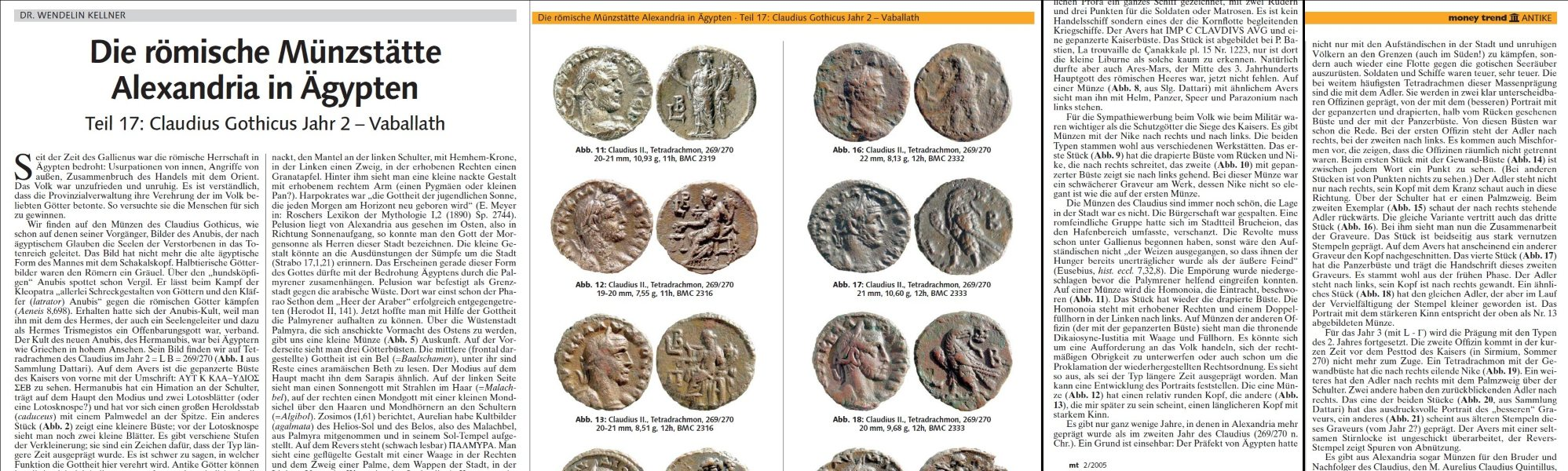
Publication Notes: Kellner’s (2009) Alexandria book collects his series of articles in the Austrian numismatic magazine, MoneyTrend. (He published other articles illustrated with coins from the AK Collection, including a series on Severan Denarii.) The magazine is nearly impossible to find in the United States, but available online by subscription. Copies of the Alexandria book can be had in the US with patience.
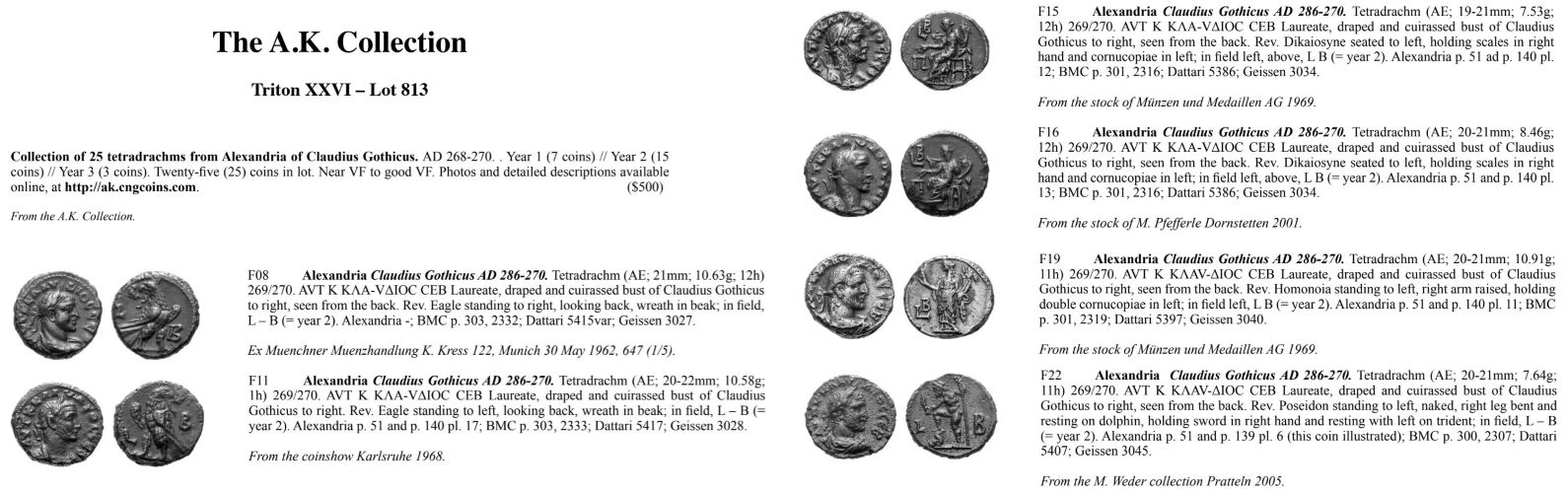
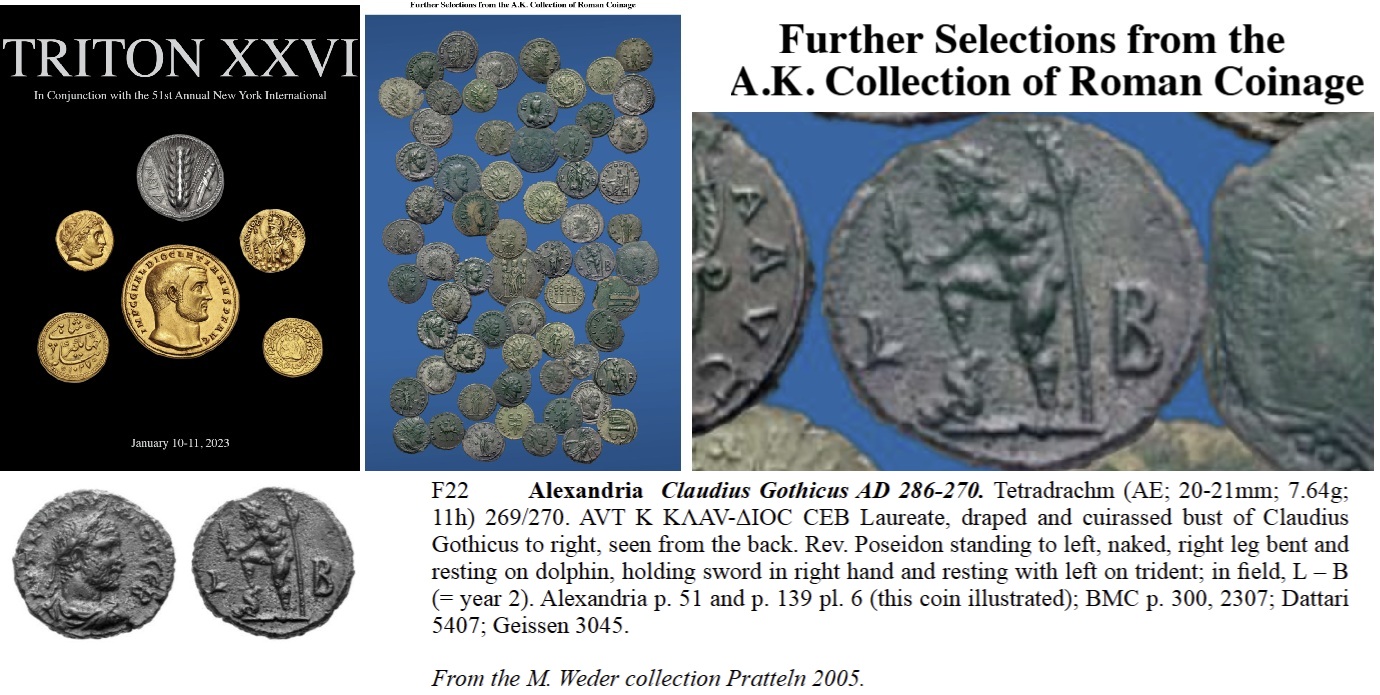
Sale notes: The enormous AK Collection was famously sold in numerous group lots of up to 100+ coins in CNG’s annual Triton sales (Triton XII [2009] through XXVII [2024]), the catalogs for which only summarized the contents. Consequently, many coins immediately lost their important collection & publication histories. However, one can recover the provenances from the “AK Supplements” that CNG published in small numbers. (Some published online as PDFs. Individual lots were temporarily itemized online, some captured by Internet Archive.) The supplements give individual photographs, descriptions, and provenances. (Excerpts from Triton XXVI AK Supplement shown above.)

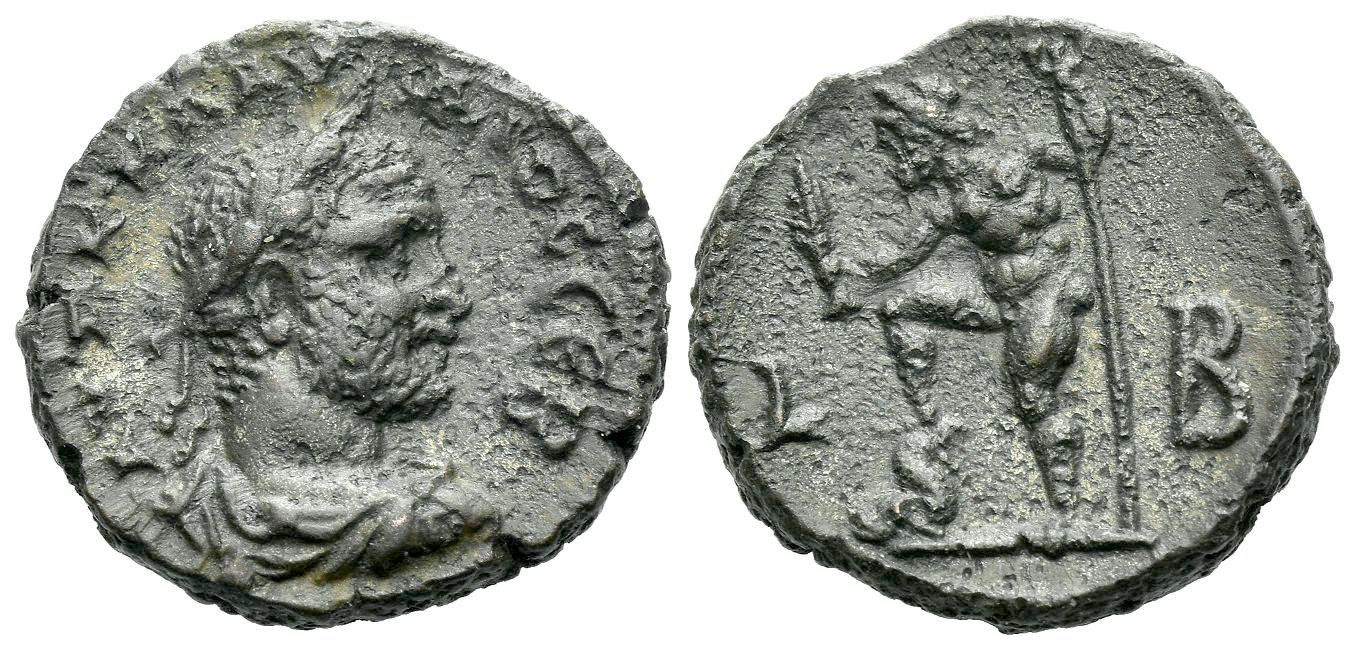
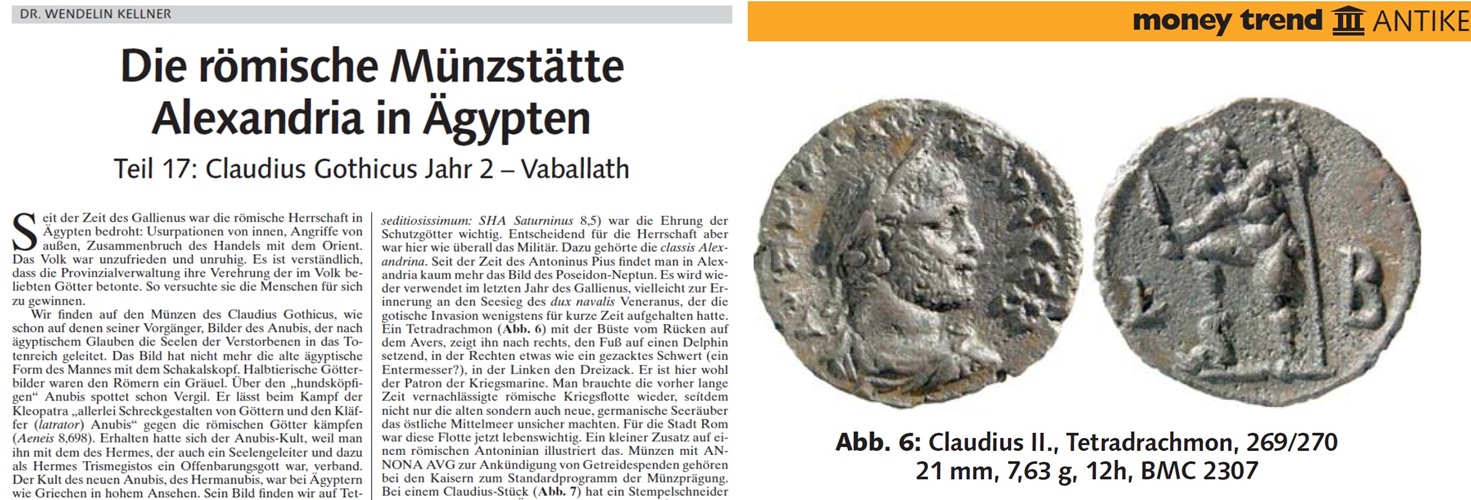
Claudius II Gothicus Potin Tetradrachm (21mm, 7.63g), 279/80 CE. Poseidon/Neptune, L B (Year 2).
(Photo credit: Naville 81.) Collection History:
AK Collection [Triton XXVI (10 Jan 2023), 813 (part, rev. ill. on p. 244), F22 (AK Collection Supplement, p. 50)];
Markus R. Weder (1953-2016) Collection [private sale to “AK,” 2005].
Published: Wendelin Kellner (2009) Die Münzstätte Alexandria in Ägypten, p. 139, No. 6 (this coin illustrated);
Kellner, “Die Muenzstatte Alexandria in Aegypten. Teil 17: Claudius Gothicus Jahr 2 – Vaballath,” MoneyTrend (2/2005), pp. 148-153: p. 149, Abb. 6 (this coin illustrated).
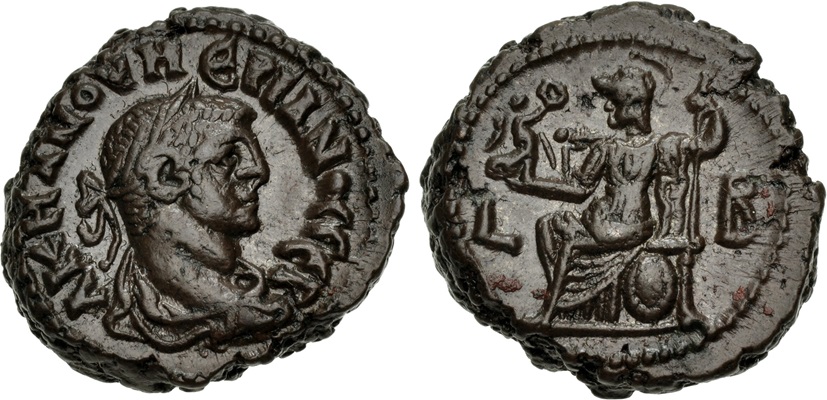
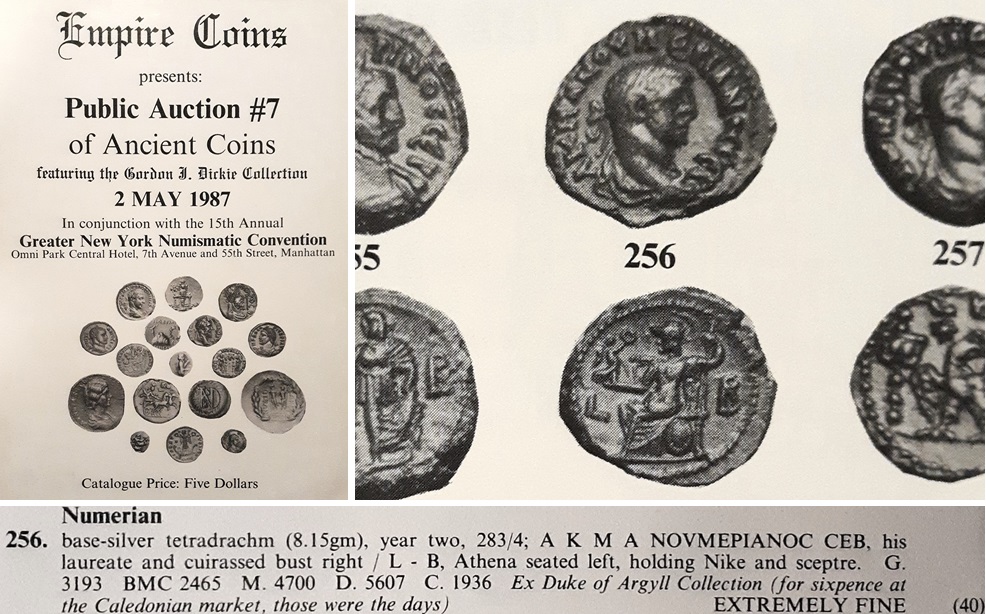
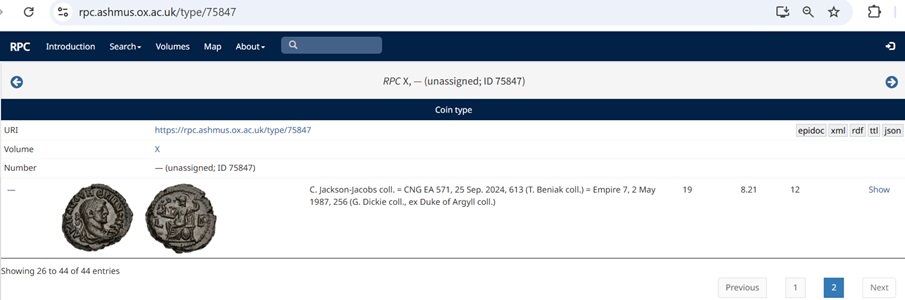
Numerian Potin Tetradrachm (19mm, 8.21g), 283/4 CE. Athena Nikephoros, LB (Year 2 of Carus).
(Photo credit: CNG.) Collection History:
Niall Campbell (1872-1949), 10th Duke of Argyll Collection [purchased c. 1930s under “Market Overt” (see note) for sixpence at the old Caledonian Market in London];
Gordon Dickie (1924-2006) Collection [Empire 7 (2 May 1987), 256];
Dr. Thomas E. Beniak Collection [CNG EA 571 (25 Sep 2024), 613].
Publication Hist.: RPC X 5110, ex. 36 (this coin illustrated online).
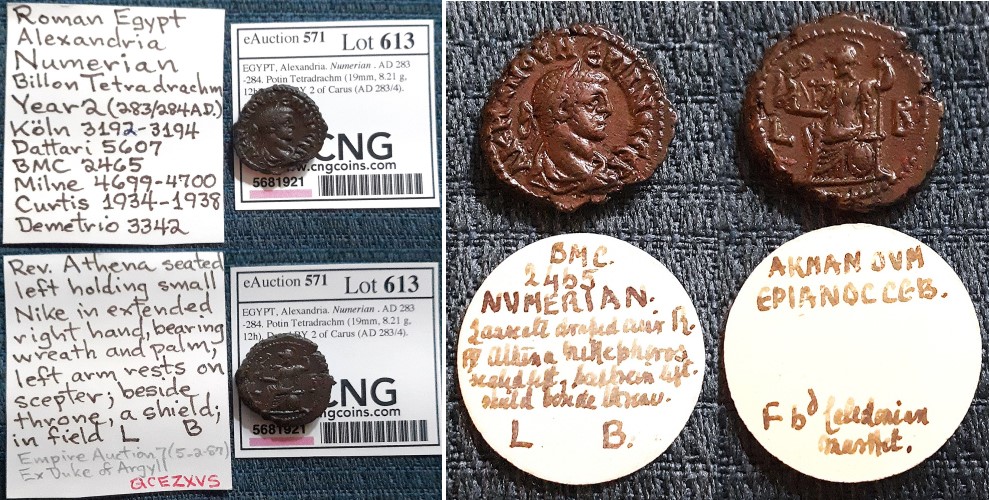
Note: This coin was once purchased under “Market Overt,” an obsolete legal principle that “provenance could not be questioned” for goods bought at “designated markets between sunrise and sunset” (Wiki)! Despite its medieval origins (the French Marché Ouvert), it survived in London until the end of the 20th cent.
Predictably, Market Overt was viewed as an invitation to sell stolen goods. One market’s infamy stood out: “New Caledonian” or “Bermondsey Market” (today, one of London’s oldest street markets). It became the face of Market Overt in 1992 when a stolen pair of important 18th century British portraits were sold there for a pittance.
In the subsequent court case, the buyer managed to keep the paintings and scandalize the British public by invoking Market Overt! (“Ludicrous legal anomaly,” complained The Independent.) The outcry prompted British lawmakers to finally abolish it in 1994.
From his collector tags, the Duke of Argyll was a frequent buyer at the old Caledonian Market near Kings Cross in the 1930s. (It would close during WWII, reopening at Bermondsey, thus “New.”) Not yet stained by ill-repute, the old Caledonian was known as a hub for antiques and “bric-a-brac.”
The Duke – Niall Campbell – had another personal connection to it. Though active since the Anglo-Saxon period, the market was only officially recognized (allowing Market Overt to apply) in 1855 when Prince Albert and Queen Victoria opened it as “Metropolitan Cattle Market.”
Albert and Victoria were, as it happens, the Duke’s great-uncle and great-aunt. (His uncle, the 9th Duke of Argyll, married their daughter.)
Carinus Potin Tetradrachm (20mm, 7.10g), 284/5 CE. Homonoia, ETOYC Γ (Year 3).
(Photo credit: Astarte.) Collection History:
Giovanni Maria Staffieri (1944-) Collection [Astarte WA 2 (9 Dec 2023), 265];
Bono Simonetta (1903-1987) Collection [acq. by GMS in 1976].
Note: Staffieri & Simonetta were friends through the Swiss Numismatic Society in the 1970s and 1980s, until Simonetta’s death. (Staffieri wrote his May 1988 obituary for the SMB [to PDF].)
Simonetta also acquired a coin from Staffieri in 1976 (not mine): Ariarathes VI Drachm (Simonetta 1977, p. 33, n. 24 = Parthica 2007, Ar. VI 39/1). Perhaps these two coins were a trade?
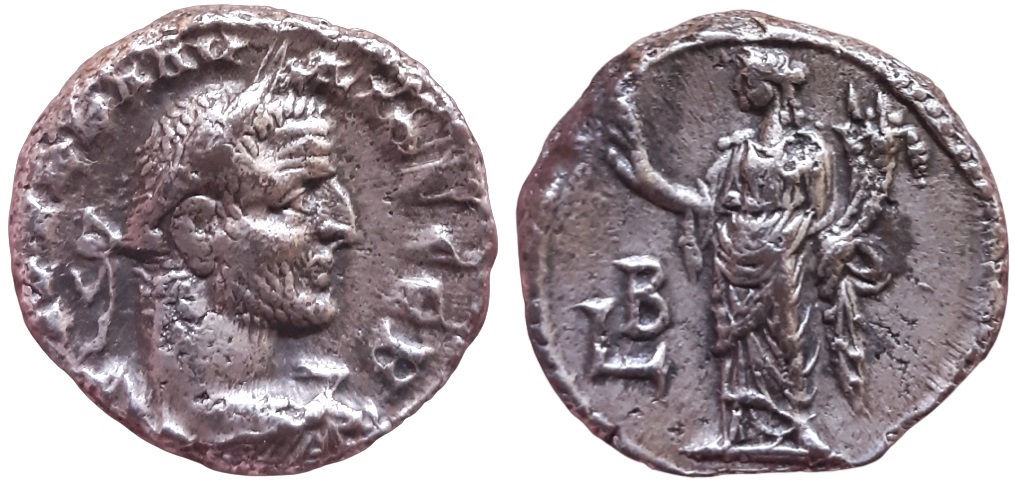
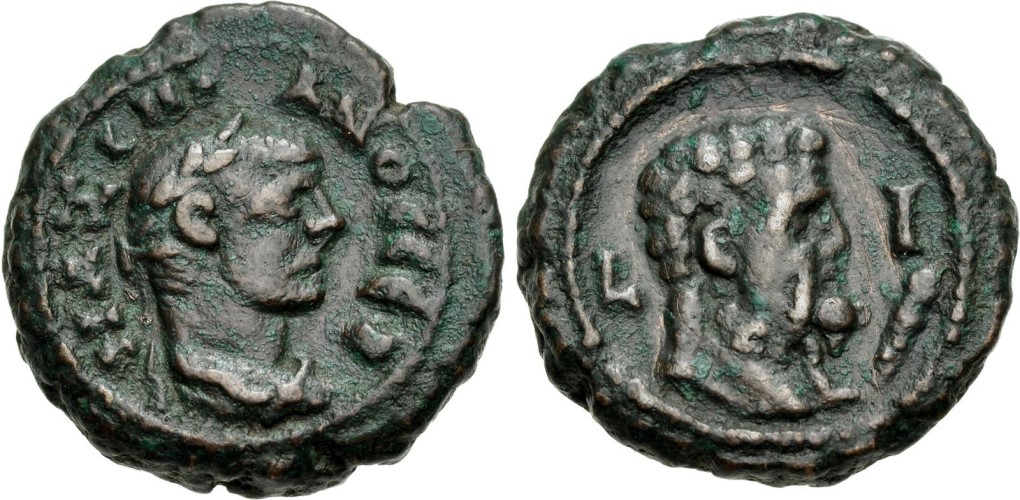
Maximianus Potin Tetradrachm (20mm, 8.85g), 294/5 CE. Hercules, L I (Year 10).
(Photo credit: CNG.) Collection History:
Col. James W. Curtis (1913-1994) Collection, no. 2080;
acq. from Fratelli Bajocchi (Raoul Bajocchi, Cairo, Egypt), Dec 1955;
H. Schulman Lee – Curtis Sale (17 Jun 1958), Lot 618 (“unique,” not ill., see excerpt below);
Keith Emmett Collection [cataloged by Zach “Beast” Beasley (n.d., ca. Summer 2008); acq. Olympus, Feb 1983, Nr. 424];
Dr. Thomas E. Beniak Collection [CNG EA 560 (17 Apr 2024), 547; acq. Beast Coins, 5 May Jul 2009].
Published: Curtis 2080 (this coin illustrated), in: James W. Curtis (1990) Tetradrachms of Roman Egypt [Durst Expanded Reprint], Supplement “A” (Olympus sale): p. 198, No. 424;
this coin cited (not illustrated) in: Curtis, James W. (1957) Tetradrachms of Roman Egypt (& 1969 edition);
Geissen 3336 (this coin cited on p. 114, “Curtis 2080 var. (Pos. der Jahreszahl)”) in Angelo Geissen (1981), Katalog Alexandrinischer Kaisermünzen, Köln, vol. IV;
RPC X (Temp.) 76191, ex. 7 (this coin illustrated online).
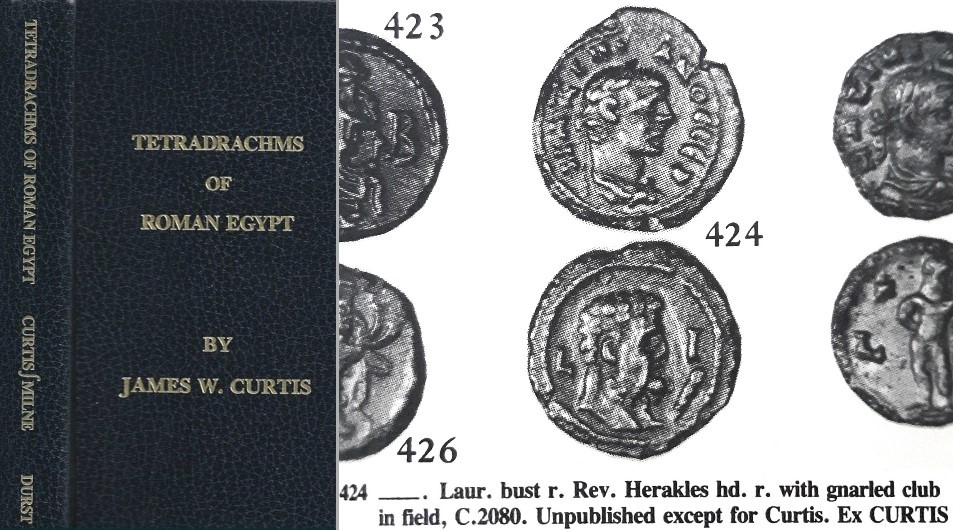

Notes: Described as “unpublished” variant in Curtis (1957, 1969, 1990) & Schulman 1958 sale (Lot 618, below). Another example from the same dies was published in 1999 in Dattari-Savio 10717.

Note: Photograph of Curtis’ holder below (larger image on Beasley site; see Note: Curtis tags). Sadly, it was apparently discarded by the buyer. All the more fortunate that Beasley had the foresight to publish photos of the ones in the Emmett coll.:

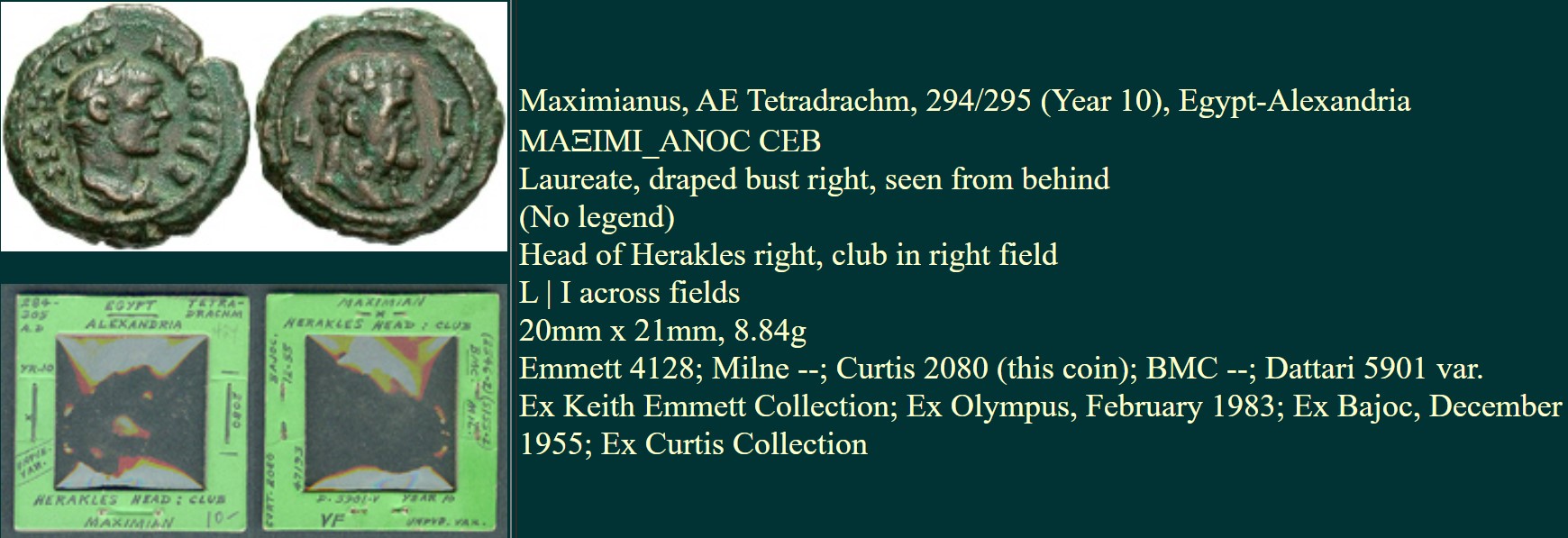
Note: Curtis tags (return to Commodus [corr.], to Julia Mamaea, to Gallienus, to Maximian):
Sadly, Col. Curtis’ distinctive coin holders have rarely survived to the present. Relatively few of his coins were photographed for his books or auctions, so the holders would provide valuable evidence of their coll. & pub. history. It is common to see coins described as “reportedly ex. Curtis Collection,” but in cases where they can be checked, this attribution often turns out to be mistaken or unlikely (see, e.g., my Commodus [ex Aiello et al.] above).
They still accompanied the coins when initially dispersed by Hans M.F. Schulman, c. 1958-1961. In the 1980s and 1990s, it was still common for Curtis coins to be advertised for sale “with his holder” (see my Gallienus above, w/ CNA XV excerpt).
When Emmett acquired a number of them from Olympus (c. 1982), Bart Lewis apparently passed along many, but not all; at least eleven holders are photographed on Zach Beasley’s page of Emmett Duplicates sold c. 2008-9 (see, e.g., my Maximian). The holders accompanying coins bought by Beniak (whether via Emmett or elsewhere), though, were apparently not preserved.
The next best thing to the physical holder is a photo of it, but that’s uncommon outside the Emmett-Beasley coins. Following that, an old auction catalog with a photo of the coin and mention of Curtis’s holder accompanying the coin provides some degree of assurance that the coin is actually ex-Curtis (such as the Gallienus or Julia Mamaea above).
Of those coins illustrated in the Supplements to Durst’s 1990 reprint of Tetradrachms of Roman Egypt (J. Curtis), only those specifically described as ex-Curtis come from his collection. Most are in Supplement A (Olympus FPL 5 [Winter 1982/3], unfortunately mislabeled as Empire Coins). But note that only some of the Supplement A coins are described as “Ex CURTIS” (see my Julia Mamaea and Maximian above).
Note: The FPL Addresses Game (return). (Okay, so I made it up myself. But now I can’t stop playing!)
Just like the coin version (which I also made up) but for old FPLs that still have their address labels (in this case, ones addressed to other dealers). Catalogs in my library:
(1) Malter Auction 1 → Seltman.
(2a) Seltman FPL 10 → Northeast Coin Co.
(2b) Seltman FPL 11 → Fountainhead (L. J. Devine).
(3) Fountainhead FPL unaddressed. Game Over.
My one Fountainhead FPL is ex-BCD Library but, for the purposes of this game, it is a dead end (not addressed or inscribed). It might be cheating a bit to use Malter 1, since it’s an auction catalog inscribed to Seltman, rather than a fixed price list (FPL) addressed & mailed to him.
The Coin Provenance Game.
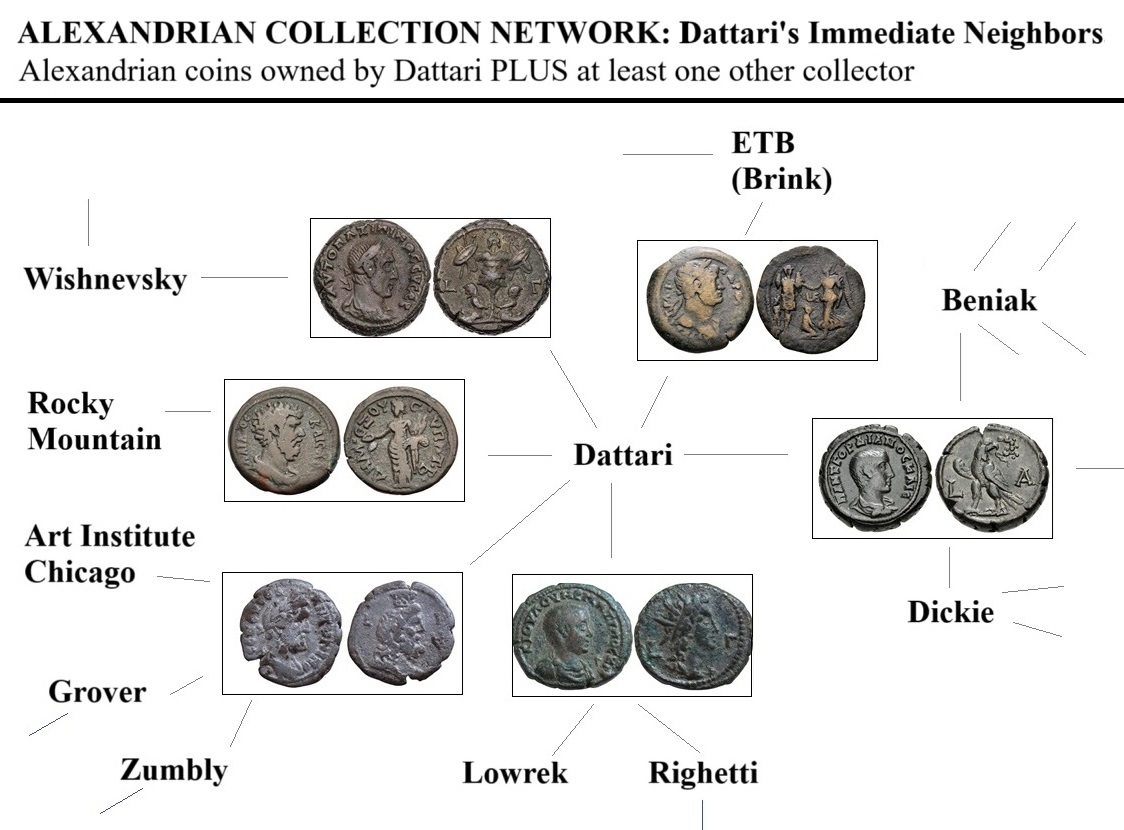
The coin was previously in the collections of Kammerer and Dattari (plus the unknown consignor to Malter 1). That means I can follow my Dattari coins as their provenances sprawl outward to their later collectors. Those collectors’ other coins (now in my collection) connect to hundreds of other collectors.
The first step is to describe only Dattari’s direct connections based only on coins in my collection:
1. Giovanni Dattari → Beniak, Brink, Dickie, Grover, Lowrek, Newell, Righetti, Staffieri, Wishnevsky, et al. (Here’s an old draft of the “step one” diagram.)
So, my coins formerly owned by Dattari had also been owned by those nine collectors. For most of those collectors, I own several of their coins. For example (I repeat this for all 9, then for all of their connections, and so on):
2. → Dr. Thomas E. Beniak: I have at least 7 coins, which are connected to at least 5 additional collectors (besides Dattari). One of them (Commodus Tet.) is the Aiello Collection.
3. → John Aiello: I own at least 8 coins, including several that were connected to 6 other collectors (plus literature). One is a Phlious AE previously in the BCD Collection.
4. → BCD (step four): Over 100 coins, previously owned by dozens of other collectors. One of them is:
2 & 5. → Righetti who, as noted above (step 1), was also connected directly to Dattari. This makes a second pathway between BCD and Dattari (shorter, only 3 individuals), forming a social network diagram in the shape of a loop or circle of 5 individuals.
Change Log (return to top):
12 Jun 2023 (draft created); 13 Jun 2023 (page published, initially with 10 coins, many more to add!); 24 Jun 2023 (additional coins to 14); 12 Jul 2023 (added 4, incl. 2 Hadrian ex ETB Collection); 8-11 Mar 2024 (5 Added: Trajan Drachm ex JHU-Wetterstrom; Commodus ex Beniak et al.; Claudius II ex AK & Weder; Carinus ex Simonetta & Staffieri; Aielus ex Dattari); 22 Mar 2024 (Sev Alex Caesar & Gallienus, ex Beniak et al.); 19 Apr 2024 (Gordian III & Maximianus, ex Beniak et al.); 10 Jun 2024 (Julia Mamaea ex Curtis, Dickie, Beniak); 11 Jul 2024 (Maximinus Eirene ex D4570, Beniak); 4 Aug 2024 (Maximus ex Dattari, Righetti, Lowrek); 2 Oct 2024 (Numerian ex Beniak, Dickie, Argyll); 30 Oct 2024 (L. Verus & Maximinus ex Wishnevsky et al; Gordian III Caesar ex Beniak et al; Commodus, Trajan, Alexander-Mamaea ex Staffieri et al); 14 Oct 2025 (Nero ex Luxor, Geissen references added for 5 more [7 total]); 31 Dec 2025 (some tag photos added for ex-Grove/AIC Trajan & Antoninus Pius, now shown with a Gordian III); 30 Mar 2026 (new Kampmann & Ganschow photos); 29 Jul 2026 (Sev. Alex. RY 10 Tyche ex Aiello, AIC, Grover, Dattari).