Celts through Central Greece [>49 Coins]
Created: 3 Sep 2022 ; Last Updated: 21 Dec 2025
(most recent: Sattelkopfpferd, Tarentum, Chalkis, Ainianes, Camarina & 3 Catana AEs, 2nd Pyrrhos, Warren Sicyon, Thebae [Rogers 550], Heraclea ex Doyle, more Lokris AE [Apollo, Demeter], Sikyon AE, Obol, Apollonia, Aegina, Boeotia AE, Phlius)
Other Pages in this Series:
- Return to: The “Top Shelf”: Object Biography, Plate Coins & Provenance Glossary
- Continue to: Page II (Greek, East: Asia Minor, Persia & Jewish Coinage)
- Continue to: Page III (Roman Provincial: Eurasia)
- Continue to: Page IV (Roman Provincial: Egypt)
- Continue to: Page V (Roman Republican & Imperial)
- Continue to: Page VI (Byzantine & Contemporaries)
Contents of This Page (or click photos or scroll):
Celts (Iberia, Gaul, C. Europe) [5 coins];
Magna Graecia & Sicily [7 coins];
Central Greece, p. I (Thrace, Macedon, Thessaly) [11+ coins];
Central Greece, p. II (Akarnania, Lokris, Phokis, Euboia) [12+ coins];
Central Greece, p. III (Peloponnesos, Athens, Corinth) [14+ coins];





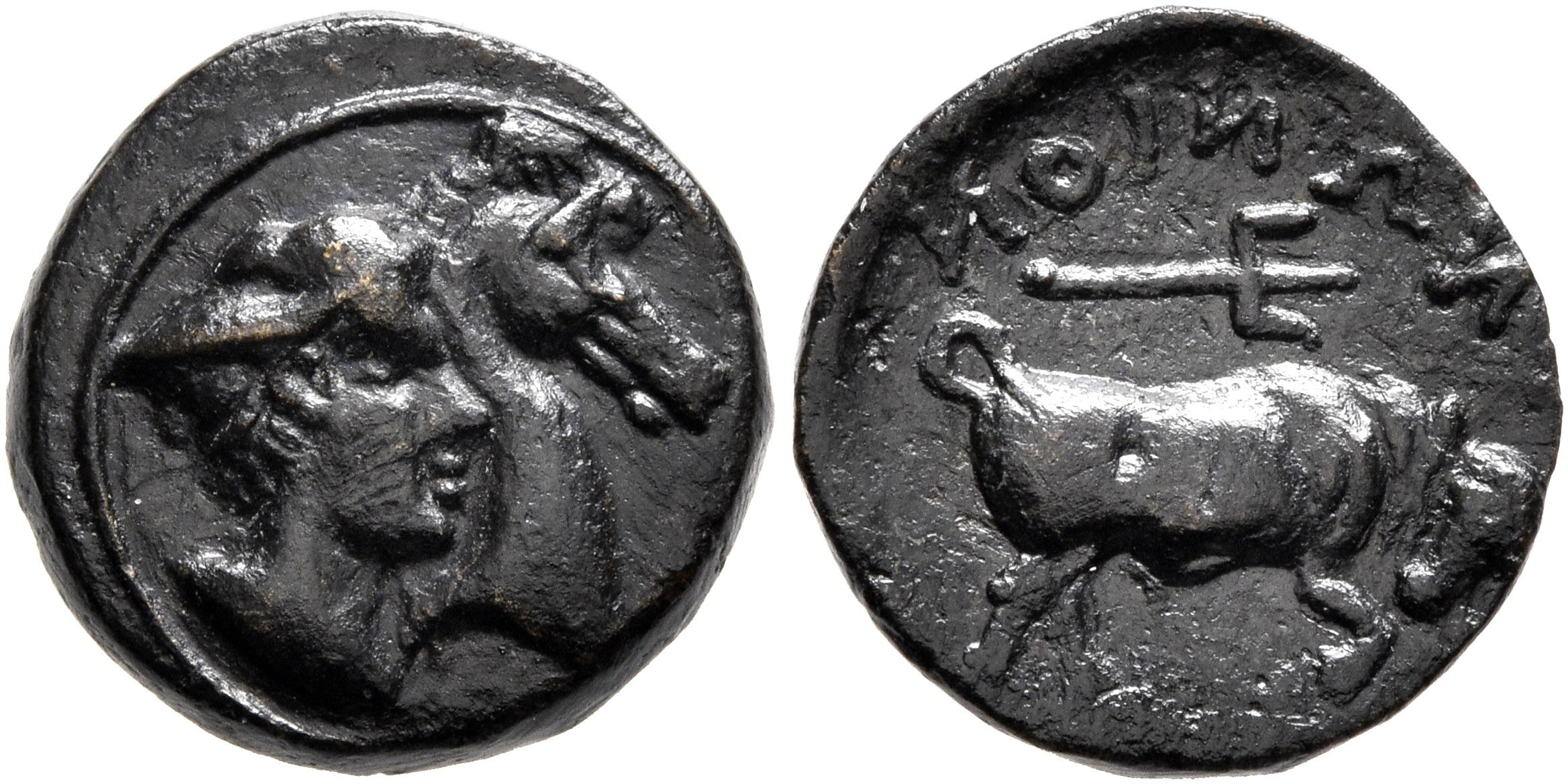

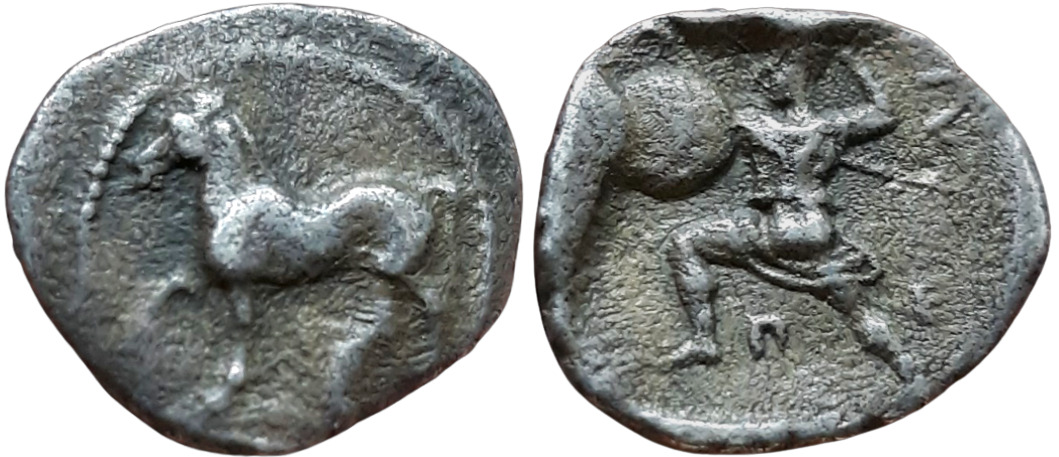
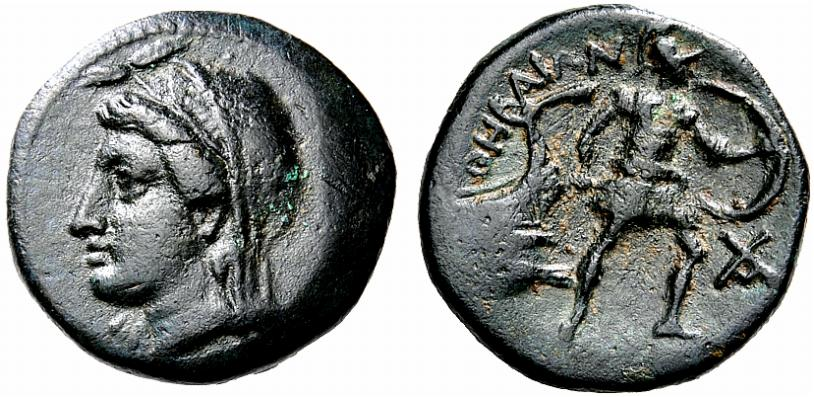

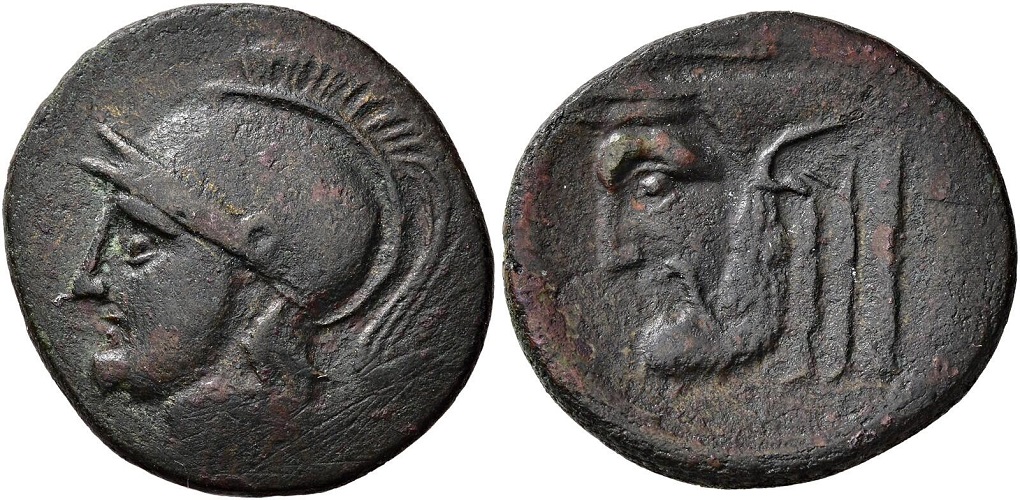
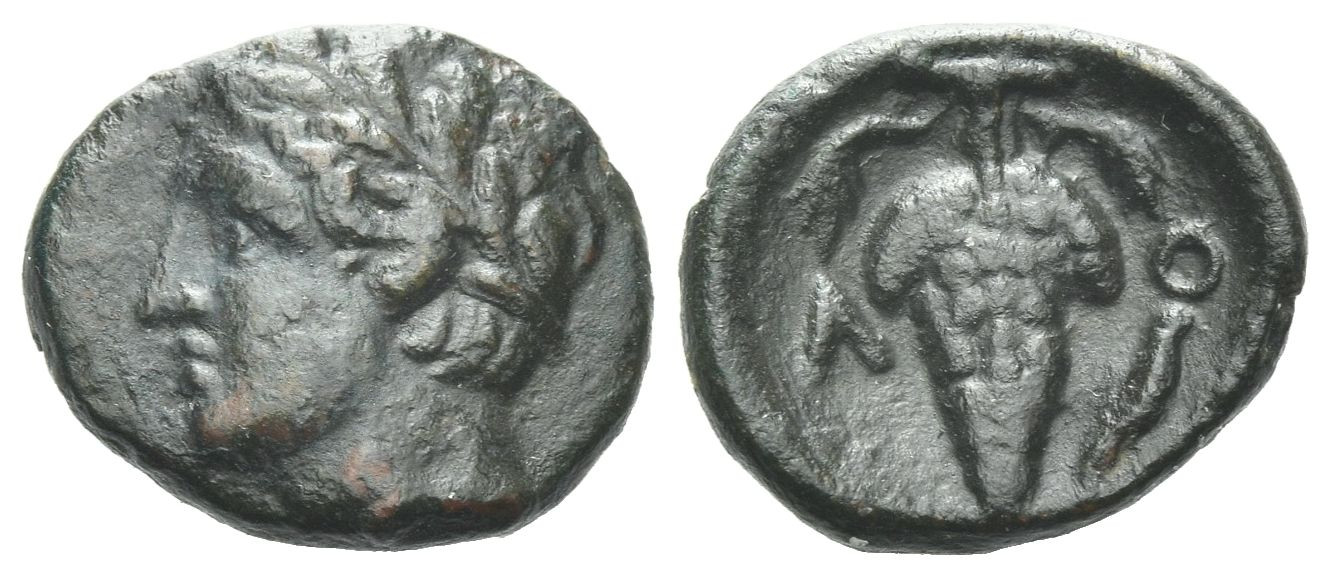
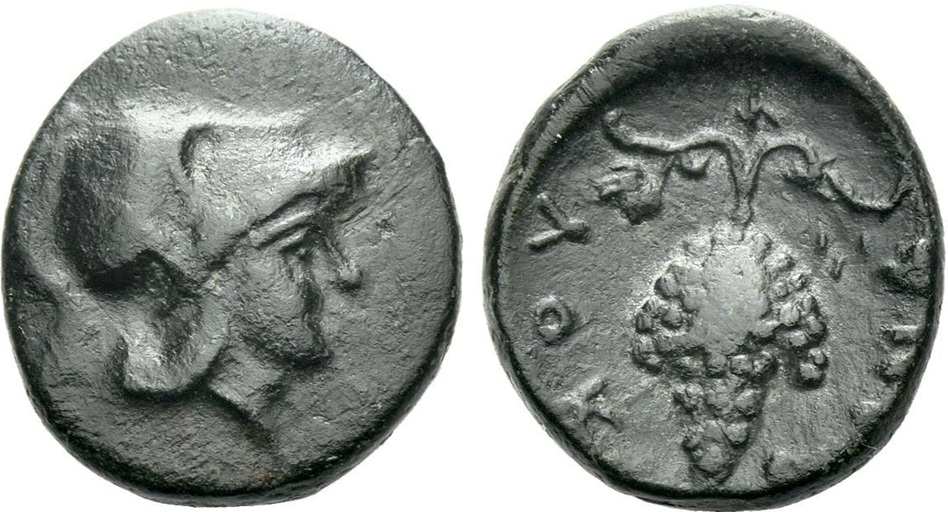
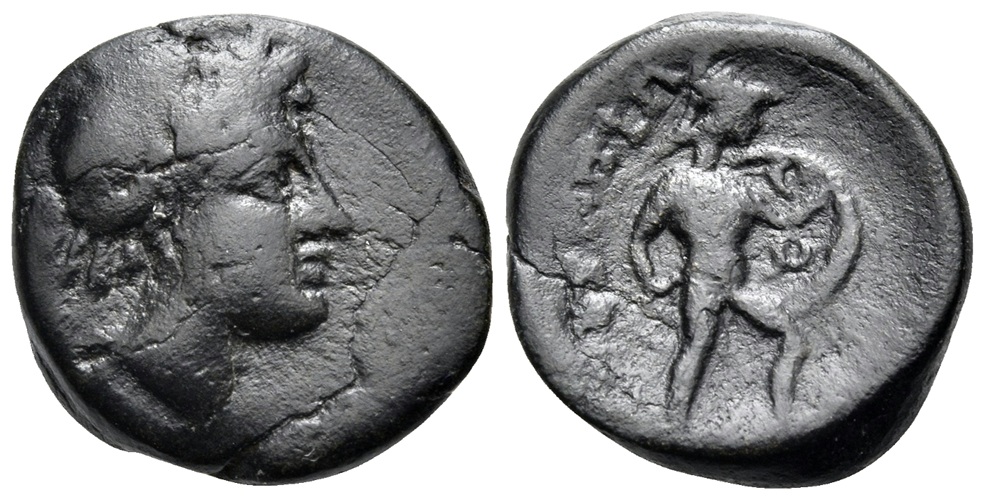

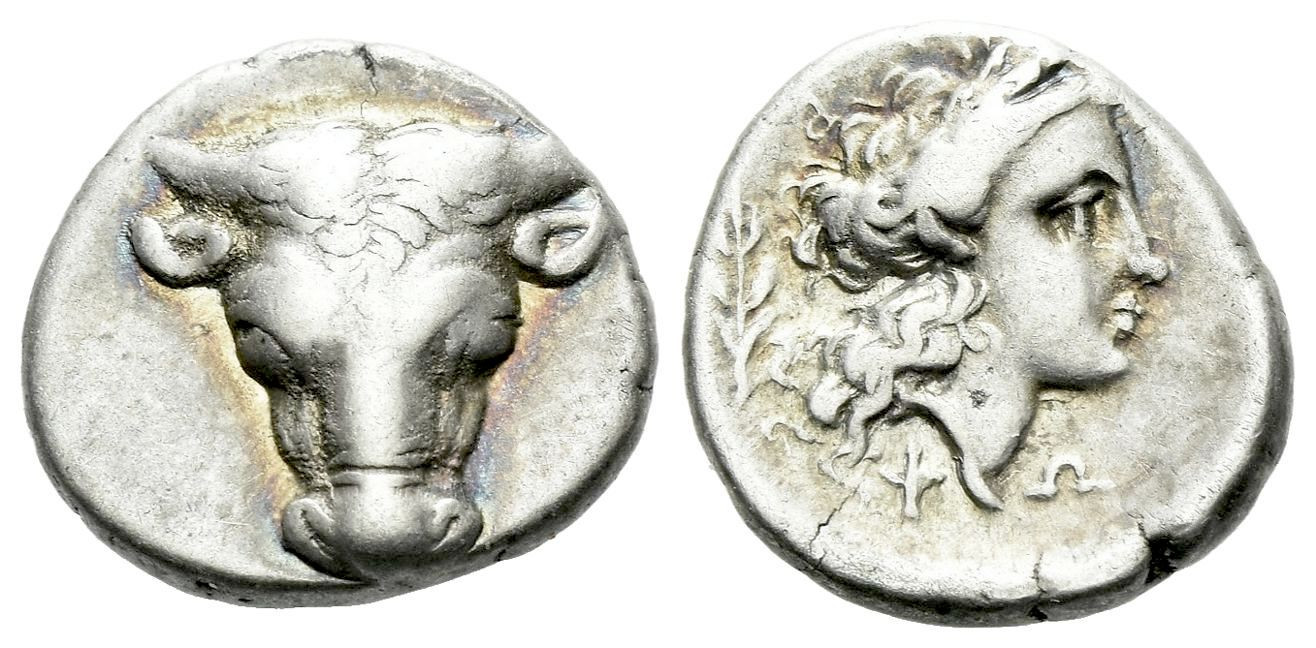





 (please reload if photo grid doesn’t fill completely to left)
CELTS & NEIGHBORS [5 Coins; top]:
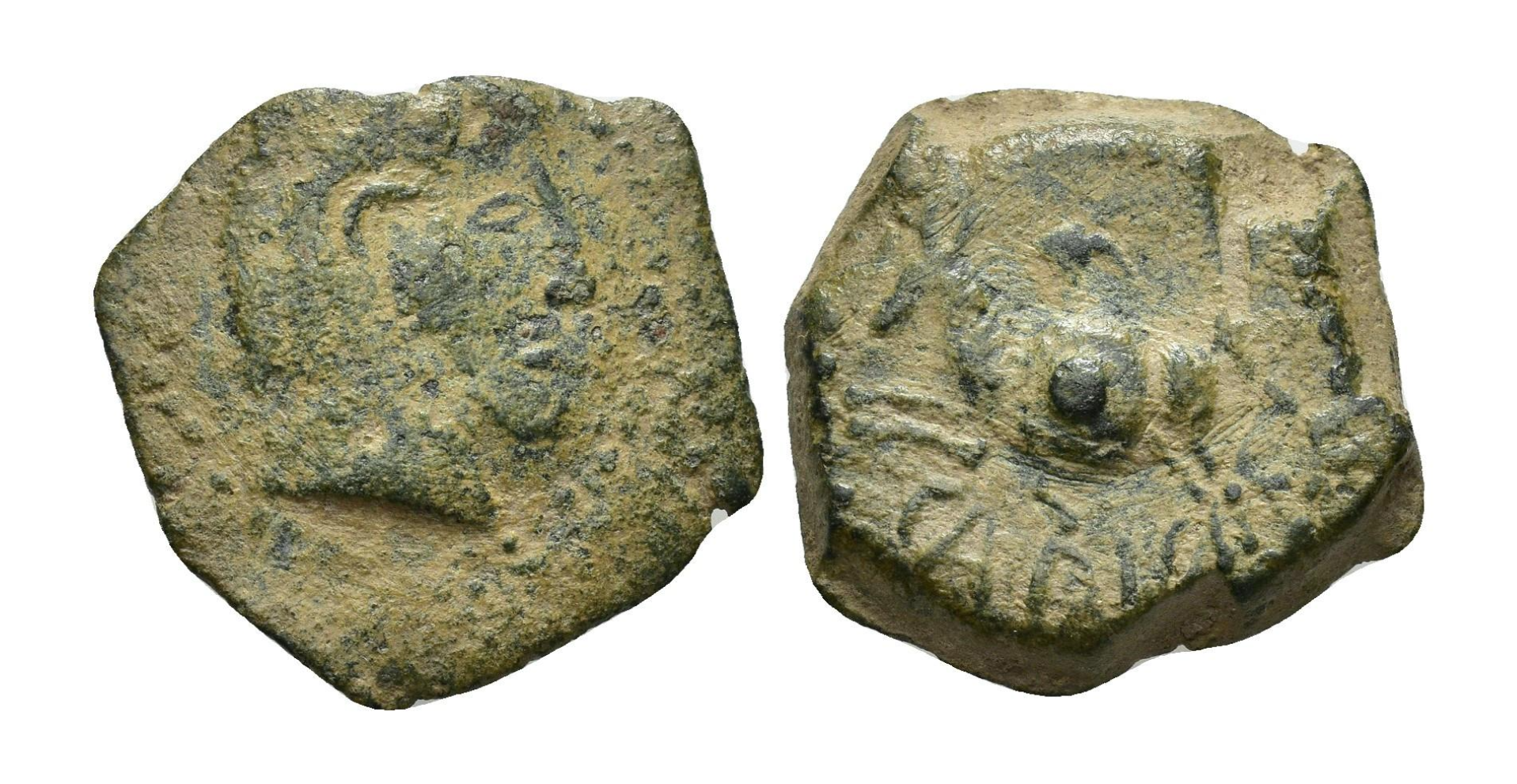
Celtiberians, Carisa AE Semis (25mm, 9,94g), c. 120-80 BCE. Bearded male head r. / Horseman w round shield, CARIS A.
(Photo credit: Vico.) Collection History:
– Colección Cores [Gonzalo Cores Uria (1930-2020), Spain; Vico Subasta 156 (Madrid, 5 Mar 2020), 35].
Published:
– Cores (2017) Moneda Antigua de la Península Ibérica, Parte 1, No. 3365 (this coin illustrated);
– Moneda Iberica (Ripollès & Gonzalbes, eds.), MIB 194/13 (illustrated online as primary “digital plate coin”). 
Celts in S. Gaul (Cavares?) T. Pom. Sex. f. AE (Sextans? 16mm, 1.67g, 6h), 1st cent. BCE. Male bust, S-SEX F / Bull, T.POM.
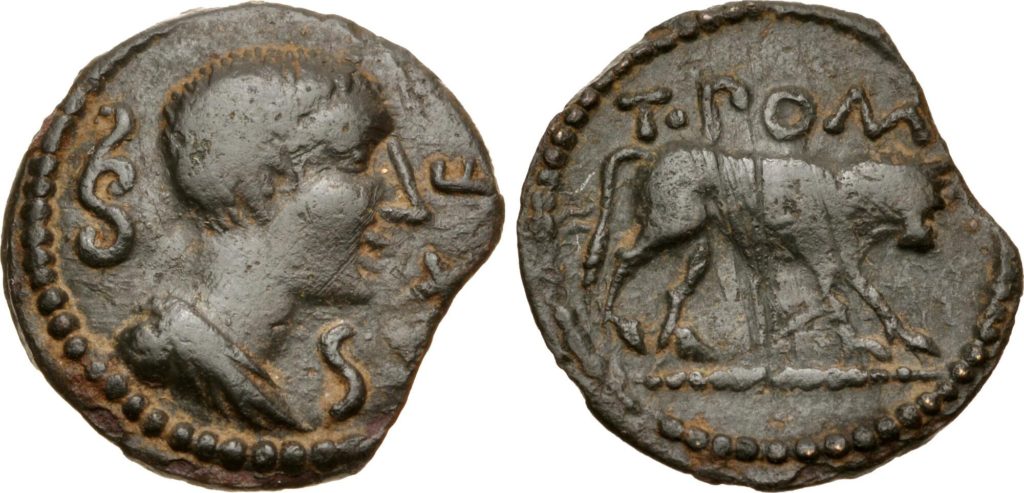
(Photo credit: CNG.) Collection History:
– Amb. Patrick Villemur (1946-) [Burgan 31 (Paris, 6 Nov 1992), 84; Triton XI (8 Jan 2008), 2];
– Nomus Brasiliana [Noenio Spinola (1940-), Brazil] Coll. (NB206).
Exhibited:
– BM&F Bovespa [B3 SA, São Paulo Stock Exchange] (28 Apr-26 Aug 2011);
– Associação Comercial da Bahia, “Dinheiro, Deuses & Poder…” (29 Sep 2011 –);
– BM&F [“Music, Mathematics & Money”] (12 Apr 2015 – 3 Nov 2016);
– Comissão de Valores Mobiliários (30 Nov 2016 – 31 Jan 2017).
Published:
– Depeyrot (2002) Numéraire Celtique (v. 1) 130.54 (this coin cited);
– RPC I Online 507, ex. 14 (illustrated, post-publication);
– (probably) Spinola (2011), Dinheiro, Deuses & Poder: A História Política do Dinheiro (“Gods, Money & Power: The Political History of Money”). (Unfortunately very hard to find in USA!)
Celts in Central Gaul (Sequani) AR Quinarius (12mm, 1.93g, 5h), 1st cent. BCE. Head of Roma / Horse. Q•DOCI – SAM•F.
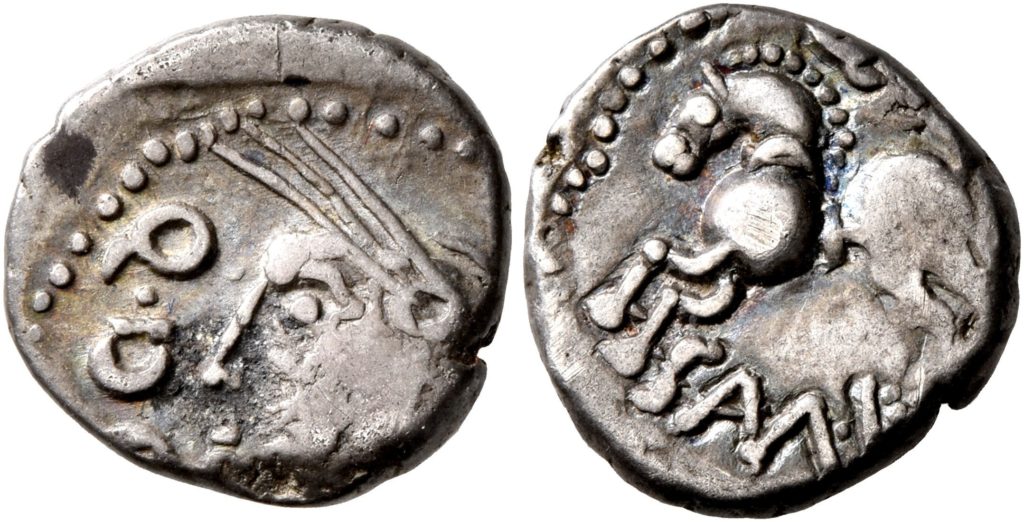
(Photo credit: Leu.) Collection Hist.:
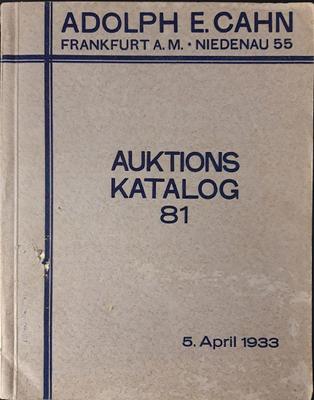
– Felix de Saulcy (1807-1880) Collection [Cahn 81 (5 Apr 1933), 1606 (part)];
– Fürstenberger Münzkabinett (Prince Karl Egon II [1796-1854] & descendants, curated by Freiherr Franz Simon von Pfaffenhoffen [1797-1872]);
– Gottlieb Wüthrich (1879-1946) Collection [Münzen und Medaillen AG, 1970s-80s, possibly FPL 445 (Jun 1982), 210 (“Av. décentré”)];
– “Old Swiss Collection,” formed 1970s [Leu WA 11 (22 Feb 2020), 4];
– Joachim Schlüter Collection [Leu WA 20 (16 Jul 2022), 109).
Publication Hist.:
– Wüthrich 115 (this coin cited on p. 28 & illustrated on Pl. V, 22), in Wüthrich, G. (1945), “Celtic Numismatics in Switzerland,” Numismatic Chronicle 5: 1-33, Pl. I-VII.
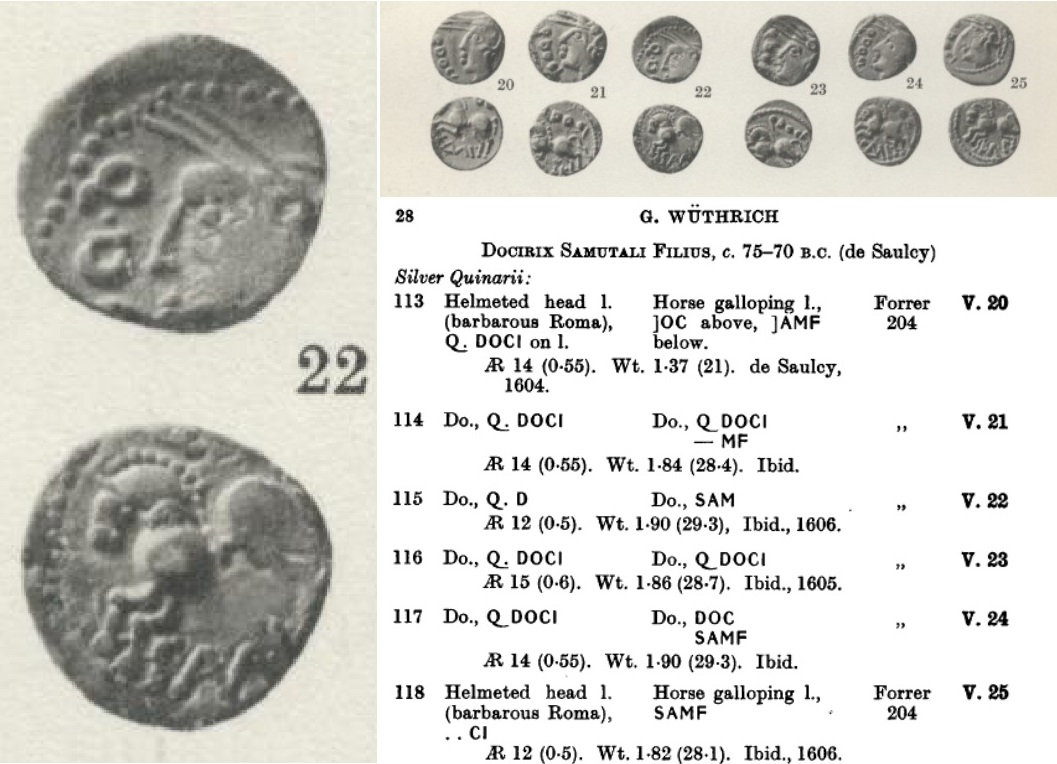
Notes: The same paper by Wüthrich was also presented to the Royal Numismatic Society at the 17 May 1945 meeting. Cited without comment in K. Christ Antike Numismatik (1967/1972: p. 49) [my copy exlibris G.F. Kolbe]. Described in Christ 1957 (pp. 242-3, n. 5) as important only for presentation of material (117 coins ill. on 7 pl.).

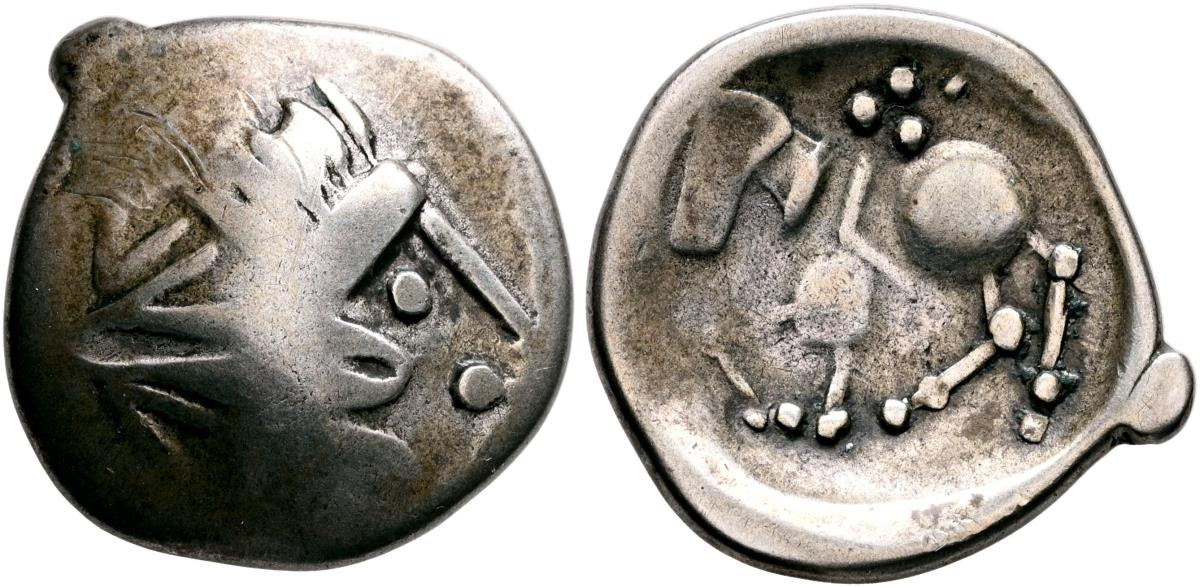
Geto-Dacians, Central Europe “Sattelkopfpferd” (Varteju-Bucaresti Type) AR Tetradrachm or Didrachm (7.18g, 21mm, 9h), 2nd cent. BCE. Celticized head / Celticized horse & rider.
(Photo credit: Leu.) Collection Hist.:
– Collection of Kurt Zimmermann (1937-2025) [Leu Web Auction 38 (13 Dec 2025), 27]:
– Collection de Monsieur Édouard Schott (1873-1954) [E. Bourgey (22 Mar 1972), 565];
– Robert Forrer (1866-1947) Collection;
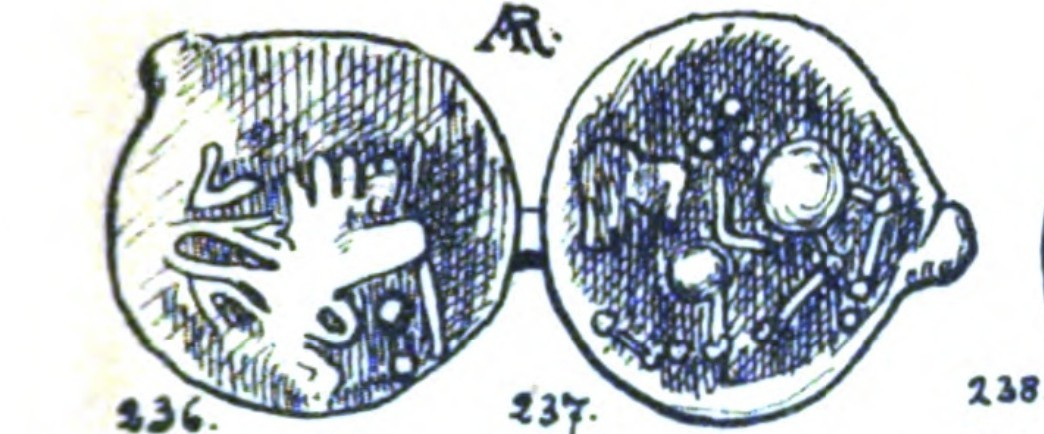
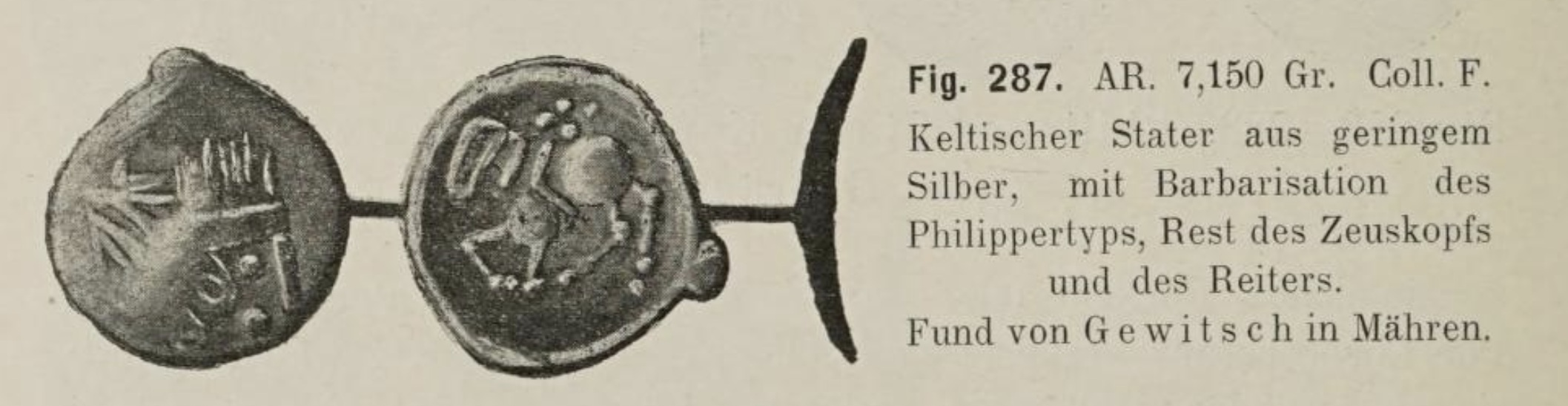
– (reportedly) ex Jevíčko Hoard (Fund von Gewitch in Mären), before 1891 (hoard considered doubtful by many later authors).
Published(with illustration):
– Forrer (1891), Fig. 236 (this coin illustrated in line-drawing on Pl. VIII), in: “Die keltischen Münzen und ihr Werth für die Prähistorie” [Part I], Antiqua IX: 5-14 u. ff. & Ppl.;
– Forrer (1904), Abb. 287 (this coin illustrated on p. 394), in: “Keltische Numismatik der Rhein- und Donaulande,” Jahr-Buch der Gesellschaft für Lothringische Geschichte und Altertumskunde XVI: pp. 385-469;
– Forrer 287 (this coin illustrated twice, on p. 150 & Pl. XXIII, cited again on p. 359), in: Keltische Numismatik der Rhein und Donaulande;
– Kolnîkovâ (1982) Fig. 6 (this coin illustrated in line drawing on p. 19, described in cited to hoard after Forrer on p. 20), in: “Mince predrímskej Dácie v Československu,” Numismatické Listy 37.1 [low-quallity image below from Snippet view/search].
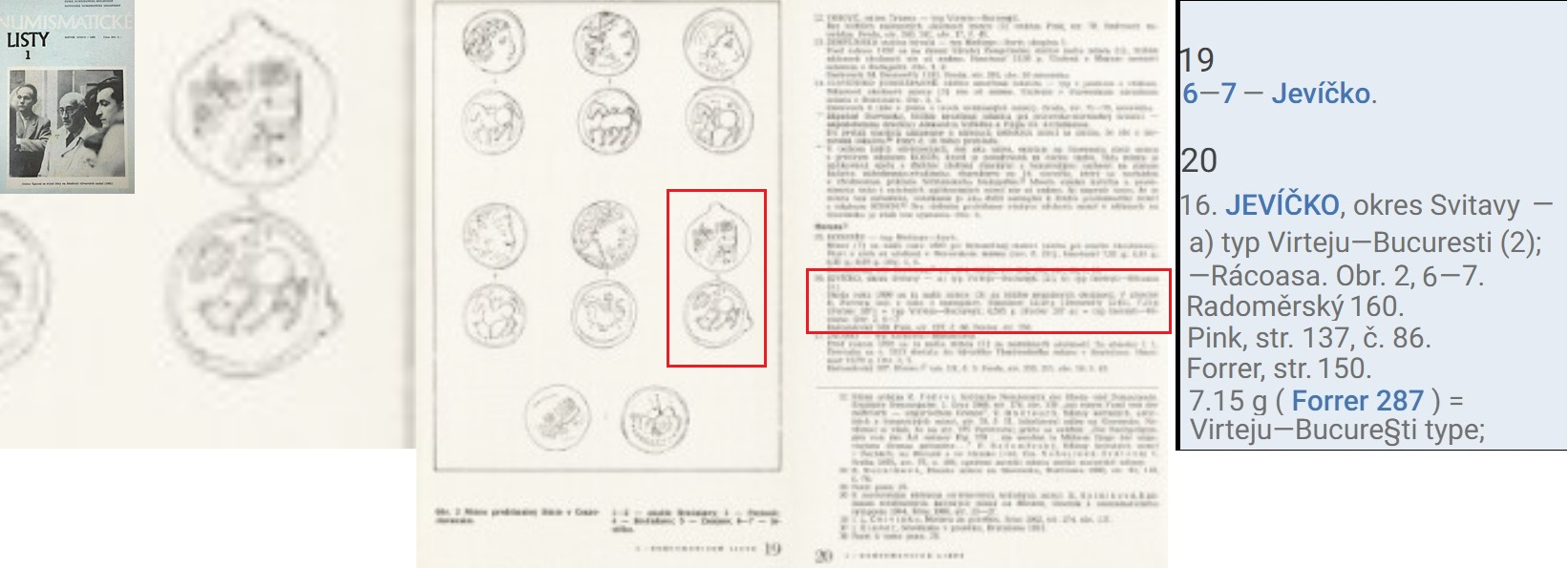
Selected Additional Publication History(cited w/out illustration):
– Eisner, p. 14 (this coin cited & hoard described), in: Jan Eisner (1927), “Mince t. zv. Barbarské na Slovensku a v Podkarpatské Rusi,” in Numismatický Časopis Československý Vol 3;
– Kolnîkovâ (1971) p. 41 (this coin described & cited to Jevicho Hoard), in: “Dako-Getische Münzen und Einige Probleme des Keltischen Münzwesens in der Slowakei,” in SCN vol. V: pp. 39-49;
– König 1965: p. 77 & 1966: pl. 138, nr. 11 (this coin cited in both), in: Marie König (1965), “Keltische Münzbilder als Geschichtsdokumente,” Celticum XII [to PDF] & (1966) “Keltische Münzbilder,” JPEK 21;
– Militký Hoard 13 (this coin cited), in: Jiří Militký (2016), “The Coins of the Taurisci and Norici Found in Bohemia and Moravia,” in Boii – Taurisci [to PDF];
– Nálezy I 160 (this coin cited on p. 174), in: Pavel Radoměrský (1955) Nálezy Keltských Mincí, in Nálezy minci v Čechách, na Moravě a ve Slezsku, E. Nohejlová-Prátová (editor);
– Numismatica Moravica vol. 2 (Brno Museum, 1965) p. 25 (this coin cited to Forrer p. 150, Fig. 287);
– Pink p. 78 (this coin cited & hoard described), in: Karl Pink (1939/1974), Münzprägung der Ostkelten und Ihrer Nachbarn;
– Preda Hoard 52 (this coin described & cited), in: Constantin Preda (1973), Monedele Geto-Dacilor (p. 240 & note 792) & his (1971) “Monedele Getice de Tip Vîrteju-Bucureşti,” in Studii şi Cercetări de Numismatică vol V (p. 70 & note 54) [to PDF];
– Rzehak (1913), p. 321 (this coin cited & hoard discussed in detail), in : “Die jüngere vorrömische Eisenzeit (Latènezeit) in Mahren,” Zeitschrift des Deutschen Vereines für die Geschichte Mährens und Schlesiens 17;
– Skutil, p. 15 (this coin cited), in: Josef Skutil (1934), “Moravska Addenda k Paulsenovi,” Numismaticky Casopis Ceskoslovensky vol 10;
– Slavova & Prokopov p. 692 (this coin cited), in: “Coin hoard with imitations of Philip II from Bulgaria.” МАИАСП 12: 685-709;
– and others.
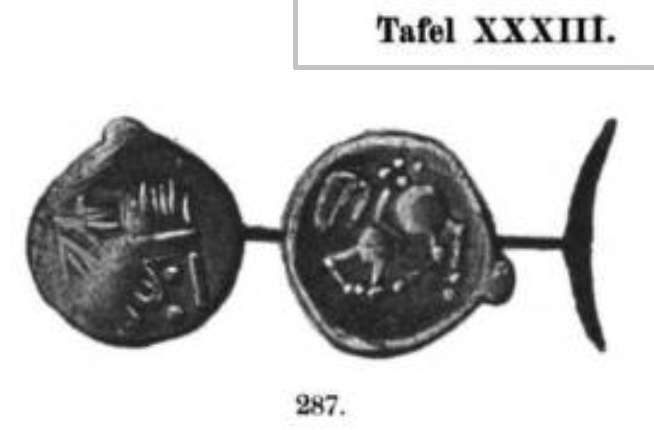
Notes: There is a lot to say about this coin, especially the controversial Jevicko hoard, from which Forrer claimed the coin originated. For now, I’ve just tried to list some of the basic data, but at some point, I’ll return to give an overview of the hoard’s scholarly history. (And possibly a bit about the history of numismatic illustrations.)
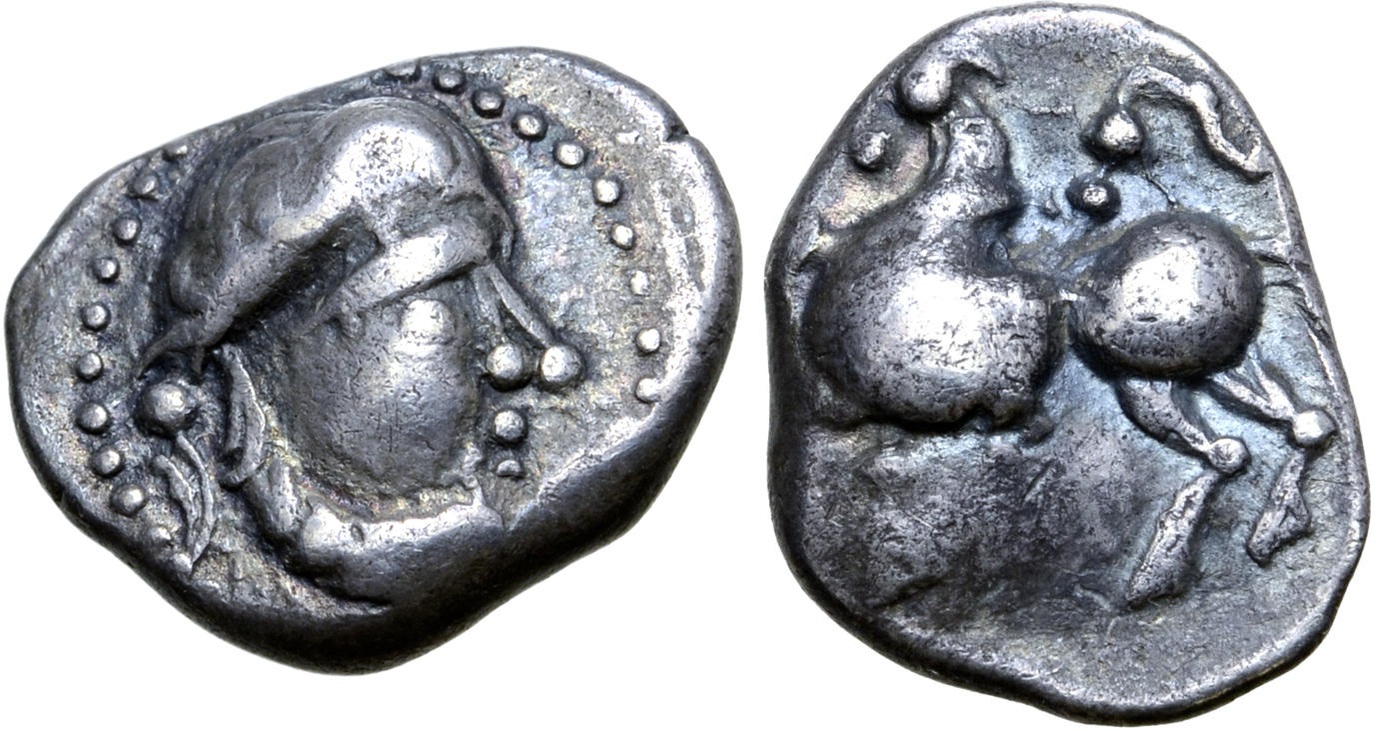
(Photo credit: Roma.) Collection Hist.:
– Hermann Lanz (1910-1998) [part II, Roma XVIII (London, 2019 Sept 29), 115].
Exhibited:
– Staatlichen Münzsammlung München, 1997 International Numismatic Congress, Berlin;
– Berliner Bank, 1997;
– Luitpoldblock Palmengarten, Munich 2003.
Published:
– Kostial – Lanz 422 (this coin, illustrated) in Kelten im Osten: Gold und Silber der Kelten in Mittel- und Osteuropa: Sammlung Lanz (1997 & 2003 eds., Munich: Staatliche Münzsammlung).
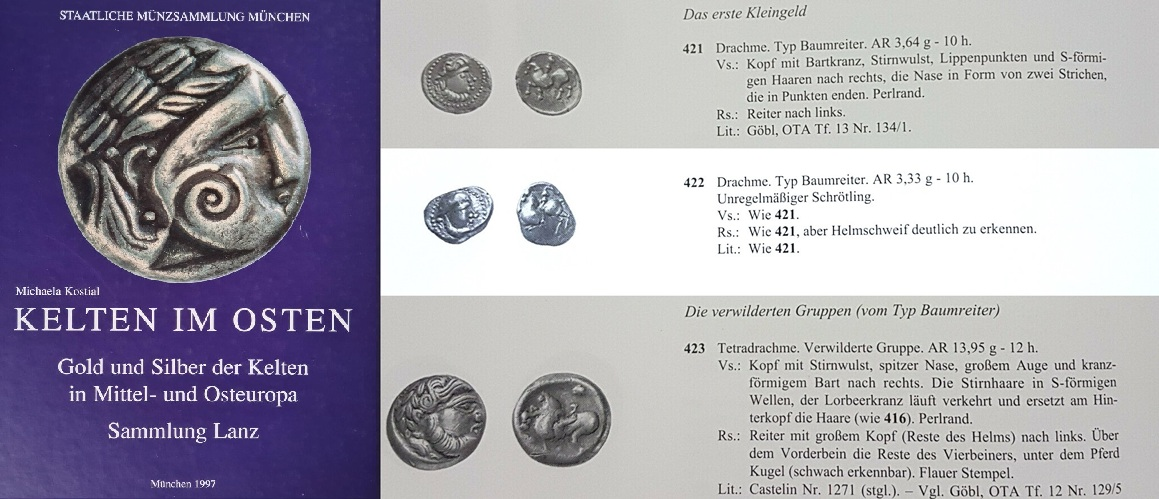
Also: “Digital plate coin” on Numista # 190528.

ITALY & SICILY [6 Coins; top]:
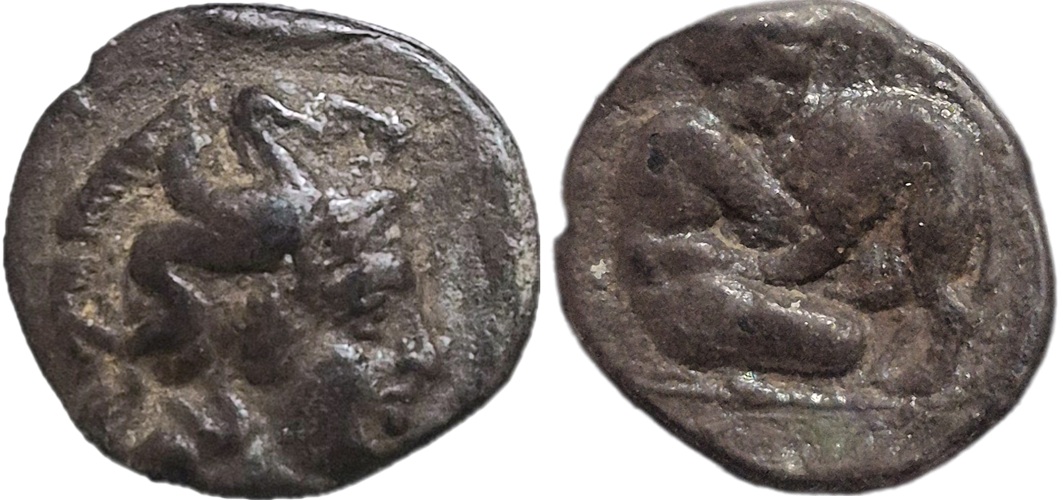
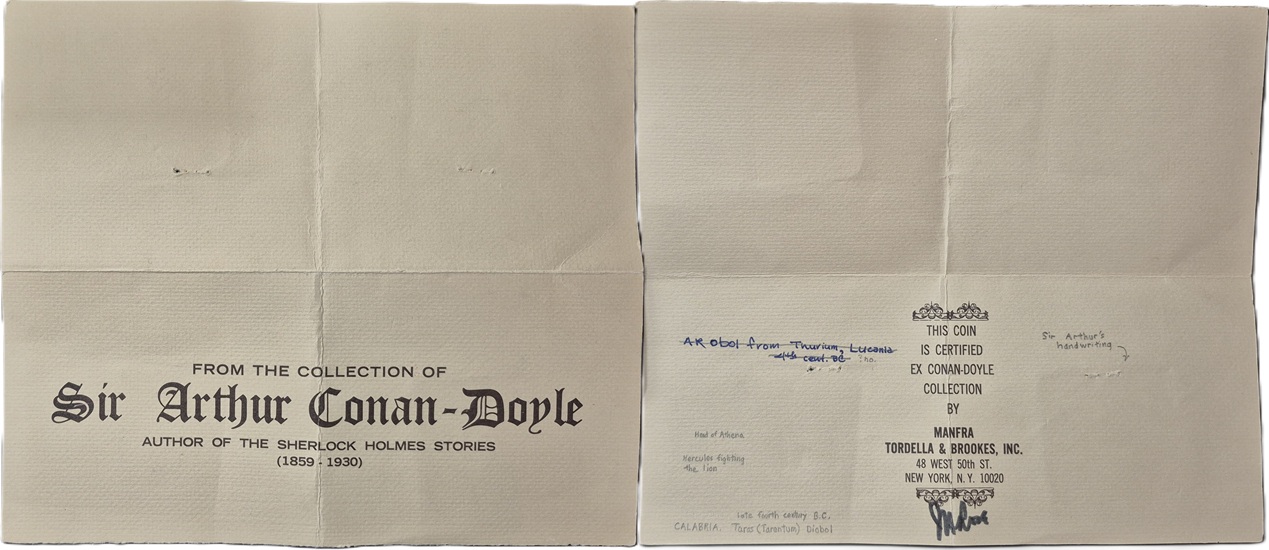
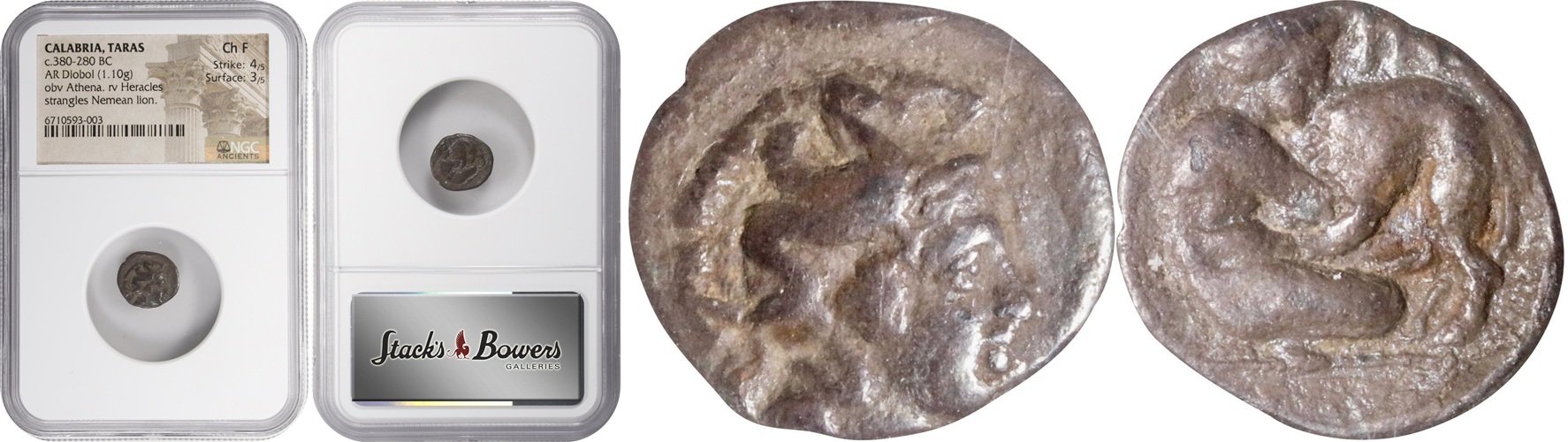
Lucania, Heraclea AR Diobol (11mm, 1.10g, 7h), c. 433-420 BCE. Athena / Herakles strangling lion, HE.
(Photo credit: CJJ & Stacks [slab & coin below, ed.].) Collection History:
– Sir Arthur Conan Doyle (1859-1930) Collection, to heirs [Manfra, Tordella & Brookes FPL (Fall, 1968), p. 5 (“Lucania,” corr. date), w/ their signed “Attractive Folder,” but ACD’s tag lost];
– Carola J. Ponterio Collection [Stack’s CCO Auction (12-16 May 2025), Lot 74011, corr. (mint & date)].
Note: Encapsulated by NGC 6710593-003 (corr., also wrong mint & date).
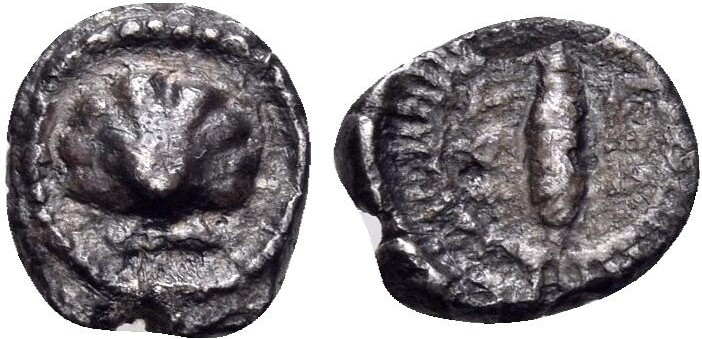
Calabria, Tarentum AR Hemilitron (7mm, 0.42g), 500-480 BCE. Cockell shell / Distaff.
(Photo credit: Nomos.) Collection History:
– Collection sans Pareille [Nomos 35 (15 Dec 2024), 956];
– Leo Mildenberg (1913-2001) Collection [w/ tag (shown below), acq. en bloc by CsP, 1970s];
– likely inherited ex Jacob Hirsch (1877-1955) Estate;
– Dr. S. Pozzi (1846 – 1918) Collection [not in Ars Classica].
Publication:
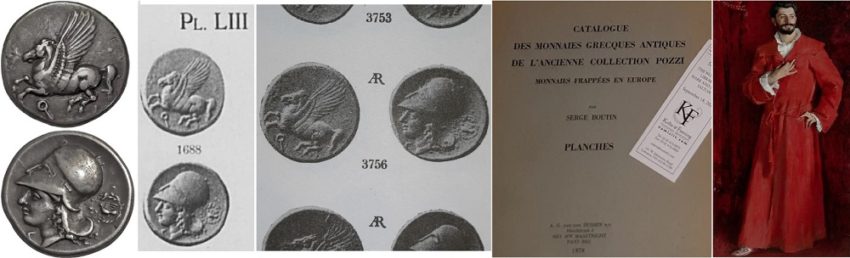
– Boutin 423 (this coin illustrated on Plate XVI, text on p. 24 [Tritémorion, 0.40g]) in Catalogue de Monnaies Grecques Antiques de l’Ancienne Collection Pozzi (1979, Maastricht: van der Dussen).
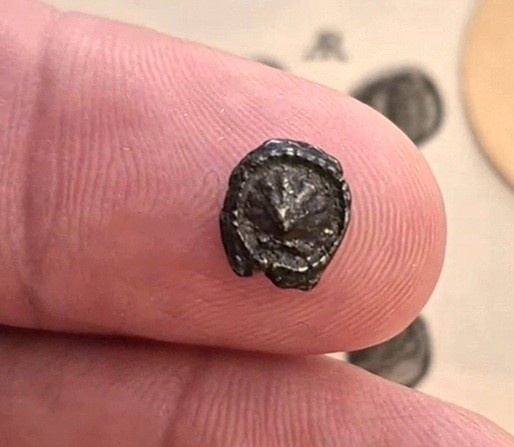
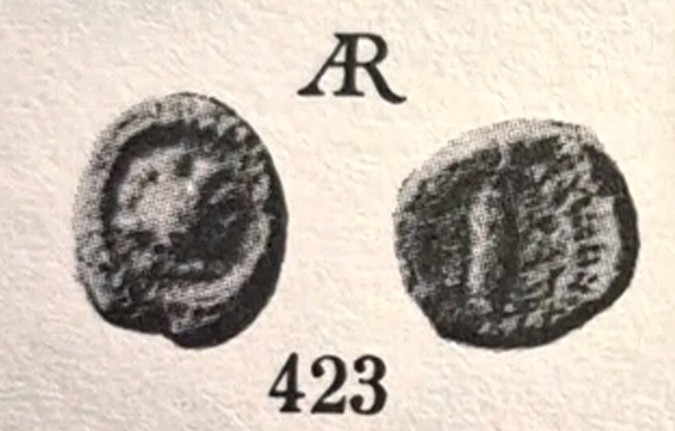
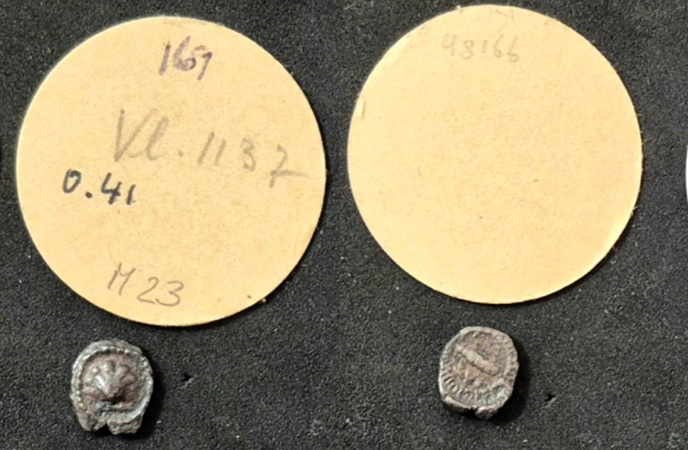
Prov. Notes: Relatively rare type, surely even more so in the pre-metal detector era (as w/ most tiny fractions). Nonetheless, many major early 20th cent. collections managed to find one (Vlasto, two): Côte 38 = Weber 528 ; Jameson 97 = Evans ; Vlasto 1137 = Moltheim ; Vlasto 1138. Sadly, Pozzi’s source for this coin is apparently unrecorded.
Hist. Notes: The distaff on the reverse is a tool used in spinning wool, one of the major industries of ancient Taras alongside fishing, especially in combination with the dies produced locally from the murex shell. A 3rd cent. BCE poem by Leonidas of Tarentum reads as follows:
“Often she shook off evening and morning sleep, / The old woman Platthís, so she could keep / Poverty far distant; grizzled and grayed, / To distaff and to spindle, spinner’s aide, / She sang until the dawn around the place / Of the long course of Athena, moving with grace, / Twirling in wrinkled hand on wrinkled knee / Enough thread for the loom; lovely was she, / At eighty years the Acheron perceiving, / Who, beautiful, was beautifully weaving.” (Epigram V; Fain 2010: 52)
Bruttium, Rhegion AR Hemilitron (7mm, 0.31g, 12h), 450-435 BCE. Lion mask / RECI in wreath, controls above/below.
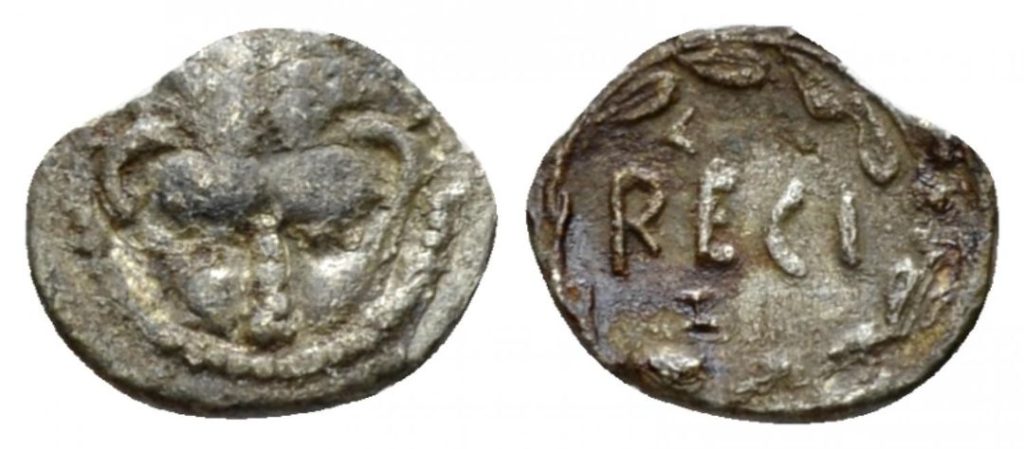
(Photo credit: Naville.) Collection History:
– Elvira Clain-Stefanelli (1914-2001) [Naville 38 (10 Mar 2018), Lot 41 (corr., denom.)].
Published:
– Plate coin in E. E. Clain-Stefanelli (1987) RBN, “Fractional Silver Coinage of Sicily and Magna Graecia” [PDF], plate XII, fig. 32-33, and p. 57.
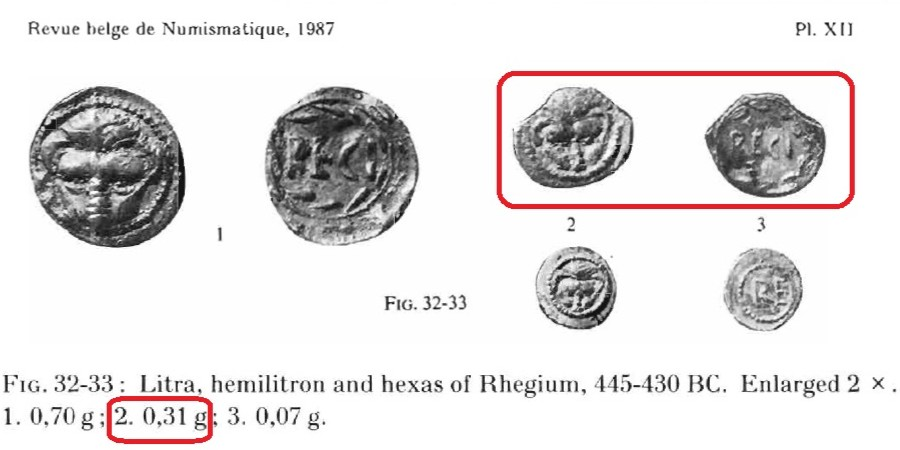
Notes: The AR Hemilitron is much rarer than the larger Litra. The best known example is the Herzfelder / Münzhand. Basel 4 specimen (Prince W.) = ANS (Newell) (same obv. die as mine). ACSearch archives 2 more: M&M GmbH 49, 32 & BFA EA 64, 115 = EA 32, 137. Unique w/ controls: K (or <?) / I (Zeta, or sideways H [Eta]?).
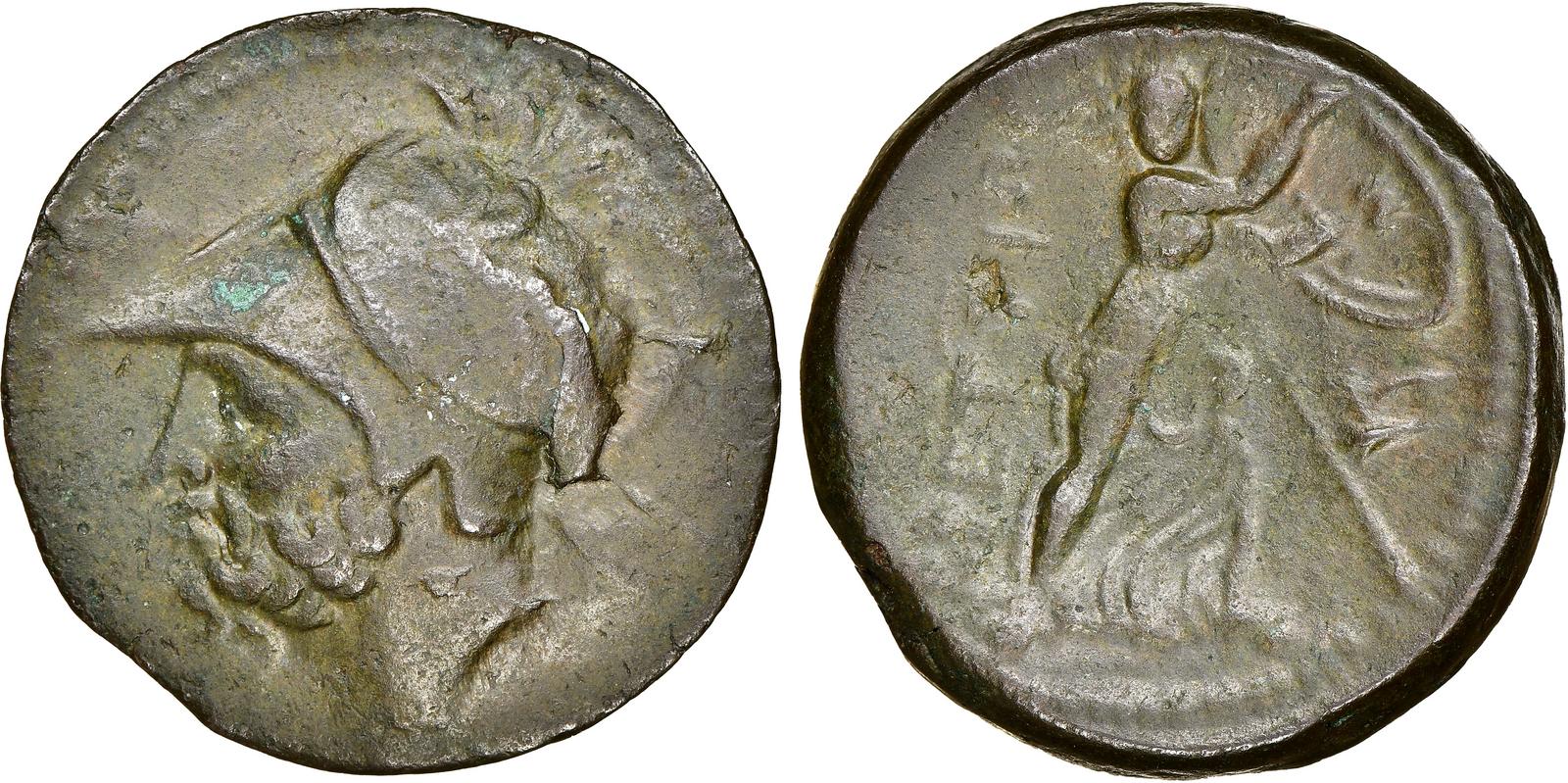
Bruttium, Brettii AE Didrachm or Reduced Sextans (24mm, 9h), c. 211-208 (?) BCE. Ares / Athena, plow [unique var.?].
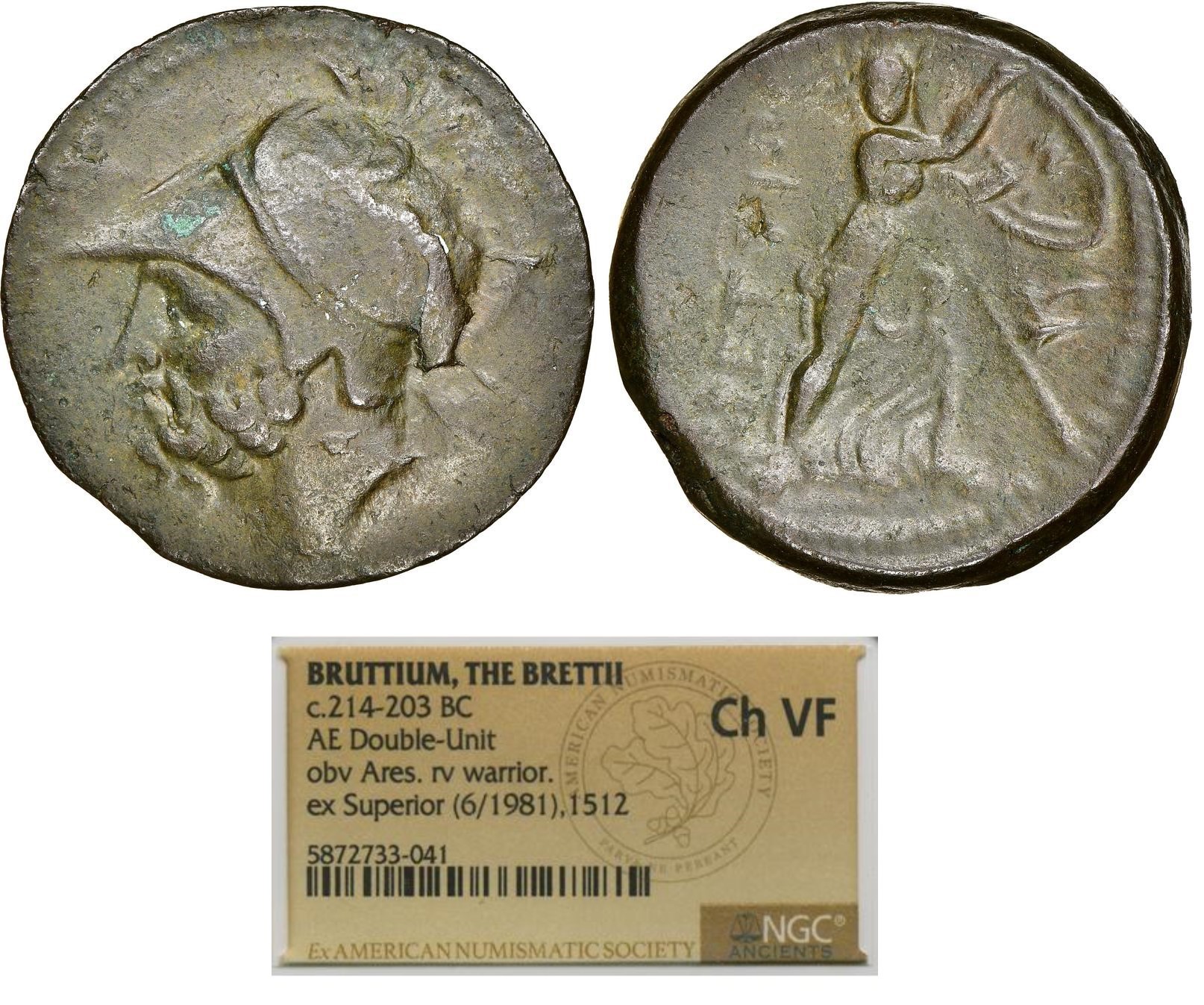
(Photo credit: CNG.) Collection History:
– Miguel Muñoz (1909-1989) [Part III, Superior (Beverly Hills, 10 Jun 1981), 1512];
– Robert W. Bartlett (1931-2017);
– American Numismatic Society [Bartlett Bequest; CNG Keystone 4 (2 Sep 2021), Lot 9];
– NGC 5872733-041, encapsulated w/ custom “Ex American Numismatic Society” label, noting also “ex Superior (6/1981), 1512”.
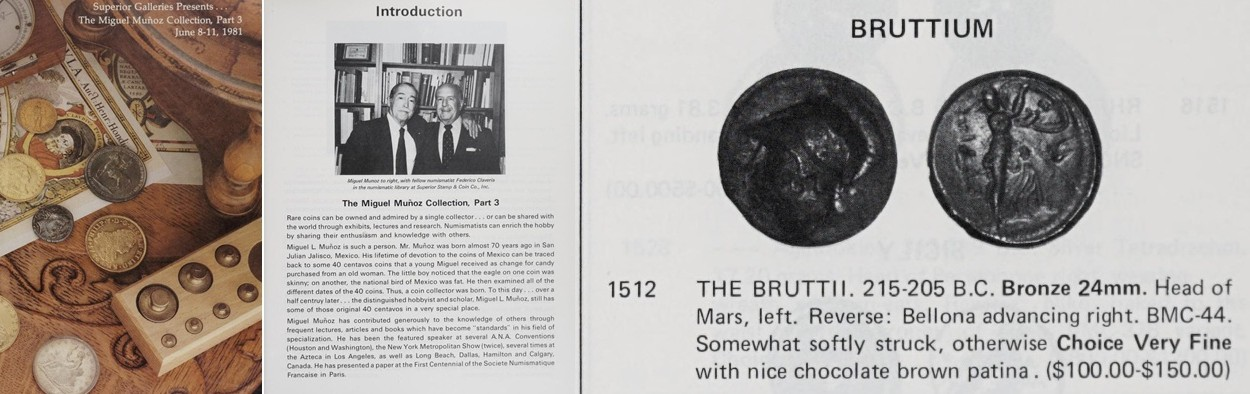
Substantine Notes: The control symbol on the reverse right field (plow?) seems to be unpublished on this type, though possibly found on other Bretti types, especially the Herakles/Athena AEs (acsearch examples). (Cont. below: Note, Bretti symbol.)
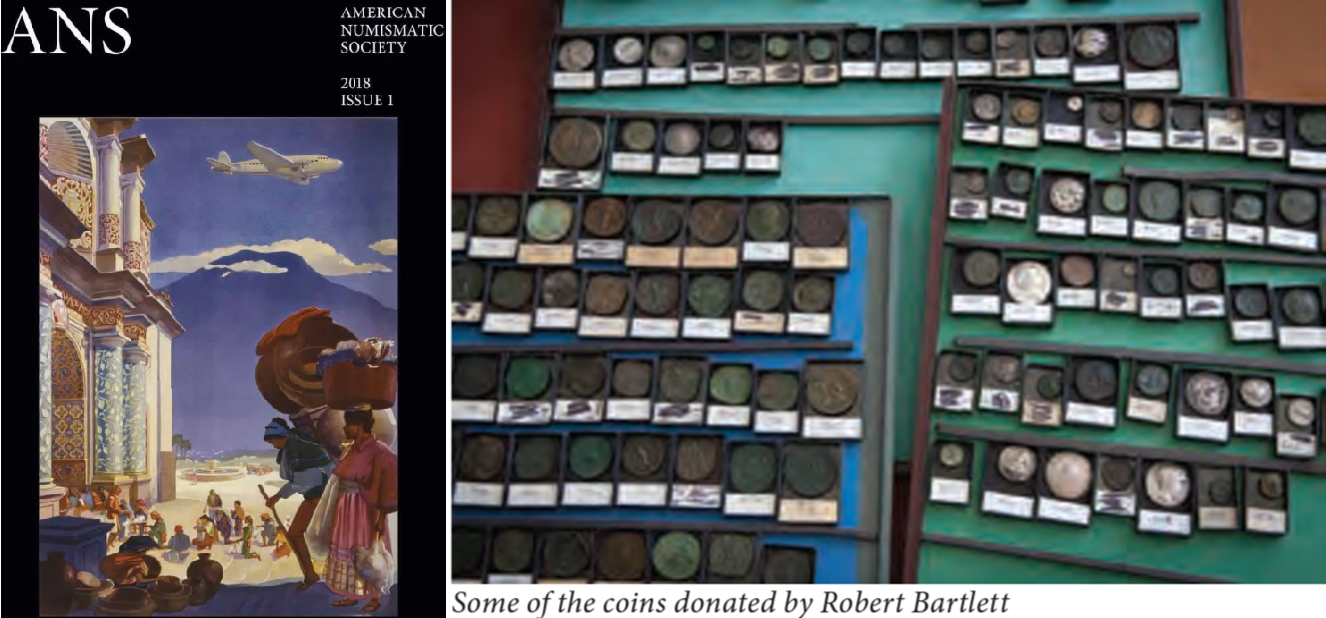
Provenance Notes: See Note, Bartlett-Muñoz on the collectors. Shown above: ANS Magazine 2018, Issue 1: p. 62; group photo, Bartlett bequest in trays at ANS, New York. For edited photo highlighting which coins I think are mine (this coin & Divus Augustus Sestertius = Keystone 4, 141), see my Bartlett provenance photos on Imgur.
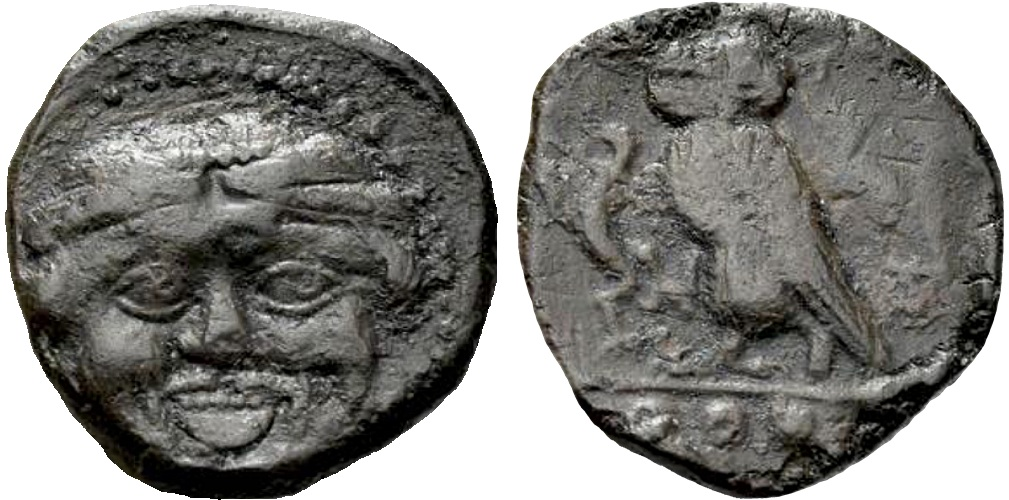
Sicily, Camarina AE Tetras (14mm, 3.17), c. 420 BCE. Gorgon / ••• Owl grasping lizard.
(Photo credit: Naville.) Collection History:
– “Lord Grantley,” John Richard-Brinsley Norton (1855-1943), 5th Baron of Grantley, w/ his collector tag [Glendining, Part VI (29 Jun 1944), Lot 2248 (part of 34, incl. 4 Camarina)];
– Richard Cyril Lockett (1873-1950) Collection [Glendining, Part II: Greek I (25 Oct 1955), Lot 756 (part of 17, incl. 8 Camarina)];
– Cornelius Vermeule (1925-2008) Collection, sold for the benefit of the Boston Museum of Fine Arts [Triton III (30 Nov 1999), prob. Lot 1655 (part of 31)].
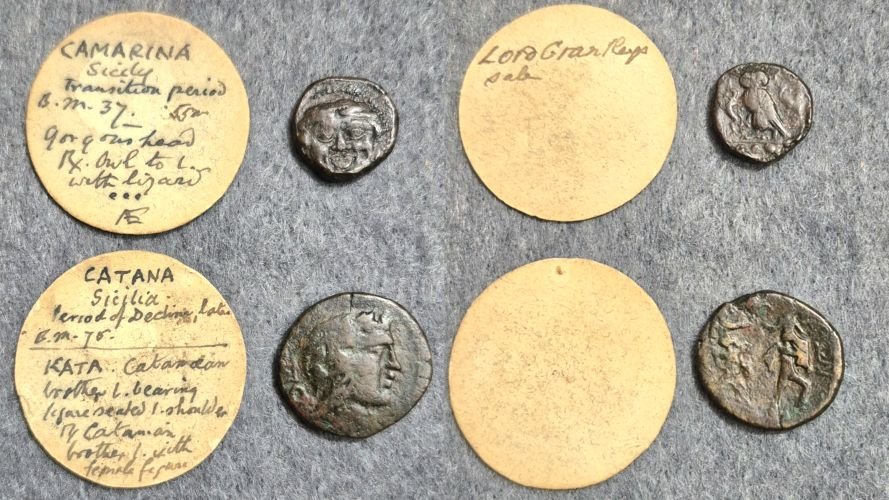
Above: Accompanied by a Catana AE (Demeter / Catanaean brothers), also ex Vermeule & Lockett, w/ tray tags in Lord Grantley’s hand. The annotation recording “Lord Grantley sale” is in Lockett’s hand.
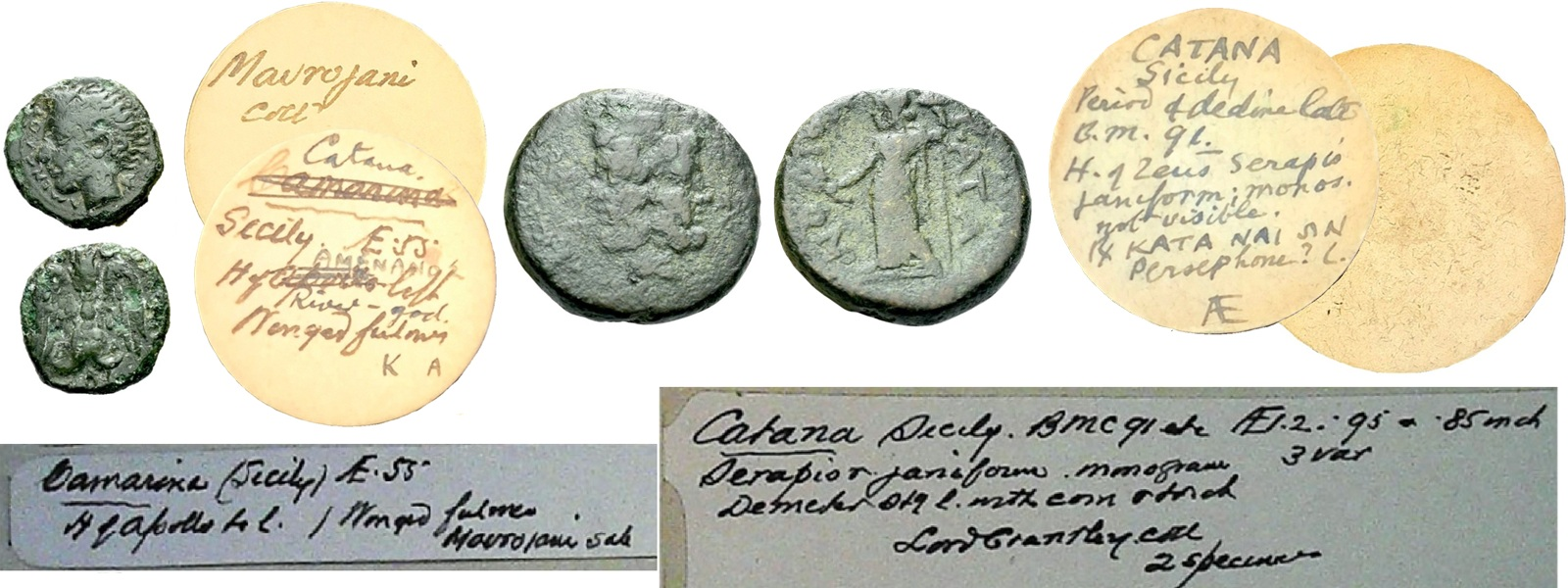
Two more Catana (Katane) AEs ex Vermeule, Lockett, and Grantley.
Left (Amenanos / Thunderbolt): Also ex Mavrojani (prob. Lot 19, twelve Catana AE). Lockett initially recorded it as Camarina (notebook excerpts from the BNS’s PDFs), later correcting his tag. (If a coin was ex Mavrojani & Grantley, Lockett usually recorded only the former.) This tag is in Lockett’s hand, though he preferred to edit older tags than to write new ones. The penciled “ΑΜEΝΑΝΟΣ” looks like Vermeule’s, though he usually used blue ink on tags (see, e.g., the Eumenia Nero on my RPC page or “Catalog Favorites”: Lockett).
Right (Janiform Serapis / Demeter): Ticket in Grantley’s hand, unaltered by Lockett or Vermeule.
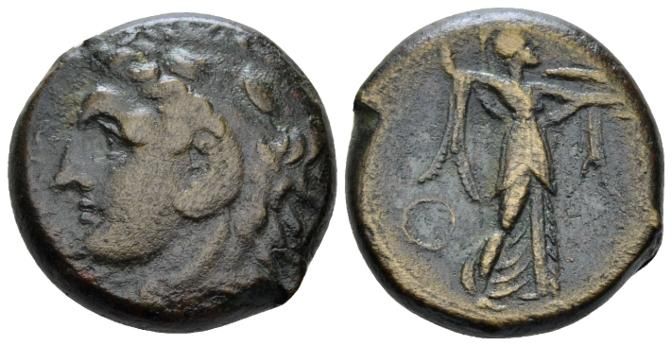
Sicily, Syracuse (Pyrrhos) AE Litra (22mm, 11.07), 278-276 BCE. Herakles / Athena.
(Photo credit: Naville.) Collection History:
– S. Mavrojani (1866-1930) Collection [Sotheby 9 Mar 1936, Lot 141 (part of 29 AE, 7 “Pyrrhus in Sicily,” bought by Baldwin for 4 pounds, 10 shillings), noted in Lockett’s purchase notebooks (Greek 12 AE Sicily)];
– “Lord Grantley,” John Richard-Brinsley Norton (1855-1943), 5th Baron of Grantley [Glendining, Part VI (29 Jun 1944), Lot 2251 (part of 44; possibly 2252, part of 59)];
– Richard Cyril Lockett (1873-1950) Collection w/ tray tag written in his own hand [Glendining, Part II: Greek I (25 Oct 1955), Lot 981 (part of 8)];
– Cornelius Vermeule (1925-2008) Collection, sold for the benefit of the Boston Museum of Fine Arts [Triton III (30 Nov 1999), prob. Lot 1655 (part)].
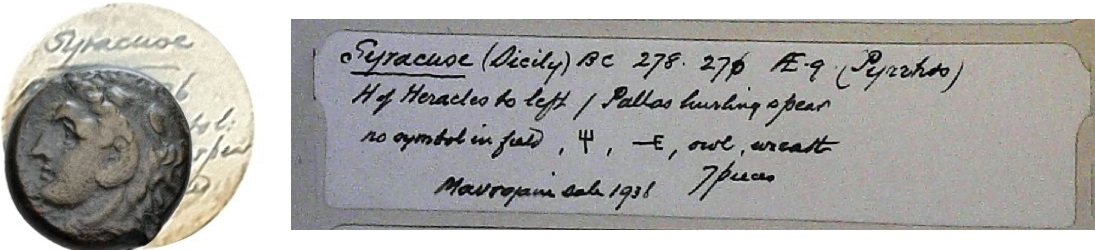
Above: Lockett tag & notebook. Below: Lord Grantley. His bio avail. in PDF from BNS.

Notes: Lockett’s ex-Mavrojani coins came mostly (probably entirely) via Grantley, though he often recorded only the former name. All 7 of the Mavrojani Pyrrhus AE of this type are mentioned in Lockett’s notebook entry (image below). See also Grantley Note below. (Grantley bio: PDF from BNS.)
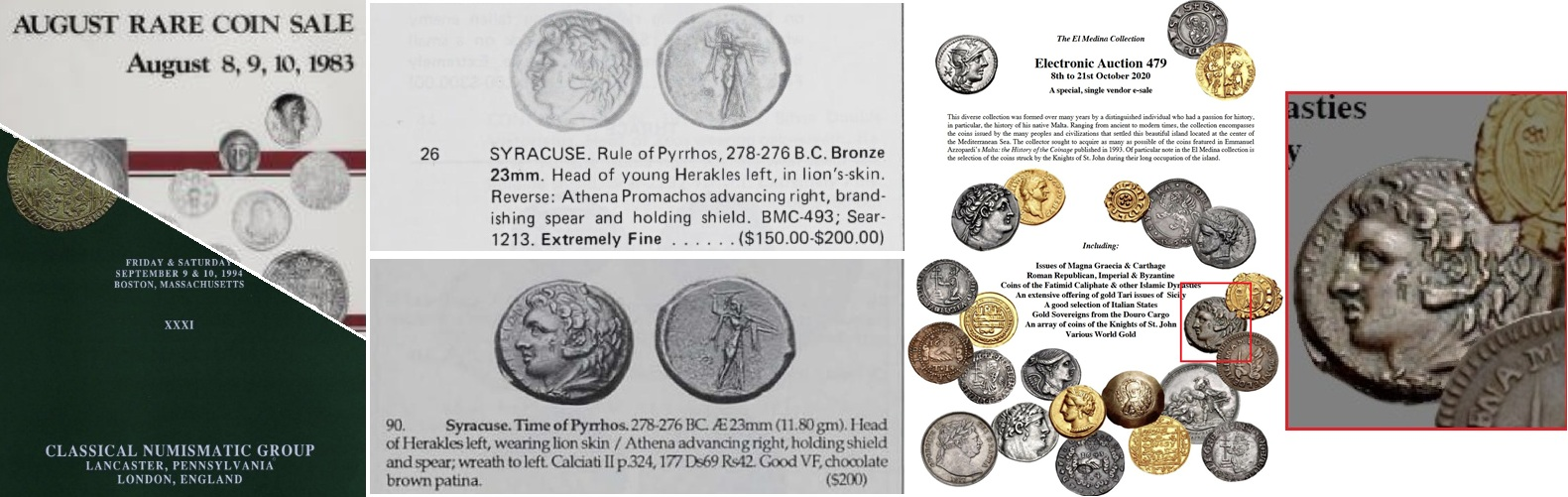
I have a nicer example, but have so far only traced the provenance to 1983:
Sicily, Syracuse (Pyrrhos) AE Litra (23mm, 11.80), 278-276 BCE. ΣΥPAKOΣIΩN, Herakles / Athena.
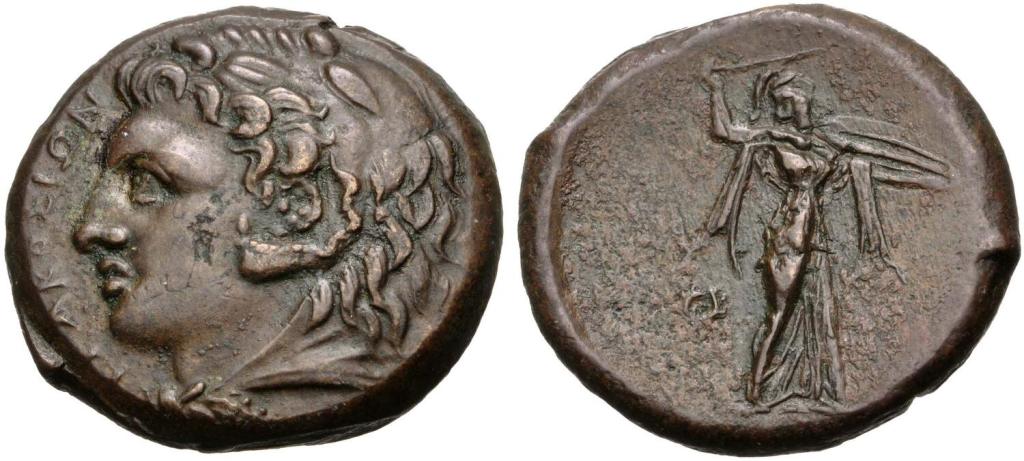
(Photo credit: CNG.) Collection History:
– El Medina Collection [Single-collection sale, CNG EA 479 (21 Oct 2020), 27, featuring this coin in promotional flyer];
– CNG Auction XXXI (Boston International Numismatic Convention, 9 Sep 1994), Lot 90;
– Superior Galleries August Rare Coin Sale (8 Aug1983), Lot 26.
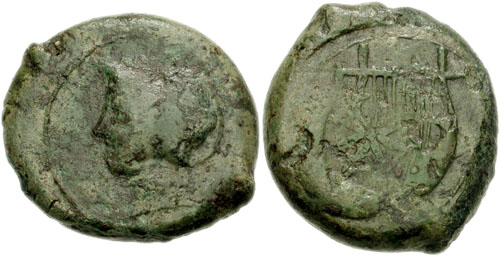
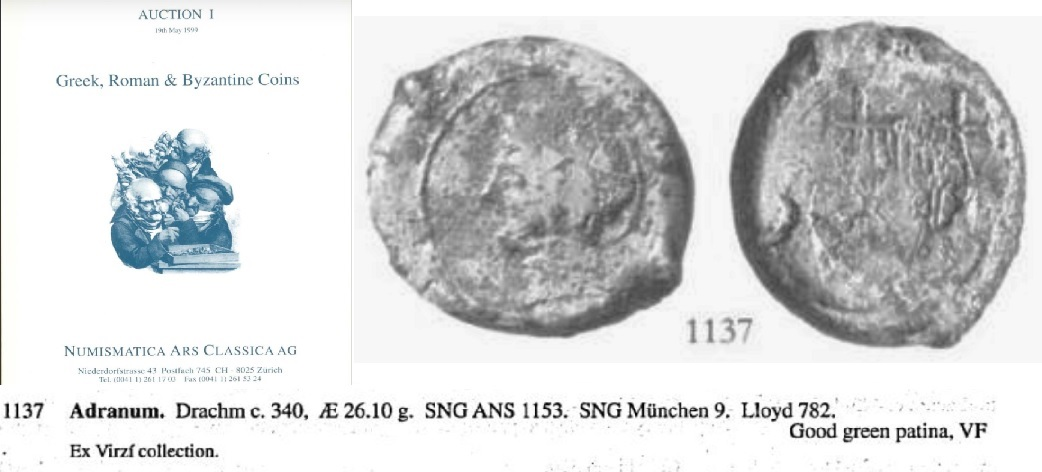
Sicily, Aetna, Adranon Mercenaries AE Drachm (30mm, 26.11g), 4th BCE. Apollo / Lyre. [Dramatic Overstrike, Syracuse.]
(Photo credit: CNG, 2005.) Collection History:
– Thomas Virzi (1881-1974);
– “Tony Hardy” (dec. by c. 2002?) Collection [NAC Auction I (19 May 1999), Lot 1137; CNG EA 116 (15 Jun 2005), Lot 56].
(see Virzi-Hardy note)
– (possibly) IGCH 2138 (Sicily, 1879) = Head NC 1879 (15 of this type, 8 struck on the same under-type), dispersed by Rollin & Feuardent.
Published:
-Virzi (n.d.) The Tom Virzi Collection of Greek Bronzes, No. 512;
– R. Calciati (1987) Corpus Nummorum Siculorum: La Monetazione di Bronzo, III: 2 st 4/5 (this coin cited);
– A. Campana CNAI (PN 98, 1996) 1.A (this coin cited on p. 35).
See Also:
– Greek Overstrikes Database (G.O.D.) 19640 (this coin);
– Castrizio (2000), La Monetazione Mercenariale in Sicilia, Series I, note 341 (citing the Calciati groupings, which cite this coin);
– Minì (1979) Hadranum 2 (citing “ex coll. Virzì, tav. 15 e 16 (14 esempl.)” on p. 199), in: Monete di Bronzo della Sicilia Antica.
Notes: A fascinating overstrike, remnants of the Syracuse Drachm design combining to create unique imagery: on the obverse, Apollo (otherwise laureate) appears to wear Athena’s helmet; and, on the reverse, the frame of the lyre (or kithara) is constructed from Syracuse’s pair of dolphins.
The patina is worse in hand (but better than Noble 130’s photo!), the overstrike most recognizable in CNG’s photo (reproduced in Callataÿ’s database).
See Virzi-Hardy Collections Note.

CENTRAL GREECE (Macedonia, Thessaly) [10 Coins; top]:
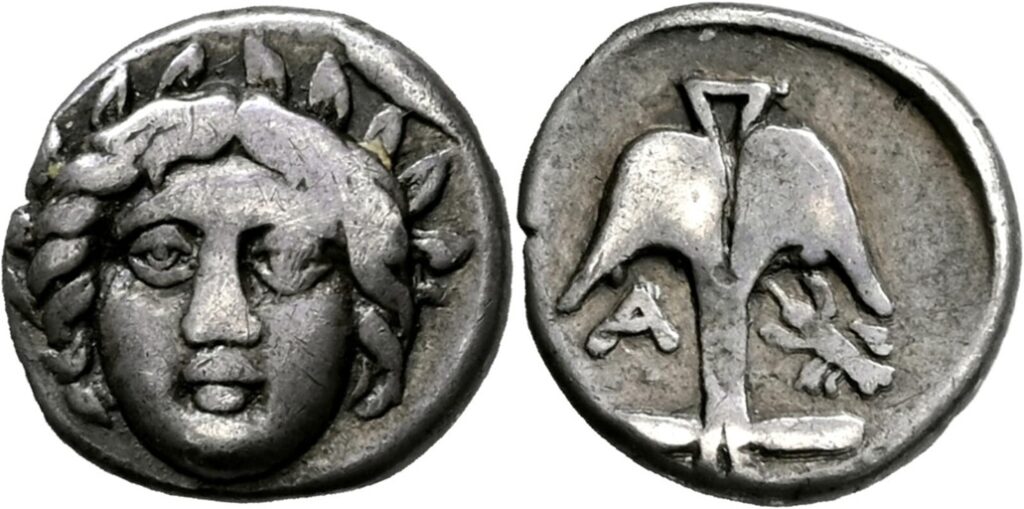
Thrace, Apollonia Pontika AR Diobol (11mm, 1.28g, 6h), 350-300 BCE. Apollo / Anchor, crayfish.
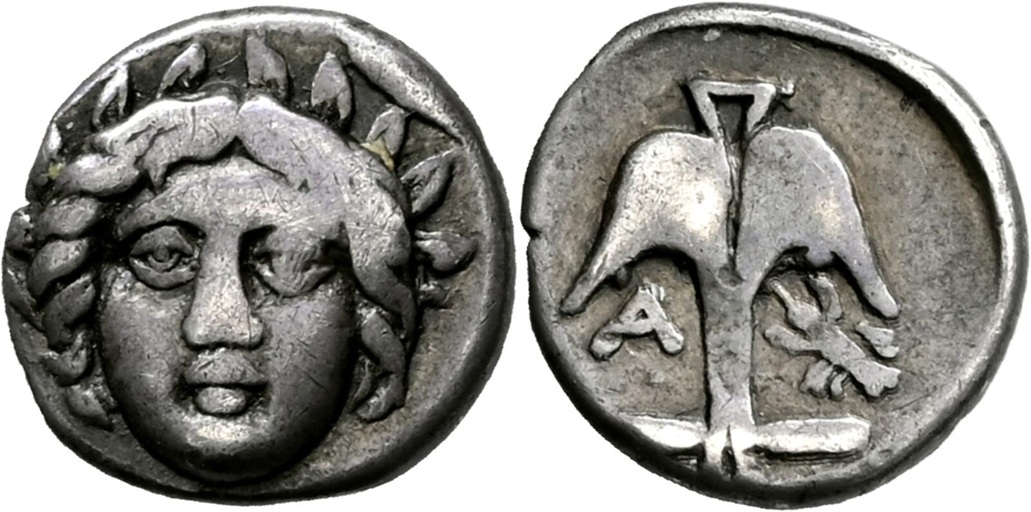
(Photo credit: Peus.) Collection Hist.:
– William Stancomb Collection [Roma e-74 (20 Aug 2020), 12 ; acq. from Spink (London), 11 Jan 1960];
– Sammlung “de face” (Coll. FH) [Peus 439 (4 Nov 2024), 1083].
Institutional Hist.:
– Ashmolean Museum, Oxford, c. 1990s (this coin “on deposit” with rest of Stancomb Collection, per “Author’s Preface,” SNG Stancomb).
Published:
– SNG Stancomb 41 (this coin), also illustrated online in Sylloge Nummorum Graecorum William Stancomb Collection;
– CNT 6310 (this coin), illustrated online in Corpus Nummorum Thracorum;
– Haymann, Florian (2024) Faszination de face: Beiträge zur Frontalität auf antiken Münzen, Nr. 1083 (this coin illustrated on Tafel III [obv.] & p. 30).
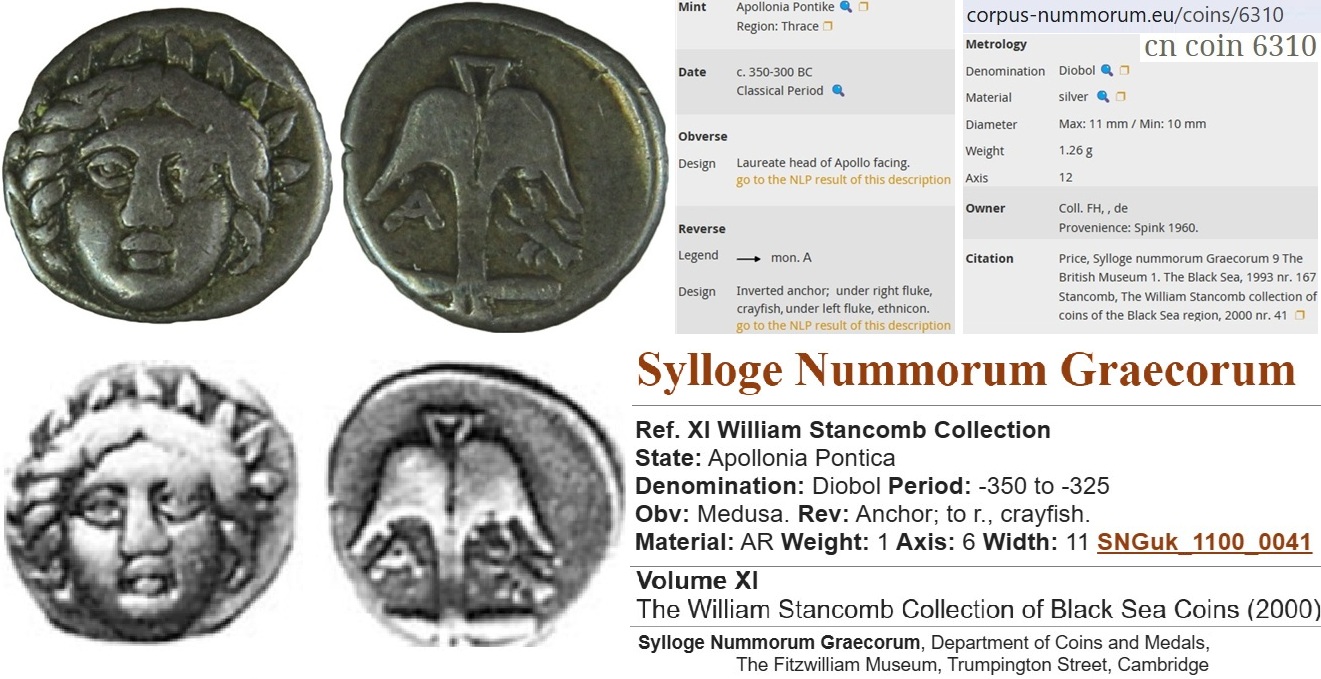
Secondary citations:
– Draganov & Paunov (2017), “An Unpublished Hoard of Apollonia Pontica and Mesembria Diobols from Dobrudja,” RCAN 3 (this coin cited on p. 312);
– Petac & Vilcu (2019), “About the Diobols Hoard of Apollonia Pontica and Mesembria Discovered in 1911 in Constanţa (Ancient Tomis),” Notae Numismaticae XIV: 43-57 (this coin cited on p. 47, “SNG 41-43”);
– SHH 136 (this coin referenced, “Stancomb 41/43”) on Sylloge Historike Hourmouziadis (J. Hourmouziadis website);
– Giulio de Florio website, c241 (May 2021): Note 6 (this coin cited as “Stancomb 41/43,” also citing SHH 136).
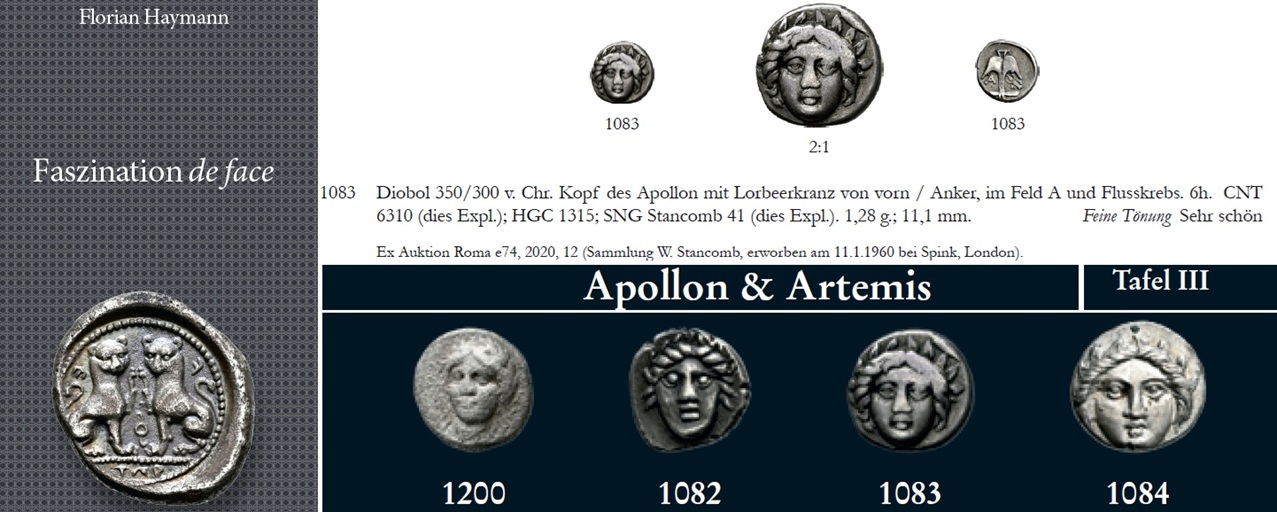
Provenance Notes:
Probably from the same find as Pozzi 1145 (rev. die match) [T. May Coll., Roma EA 1] & the “European Connoisseur collection” (double die match) [Morton & Eden 124], all of which show remarkably similar wear, toning, and other surface details (minor encrustrations and cleaning marks), based on high quality digital photos from recent auctions.
A strong candidate may be the 1911 Constanţa Hoard (Petac & Vilcu 2019) of 30-40 similar Diobols, the majority dispersed, which is known to have included coins from these dies in comparable condition. (About a dozen examples are in the Sutzu Numismatic Collection of the Romanian Academy, but better photos are needed to compare surface quality.)
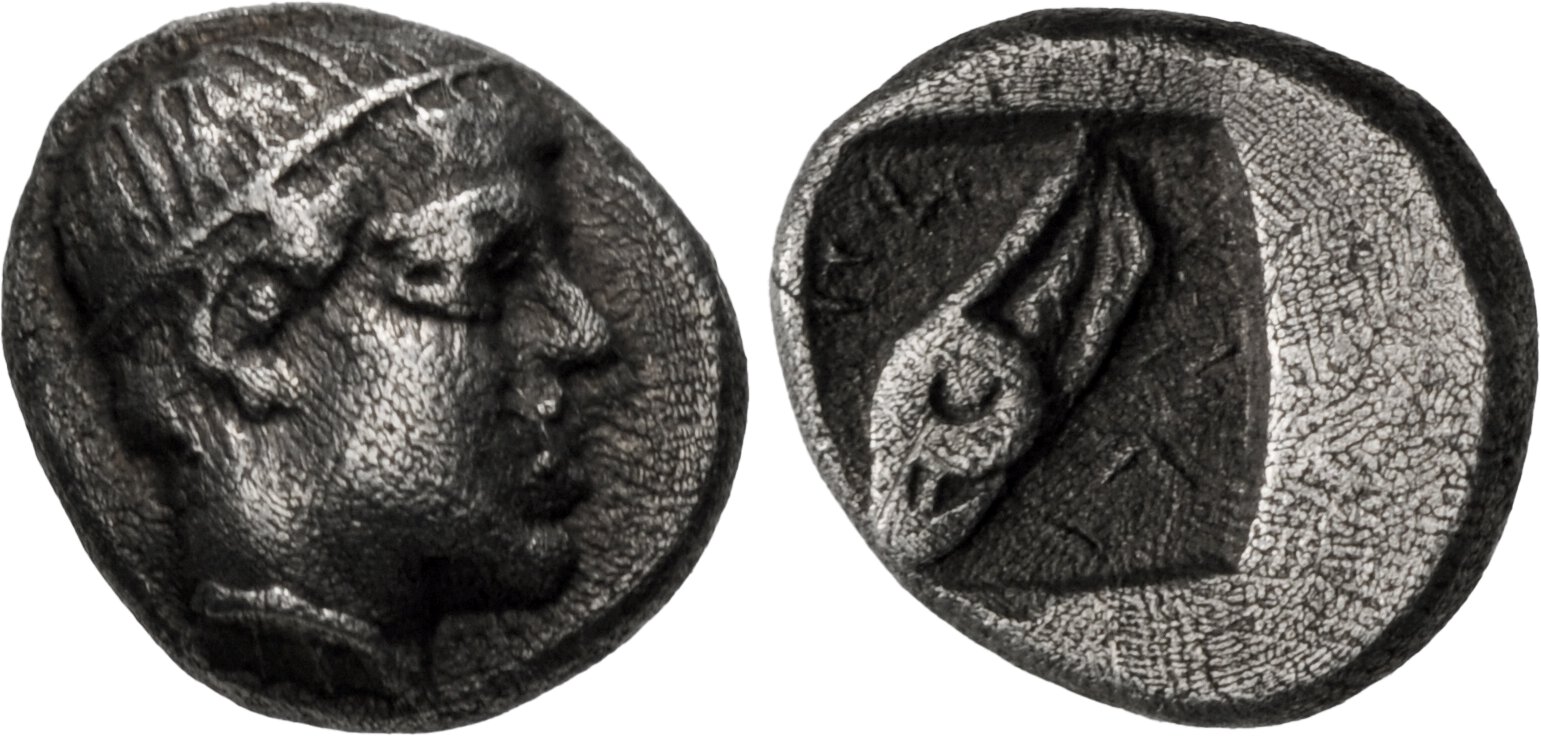
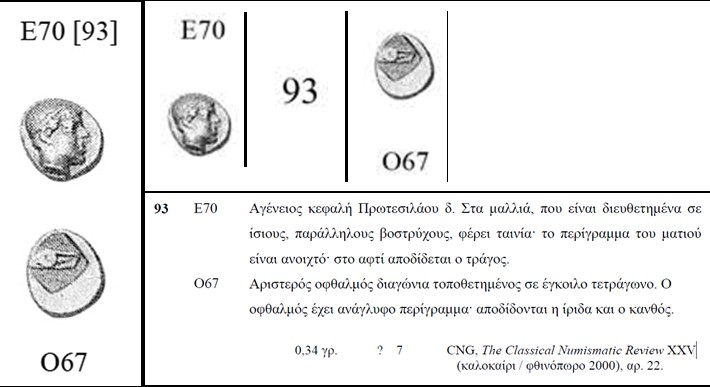
Macedon, Skione AR Hemiobol (6mm, 0.34g), c. 5th Cent. BCE. Protesilaos (?) / Human eye.
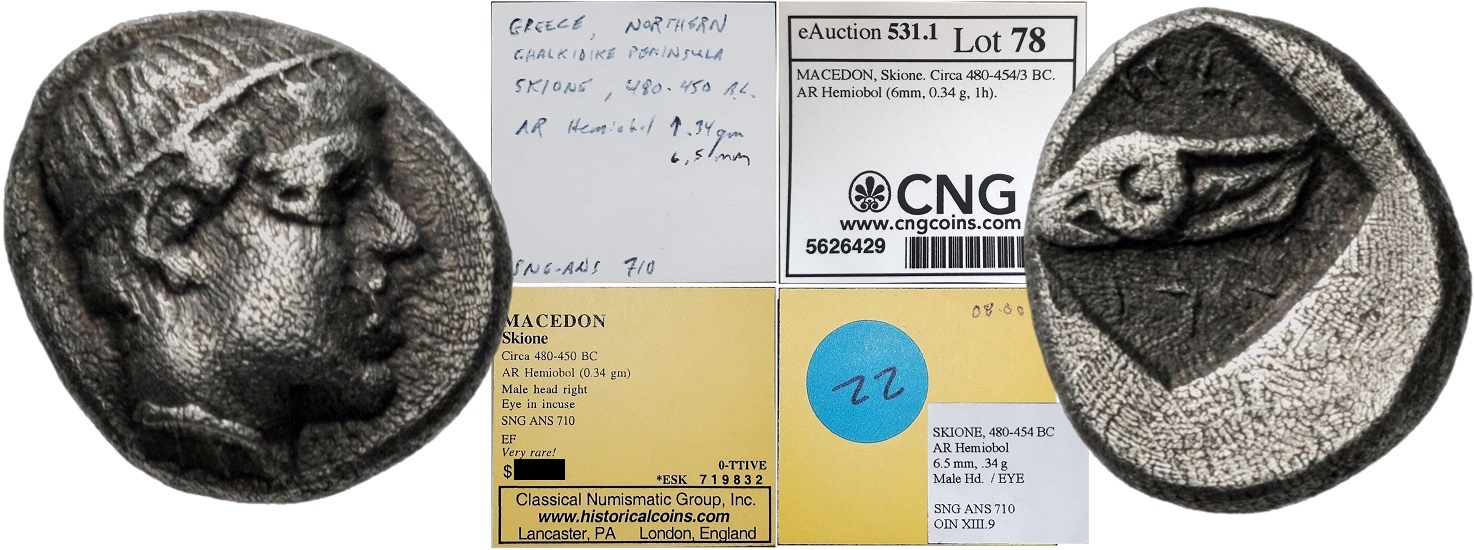
(Photo credit: CNG [ed.].) Collection Hist.:
– Dr. Jay M. Galst (1950-2020) [CNR XXV, “A Selection of Macedonian Fractions” (Summer 2000), 22; CNG EA 531.1 (25 Jan 2023), 78], w/ his hand-written label & small typed tag (from ANS exhibit?).
Published:
– OIN XIII.9 (this coin illustrated) in Galst & van Alfen, Ophthalmologia Optica et Visio in Nummis (2013, NY: ANS) [Google Books: 118-p. preview];
– Marathaki (2014; The history and coinage of ancient Skione in Chalcidice[?]) No. 93 (E70/O67), Page 81 (catalog), p. 284 (index), Ppl. 27 & 57 (enlarged 2x). Only cited specimen of obv. die.
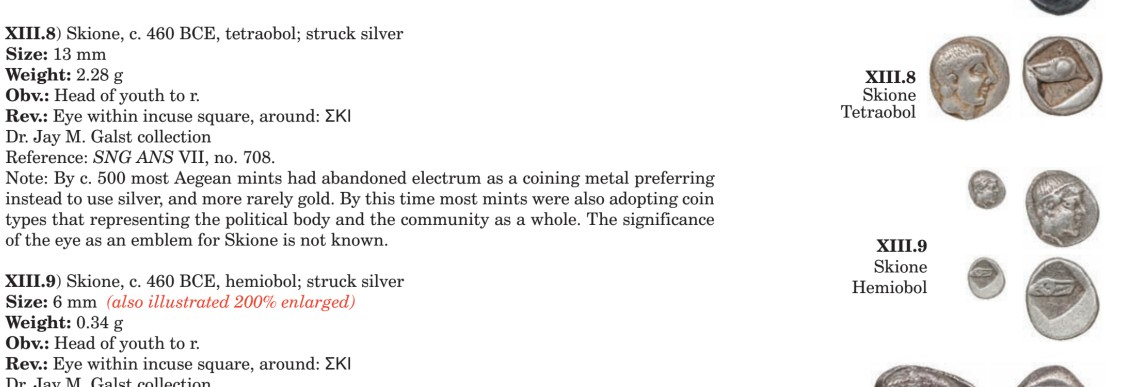
Exhibition Hist.: Possibly part of exhibition, “Ophthalmologia in Nummis,” at American Numismatic Society (NYC, dates uncertain). Galst frequently exhibited coins & medals; the small white tag appears to be a display tag, perhaps assoc. w/ book’s publication.
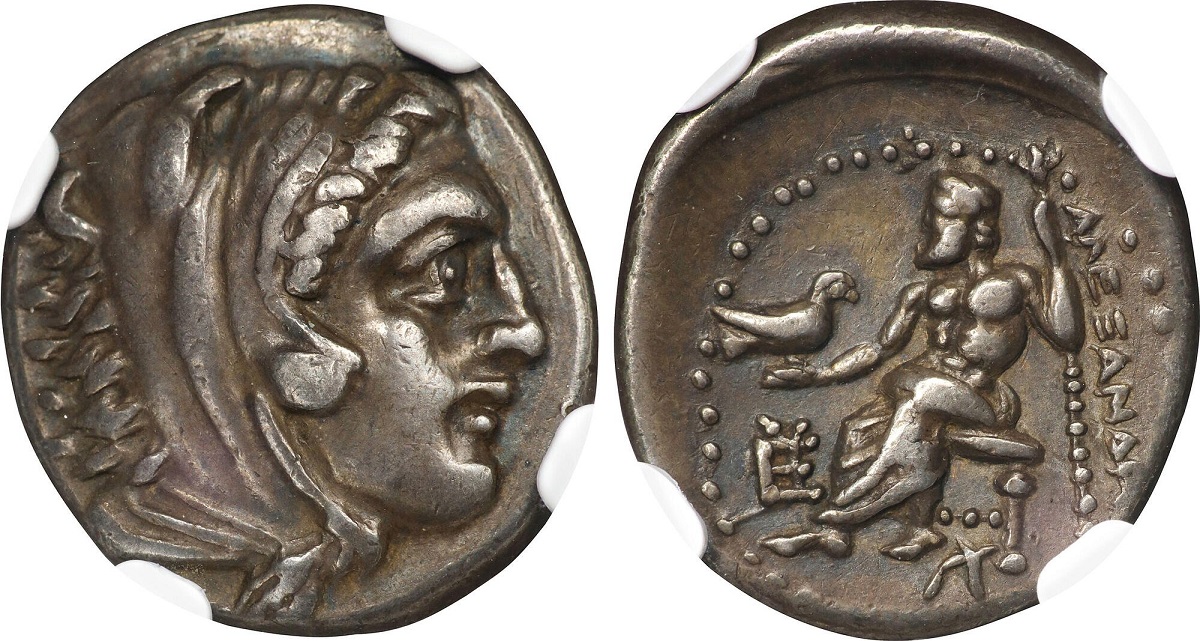
Kings of Macedon, Alexander III AR Drachm (17mm, 4.31g, 12h), Sardes, 323/2 BCE. Herakles / Zeus, torch.
(Photo credit: Stack’s.) Collection Hist.:
– Richard Cyril Lockett (1873-1950) Collection [acq. Baldwin’s n.d.; Part VI/Greek II, Glendining (London, 12 February 1958), Lot 1378 (part, not ill.)];
– Salton Collection, Mark Salton-Schlessinger (1914-2005) & Lottie Salton (née Aronstein, 1924-2020) [Stack’s Bowers NYINC 16 Jan 2023 (Salton Greek, Part II), Lot 26097];
NGC 6369914-015;
– (likely) ex Sinan Pascha Hoard, c. 1919 (IGCH 1395).
Published:
– SNG Lockett 1501 (this coin illustrated) in Sylloge Nummorum Graecorum. British Series. Volume III. The Lockett Collection. Part II (1942, London).
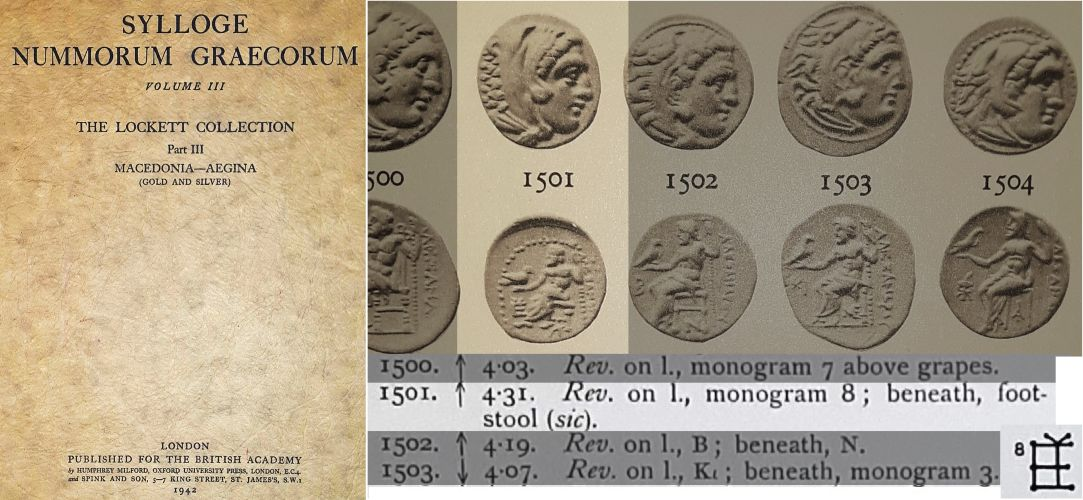
Provenance Notes: The Sinan Pascha Hoard (IGCH 1395), deposited c. 318 BCE, contained at least 652 examples acq. by Newell in commerce, initially in London (Spink, 1919-20s), then Athens. Newell’s assemblage incl. a number of this type (Price 2600) of similar condition & patination: “very thin patches of purple oxide with light brownish discoloration of the remaining portions of the surfaces” (Thompson ADM, quoting Newell). In many cases “subsequent cleaning has removed this evidence,” but note the dark bands still visible in the recesses, particularly around the reverse devices, on the examples from the hoard at the ANS. For more on the hoards significance, see Thompson ADM: p. 86ff.
Tag Notes: Salton’s collector tag for Lot 26099 was mistakenly incl., prev. SNG Lockett 1499 (prov. not noted by Stack’s but recognized by Kolner when it reappeared a few months later; I bid unsuccessfully both times).
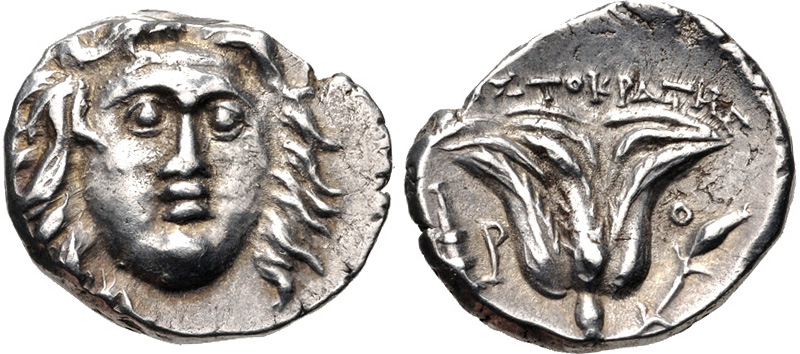
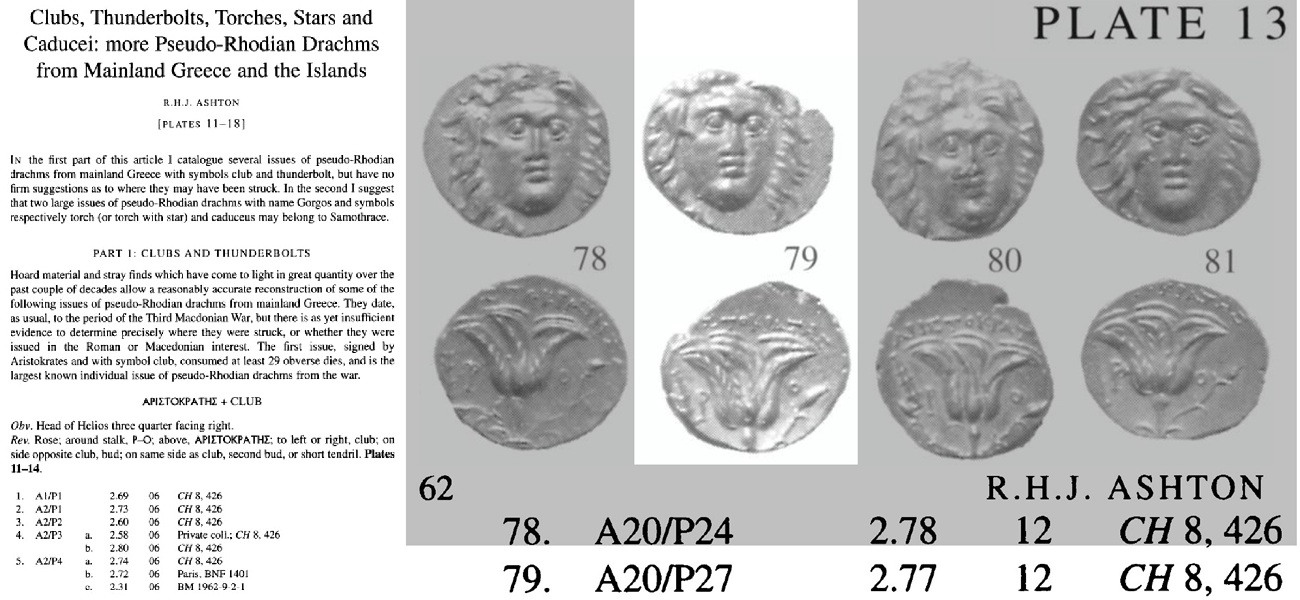
Macedon, temp. Perseus, Pseudo-Rhodian AR Drachm (15mm, 2.77g, 12h), Third Macedonian War, 177-168 BCE. Helios / Rose. Aristokrates.
(Photo credit: CNG.) Collection Hist.:
– 1992 Thessalonike Area Hoard (CH VIII, 426).
Published:
– Ashton (2002, NC), “Clubs, Thunderbolts, Torches, Stars and Caducei…” p. 62, No. 79 & pl. 13 (this coin illustrated). (Larger image here.)

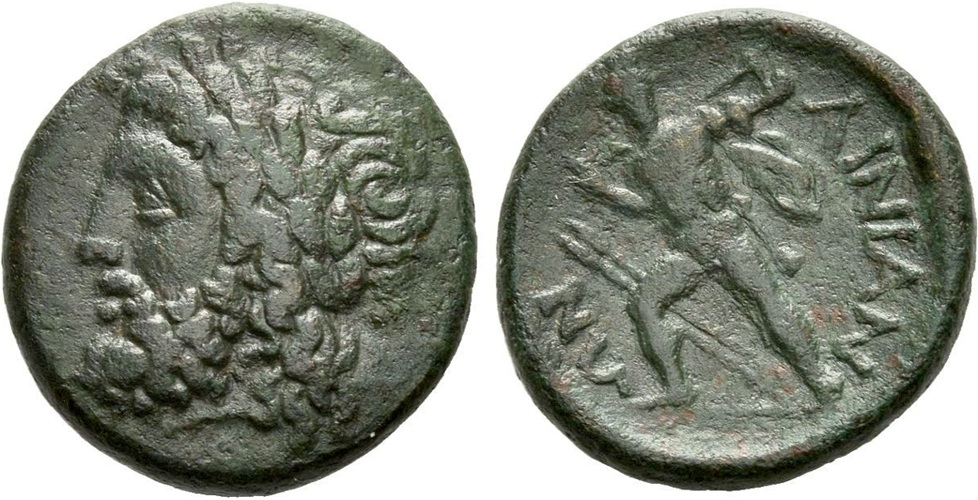
Thessaly, Ainianes (Hypata) AE Dichalkon (18mm, 5.97g), c. 302-286 BCE. Zeus / Hero Phemius (Phemios) shooting sling.
(Photo credit: Naville.) Collection Hist.:
– H.C. Lindgren (1914-2005) Collection;
– BCD Collection [Nomos Auction 4 (Zurich, 10 May 2011), 1435.1; bt. fro m Lindgren May 1991, possibly while visiting his San Francisco home (see note from BCD)];
– Sheik Saoud Al-Thani (1966-2014) [“Man in Love with Art Collection, Part VIII,” Naville 98 (12 Oct 2025), 400].
Published:
– Lindgren II 1392 (this coin illustrated), in: H.C. Lindgren (1989), Ancient Greek Bronze Coins: European Mints;
– BCD Thessaly I 1435.1 (this coin illustrated on p. 161).
See also: Wildwinds Thessaly, Ainianes page (this coin illustrated online, after Nomos 4).
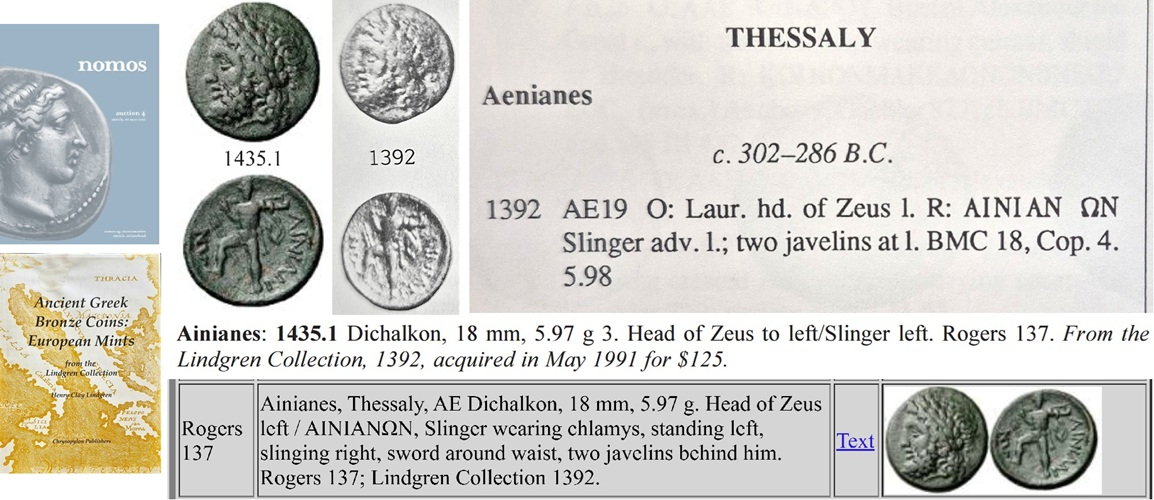
The Slinger not the Singer!
Substantive Notes: The reverse figure is sometimes misidentified as the Homeric bard, Phemius. But this is the hero Phemius mentioned by Plutarch (Greek Questions, 13), legendary King of the Ainianes, who won their territory by defeating the King Hyperochus in single combat. When Hyperochus turned his back to put his dog away, Phemius slung a stone at him, killing him.
Provenance Notes (BCD – Lindgren): Although this coin didn’t come w/ BCD’s tag, the catalog records that he bought it privately from Lindgren in May 1991. My one other BCD-Lindgren coin (Orchomenus, Lindgren II 513, later Aiello) is also dated May 1991.

BCD probably bought both when visiting Lindgren’s San Francisco home. Thirty years later he wrote: “this writer feels privileged and fortunate to have been at his home and bought coins from his collection. His little-known poetry booklets allow us to see him from a different angle and his life, when he passed away at an advanced age, could be summed up as ‘a life well lived’” (BCD Lib. Dupls. 2022, 2023; see also 2020).
Provenance Notes (BCD – Al-Thani): Like the Pelinna Obol & Thebae AE below (BCD Thessaly I 1433.7 & 1348), this coin was bought by Sheik Al-Thani (1966-2014) at Nomos 4 in 2011. In fact, he bought most of the lots. He was known for just that: buying out entire auctions and bidding the prices up to extraordinary levels. (When auctioned again years later, they usually achieved only a fraction of their 2011 prices.)
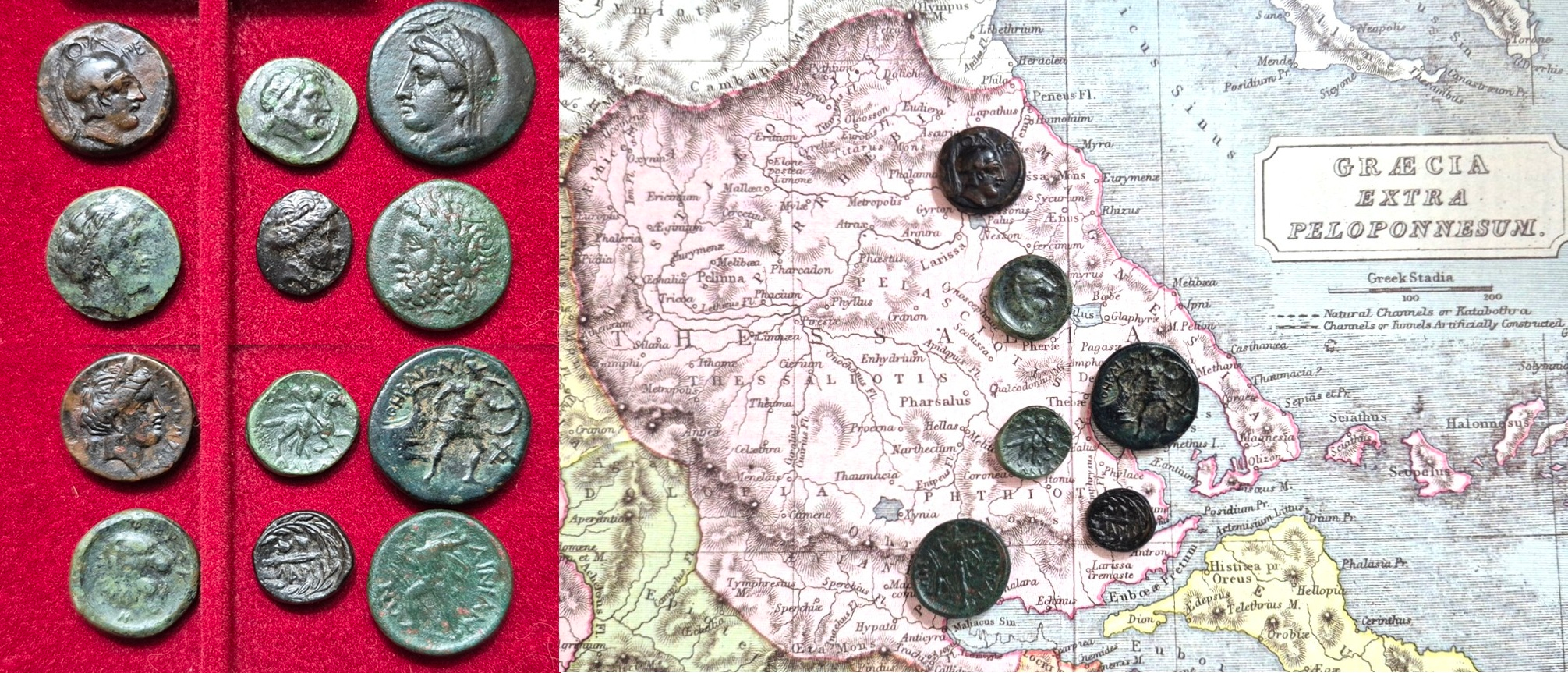
Below, six of Al-Thani’s BCD Thessaly bronzes (1058, 1348, 1435.5, 1435.12, 1435.27, 1435.1) are placed by their mints on the map from BCD Thessaly II (Triton XV). The four to the lower-right (Halos, Thebae, Larissa Cremaste, Ainianes/Hypata) are from the Phthiotis region to the south of Thessaly. The Thebae & Halos revs. have the AX monograms of a Phthiotic Achaean League of several neighboring cities.
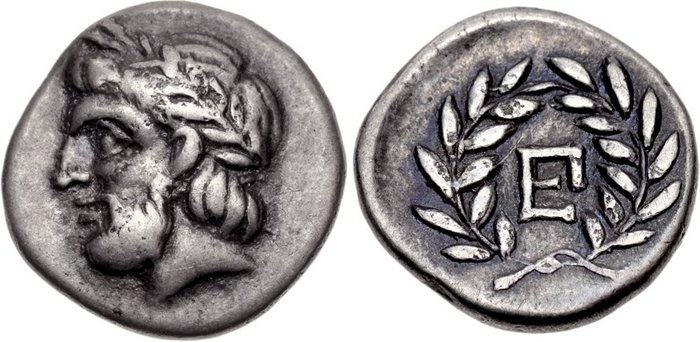
Thessaly, Heraclea Trachinia AR Obol (10mm, 0.80g, 11h), c. 380-350 BCE. Lion head / Club & ivy leaves.
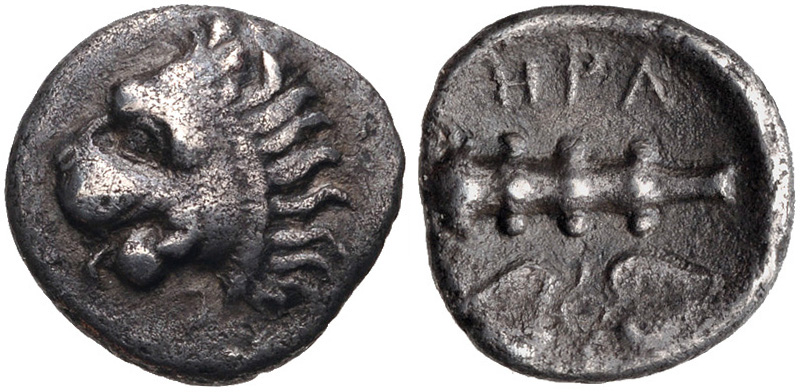
(Photo credit: CNG.) Collection Hist.:
– Jean P. Lambros (1843-1909) [Hirsch XXIX (Munich, 9 Nov 1910), 316; see Note 2-a];
– F. Robert Jameson (1861-1942) [collection bought en bloc by Jacob Hirsch];
– (presumably) Jacob Hirsch (1874-1955) Estate [inherited by Leo Mildenberg, acq. by Bank Leu, Zurich, c. 1955; but sold when?];
– BCD Collection [NAC Auction D (Zurich, 2 Mar 1994), 1397; CNG EA 290 (7 Nov 2012), 20];
– Jim Gilman [acq. Kirk Davis, 2014; later, Kirk Davis 78 (2021), 25 & CNG 120 (11 May 2022), 91];
w/ BCD tag & photos, NAC labels, Gilman’s envelope.
Published:
– Jameson 1081A, in Collection R. Jameson: Monnaies Grecques Antiques (1913, Paris: Feuardent), desc., Vol 1, p. 245 & ill., Vol 2, Pl. XCIV) [Note 2-b].
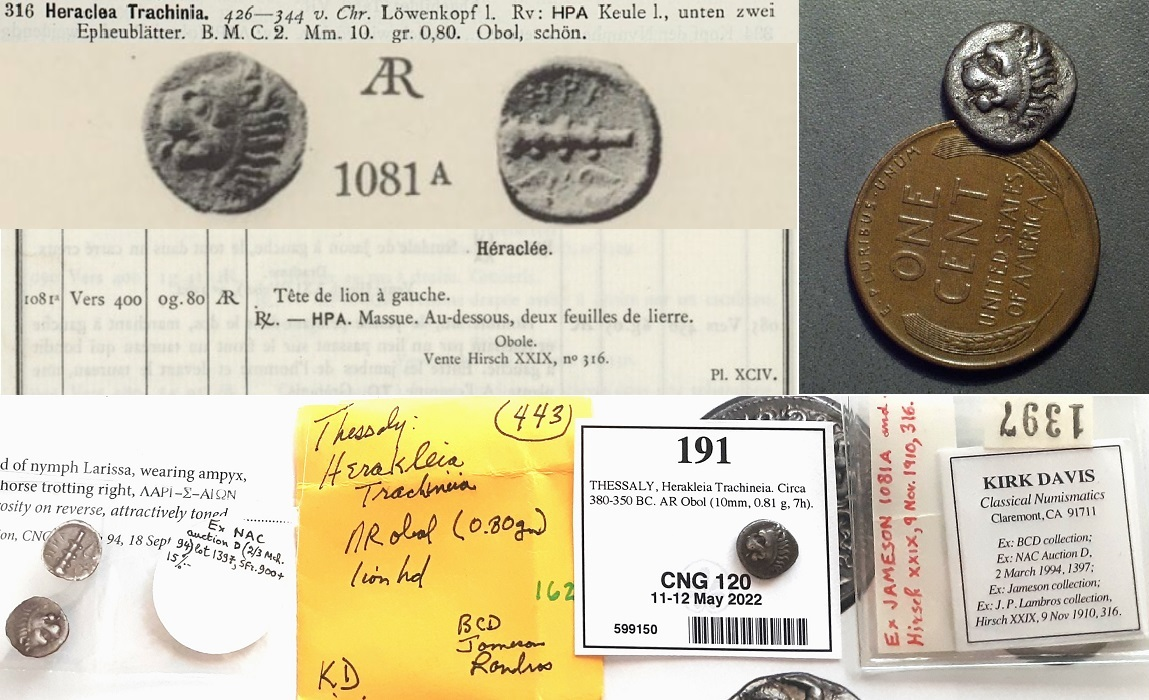
See also: “Catalog Collection Favorites.” The lovely photo of the coin & U.S. penny below comes from a Kirk Davis’s VCoins listing; my “coin in hand video” also available).
Notes: BCD wrote the following about another silver fraction from the Jameson Collection (Nr. 2057), which could equally apply to this one:
“It is not often that a collector is lucky enough to acquire a coin that has been owned and handled by such legendary collectors as the above. This writer is awed by the aura of previous owners to whom the name of Jacob Hirsch, a dealer, should be added as he catalogued and sold this coin twice…” [BCD Lokris-Phokis 52.]

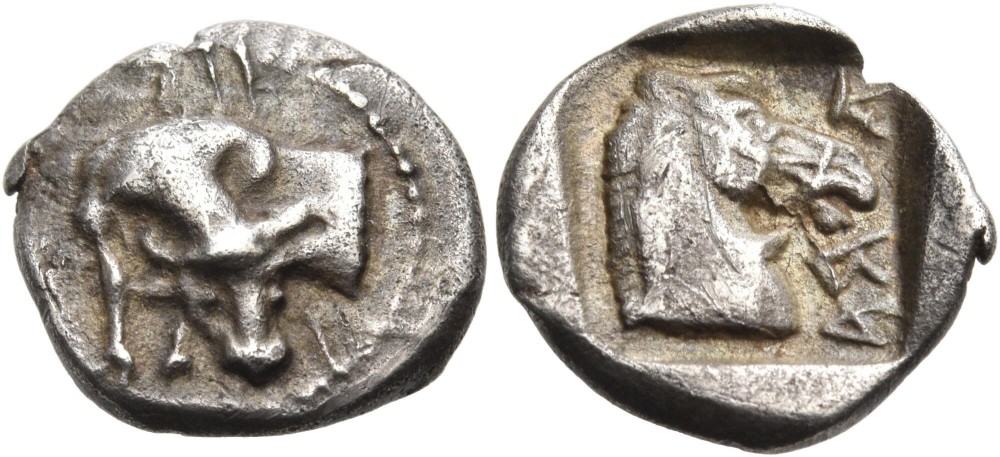
Thessaly, Krannon AR Obol (11.5mm, 0.97g, 11h), c. 460 BCE. Bull (trident behind) / Horse.
(Photo credit: Nomos.) Collection Hist.:
– Collection sans Pareille [Nomos 29 (5 Nov 2023), 724];
– Leo Mildenberg (1913-2001) Collection [acq. en bloc by CsP, 1970s];
– Münzen und Medaillen FPL 206 (Dec 1960), 21.
Published:
– Liampi 1996, p. 106 Group I.I.B, 4d [specimen “d”] (this coin cited to MMAG).
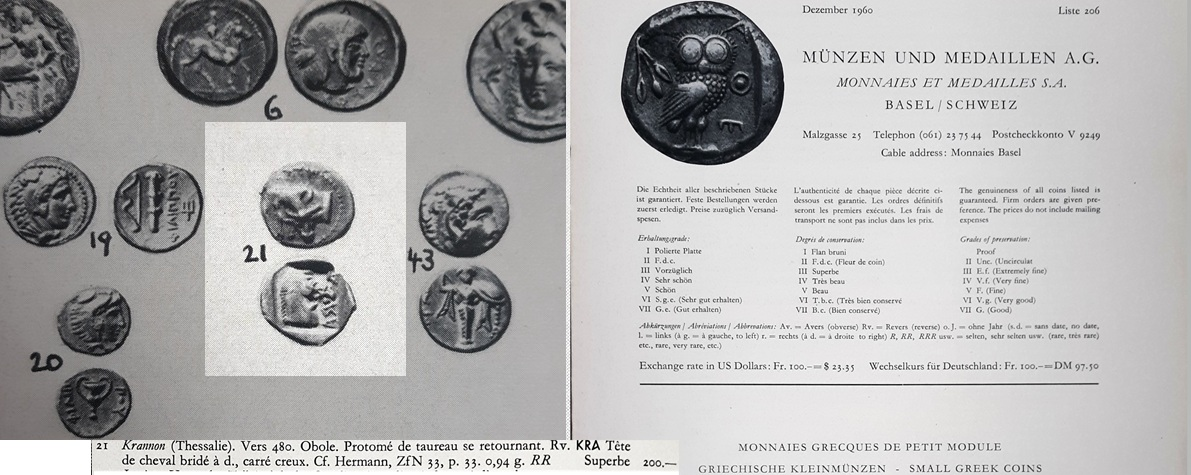
Substantive Notes: Taurokathapsia issue, as the chalkous below. Not mentioned in MMAG or Nomos catalogs (but see Liampi 1996: 106), a trident is faintly visible behind the bull. (The event honored Poseidon.) See the “coin in hand video.”
Provenance Notes: Thessalian fractions w/ pre-1970 provenances are always prizes to treasure, (esp. those deriving from distinguished old collections; see also the Heraclea & Pelinna Obols on this page). In BCD Thessaly II (p. 280), the collector commented on “the scarcity of [Thessalian fractions] in the pre-1980’s auction catalogues and the market generally.”
Thessaly, Krannon AE Chalkous (13mm, 2.10g, 12h), c. 400-350 BCE. Thessalos & horse / Bull & trident.
(Photo credit: CNG.) Collection/Publication History:
– BCD Thessaly II 115.4 = BCD Collection [Triton XV (NYC, 3 Jan 2012), Lot 115 (part), w/ auction tag, but sadly not BCD’s round collector tag].
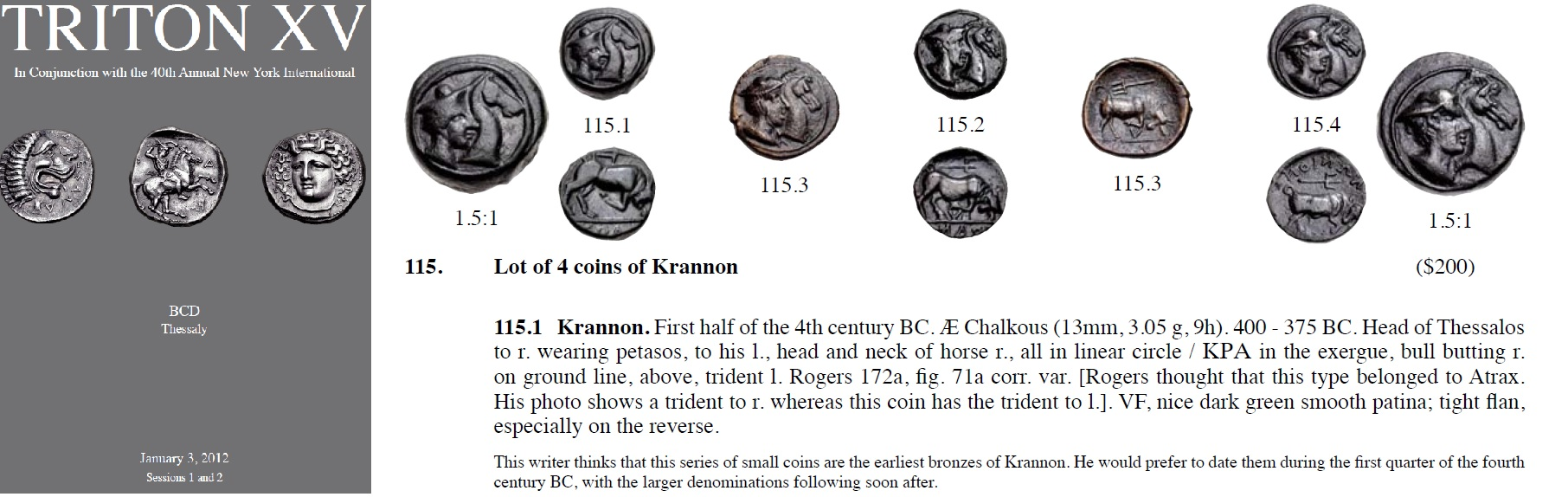
Hist. Notes: One of the many Thessalian coins issued for the Taurokathapsia, an event that combined horse-riding and bull-wrestling. The most impressive maneuver seems to have involved the rider dismounting the horse while wrapping a cloth band around the bull’s horns, then wrestling & immobilizing it.
See also: Taurokathapsia coins: Krannon Obol above; Krannon bronze ex Rogers below; Nero bronze depicting the event on RPC page; and, in my “BCD tags” discussion, Pherae AE bottom center & archaic Larissa Drachm.
Coin-in-Hand Video: on Imgur or on YouTube.
BCD sale catalogs on my “Catalog Collection Favorites.”
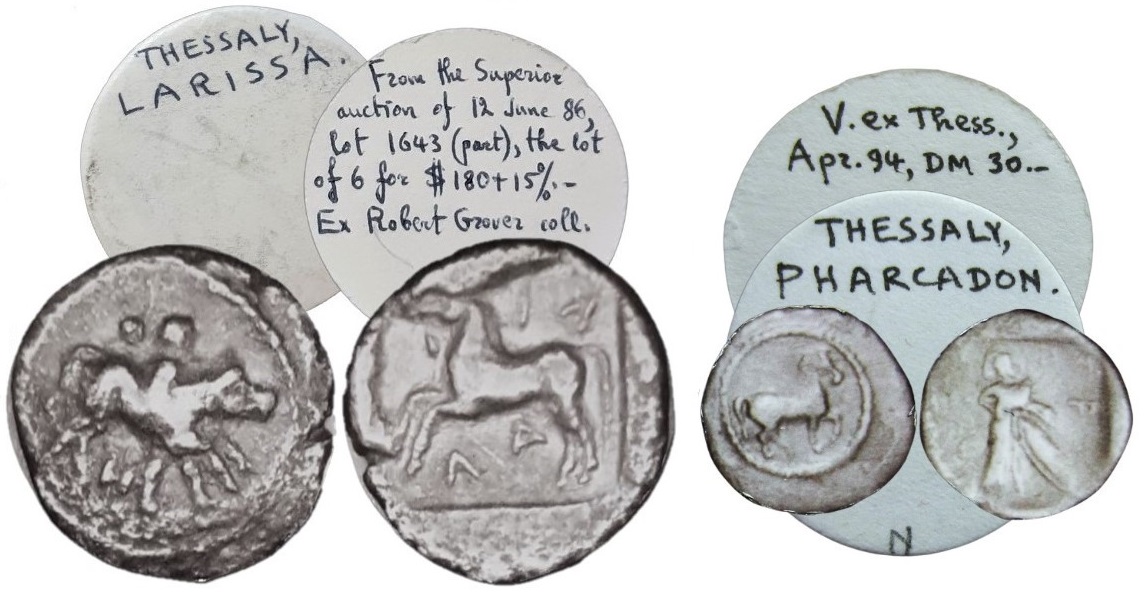
Thessaly, Larissa AR Drachm (19.5mm, 5.68 g, 5h), early 4th cent. BCE. Facing head of Larissa / Horse grazing.
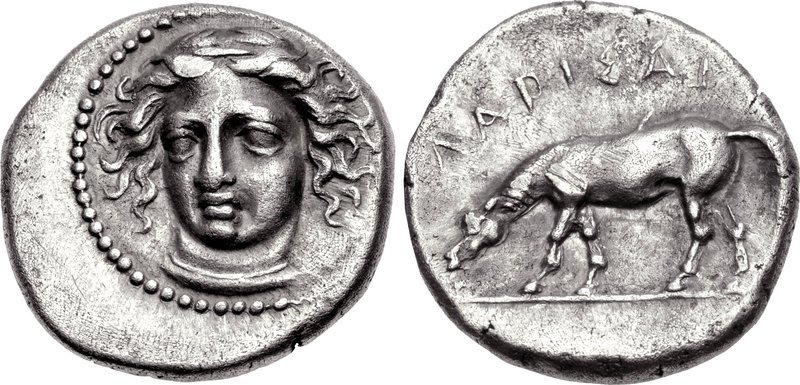
(Photo credit: CNG.) Provenance & Collection Hist.:
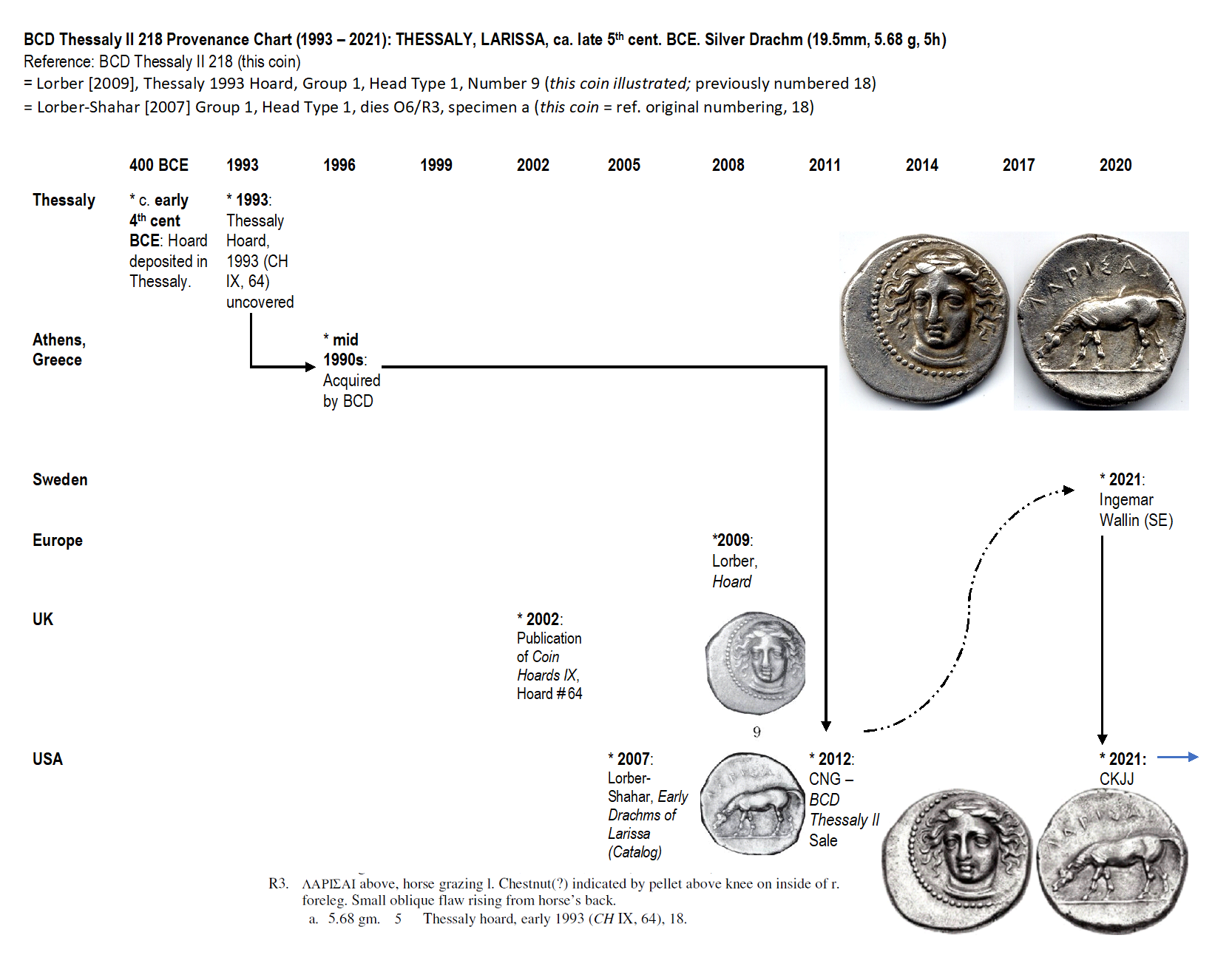
– Ex Thessaly Hoard, 1993 (CH IX, 64);
– BCD Collection [Triton XV (NYC, 3 Jan 2012), Lot 218].
Publication History: BCD Thessaly II 218;
– Lorber-Shahar (2007) “Early Facing Head Drachms of Larissa (Catalog),” O6/R3, specimen A (this coin, citing Thess. Hoard No. 18);
– Lorber (2009, SNR) “Thessaly 1993 Hoard (CH IX 64),” page 131, No. 9 & Plate 9 (this coin illustrated).
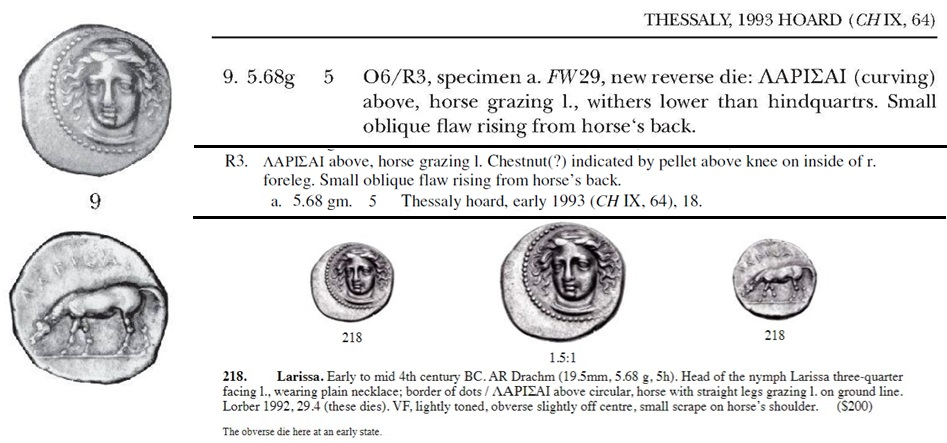
Note: On the revised chronology of Lorber (1992, FW) & Thess. Hoard 1993 numbers, see also Lorber (2008, AJN). See “provenance chart” (1993-2021) for this coin or the Blog Post: “‘Provenance Diagrams’ for Ancient Coins“: 
Thessaly, Pelinna AR Obol (~13mm, 0.82g, 7h), c. 425-400 BCE. Horse trotting / Peltast (warrior) with shield about to hurl spear.
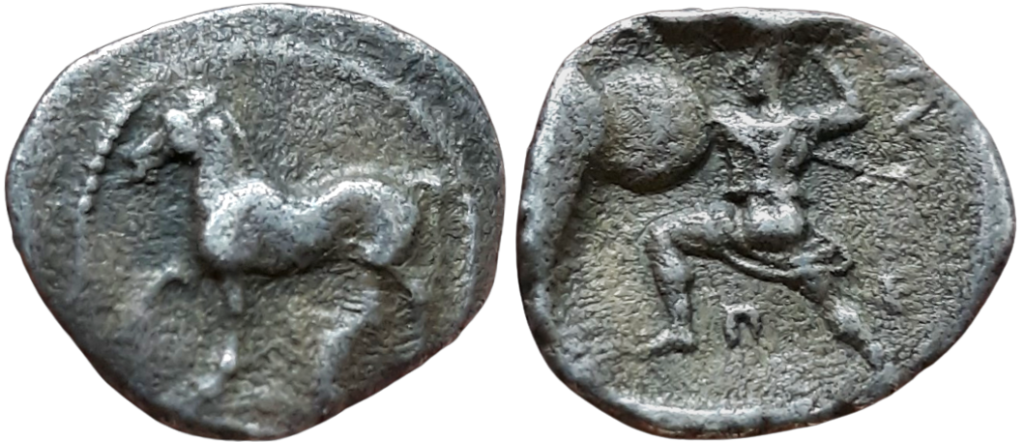
(Photo credit: Jackson-Jacobs.) Collection Hist.:
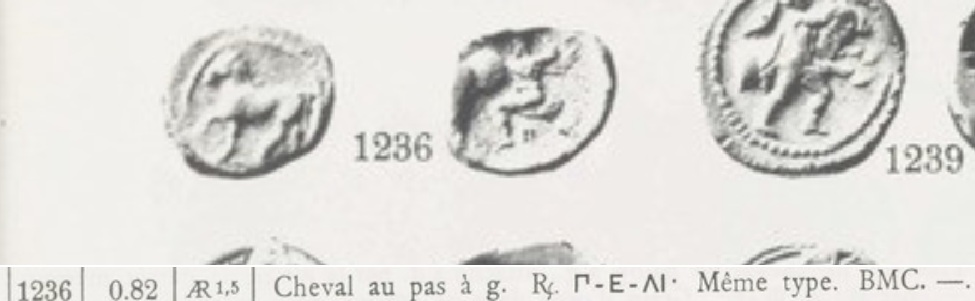
– Dr. S. Pozzi (1846 – 1918) Collection [Naville Ars Classica I (Lucerne, 14 Mar 1921), 1236];
– BCD Collection [Nomos Auction 4 (Zurich, 10 May 2011), Lot 1433 (part)];
– Sheik Saoud Al-Thani (1966-2014) [NAC Auction 133 (“Collection of a Man in Love with Art, Part V,” Zurich, 21 Nov 2022, Lot 59].
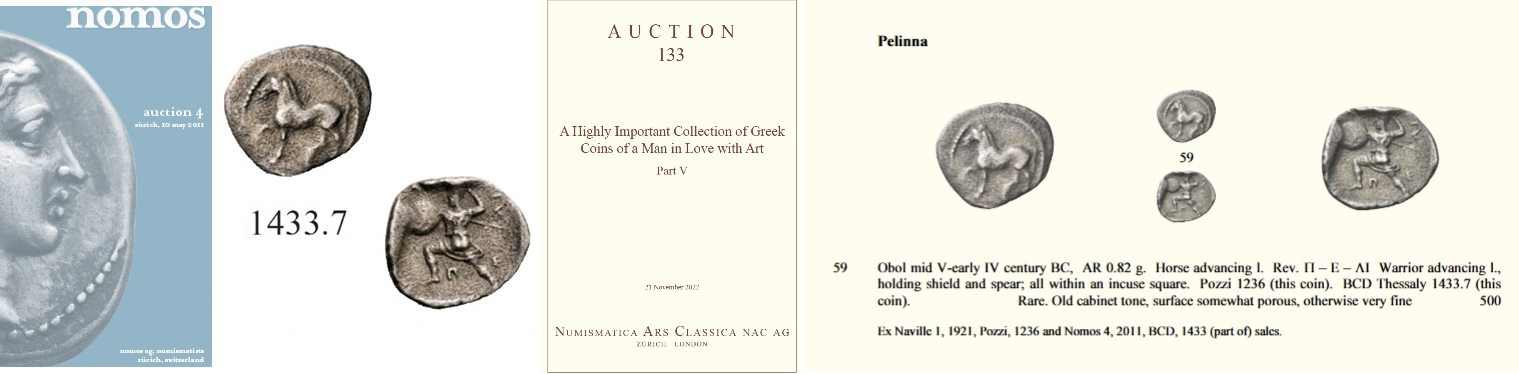
Publication Hist.: Boutin 2826 (this coin illustrated on Pl. CXXVI) in: Serge Boutin (1979), Catalogue de Monnaies Grecques Antiques de l’Ancienne Collection Pozzi (Maastricht: van der Dussen) [I have two copies of Boutin-Pozzi, ex Salton Library & ex Bibliothek Wenninger];
– BCD Thessaly I 1433.7 (this coin, p. 158) [also ex Bibliothek Wenninger];
– Sprawski (2014) “Peltasts in Thessaly” p. 96, note 9 (this coin cited);
– Sprawski (2009) Tessalia, Tessalowie i ich sąsiedzi, p. 142, n. 335 & p. 161 (this coin cited).
Did BCD acq. this coin in Berlin 1981, among “some rare fractions from the Pozzi collection. An old collection dispersed?” (See LHS 96, 1037.) Re: Dr. Pozzi, see Note 2C, Pozzi Bio (see also the Corinth AR Stater, below, Sikyon Obol, Boeotian AE.
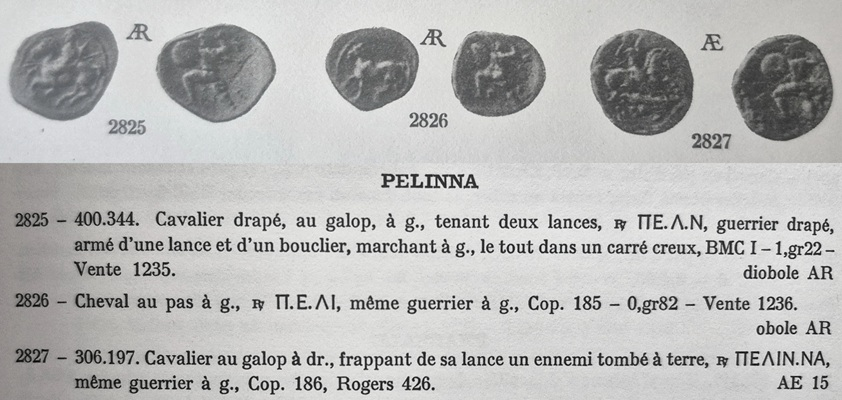
See also Rogers-Pozzi Note: Rev. Edgar Rogers (1873-1961) cites this coin in error on p. 142 of his classic (1932) The Copper Coinage of Thessaly: “E.R. ex Pozzi 1236 (Fig. 234)” (i.e., in the Rogers Collection). Being a book about Thessaly’s AE, a different Pelinna coin is described & illustrated.
Notes: A spectacular little moment of rhytmos, the characteristic feature of movement captured in 5th century Greek art. (A popular illustration of the rhytmos concept is the Discobolus frozen at the height of his windup.)
The peltast is mid-movement, just about to release the spear: He has lunged forward with the lead foot and begun turning the torso and shield to the outside, stretching the chest and shoulders; the gluteal muscles are in dramatic exertion under the flowing tunic; in the next instant he will twist, extend the right arm, and release the spear like an arrow from a bow.
(On some dies, as here, the lead foot may be elevated: Is he going to hop into the final hurl? I think so. Try it.)

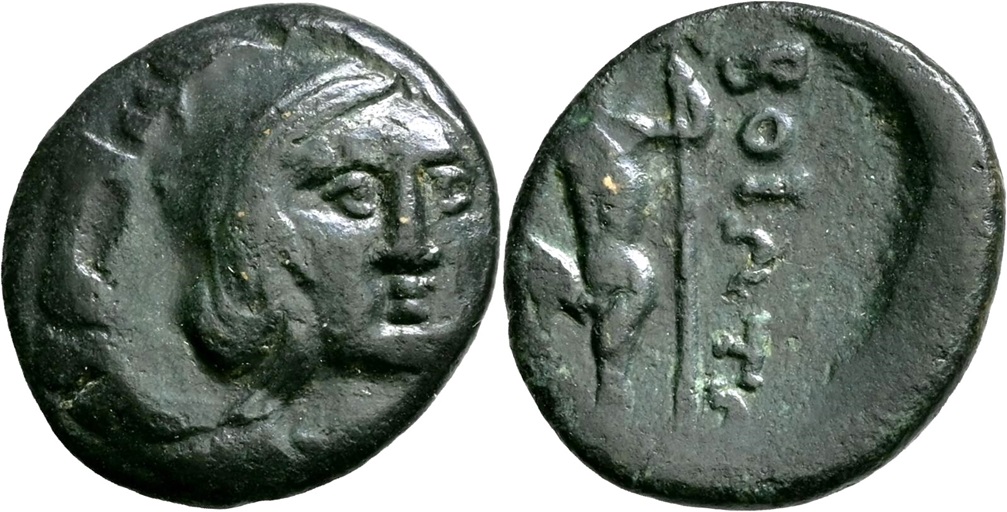
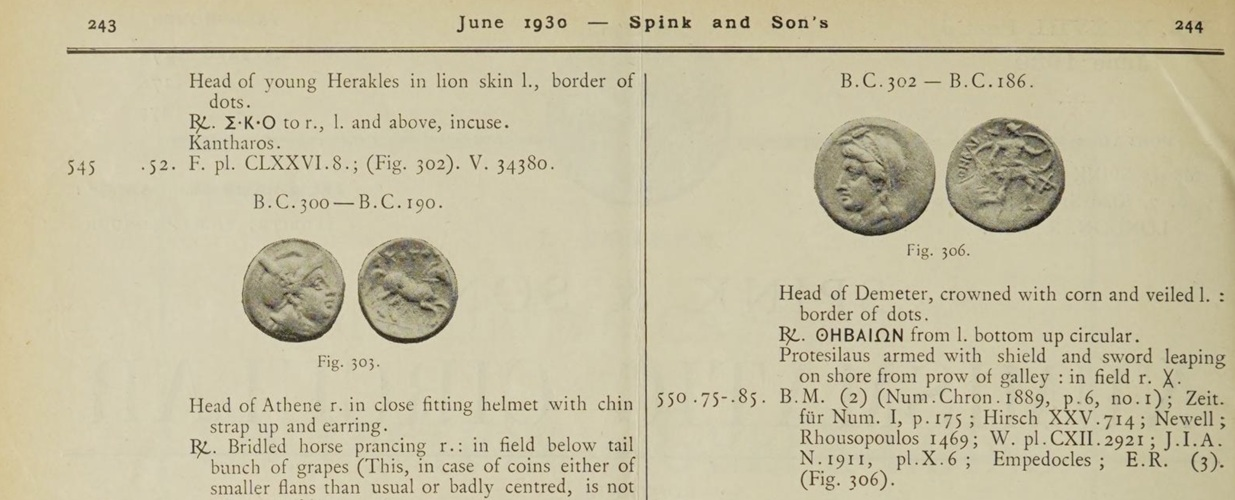
Thessaly, Thebae AE Tri- or Tetrachalkon (22mm, 7.67g, 1h), 302-286 BCE. Demeter / Protesilaos.
(Photo credit: Nomos AG.) Collection Hist.:
– Rev. Edgar Rogers (1873-1961) Collection;
– Lt. Col. Reginald Keble Morcom (1877-1961) Collection;
– Christopher Morcom (1939-) Collection of Pedigreed Coins of Greece & the Aegean Islands [CNG 76, part 1 (12 Sep 2007), Lot 421];
– BCD Collection [Nomos Auction 4 (Zurich, 10 May 2011), Lot 1348];
– Sheik Saoud Al-Thani (1966-2014) [NAC Summer 2025 Auction (30 Jul 2025), 386].
Selected Publication Hist.: Rogers 550 (this coin illustrated in Fig. 306), in: Edgar Rogers (1932), The Copper Coinage of Thessaly;
– reprinted from Spink Numismatic Circular XXXVIII.6 (Jun 1930) (this coin ill. on p. 224);
– BCD Thessaly I, 1348 (Nomos 4, this coin ill. on p. 127);
– Boehm Fig. 6 (this coin illustrated, after CNG 76), in: Boehm, Ryan (2019), “The Foundation of Phthiotic Thebes,” Orbis Terrarum 17: pp. 53-81.
See also, among many others (cited but not illustrated):
– A. Moustaka (1983), Kulte und Mythen auf Thessalischen Münzen (this coin cited on p. 116);
– Gkikaki (2011 Dissertation) Die Weiblichen Frisuren auf den Münzen und in der Großplastik [Women’s hair styles on coins and in sculpture in classical and hellenistic times] (this coin cited after Rogers 550 on p. 39, note 82);
– Preka-Alexandri & Yannis Stoyas (2018) (this coin cited on p. 39, note 63) & Stoyas (2012) (this coin cited on p. 152, note 82);
– Haagsma et al. (2019), “Ethnic Constructs from Inside and Out: External Policy and the Ethnos of Achaia Phthiotis” (this coin cited on p. 298, note 89);
– A. Stamatia & S. Kravaritou (2020), “Ενεπίγραφες επιτύμβιες στήλες από το Νότιο νεκροταφείο των Φθιωτίδων Θηβών” (this coin cited on p. 363, note 5).
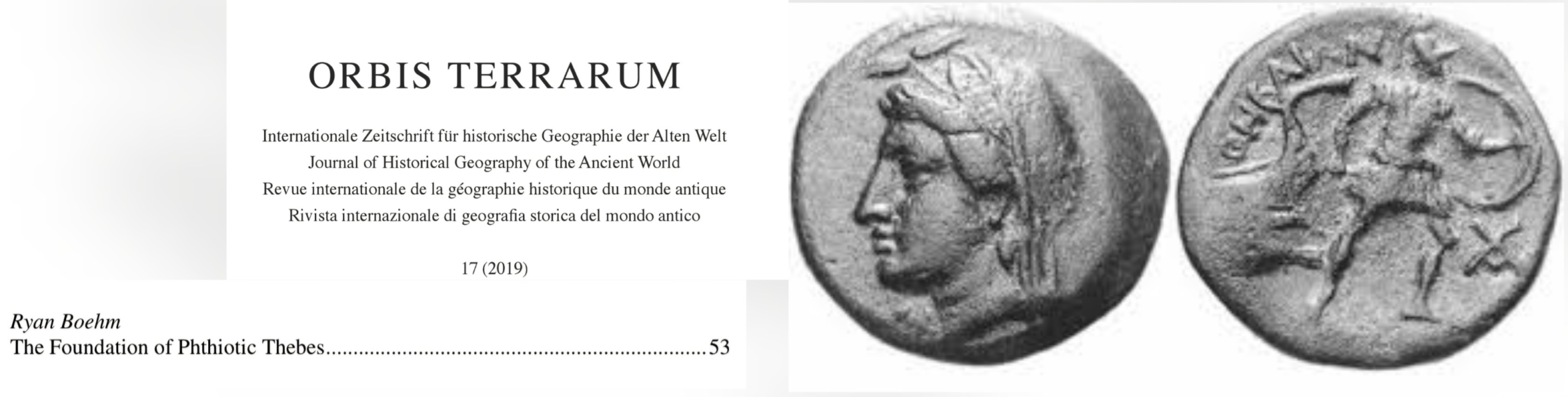
See also: Wildwinds “cover coin” for Thebai text-page; “plate coin” on Thebai thumbnails-page (after Morcom sale);
– CoinProject 76000421 “digital plate coin” (after Morcom);
– Numista Thebai “digital plate coin” (after BCD Thessaly);
– IRIS (Online Greek Coinage) reference type (this coin cited after Rogers [1932], 550).

Notes: The Nomos 4 catalog included the following: “A note from BCD: Most of the Rogers coins went to the British Museum and even the “leftovers” had been dispersed via Baldwin’s by the time I started collecting. To finally acquire a coin that once belonged to the legendary pastor collector and was also illustrated in his book that has been a faithful companion for decades, was a cause for celebration.“
Fortunately, Col. Morcom had acquired several, probably directly from Rogers, giving those coins unbroken chain-of-custody since before WWII.
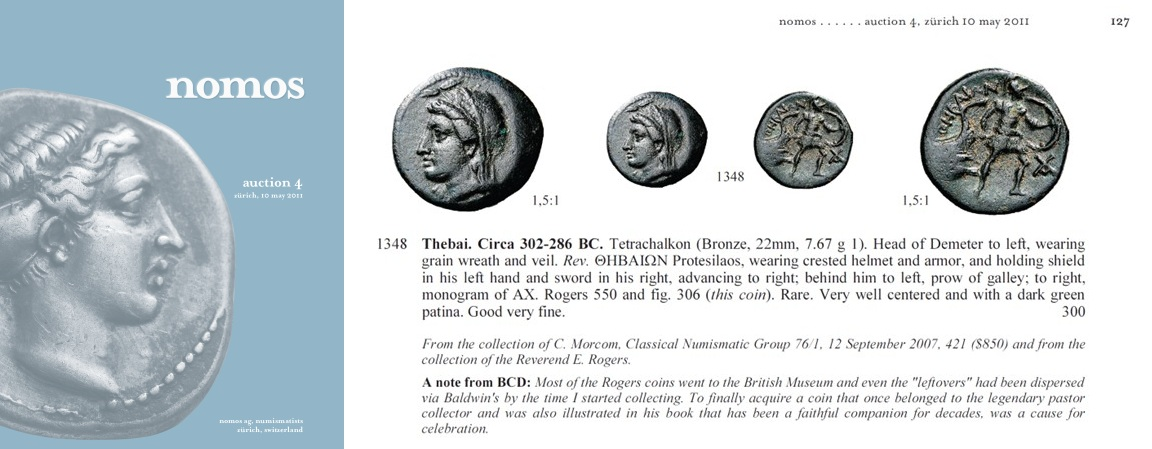
Rogers Tags: Of a different coin, BCD once wrote:
“To this collector the Rogers ticket was worth much more than the coin and was always fondly contemplated; an imaginary link with a very different past when there were far fewer Thessalian bronzes around while scholars and collectors studying them had much more time at their disposal.“
The coin above lost its Rogers tag before I got it. The one below did not:
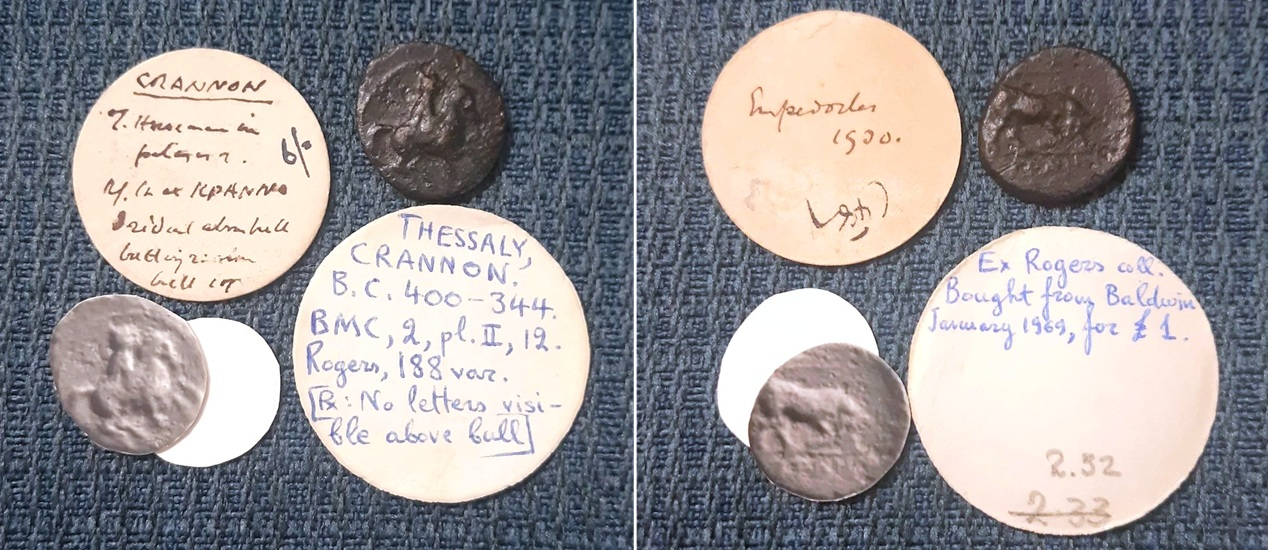
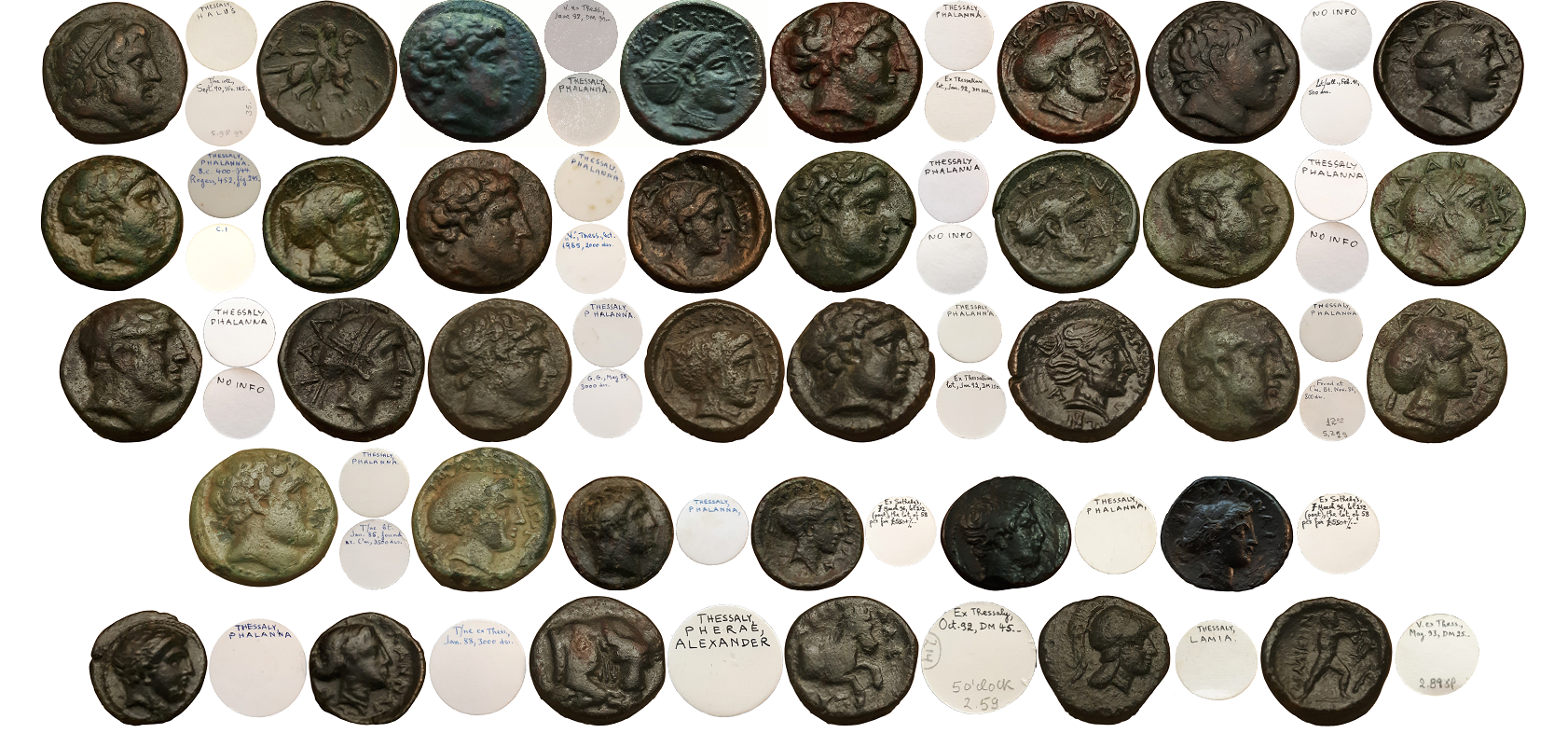
A small Krannon bronze, shown above with Rogers’s handwritten tag (noting it was ex-Empedocles,1920) and BCD’s tag and photos. Provenance notwithstanding, why would BCD take the trouble to photograph a seemingly common coin in poor condition? In fact, it is not as common as it might first appear. Instead, it is a double die-match to BCD Thessaly II 118.4, about which BCD commented in Triton XV: “This rare obverse die does not have a ground line.“
Note: Returning to the theme of Thebaean coin, for another Protesilaos [alt: Protestilaus], see his diademed head on my Skione Hemiobol above. (The apotropaic eye on the reverse is a metonym for his war galley, serving as the usual decoration on the prow.) One of the more exciting mythological characters to appear on Greek coins, he was the first Greek to die in the Trojan War, killed by Hector, having leapt ashore first despite the prophesy that whoever did so would die. On the Hemiobol above, he wears only a taenia (diadem), perhaps suggesting his role as King of Phylace.
CENTRAL GREECE (Akarnania, Lokris, Phokis, Euboia) [11+ Coins; top]:
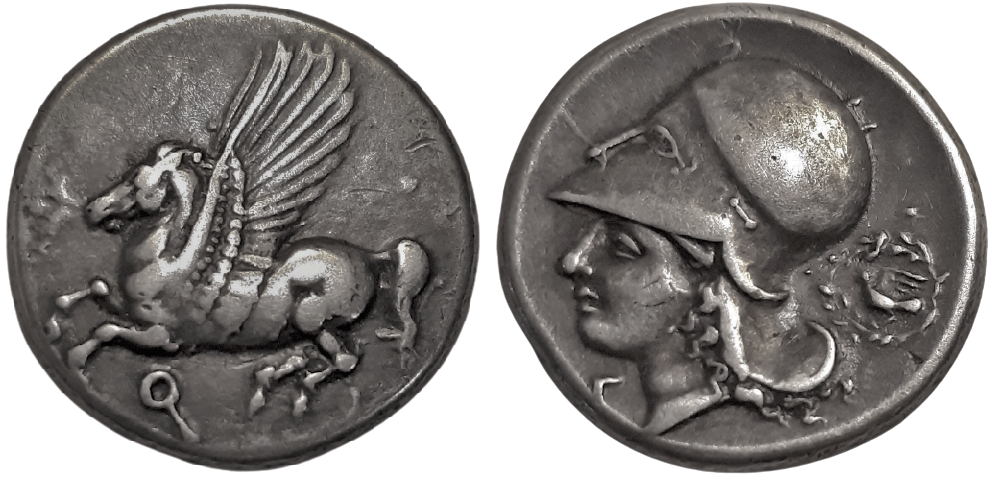
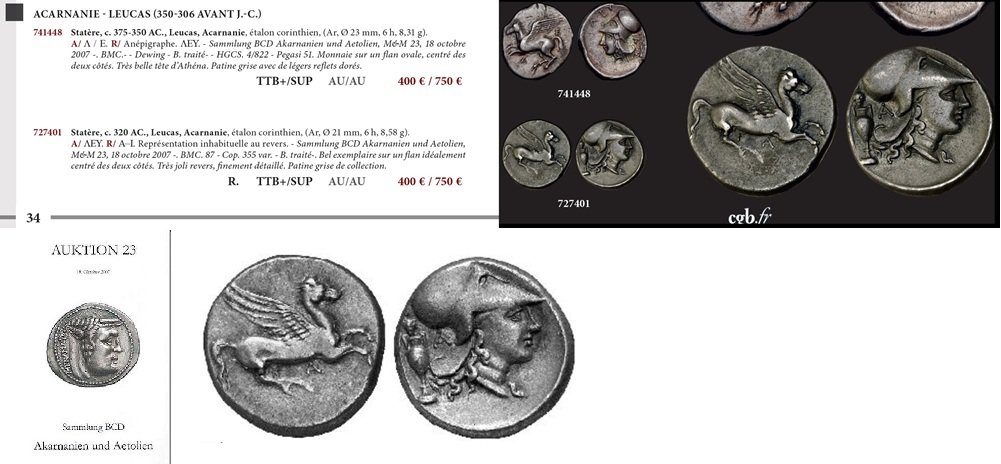
Akarnania, Leukas AR Stater (20mm, 8.62g, 6h), c. 300 BCE. Pegasos flying / Head of Athena, grapes & amphora.
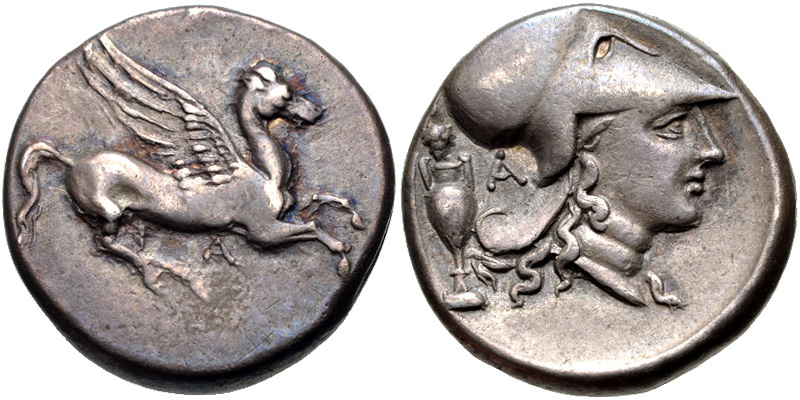
(Photo credit: CNG.) Collection/Publication Hist.:
– BCD Collection [Münzen & Medaillen GmbH 23 (Munich, 18 Oct 2007), Lot 278 (part)];
– CGB (Paris) Live Auction 7 June 2022, Lot 26;
– BCD Akarnania 278.1.

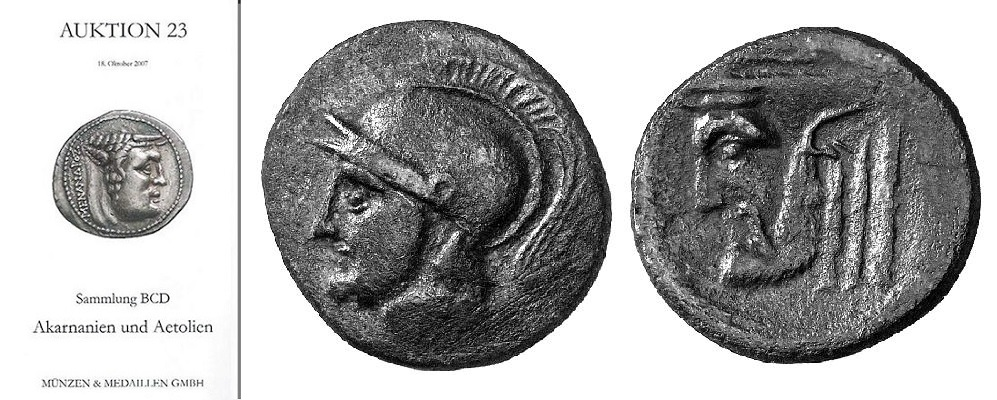
Akarnania, Federal Coinage AE (21mm, 5.17g, 4h), 3rd cent BCE. Athena / Man-headed bull, Achelӧos.
(Photo credit: CNG.) Collection/Publication Hist.:
– reportedly found in Phokis;
– BCD Collection [Münzen & Medaillen GmbH 23 (Munich, 18 Oct 2007), Lot 42];
– Michel Thys, Sammlung Flussgötter-Darstellungen [Jacquier 52 (15 Sep 2023), Lot 513];
– BCD Akarnania 42.

Locris Opuntii AE Chalkous (13mm, 1.65g, 7 h), 3rd cent. BCE. Head of Athena / Grapes, Λ – Ο, lower r.: knemis.
(Photo credit: Naville.) Collection/Publication Hist.:
– BCD Lokris-Phokis Duplicates [Naville 89 (12 May 2024), 121].
Publication Hist.:
– H-D Group 15, 21a (O2/R14, this coin illustrated on pl. 44, text on p. 191), in Humphris & Delbridge (2014), Coinage of the Opountian Lokrians [PDF avail. from RNS] from plaster casts made by BCD.
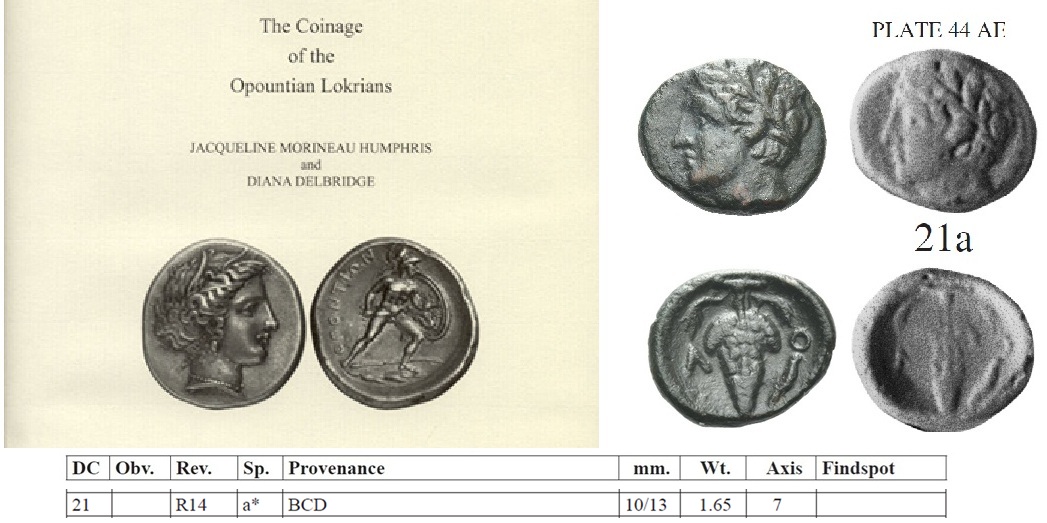
Note: The symbol on the lower right is a knemis (or cnemis) — a greave, armor covering the lower leg. (Examples on Wiki.) In the local context, it seems to be a canting pun of the sort commonly found on Greek & Roman Consular coins. As Humprhris & Delbridge (2014: p. 1) explain:
“The countryside of Lokris is dominated by Mount Knemis, named after its shape (‘knemis’ is Greek for ‘greave’). The appearance of the knemis on several denominations refers to this feature, which is also reflected in the use of the expressions Hypoknemidian and Epiknemidian Lokris to describe the area, words which are abbreviated on some of the coins. The chief city in this area was Opous…“
(One might suspect it of being a synecdoche for the local hero Ajax, except that he is invariably nude, aside from helmet, shield, and spear. He even fights barefoot, which I find hardest to imagine.)
Locris. Lokri Opuntii & Lokri Epiknemidii AE Chalkoi X7 (12-14mm, 1.59-3.67g), 3rd-2nd cent. BCE. Head of Athena (one Apollo) / Grapes.
(Photo credit: Naville.) Collection/Publication Hist.:
– BCD Lokris-Phokis Duplicates [var. Naville Numismatics Auctions, some w/ BCD collect tags & prior provenances indicated];
– Findspots incl.: Halos, Phokis, Psophis, Thessaly, one ex Rauch 22 (1978);
– these coins illustrated in Humphris & Delbridge (2014), Coinage of the Opountian Lokrians [PDF avail. from RNS] from plaster casts made by BCD.
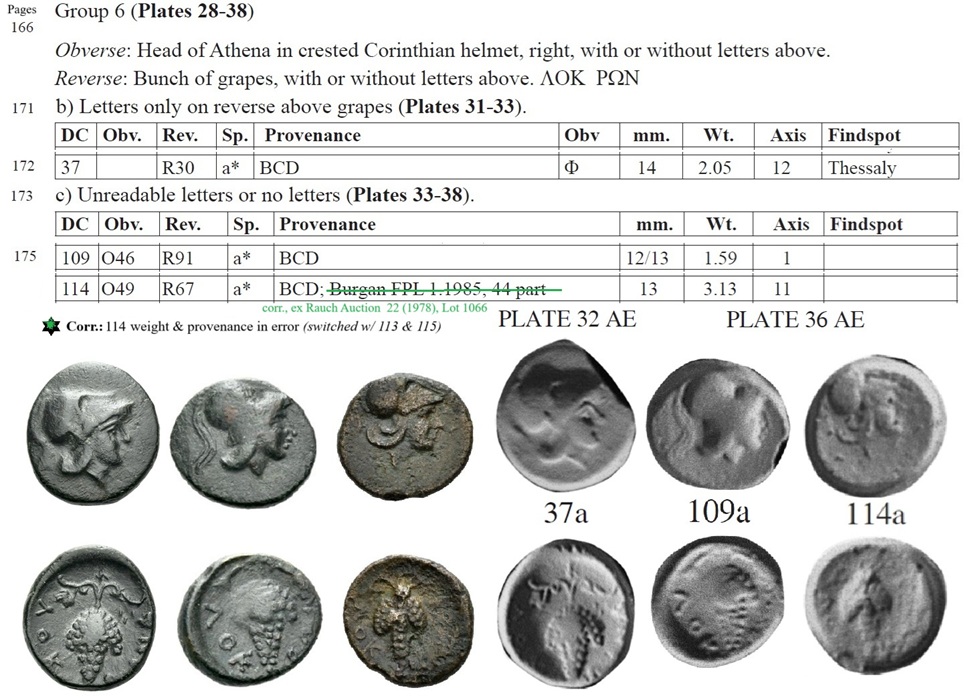
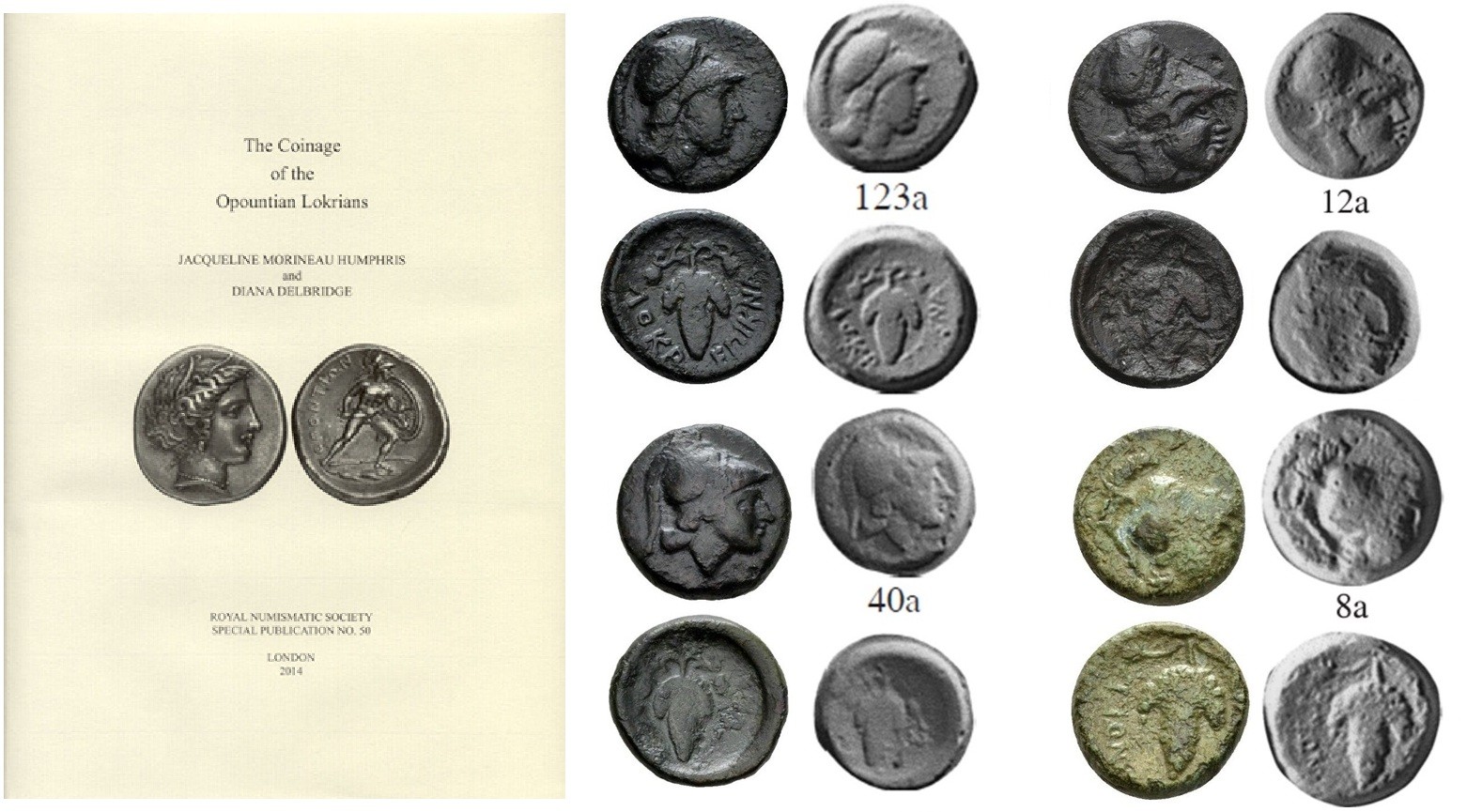
Notes: In addition to nine plate coins (these seven, one above, one below), I have several others that are cited (including the ex-Copenhagen coin below & a countermarked RPC).
The H-D corpus illustrates why the BCD Collection was so valuable for scholarship: his initials appear in the text & catalog over 2,000 times, a considerable portion of the plate coins illustrated from his hand-made plaster casts.
Locris Opuntii AE Chalkous (12mm, 3.05g, 7 h), 3rd cent. BCE. Head of Athena / Grapes.
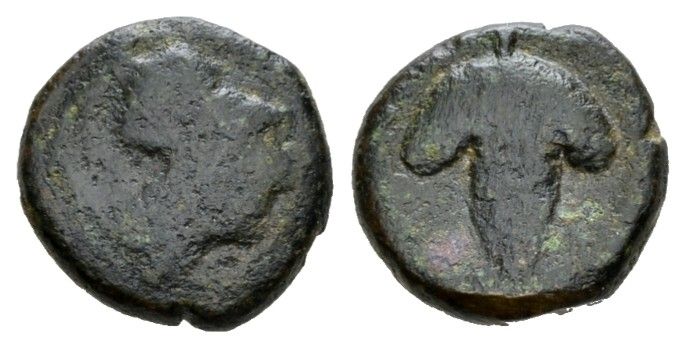
(Photo credit: Naville.) Collection/Publication Hist.:
– Ex Danish National Museum, Copenhagen, Duplicates (reportedly);
– (presumably) C.J. Holm [early 1960s; c. 1966-1975];
– BCD Lokris-Phokis Duplicates [Naville 14 (11 Apr 2015), 54 (unsold); BCD’s tags apparently lost afterward];
– this coin cited in Humphris & Delbridge (2014), p. 207, group 23.1 (unidentified dies, final coin).
Provenance Notes: On the provenance history of the Copenhagen Duplicates, via the Holm & BCD Collections, see Note 3 below.
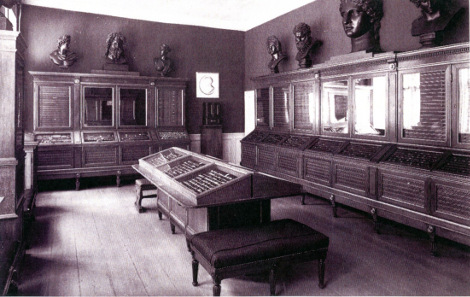
Image source: muenzenwoche
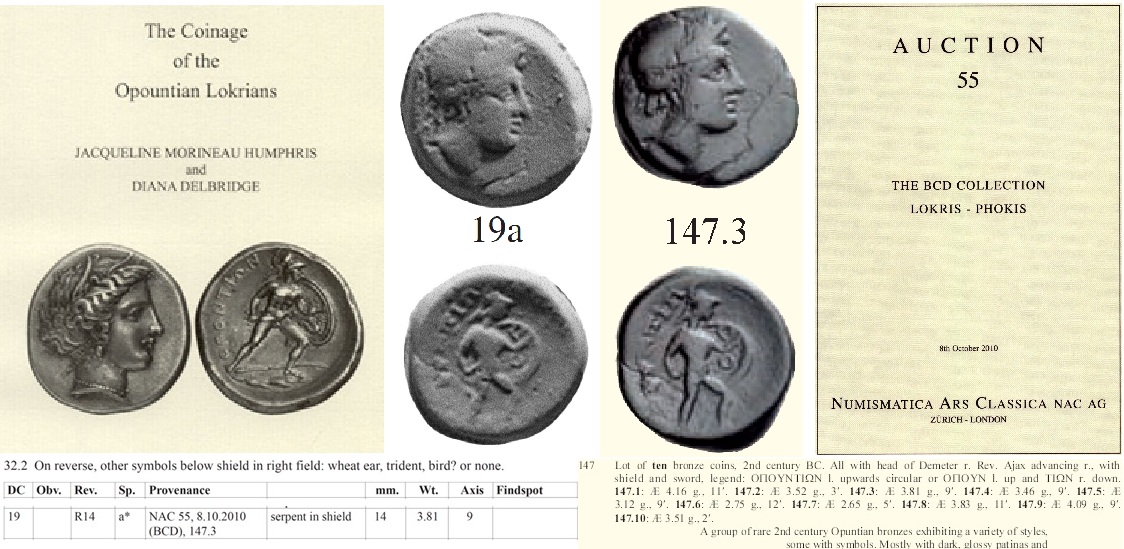
Locris Opuntii AE (15.5mm, 3.79g, 9h), 2rd cent. BCE. Head of Demeter / Ajax advancing, sword & serpent-decorated shield.
(Photo credit: Nomos AG.) Collection/Publication Hist.:
– BCD Collection [NAC 55 (Zurich, 8 Oct 2010), 147 (part)];
– John Aiello Collection [Nomos Obolos 38 (20 Jul 2025), Lot 138].
Publication Hist.:
– BCD Lokris-Phokis 147.3 (this coin illustrated on p. 59);
– H-D Group 32.2, 19a (O10/R14, this coin illustrated on pl. 57, text on p. 213), in Humphris & Delbridge (2014), Coinage of the Opountian Lokrians [PDF avail. from RNS] from plaster casts made by BCD.
Phokis, Federal Coinage (Phokian League) AR Hemiobol (8mm, 0.40g, 6 h), 485-480 BCE. Head of bull / Corinthian helmet.
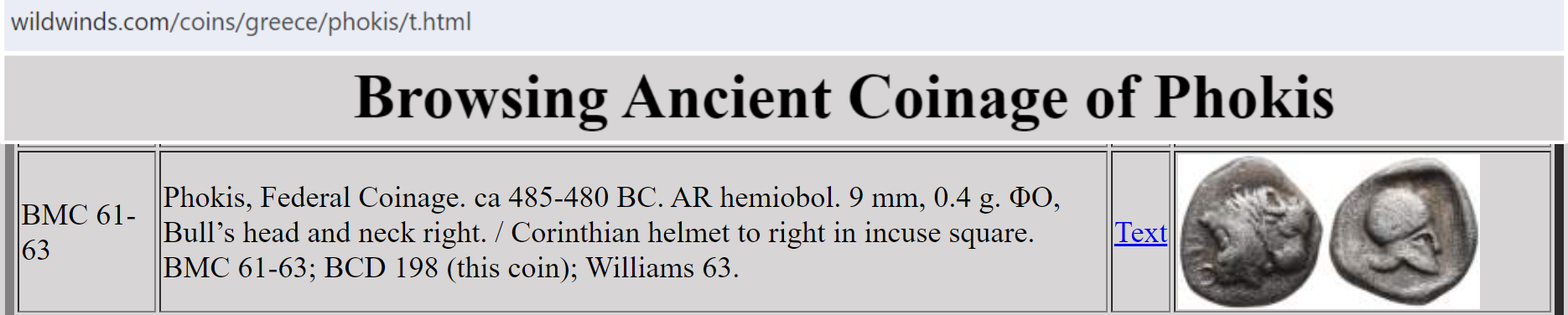
Phokis, Federal Coinage (Phokian League) AR Hemiobol (9mm, 0.40g, 6 h), 485-480 BCE. Head of bull / Corinthian helmet.
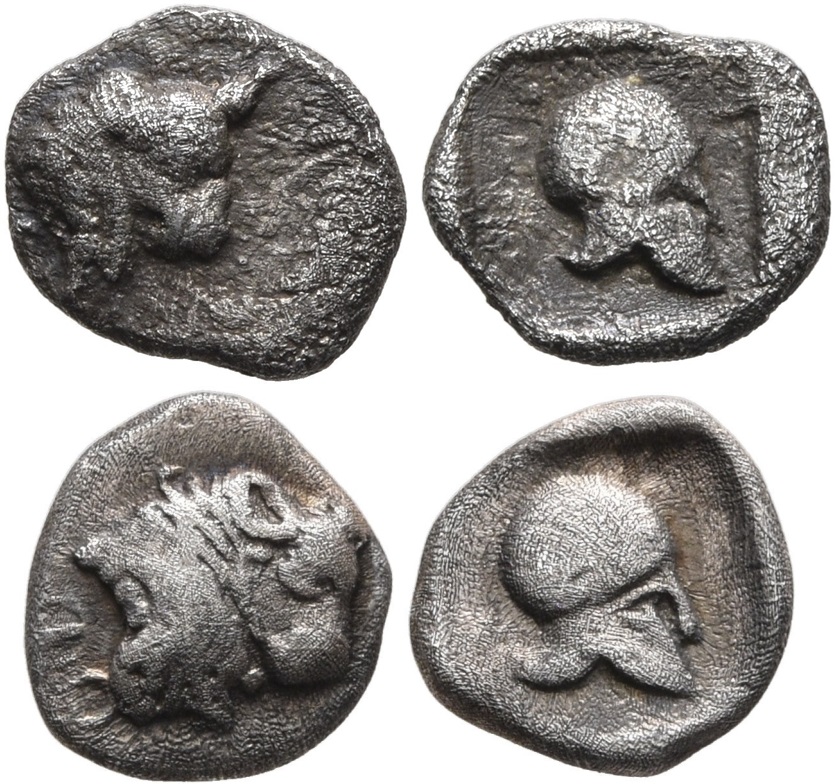
(Photo credit: NAC.) Collection/Publication Hist.:
– BCD Collection [NAC 55 (Zurich, 8 Oct 2010), 197];
– BCD Lokris-Phokis 197 (this coin illustrated, p. 78);
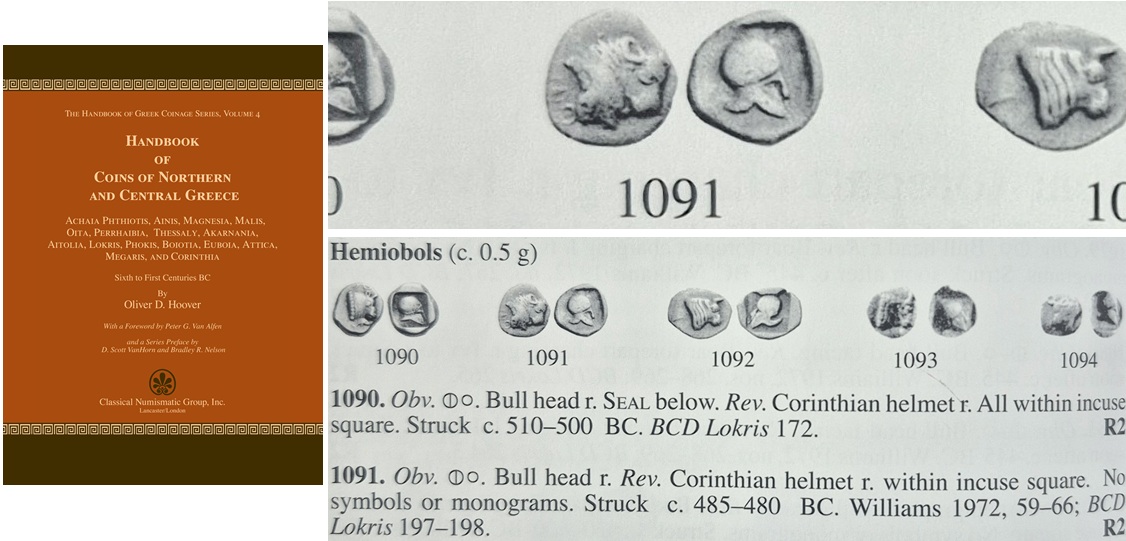
– HGC 1091 (this coin cited on page 318, “BCD Lokris 197-198″) in: O. Hoover (2014), Handbook of Greek Coinage, volume 4: Northern and Central Greece.
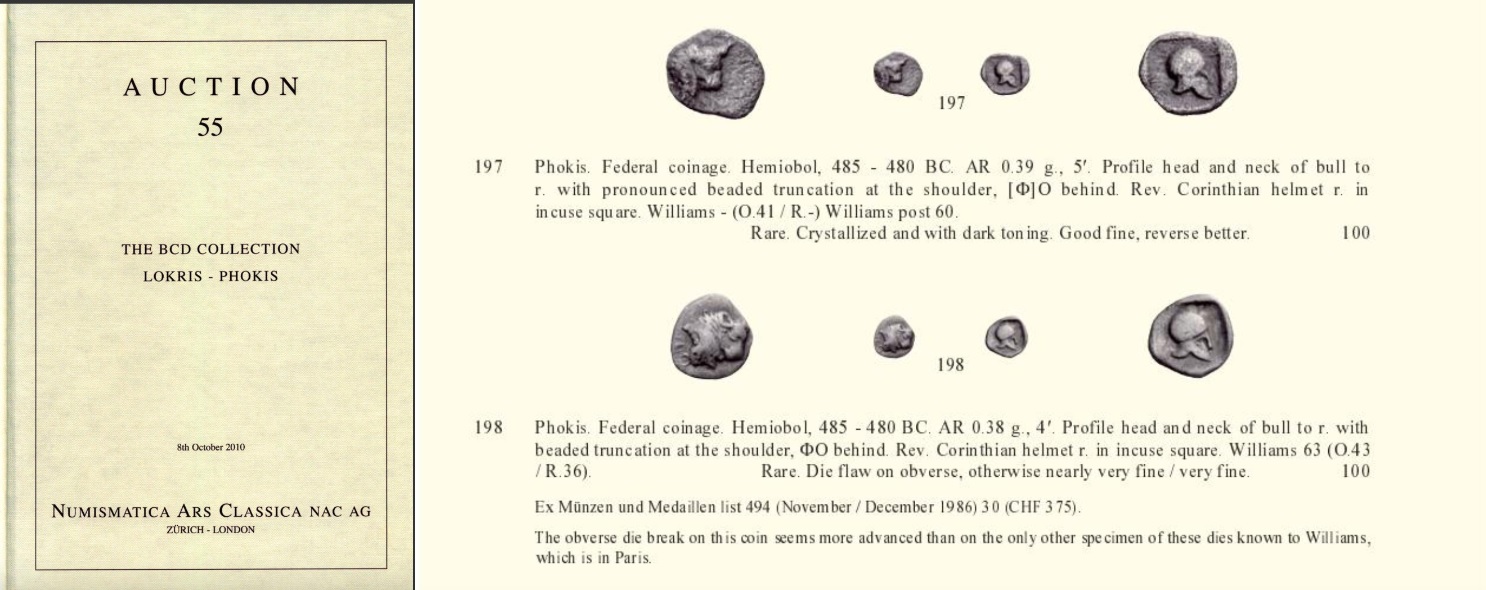
(Photo credit: NAC.) Collection/Publication Hist.:
– BCD Collection [NAC 55 (Zurich, 8 Oct 2010), 198];
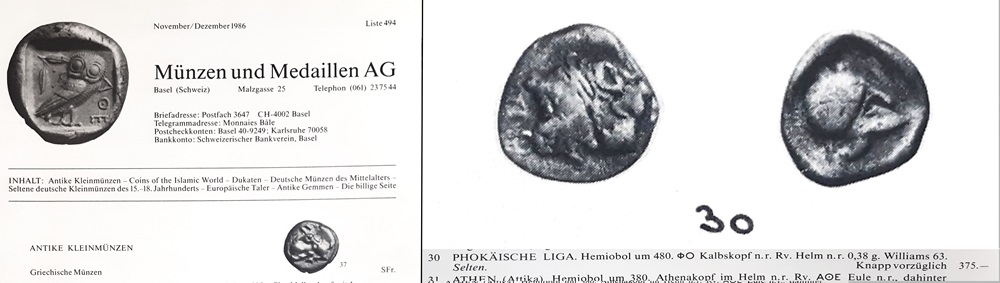
– Münzen und Medaillen FPL 494, “Antike Kleinmünzen” (Nov-Dec 1986), Nr. 30];
– BCD Lokris-Phokis 198 (this coin illustrated, p. 78);
– Wildwinds (Phokis) “digital plate coin,” BMC 61-63 (this coin illustrated for type);
– HGC 1091 (this coin illustrated on page 318, “BCD Lokris 197-198″) in: O. Hoover (2014), Handbook of Greek Coinage, volume 4: Northern and Central Greece..

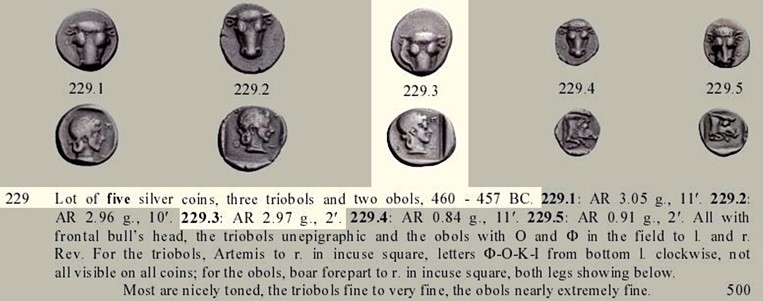
Phokis, Federal Coinage AR Triobol – Hemidrachm (15mm, 2.97g), 460-457 BCE. Head of bull / Artemis.
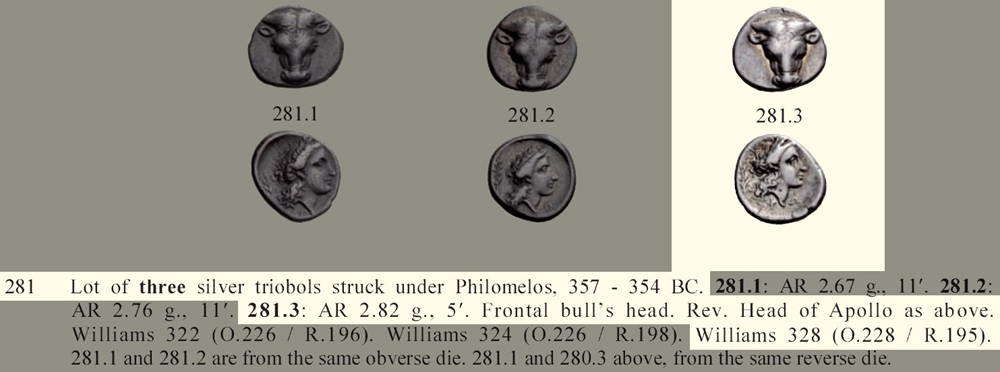
Phokis, Federal Coinage AR Triobol – Hemidrachm (15mm, 2.82g), 357-4 BCE. Head of bull / Apollo.
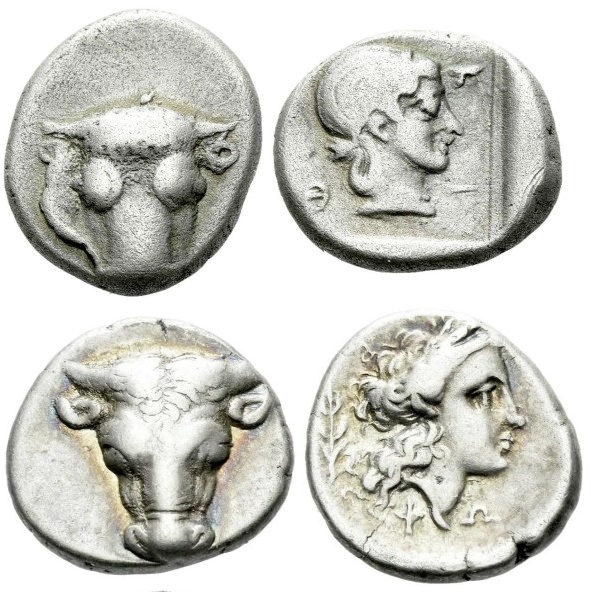
(Photo credit: Naville.) Collection/Publication Hist.:
– BCD Collection [NAC 55 (Zurich, 8 Oct 2010), 229 (part)];
– BCD Lokris-Phokis 229.3 (this coin illustrated, p. 86).
(Photo credit: Naville.) Collection/Publication Hist.:
– BCD Collection [NAC 55 (Zurich, 8 Oct 2010), 281 (part)];
– BCD Lokris-Phokis 281.3 (this coin illustrated, p. 104).
High-relief bull, reminiscent of (though significantly later than) the Acropolis Moschophorus (Calf Bearer) (mid-6th BCE). Coin-in-hand video (imgur [25s], YouTube [20s]):

My favorite die-pair among Triobols of the Third Sacred War (Wiki). Struck by Philomelos, Strategos of the Phokian League, who famously plundered the Temple of Apollo at Delphi in 356 (see Hammond JHS 1937). The Sacred War coins, which funded mercenary forces, must have been struck mostly from the Apollonion‘s looted silver (see Williams 1972: 46-62ff; Head 1911: 339; Carradice 1995: 12-3, 49; Carradice & Price: 79).
A grave sacrilege, of course. (Apollo had his revenge on the Phokians.) The Lokrians melted down recovered coins.
A generation later, Apollo gave his blessing for an issue of Amphictyonic Staters from his temple’s silver, c. 336, to rebuild after it was damaged by an earthquake. (Might the Phokian League have had a secret admirer in Poseidon?)
Boeotia, Boeotian League AE Chalkous (18mm, 4.03g, overstruck on Antigonos II), Alliance War Issue w/ Antigonos III (?), c. 224-222 BCE. Demeter (over Herakles) / Poseidon.
(Photo credit: Noble.) Collection Hist.:
– Dr. S. Pozzi (1846 – 1918) Collection [not in Ars Classica];
– Sammlung Prof. Dr. P. R. Franke (1926-2018) [Grün 64 (20 Nov 2014), 613 (unsold); Solidus 85 (21 Sep 2021), 228];
– Sammlung “de Face” (FH Coll.) [Peus 439 (4 Nov 2024), 1120];
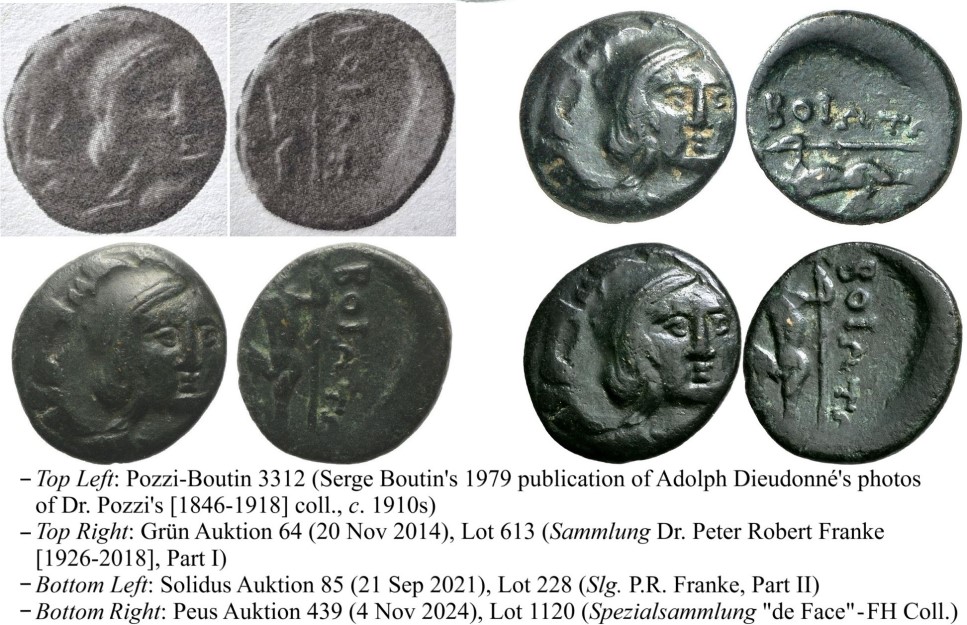
– (possibly) ex Christopher & RK Morcom Collection (viz., Triton XI, 1743, group of 94, incl. “AE issues…BOEOTIA, Federal coinage (2)”). See Franke-Morcom-Pozzi Note.
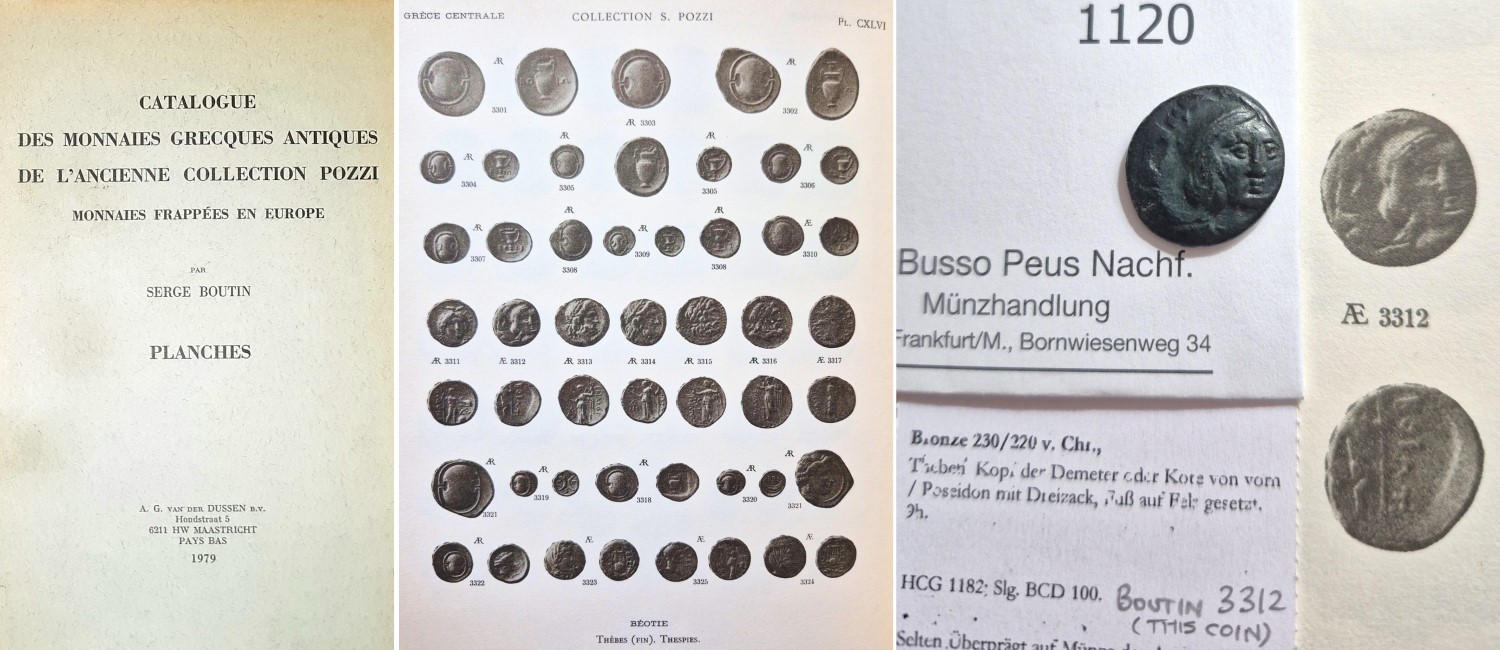
Publication Hist.: Serge Boutin 3312 (this coin illustrated on Plate CXLVI) in Catalogue de Monnaies Grecques Antiques de l’Ancienne Collection Pozzi (1979, Maastricht: van der Dussen);
– Greek Overstrikes Database: Nos. 3373 & 1459 (both this coin, illustrated from Grün 64 & Solidus 85);
– Haymann, Florian (2024), Faszination de Face, p. 39 & Plate XI (this coin).
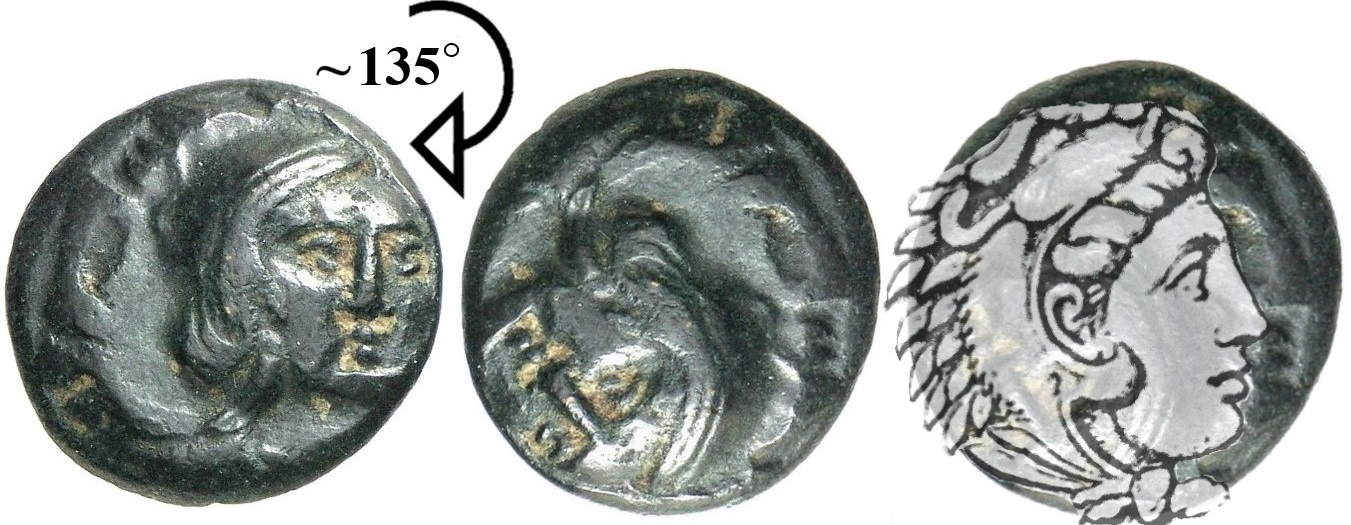
Notes: This type was virtually always overstruck on bronzes of Antigonos II Gonatas. Thus, in addition to Demeter facing, we can still see the profile of Herakles on this obverse. These coins were probably struck after the death of Demetrios II in 229 BCE, who had invaded Boeotia and introduced Macedonian coins as local currency. These may be among the only coins struck locally during the period of Macedonian control, which lasted until 197 BCE, when the Roman general Titus Quinctius Flaminius conclusively defeated Philip V in the Second Macedonian War.
This coin appears twice in the Greek Overstrikes Database (nrs. 3373 & 1459), after the two major sales of Peter Robert Franke’s (1926-2018) collection, Grün 64 (2014) & Solidus 85 (2021).
Had it been recognized as ex-Pozzi, I’m sure it wouldn’t have gone unsold at the former. Nor, I suspect, could I have gotten it for the minimum bid at the “Spezialsammlung de Face” sale!
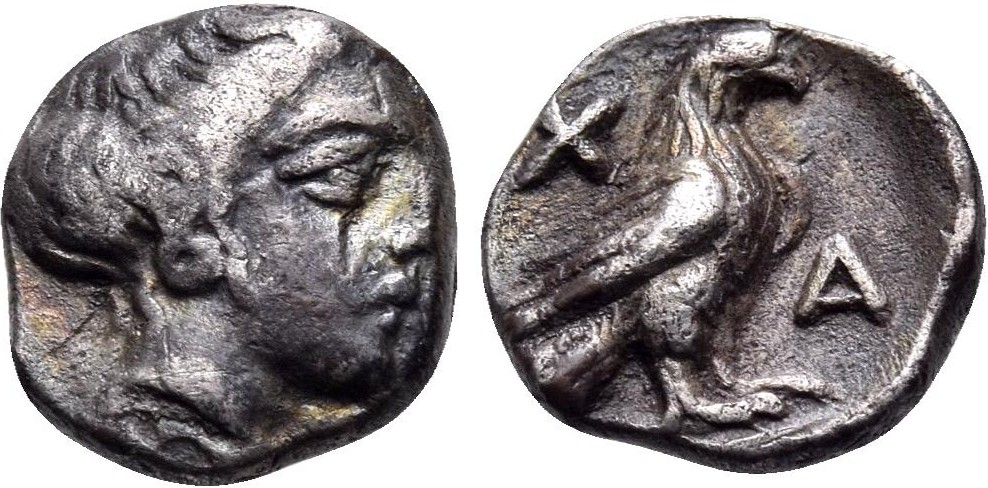
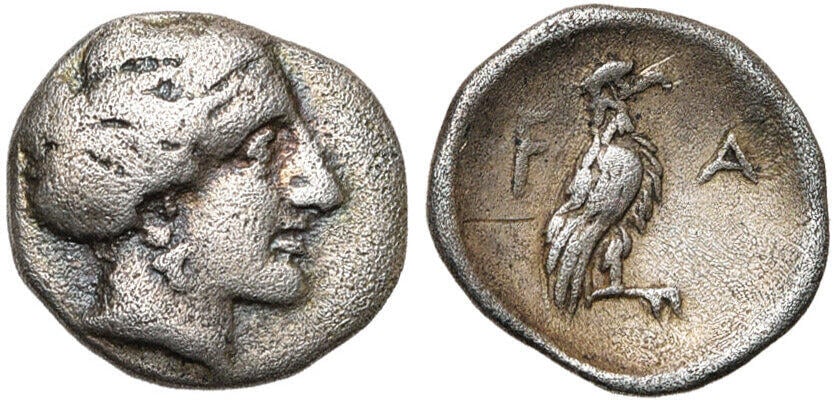
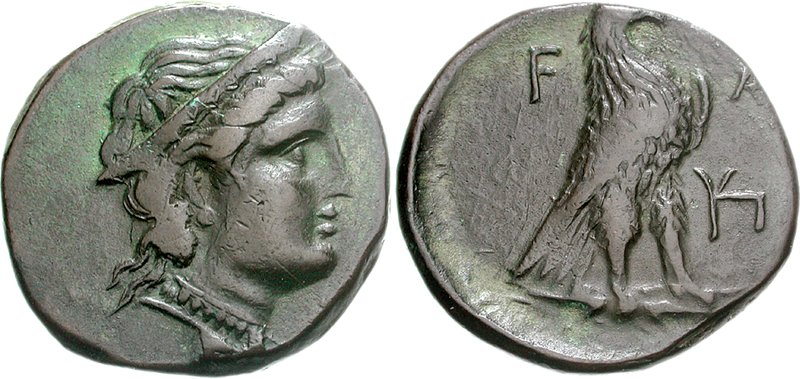
Euboea, Chalkis AR Obol (8mm, 0.54g, 9h), c. 338-308 BCE. Nymph / X-A, Eagle.
(Photo credit: Nomos.) Collection Hist.:
– CsP 1291 = Collection sans Pareille, Part III, with handwritten round* tray tag [Nomos Obolos 35 (15 Dec 2024), 1291];
– BCD Euboia 133 (p. 27, ill. w/ rev. enlargement) = BCD Collection [Lanz 111, 25 Nov 2002, 133; “acquired after decades of search” (per Nomos 20 catalog)].
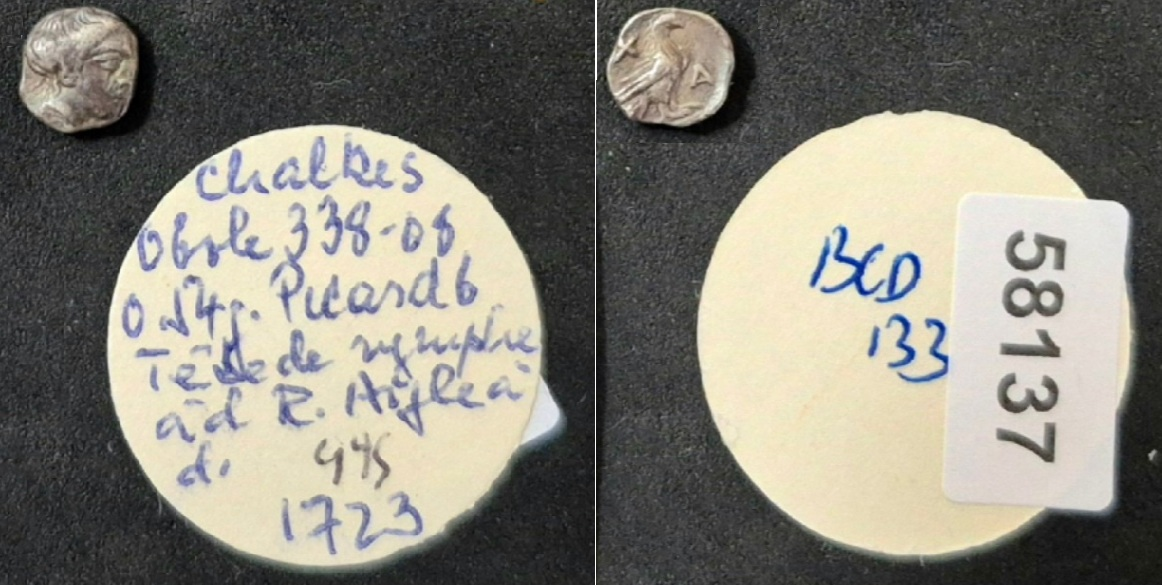
Tag Note: My six CsP coin tags vary: three came only w/ Mildenberg’s penciled round tags (e.g., Sikyon Obol below); three handwritten tags by the Collectionneur sans Pareille were round off-white (here), blue square & white square (Eion, 1201 & 1203). Most have 5-digit numbers written or on stickers; I don’t know why.
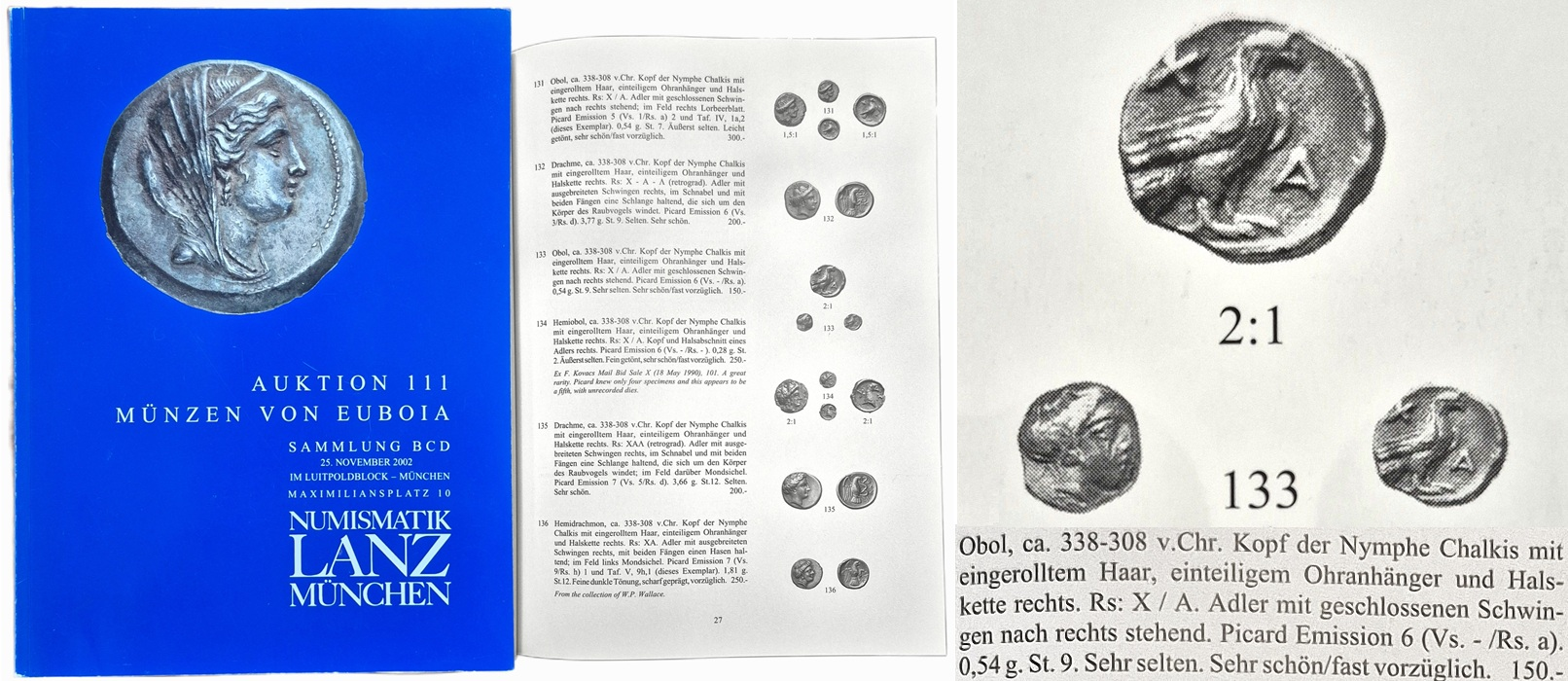
Provenance Notes: Nomos 20, Lot 141‘s cataloger (ASW, I’m sure) called BCD’s coin (now mine) “inferior,” elaborating:
“This coin goes to prove that really rare coins really are rare! BCD had an example of this issue, acquired after decades of search, but of really mediocre quality, with an off-center obverse lacking part of the nymph’s nose! What he would have paid for this one had he seen it, would be a figure of dreams.“
Unfortunately, ASW (?) did not say where BCD finally found his. One possibility: W.P. Wallace (1907-1965), c. 1990s, from whose collection BCD acquired numerous Euboian coins (incl. my Eretrian Octopus Obol & Federal AE below).
Reference Notes: Picard seems not to list this example in his 1979 die-study of Chalcis, though he referenced a 0.58g example from the W.P. Wallace (1907-1965) collection, also with dies oriented at 9h (Wallace 518 = Picard 6th em., 1a, 3rd example, p. 29). Might it have been this coin? I haven’t found it yet in Wallace’s publications or notebooks (digitized by ANS), so evidence either way may no longer exist.
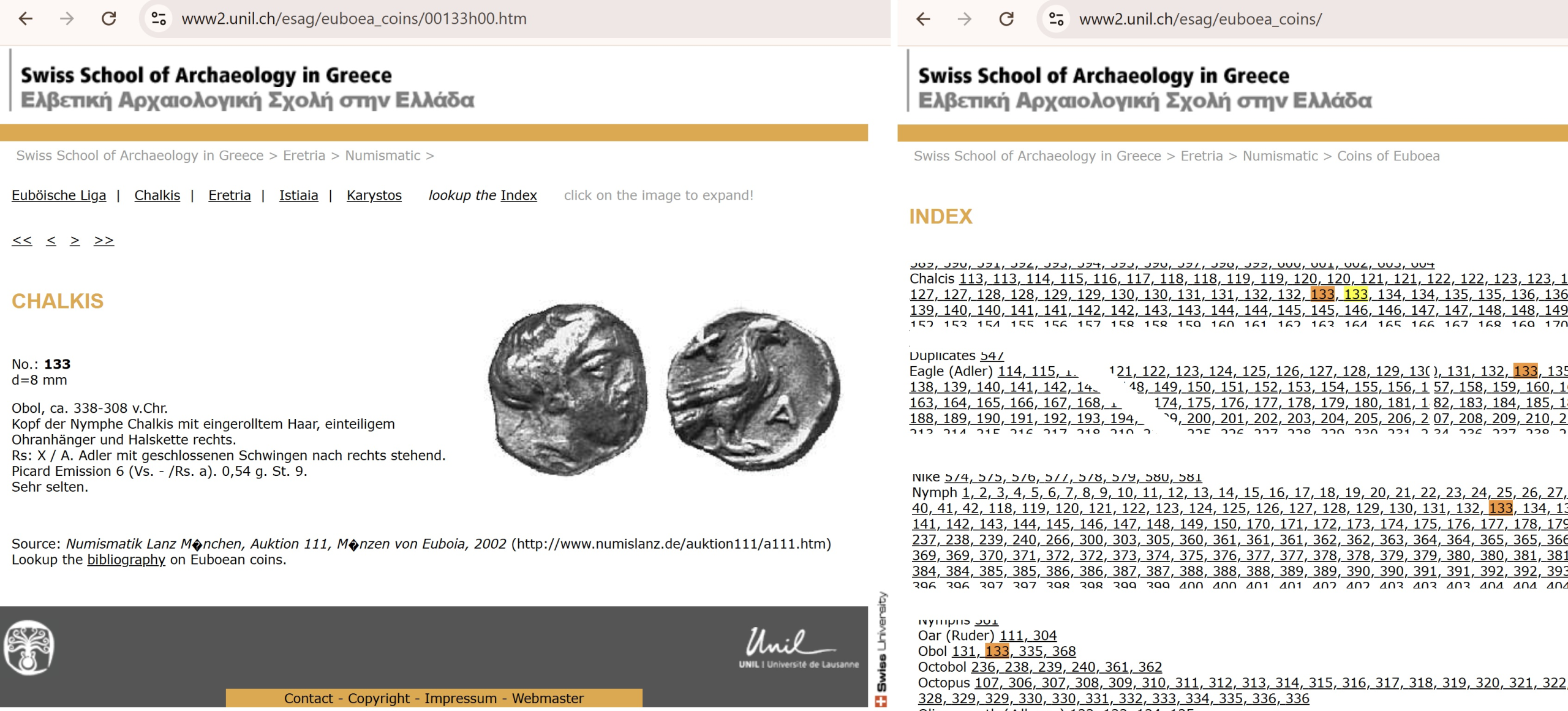
See also: This coin illustrated online (after Lanz 105) by University of Lausanne, Swiss School of Archaeology in Greece, index of BCD Euboia.
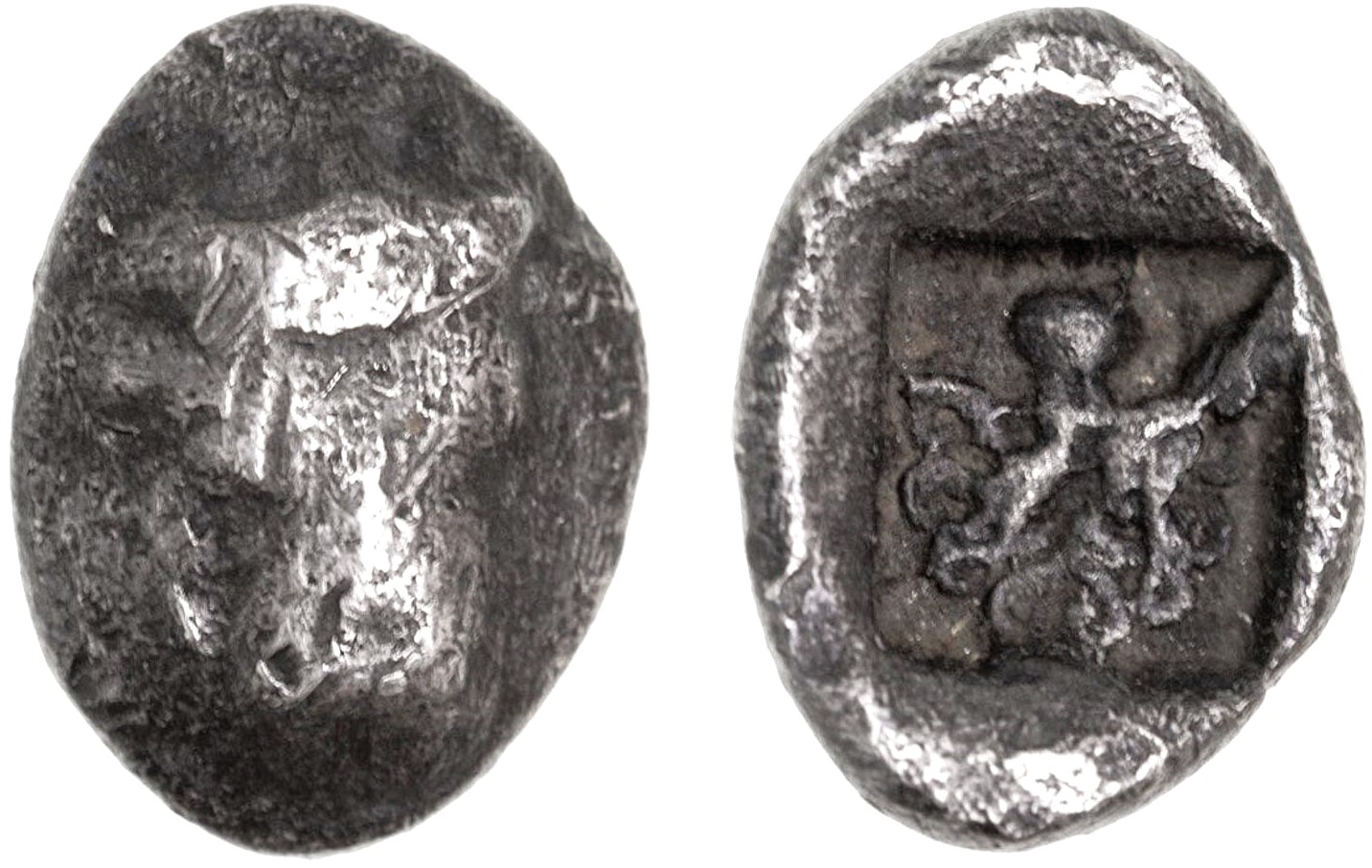
Euboea, Eretria AR Obol (6-9mm, 0.57g, 6h), c. 500-465 BCE. Head of bull / Octopus.
(Photo credit: Noble.) Collection Hist.:
– BCD Collection;
– W.P. Wallace (1907-1965).
Notes: See Wallace Note. Probably one of the seven such obols in the metallurgical analysis in Wallace’s (1962, NC) “The Early Coinages of Athens and Euboia” (p. 27, “Obol, no letter (7)”).
Quick coin-in-hand video: On Youtube or Imgur.
Euboea, Federal Coinage [Euboean League] AE Dichalkon (16mm, 4.39g, 6h), c. 191-170 BCE. Veiled female / Bull, wreath above.
(Photo credit: Nomos.) Collection Hist.:
– John Aiello Collection [Nomos Obolos 33 (11 Sep 2024), 255];
– BCD Collection (w/ collector tag, corr. different coin, same hoard [see tag notes & addl. images below]);
– W.P. Wallace (1907-1965) [hoard acq. Sep. 1952];
– Ex IGCH 230, “Euboea, before c. 1940” Hoard (Mørkholm & Thompson 1973: p.37 ; see also CoinHoards.org entry).
Publication Hist.:
– Wallace 1956: p. 121, “Wallace AE 2” (Hoard 3), No. 8 (wreath, 2nd, 4.4g; this coin cited);
– Picard p. 194, Em. 33, “trésor Wallace” n. 2, 8 (this coin cited).
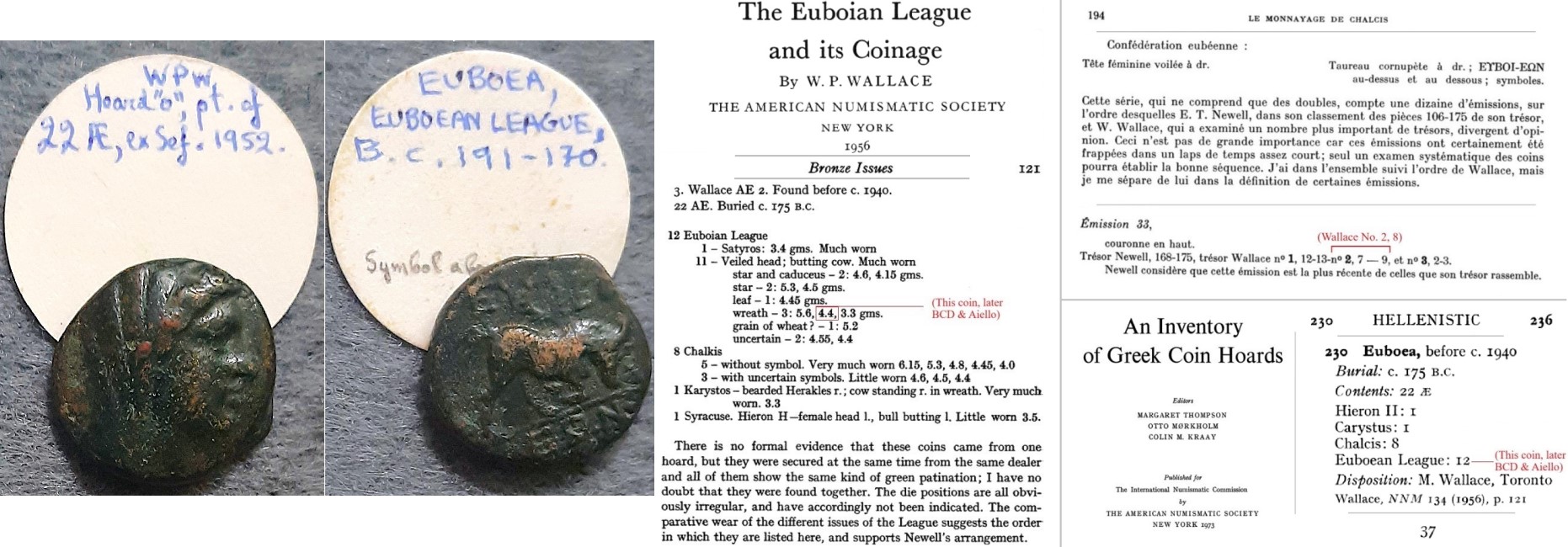
Notes : The obverse is usually described only as “veiled female” but Wallace suggested Isis. (There was a Temple of Isis at Eretria.)
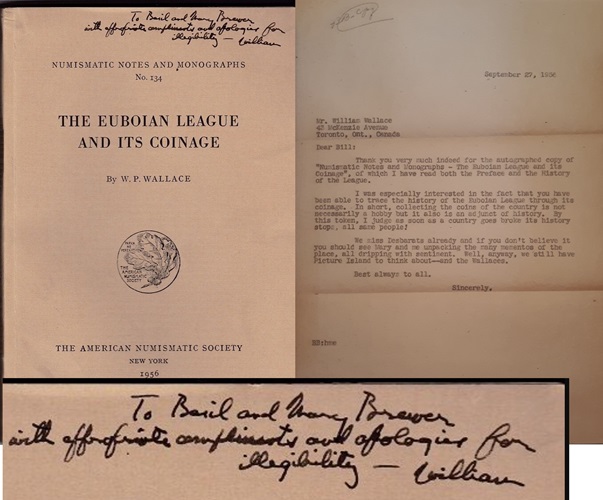
Tag Notes: BCD’s tags for coins from the Wallace hoard were mixed up; I received the tag belonging to the first coin w/ star above (5.26g, 12h). Always put weights on your tags! It didn’t prevent the mix-up this time, but including weight to 0.01g helped identify & mitigate it. See also Wallace Note.
Addl. Images: BCD Tags (corr., on Imgur), publication collage (larger on Imgur), signed/inscribed copy of Wallace 1956 (larger photo on Imgur).


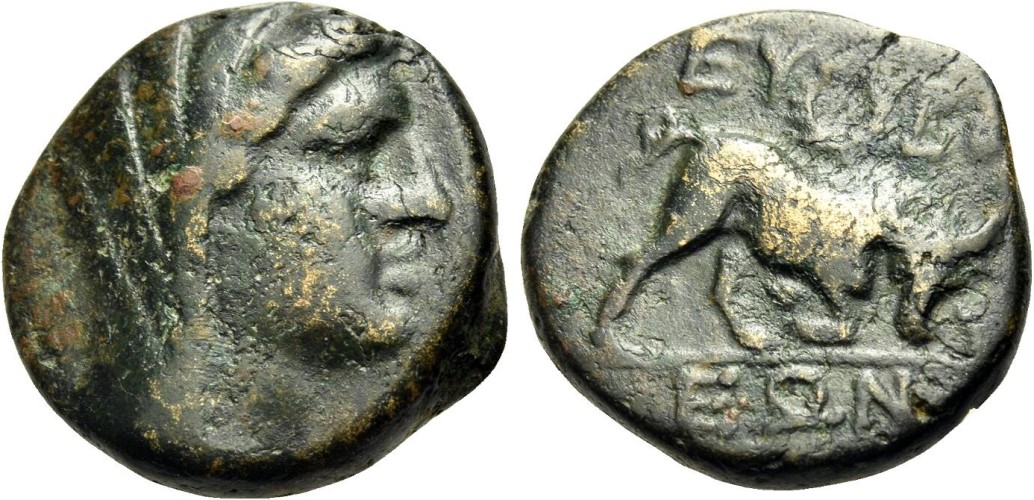
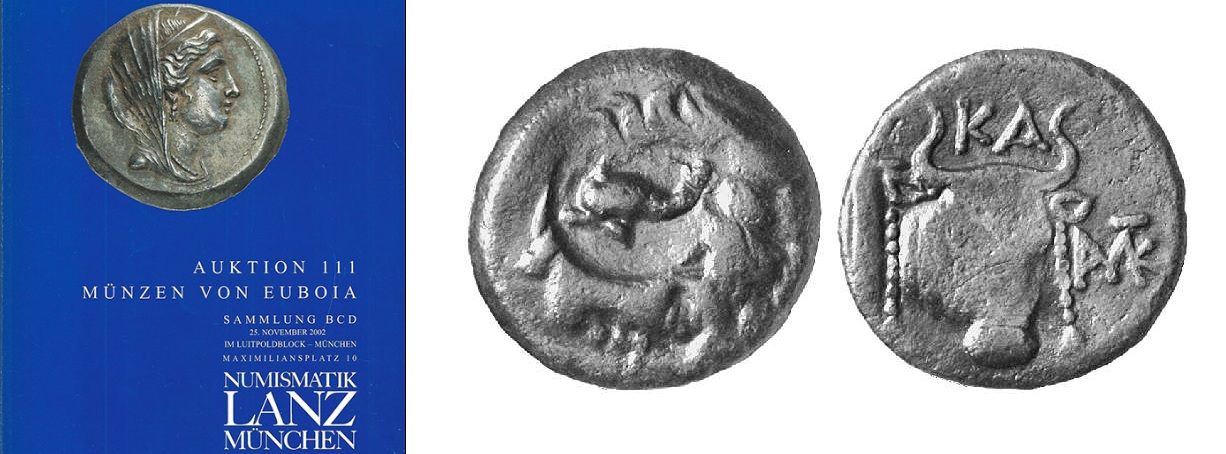
Euboia, Karystos AE (Dichalkon? 18mm, 3.28g, 12h), 3rd-2nd BCE. Head of Herakles, dolphin countermark / Head of bull.
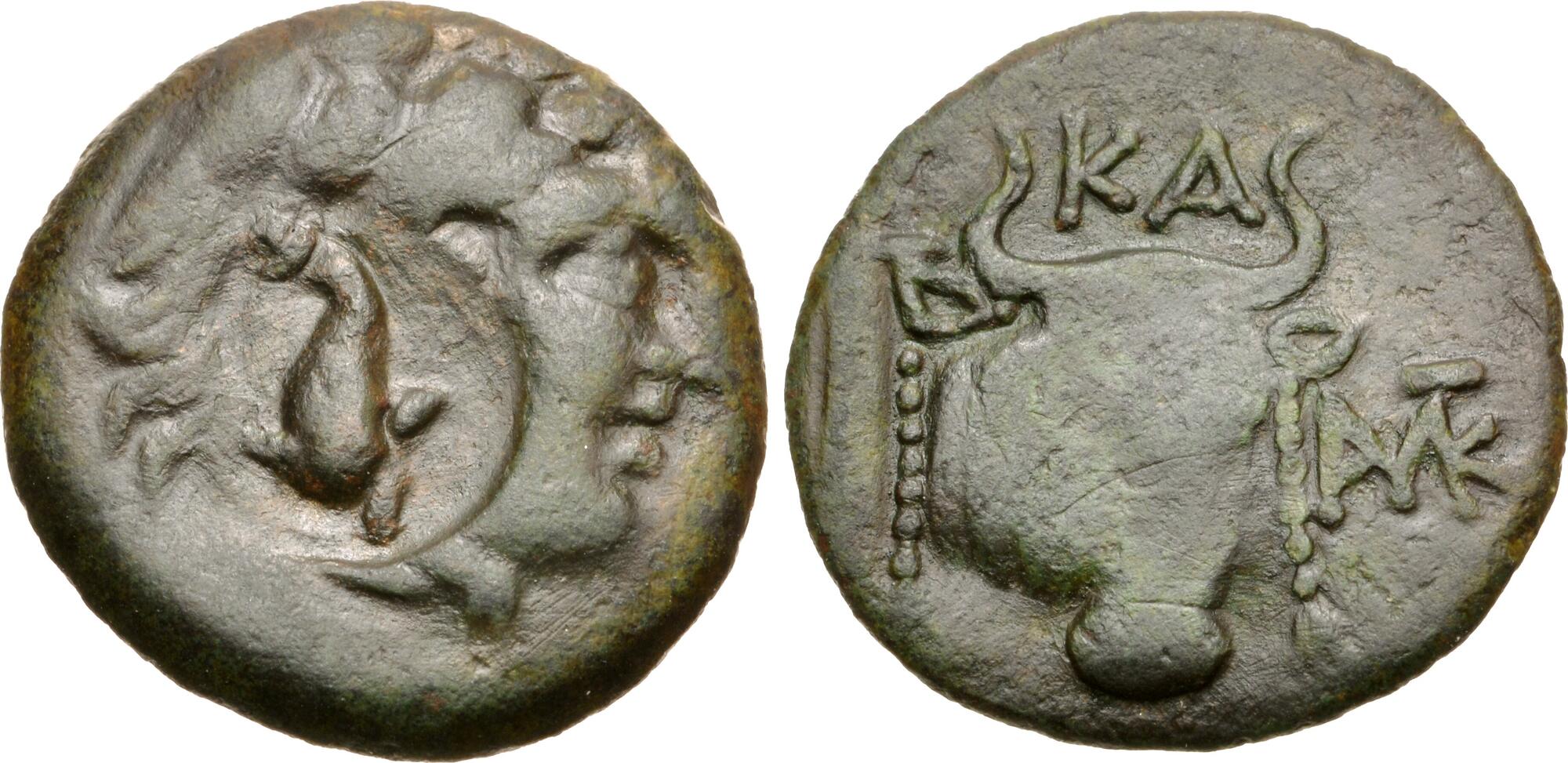
(Photo credit: CNG.) Collection/Publication Hist.:
– BCD Collection [Lanz 105 (Munich, 25 Nov 2002) 587 = BCD Euboia 587].
See also: This coin illustrated online (after Lanz 105) by University of Lausanne, Swiss School of Archaeology in Greece, with their excellent index of BCD Euboia.

CENTRAL GREECE (Peloponnesos, Arkadian League, Athens, Corinth) [16+ Coins; top]:
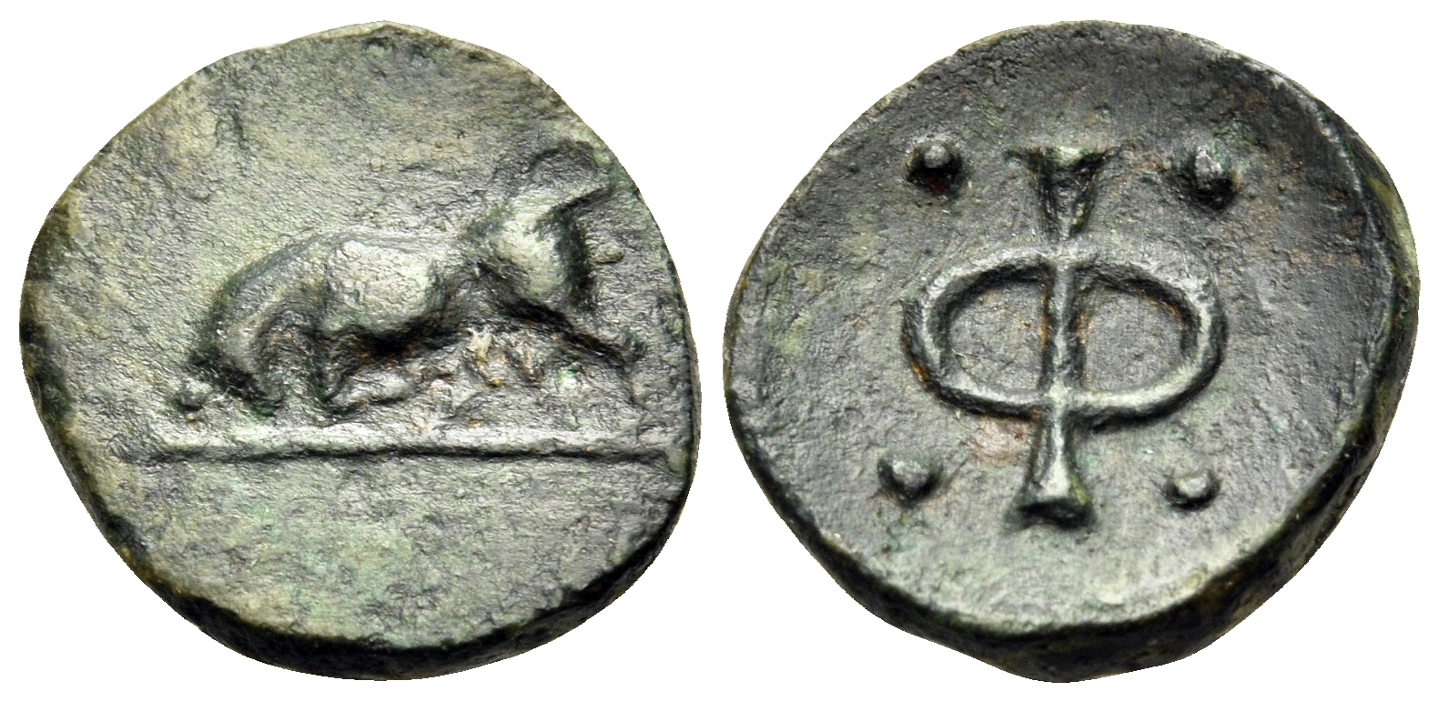
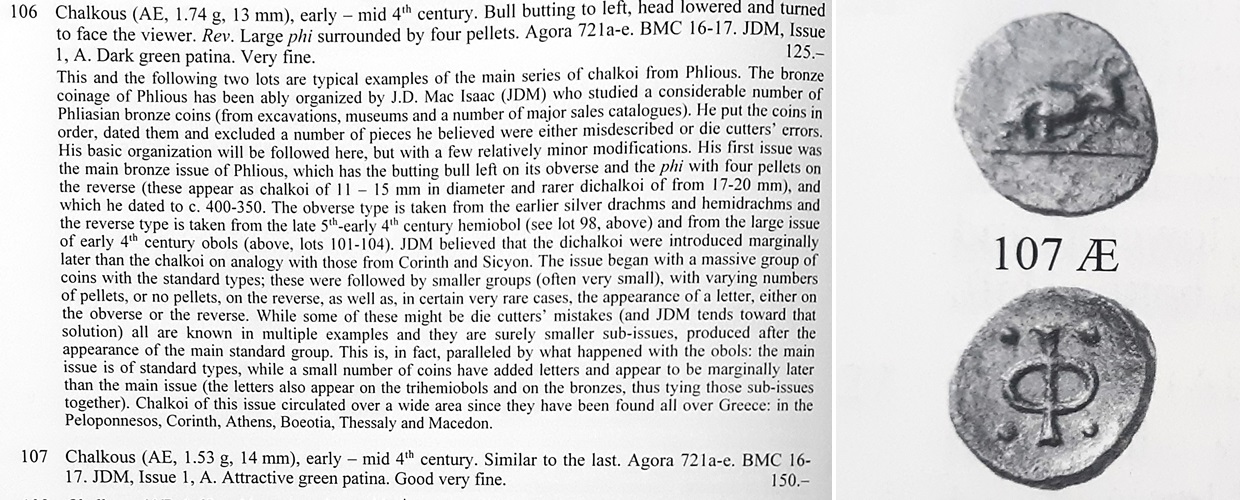
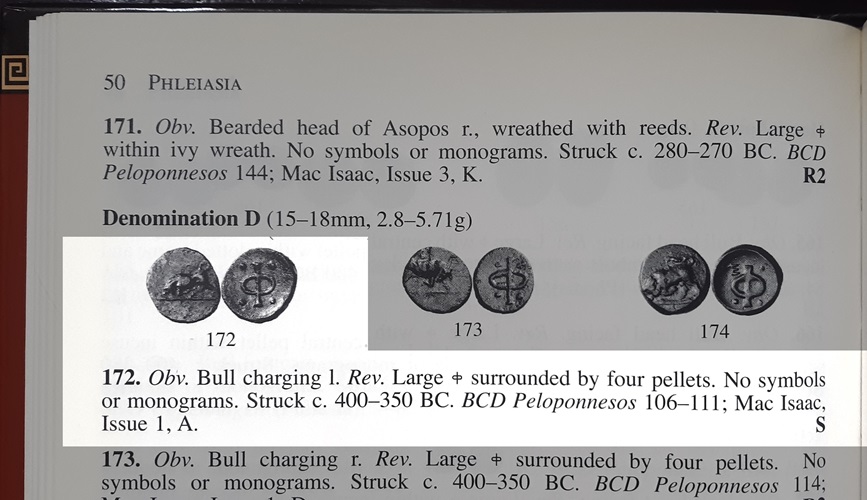
Philasia, Phlius AE Chalkous (13mm, 1.54g, 12h), c. 400-350 BCE. Bull / Phi & four dots.
(Photo credit: Nomos.) Collection/Publication Hist.:
– John Aiello Collection [Nomos Obolos 33 (11 Sep 2024), 302];
– BCD Collection [LHS 96 (Zurich, 8 May 2006), 107];
Publication: BCD Peloponnesos 107, pp. 46 (text), 47 (ill.) [cataloged by Alan S. Walker, 2006, Leu Numismatics];
– HGC (5) 172 (this coin illustrated), p. 50 in: O. Hoover (2011) Handbook of Coins of the Peloponnesos [Handbook of Greek Coinage, vol. 5] (Lancaster, PA: CNG).
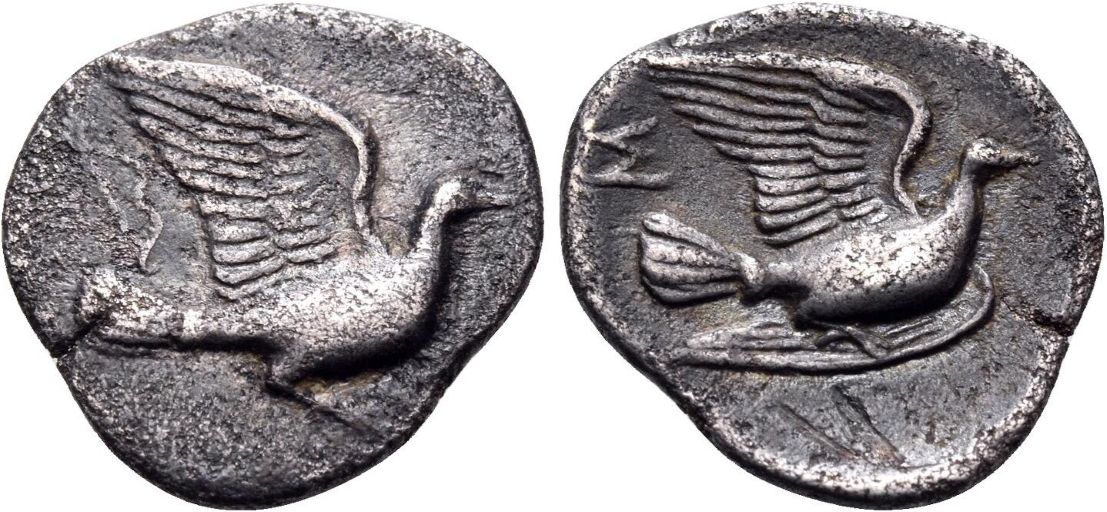
Sikyonia, Sikyon AR Obol (12.5mm, 0.82g, 12h), c. 370-340 BCE. Dove taking flight / Dove flying.
(Photo credit: Nomos.) Collection/Publication Hist.:
– Collection sans Pareille [Nomos 35 (15 Dec 2024), 1326];
– Leo Mildenberg (1913-2001) Collection [w/ tag (shown below), acq. en bloc by CsP, 1970s];
– likely inherited ex Jacob Hirsch (1877-1955) Estate;
– Dr. S. Pozzi (1846 – 1918) Collection [not in Ars Classica].
Publication:
– Boutin 4076 (this coin illustrated on Plate CLXXX) in Catalogue de Monnaies Grecques Antiques de l’Ancienne Collection Pozzi (1979, Maastricht: van der Dussen).
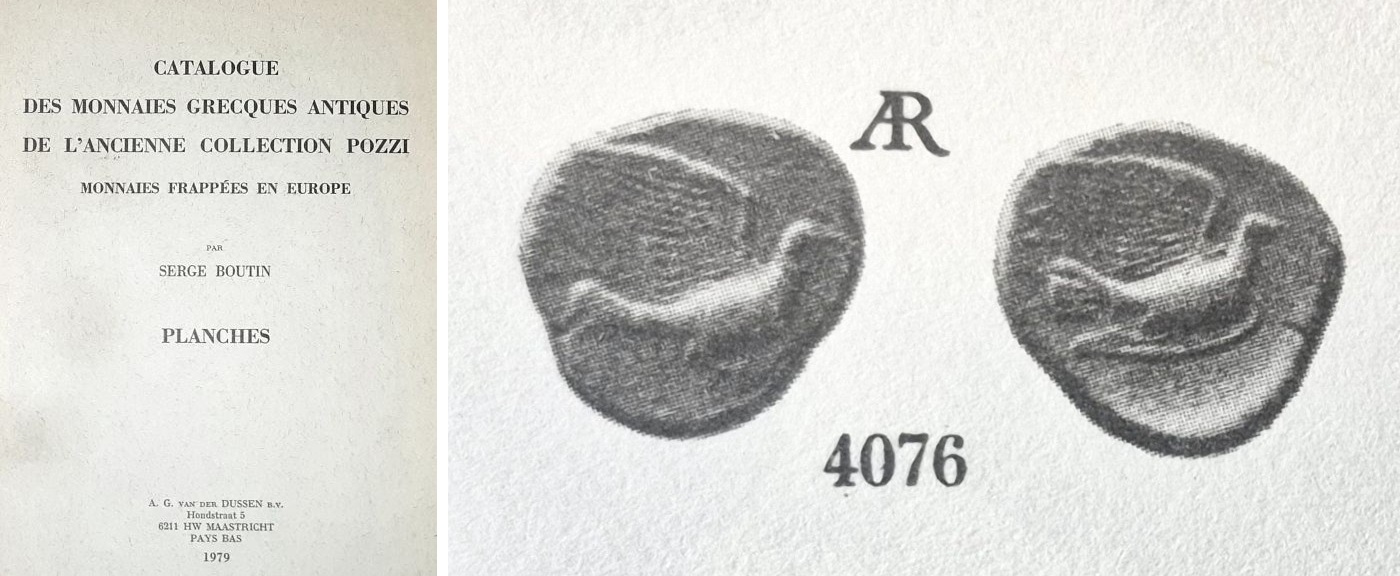
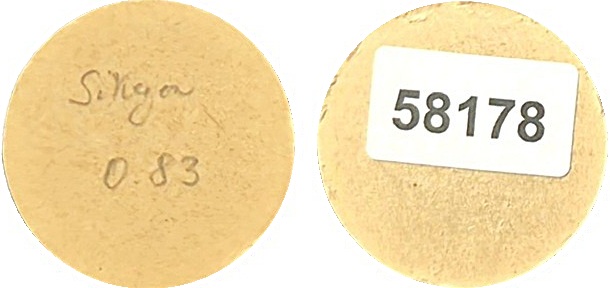
Notes: This obverse type is invariably described as “dove alighting” (landing). Clearly it’s “in transition,” but is it landing or taking off? In Greek and Roman art, including on coins, alighting birds are depicted looking downward, where they intend to land. (That’s what they do: photos of birds landing.) The Sikyon “doves in transition” look ahead and slightly upward, as a bird does when taking flight. (Photos.)
Moreover, the dove in transition (landing or taking off) is always on the obverse. The double-dove coins are noteworthy, but not unique, in that we are meant to see obverse and reverse as a sequence: First the dove takes flight; then it flies. The usual modern reading would be nonsensical: First the bird lands; then the bird flies. No. It’s taking off.
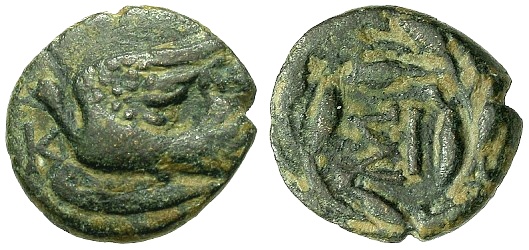
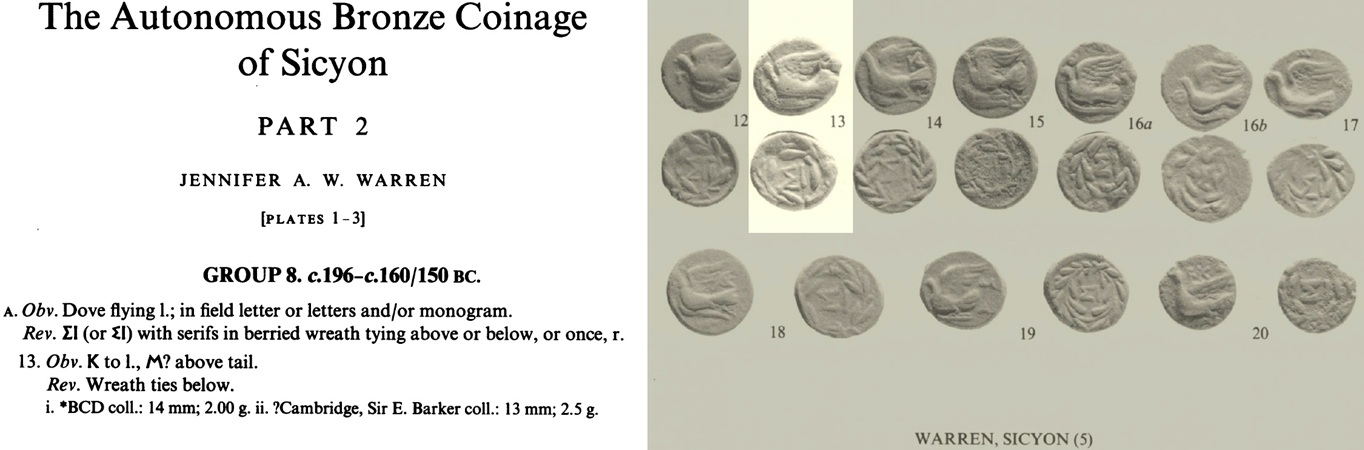
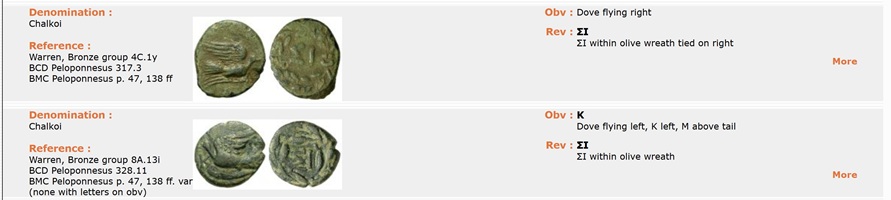
Sikyonia, Sikyon AE Chalkous (14mm, 2.00g, 7h), c. 250-200 BCE. Dove flying left / ΣΙ within wreath.
(Photo credit: FAC.) Collection Hist.:
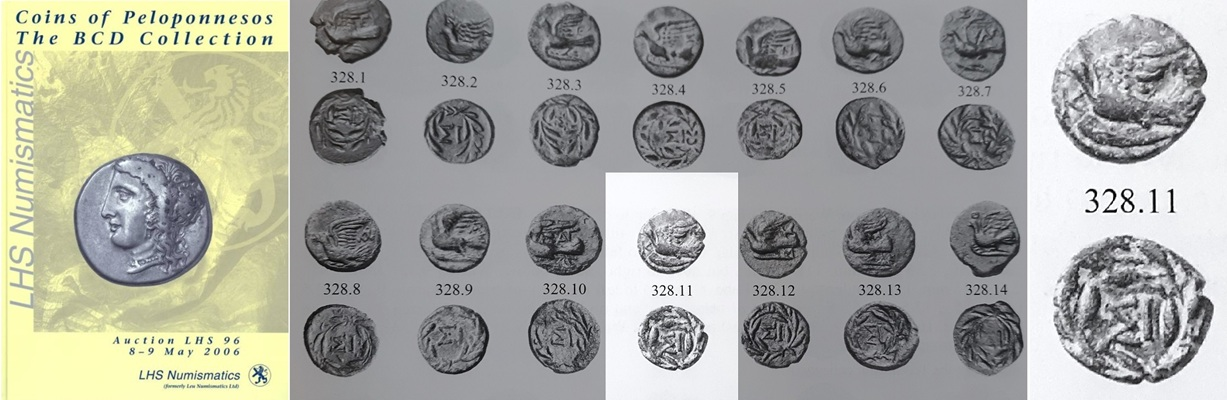
– BCD Collection [LHS 96 (Zurich, 8 May 2006), 328 (part)];
– Noble 126 (23 Mar 2021), 2645, part;
– Forum Ancient Coins (n.d.), GB29479.
Publication: BCD Peloponnesos 328.11 [cataloged by ASW, 2006, LHS Numismatics (Leu)];
– J. Warren No. 8A.13i in “The Autonomous Bronze Coinage of Sicyon (Part 2)” (1984, NC 144), described on p. 8, illustrated on pl. 1, No. 13.
Also: “Digital plate coin,” Coin Project ID 29479 [site down (?), alt. URL, not archived; PDF saved].

Shown Below: BCD’s custom bound, inscribed set of Warren’s 3-part series on “The Autonomous Bronze Coinage of Sicyon” (NC, 1983-5, plus her 1998 essay “Updating (and Downdating)…”). This copy was illustrated in the Numismatic Bibliomania Society’s electronic publication, The E-Sylum Vol. 28 (30).
Together, this coin and volume are one of the highlights of my most prized subcollection:
“Plate coins with signed association copies.”
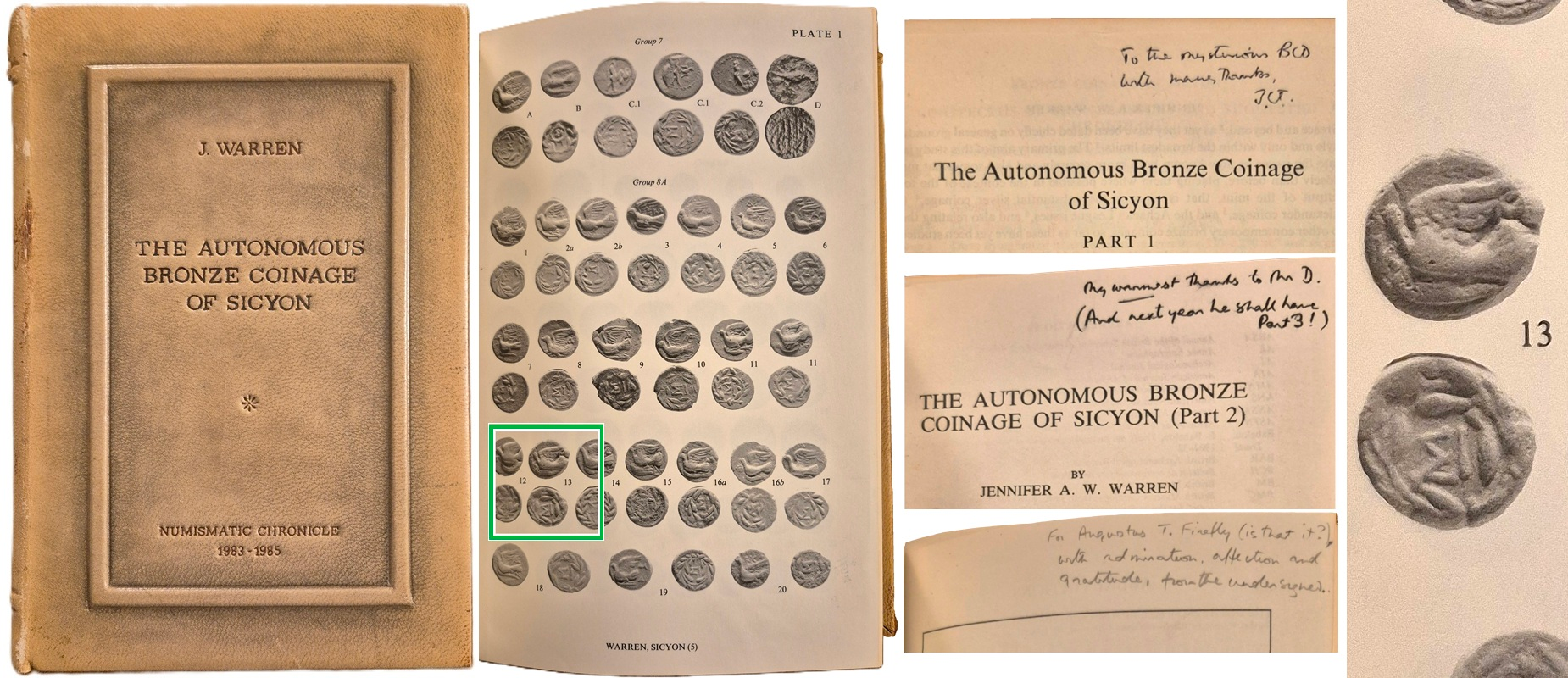
The BCD Library previously sold duplicate copies in 2014, 2020, and 2022 (where I was underbidder!), each with the same articles bound together in tan half leather. BCD has confessed elsewhere that “he owned several copies of” critical references, “all nicely bound and placed at strategic locations within his residences.” Warren’s Sicyon received such treatment, it seems.
Two things make the present “association copy” a unique artifact in its own right:
(1) Warren personally inscribed each article to BCD, thanking him for his contributions to the dataset (and joking affectionately about the mystery of his identity); and,
(2) it received a beautiful full tan morocco binding, with artistic blind panels after the style of Numismatic Chronicle offprints (I presume by Marianna Koilakou of Athens [her wonderful website]).
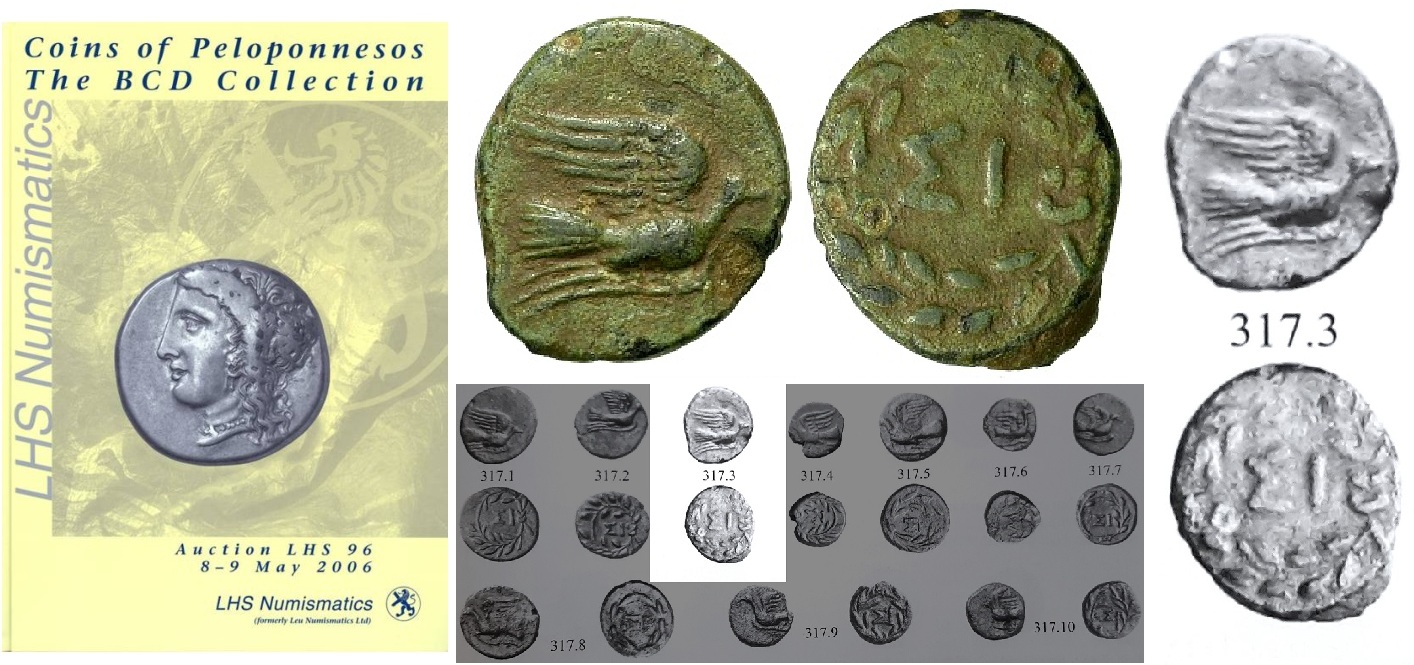
Sikyonia, Sikyon AE Chalkous (17mm, 2.69g, 12h), c. 250-200 BCE. Dove flying right / ΣΙ within wreath.
(Photo credit: FAC.) Collection/Publication Hist.:
– BCD Collection [LHS 96 (Zurich, 8 May 2006), 317 (part)];
– Noble 126 (23 Mar 2021), 2645, part;
– Forum Ancient Coins (n.d.), GB29480.
Publication: BCD Peloponnesos 317.3, illustrated on p. 91 [cataloged by ASW, 2006, LHS Numismatics (Leu)];
– Prob. among “twenty-two other examples recorded” but not individually cited in Warren Group 4.c.1, in her “The Autonomous Bronze Coinage of Sicyon (Part 1)” (1983, NC 144).
Also: “Digital plate coin,” Coin Project ID 29480 [site down (?), alt. URL, not archived; PDF saved].

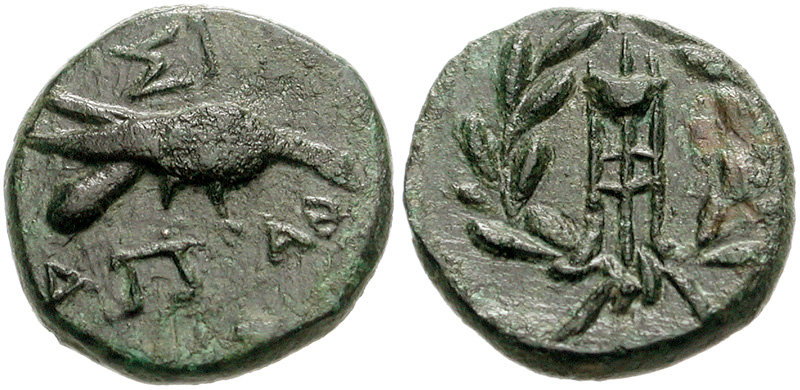
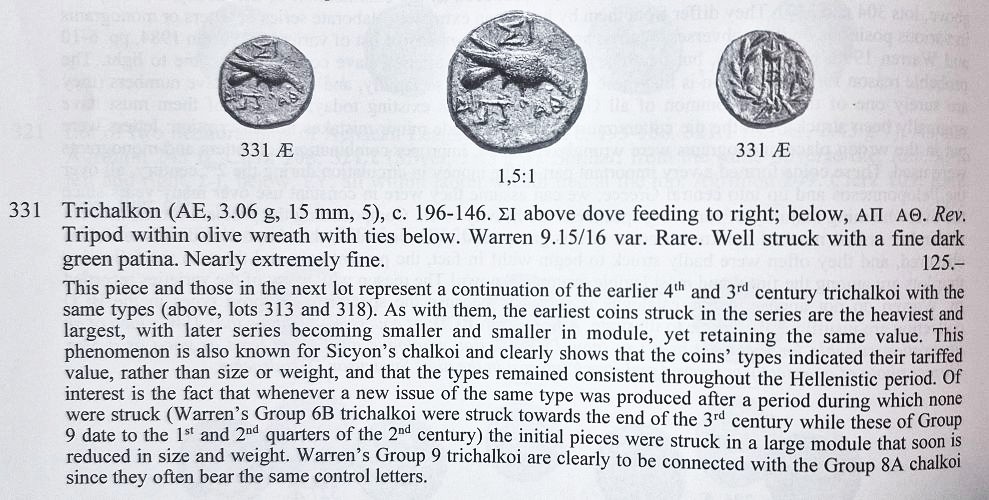
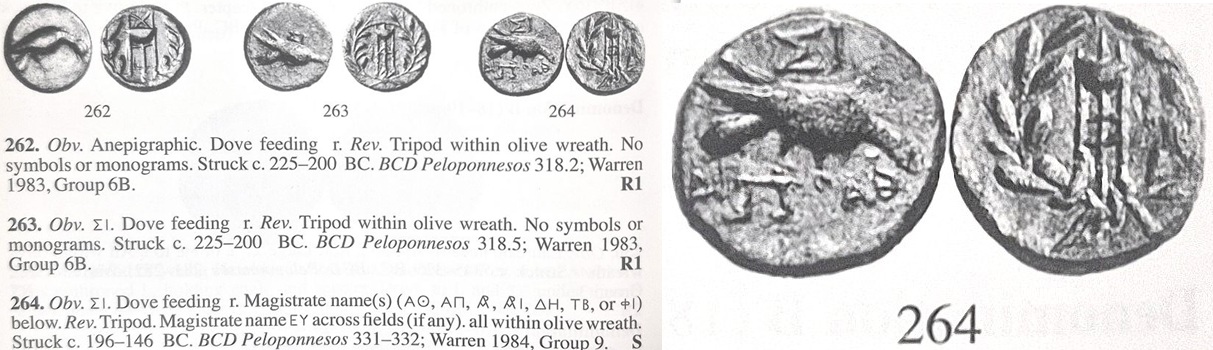
Sikyonia, Sikyon AE Trichalkon (15mm, 3.07g, 6h), c. 196-146 BCE. Dove feeding, AΠ AΘ / Tripod within wreath.
(Photo credit: CNG.) Collection/Publication Hist.:
– Anthony Kent Collection [CNG EA 589 (18 Jun 2025), 135 ; acq. CNG Webshop (n.d.) 775208];
– BCD Collection [LHS 96 (Zurich, 8 May 2006), 331];
Publication: BCD Peloponnesos 331, p. 94 (text & ill.) [cataloged by ASW, 2006, LHS Numismatics (Leu)];
– HGC (5) 264 (this coin illustrated), p. 66 in: O. Hoover (2011) Handbook of Coins of the Peloponnesos [Handbook of Greek Coinage, vol. 5] (Lancaster, PA: CNG).
Olympia, Elis AR Obol (12mm, 0.86g, 5h), 105th Olympiad, c. 360 BCE. Hera or Nymph / Eagle.
(Photo credit: Elsen 155.) Collection Hist.:
– BCD Collection [Leu 90 (Zurich, 10 May 2004), 126)];
– Marc Bar (1921-2015) Collection [Elsen 155 (16 Jun 2023), 140].
Publication: BCD Olympia 126 [cataloged by Alan S. Walker, Leu Numismatics];
– HGC (5) 472, in O. Hoover (2011) Handbook of Coins of the Peloponnesos [Handbook of Greek Coinage, vol. 5] (Lancaster, PA: CNG), pp. 101-2.
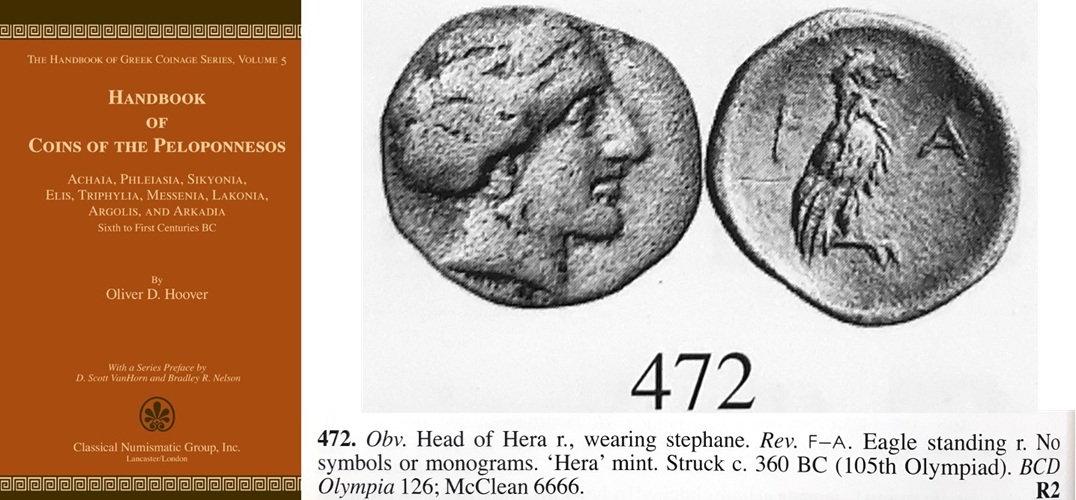
Notes: Both of them using this same specimen, Oliver Hoover (HGC) identifies the obv. as Hera, while Alan S. Walker (BCD Olympia) calls her “the eponymous nymph Olympia.” Why the difference?
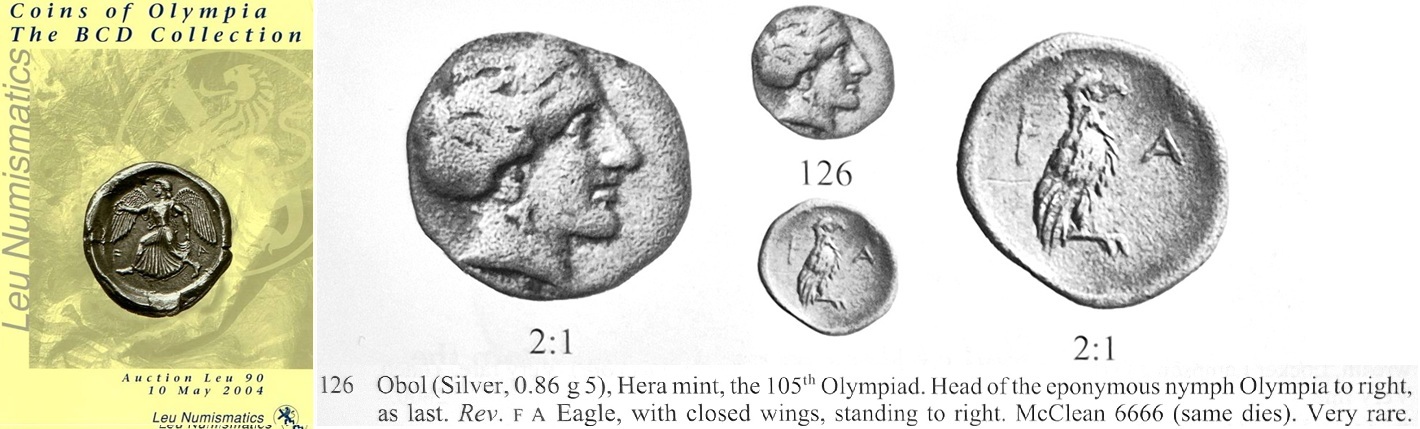
ASW comments (p. 63) that those wearing a stephane are Hera; those without one (hair in rolls) must be Olympia. Importantly, there is an AR Stater inscribed OΛYMΠIA on the reverse, naming the nymph (BCD Olympia 118, pp. 52-3): “Both the legend and the lack of the stephane prove that she’s not Hera: she reappears, in a more mature and commanding way, on the contemporary issues of the Hera mint (see below, lots 122-127)” — i.e., including my coin, 126.
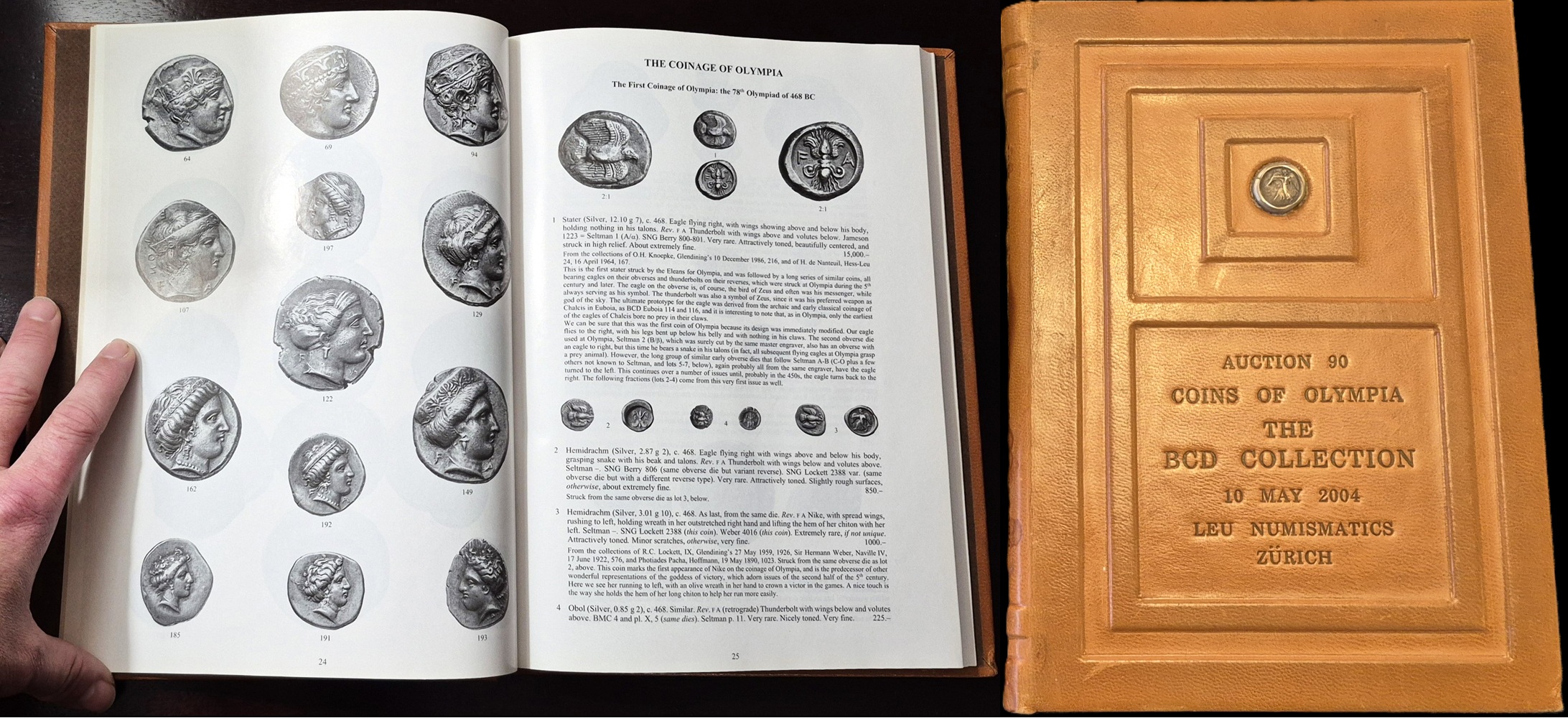
My special edition of BCD Olympia, shown above is leather-bound & inscribed by the collector to Maj. A. Milavic. See full set on “Catalog Favorites” page.
Olympia, Elis AE Diassarion (27mm, 12.56g, 12-1h), c. 30s BCE. Hera / Eagle on thunderbolt.
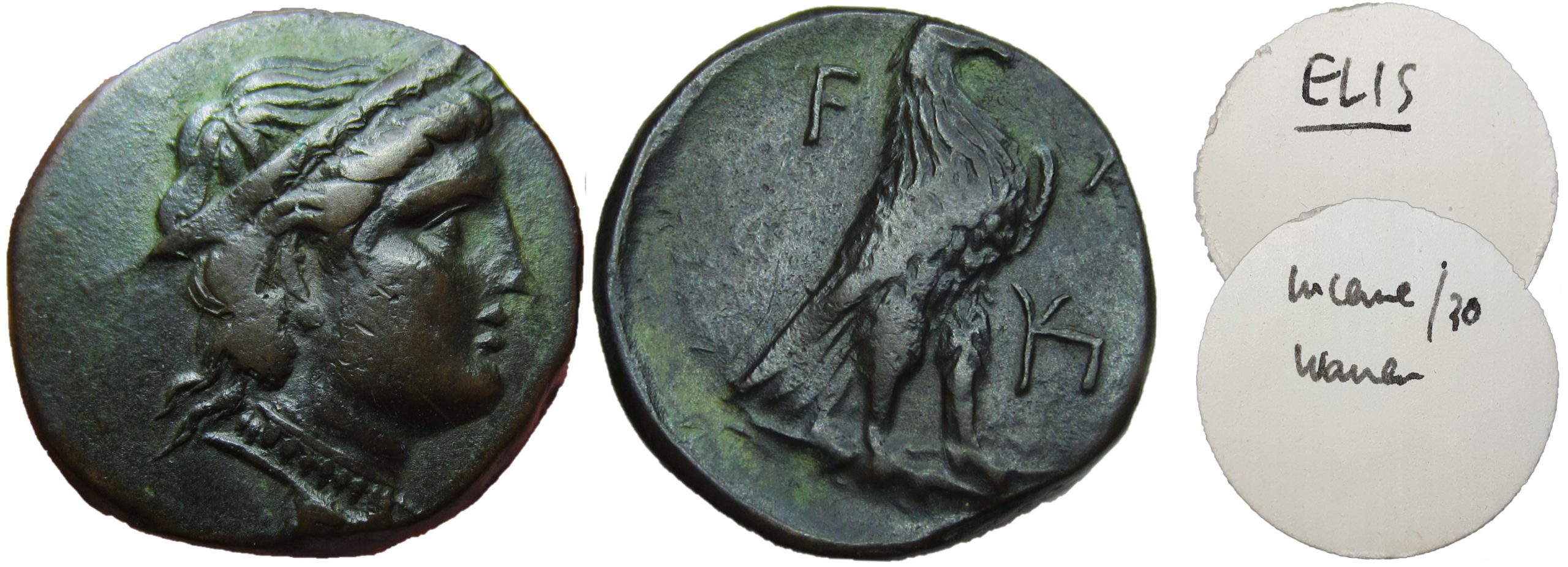
(Photo credit: CNG 76, part 1.) Collection/Publication Hist.:
– Sammlung Gustav Philipsen (Copenhagen, 1853-1925) [Hirsch XXV (25 Nov 1909), 1300 (Pl. XVI)];
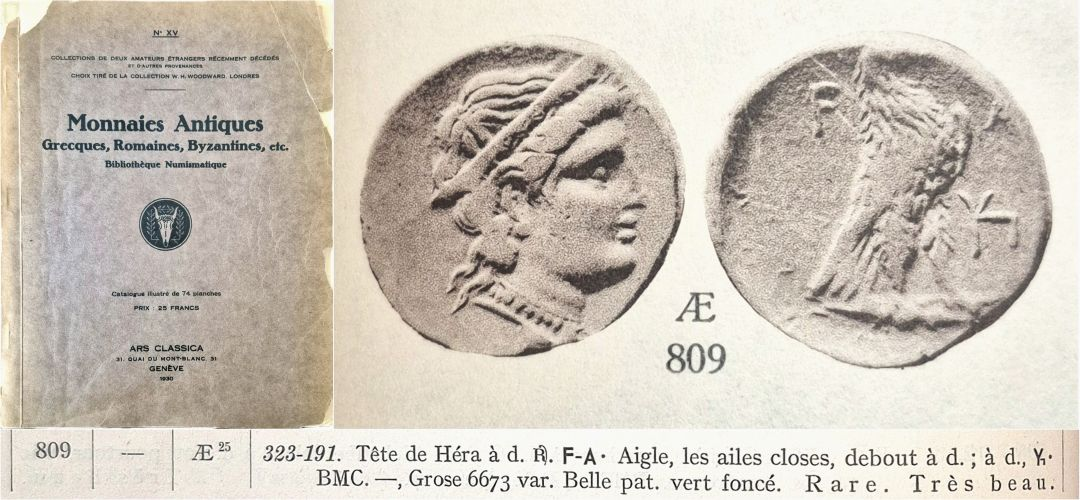
– E. P. Warren (1860-1928) Collection [Naville Ars Classica XV (2 Jul 1930), Lot 809 (Pl. 28), ex “amateur étranger récemment décédé”];
– Lt. Col. Reginald Keble Morcom (1877-1961) Collection;
– Christopher Morcom (1939-) Collection of Pedigreed Coins of Greece & the Aegean Islands [CNG 76, part 1 (12 Sep 2007), Lot 562];
– Sammlung Prof. Dr. P. R. Franke (1926-2018) [Solidus 108 (8 Nov 2022), Lot 137].
– (prob.) Ex IGCH 216 (unknown late 19th century hoard, per BCD & Nicolet; probably 1887-1894/5, when Athens acquired 7 coins); officially “12+” coins (acquired by BMC, 1903); possibly dispersed by Canon [Rev.] William Greenwell (1820-1918)?
Substantive Notes: This type is interesting for its controversial dating, debated for generations, with little besides stylistic factors to decide whether it belongs in the 4th to 3rd century (Franke, Wojan), the 30s BCE (J. Warren, BCD, Hoover), or somewhere in between (Wroth, Strauss, Nicolet, Moustaka)! Some relevant references noted on the description page.
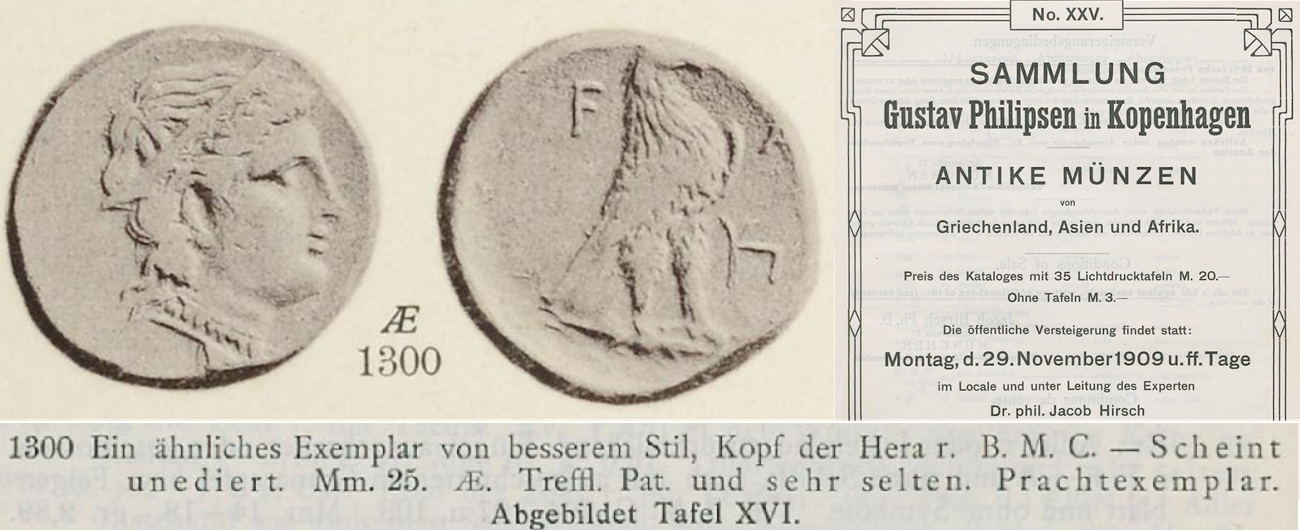
Provenance Notes: It is interesting to note that several of my coins were cataloged multiple times by Jacob Hirsch (1874-1955). (See also: Heraclea Obol on this page; Abydos AE on Page II.) More than 20 years after cataloging this coin for the second Philipsen sale (image source: U. Heidelberg), he included it in Ars Classica XV (my copy shown below), presumably from the estate of the “amateur étranger récemment décédé.” The consignor was named as E.P. Warren by Col. Morcom, who was in a position to know, having privately purchased others of his coins. (Warren had used similar pseudonyms for previous auction consignments.)
See Also: Coinproject ID 76000562, “digital plate coin” [archived].
Notes: See also the Boeotia AE above, ex Franke & Pozzi (Boutin 3312), which I suspect Franke acq. from a Triton XI group lot (1743).

Messenia, Messene (Polykles) AR Hemidrachm – Triobol (16mm, 2.25g, 10h), Polykles c. 35 BCE. Head of Zeus / Tripod in wreath.
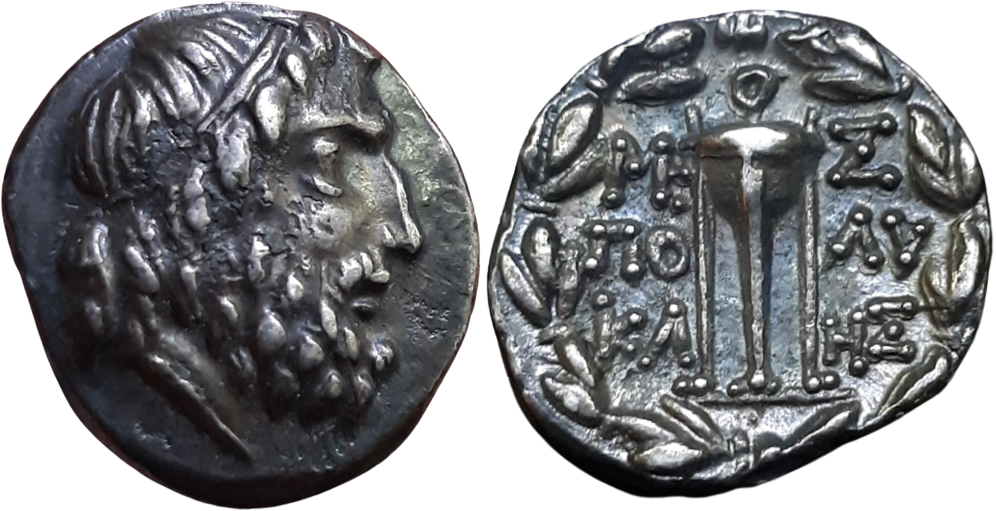
(Photo credit: Jackson-Jacobs.) Collection Hist.:
– Kommerzienrat H. Otto, Stuttgart (Heinrich Otto, Jr., 1856-1931) [Hess 207 (Lucerne, 1 Dec 1931), 493];
– “Prominent European Cabinet” (also Slg. H. Otto) [Bolender Auction 110 (29 Sep 1937), Lot 149 (misdescribed as Drachm), all 367 ancients apparently ex-Hess 207];
– John A Sawhill (1892-1976);
– James Madison University (Sawhill Bequest) [Stack’s (NYC, 15 Mar 1979), 157 (part)];
– BCD Collection [CNG 81-2 (Lancaster, 20 May 2009), 2327].
Publication: BCD Peloponnesos II 2327 (this coin illustrated on p. 48 & title page [obv. enlarged]);
– C. Grandjean No. 203-g (D125/R171 – this coin) in Les Messéniens de 370/369 au 1er Siècle de Notre Èr: Monnayages et Histoire (2003, Athens: Ecole Française).
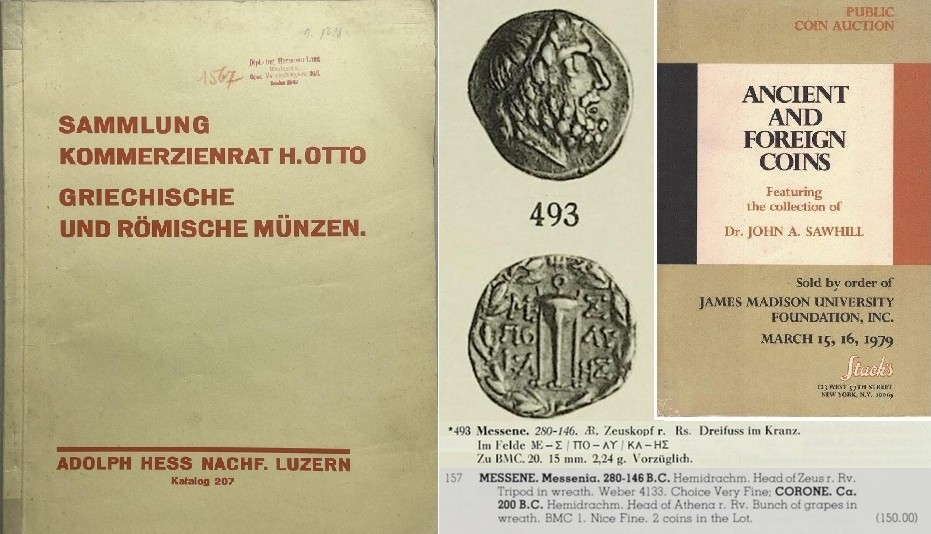
See also: Mentioned in CoinWeek article announcing the sale at Künker e-sale 65 (23 Feb 2021, Lot 7037): “From the field of Greek coins stands out a rare hemidrachm from Messene, formerly part of the BCD collection.”
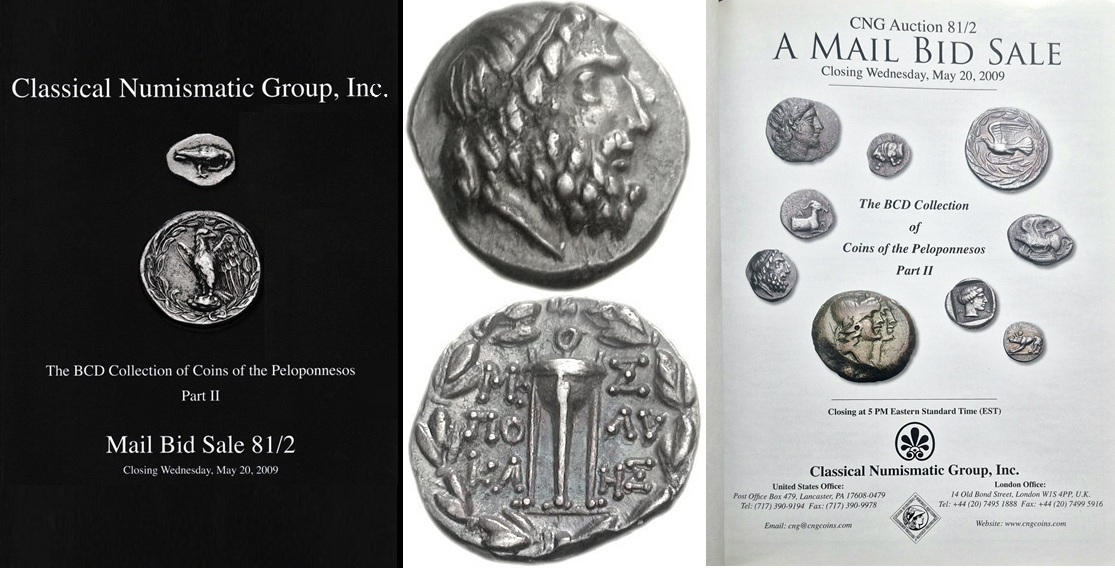
Note: See my copies of the Hess-Otto sale (ex Bibliothek Hermann Lanz), Stacks-Sawhill (ex BCD Library Duplicates), and CNG 81 (copies ex Hendin & Bibliothek Alois Wenninger) on my “Catalog Favorites” page.
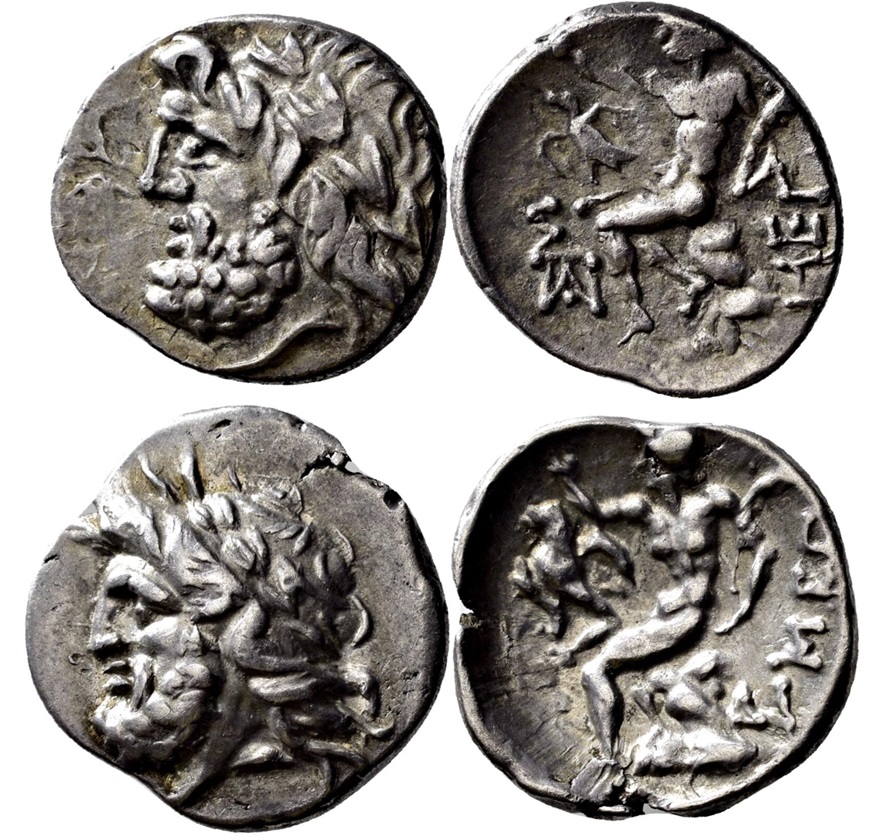
Argolis, Epidauros AR Hemidrachm (14mm, 2.55g, 6h), c. 280-250 BCE. Head of Asclepius / EΠ monogram in wreath.
(Photo credit: CNG.) Collection Hist.:
– Ex 1979/80 Epidaurus Hoard (Coin Hoards VII, 69; CH VIII, 298);
– BCD Collection [CNG 84 (5 May 2010), Lot 502, corr. (reference, incomplete prov.)];
– Weise Collection [CNG EA 547 (4 Oct 2023), Lot 155, corr. (same)].
Publication Hist.: Requier 105 (R4/D4), this coin illustrated on Pl. 5 in Pierre Requier (1993) “Le Monnayage d’Épidaure à la Lumière d’un Nouveau Trésor,” SNR 72: pp. 29-46, pl. 1-8.
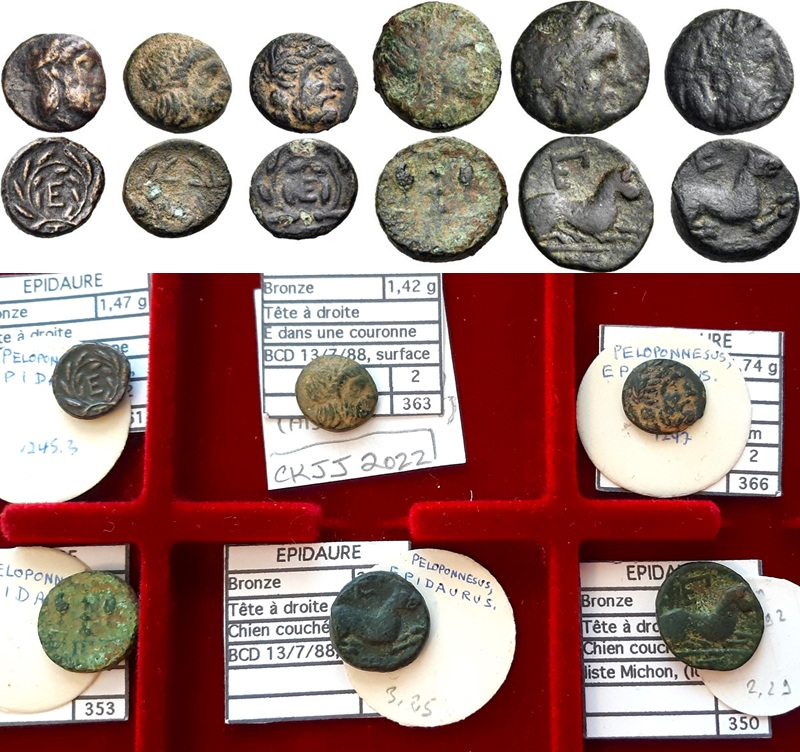
Argolis, Epidauros AE Chalkous (11.5mm, 1.18g, 12h), c. 3rd cent. BCE. Head of Asclepius / E in wreath.
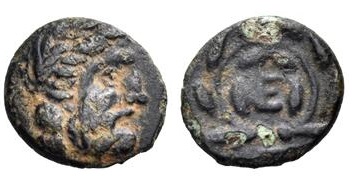
(Photo credit: Nomos [edited].) Collection Hist.:
– (prob.) Athanasios Rhousopoulos (1823–1898), before 1890 [prob. ex Hirsch XIII (Rhousopoulos sale, 15 May 1905), 2729 (corr., ref. BMC 22)];
– BCD Collection [(prob.) ex Bank Leu, 1979 & presumably old stock of Jacob Hirsch (1874-1955)];
– Maleatas Collection of Epidauros [Nomos 24 (Zurich, 22 May 2022), 137.3 (corr.: weight, axis, diameter, provenance)].
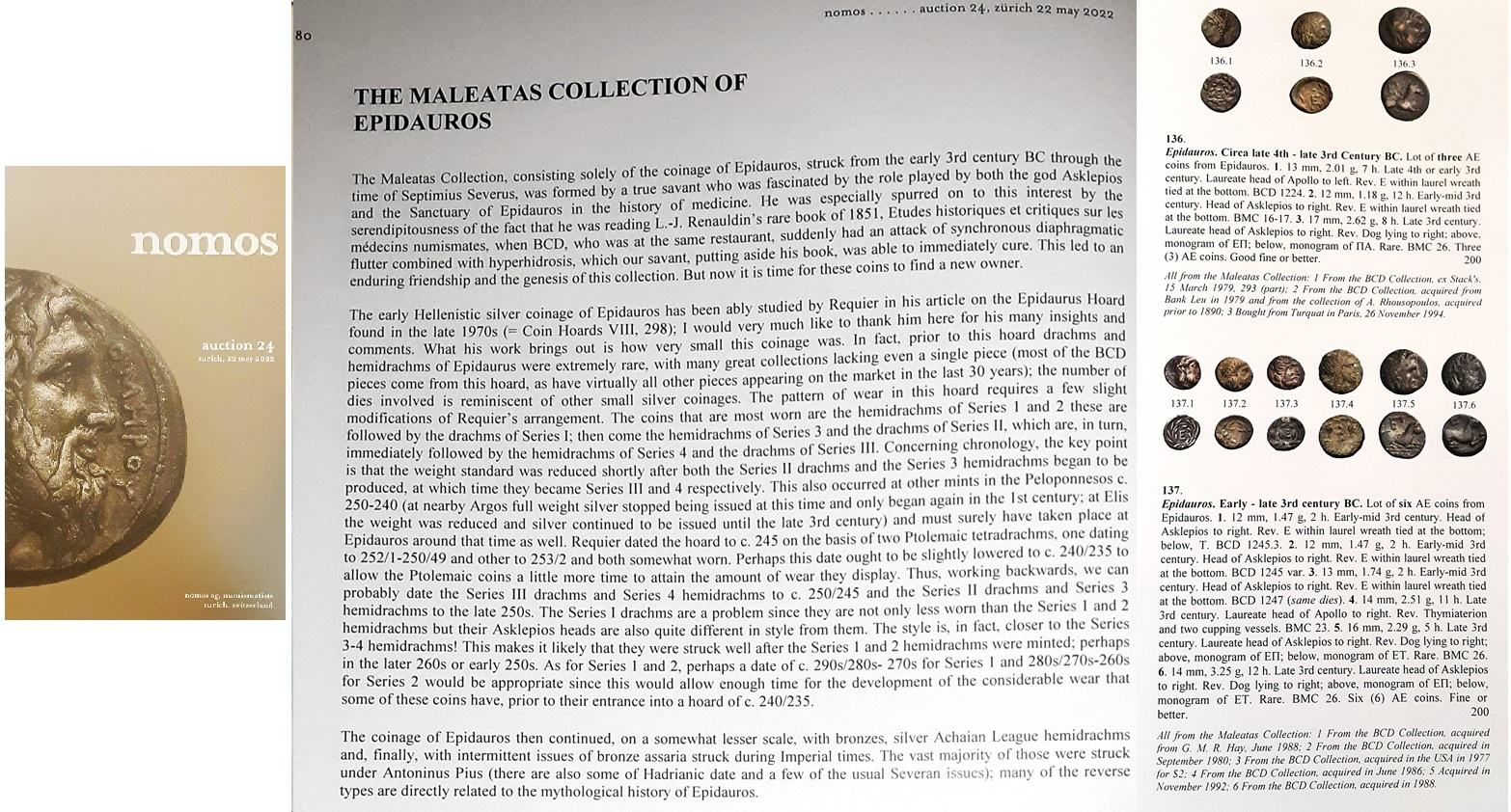
Provenance Notes: See Note 4 re: the corrected provenance (?) from Nomos 24.
Below, tray photo of the full group of six with assorted tags (BCD, Maleatas, etc.) with the Nomos 24 photo above.
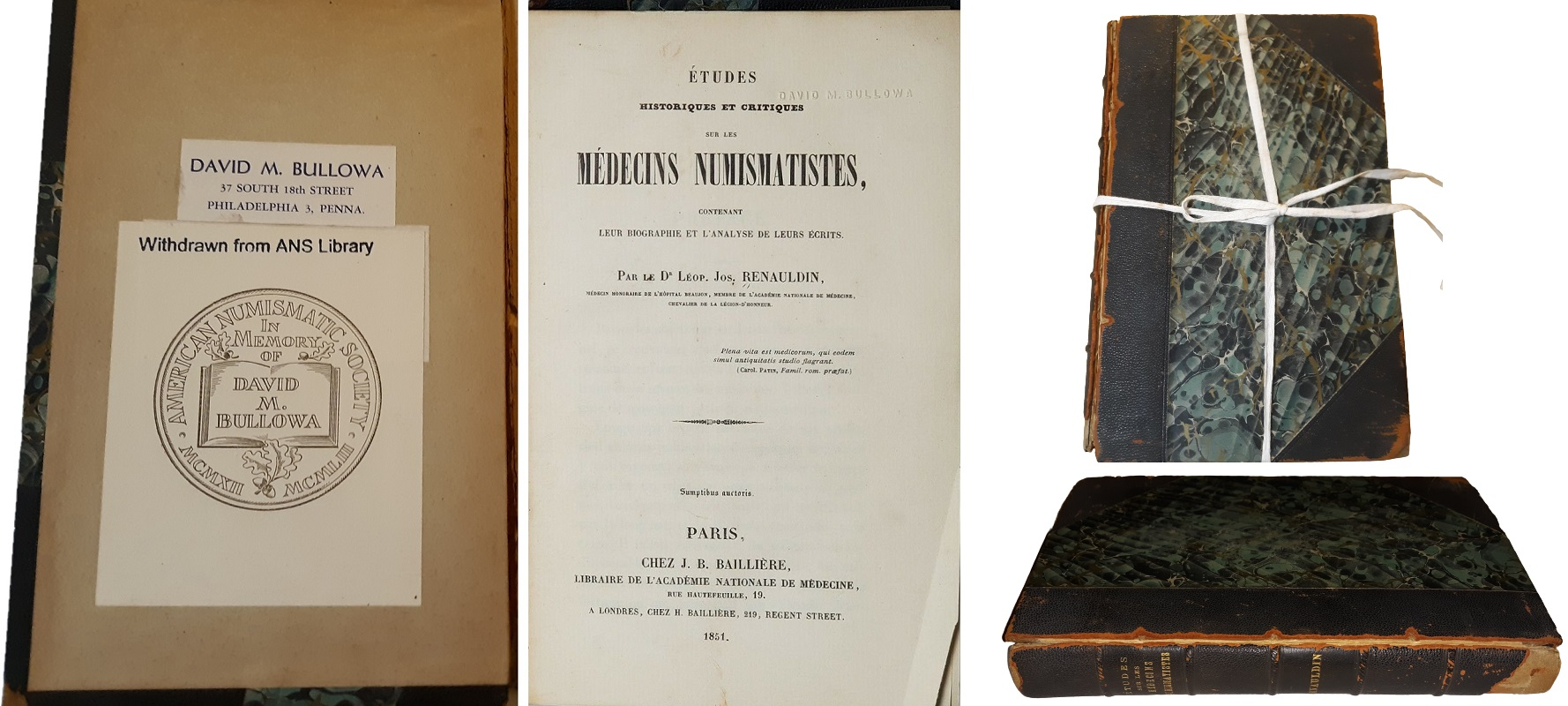
Bibliographic Note: The introductory essay (above, click to enlarge) mentions Renauldin’s exciting 1851 page-turner (Études Historiques et Critiques sur Les Médecins Numismatistes, Contenant Leur Biographie et l’Analyse de Leurs Écrits [for the brave, Archive has all 574 + xvi pp.!]). As I can’t imagine another opportunity arising, below is my surprisingly well-used copy, previously from the David Bullowa (1912-1953) & ANS Libraries, with their bookplates. (It was illustrated in the Sep 19 2021 issue of The E-Sylum [24.38:a2].)

Arkadian League, Megalopolis AR Hemidrachm – Triobol (16mm, 2.22g, 10h), c. 80s – 50s BCE. Head of Zeus / Pan, eagle.
Arkadian League, Megalopolis AR Hemidrachm – Triobol (17mm, 2.33g, 5h), c. 80s – 50s BCE. Head of Zeus / Pan, eagle.
(Photo credit: Peus.) Collection Hist.:
– BCD Collection [LHS 96 (Zurich, 8 May 2006), 1560];
– Burkhard Traeger [Peus 430 (Frankfurt, 27 Apr 2922), 56].
Publication: BCD Peloponnesos 1560;
– Traeger No. 466 in Arkadien: Die Münzstätten und Münzen von der Archaischen bis zur Hellenistischen Epoche (2021, Bremen: BNG).
See Note 5.
Collection Hist.:
– Ex “Peloponnesos Hoard” Spring 1985 (prob. CH VIII 338, Greece, 1986 or Earlier) [per BCD Collector tag];
– BCD Collection [LHS 96 (Zurich, 8 May 2006), 1561];
– Burkhard Traeger [Peus 430 (Frankfurt, 27 Apr 2922), 56].
Publication: BCD Peloponnesos 1561;
– Burkard Traeger No. 454 (?) in Arkadien (2021). See Note 6.
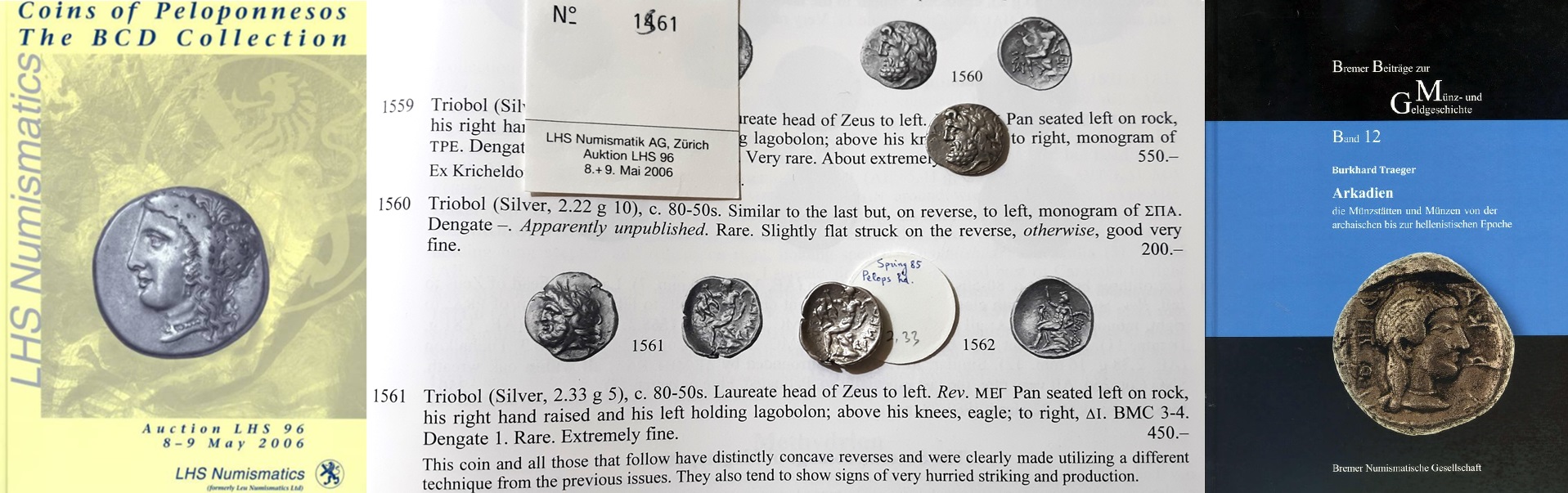
Notes: While the AR Triobols were among the more modest offerings, BCD Peloponnesos I was perhaps the most comprehensive-ever private collection of the Arkadian League. Lot 1511, the opening AR Stater, included the following comment by its cataloger, ASW:
“… the only complete set of Arkadian League staters, assembled by obverse die, ever to appear in a single sale (and it is very unlikely that another complete set will ever appear again).”
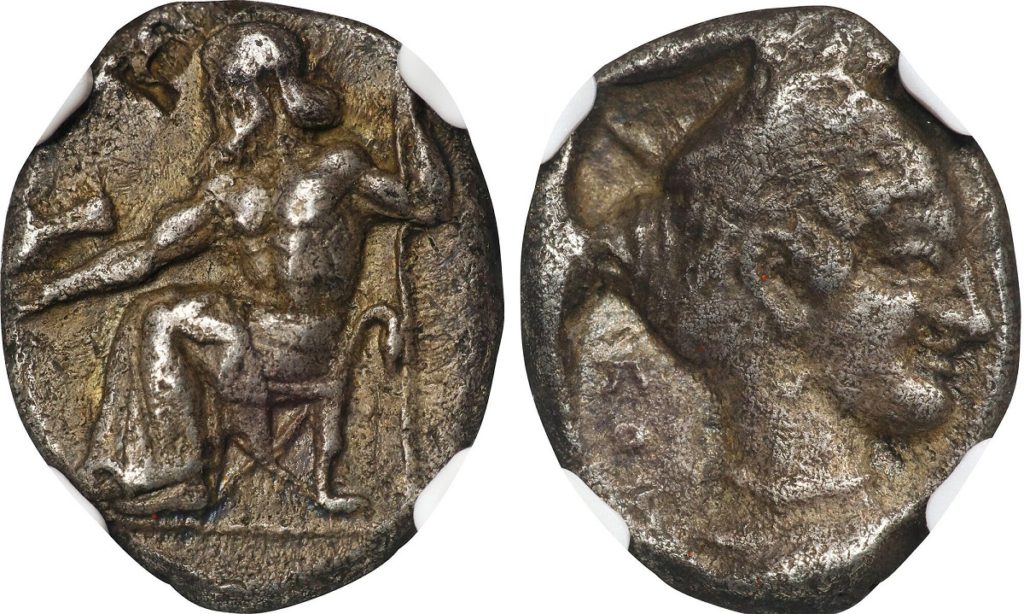
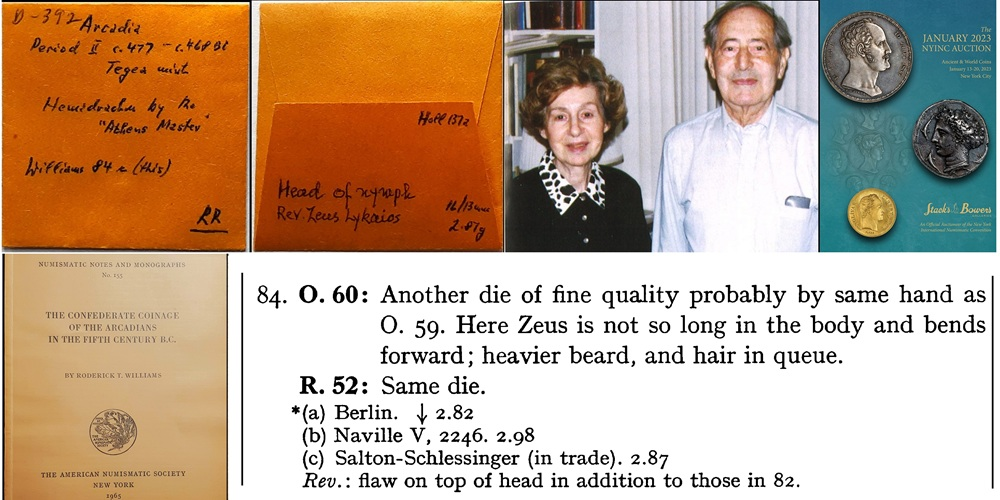
Arkadian League, Tegea AR Hemidrachm – Triobol (14mm, 2.87g, 12h), 465-460 BCE. Zeus seated / Kallisto.
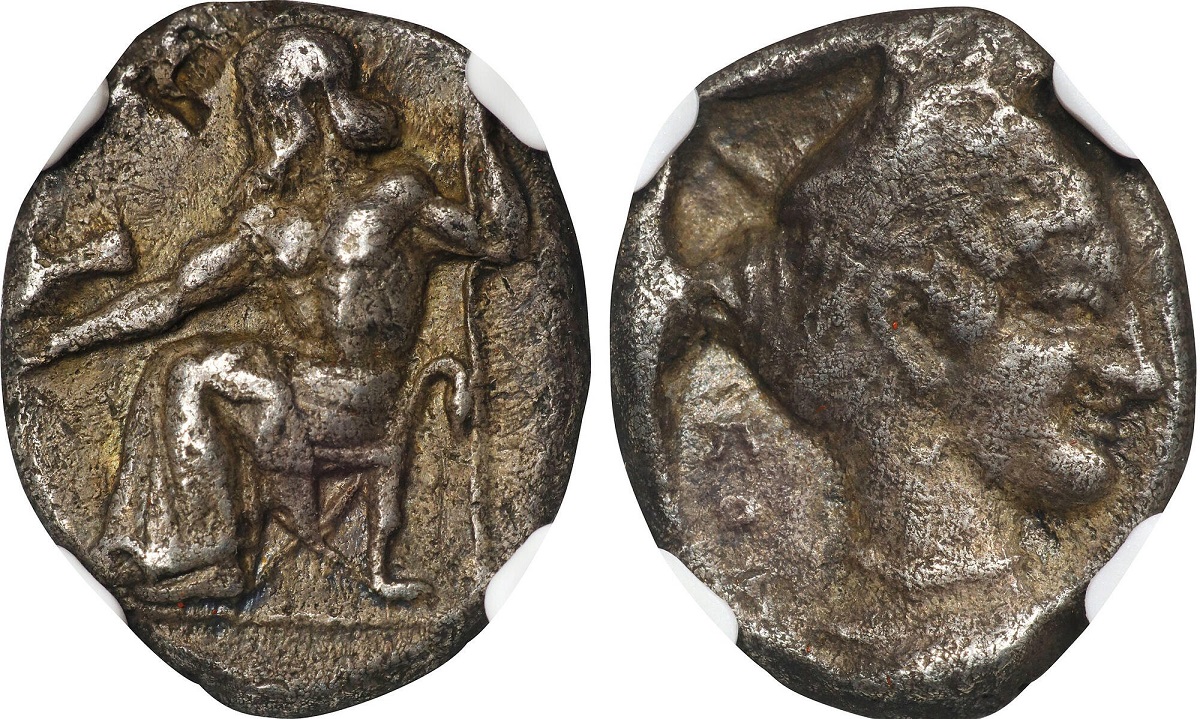
(Photo credit: Stack’s.) Collection Hist.:
– Salton Collection, Mark Salton-Schlessinger (1914-2005) & Lottie Salton (née Aronstein, 1924-2020) [Stack’s Bowers, “Salton, Part II: Greek” (NYINC 16 Jan 2023), Lot 26097];
– NGC 6369943-009.
Publication: Williams 84c (this example cited) in The Confederate Coinage of the Arcadians in the Fifth Century B.C. (ANS, 1965).
Notes: Both dies engraved by the so-called “Athens Master.” (See Note 7.)

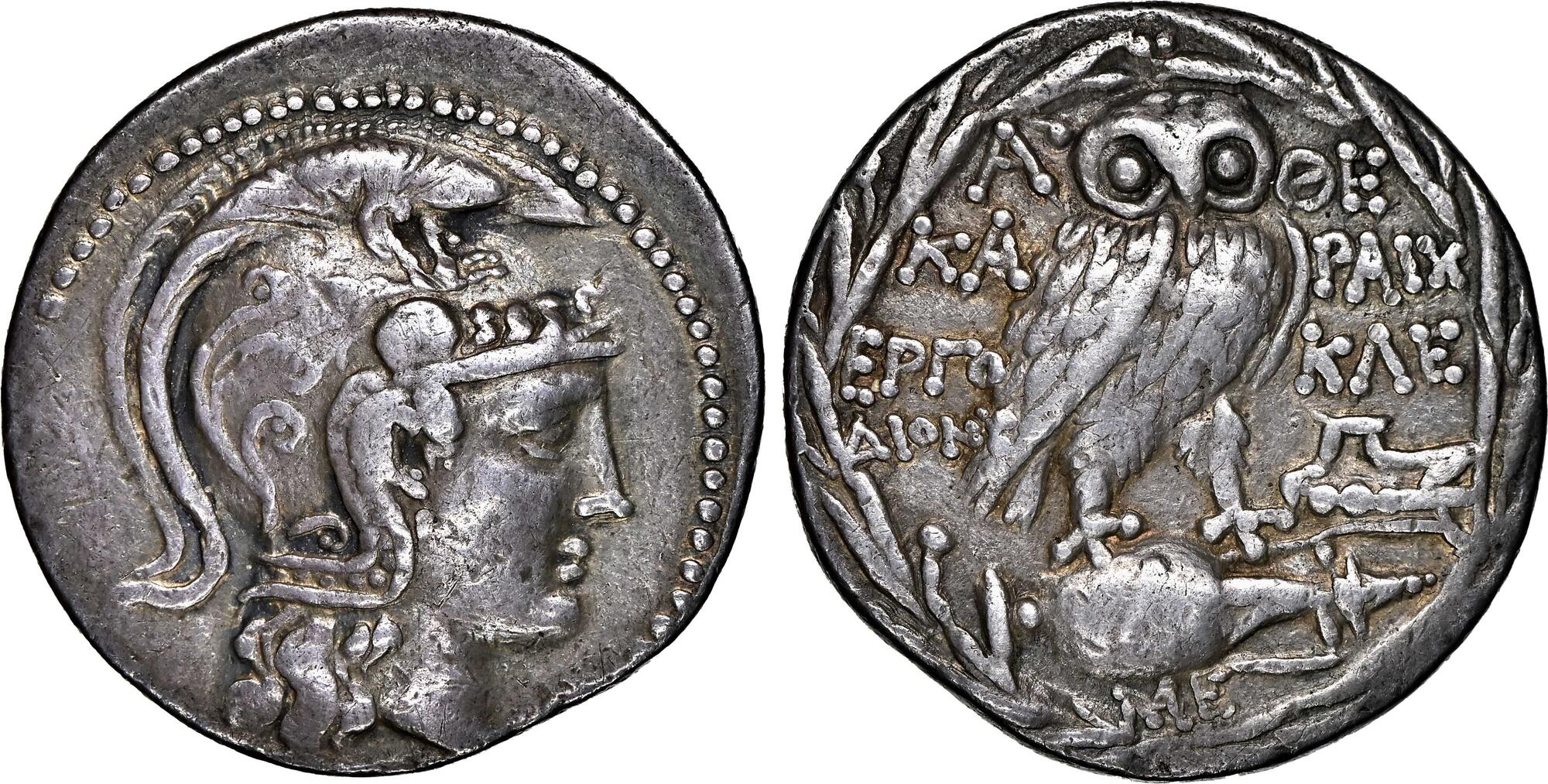
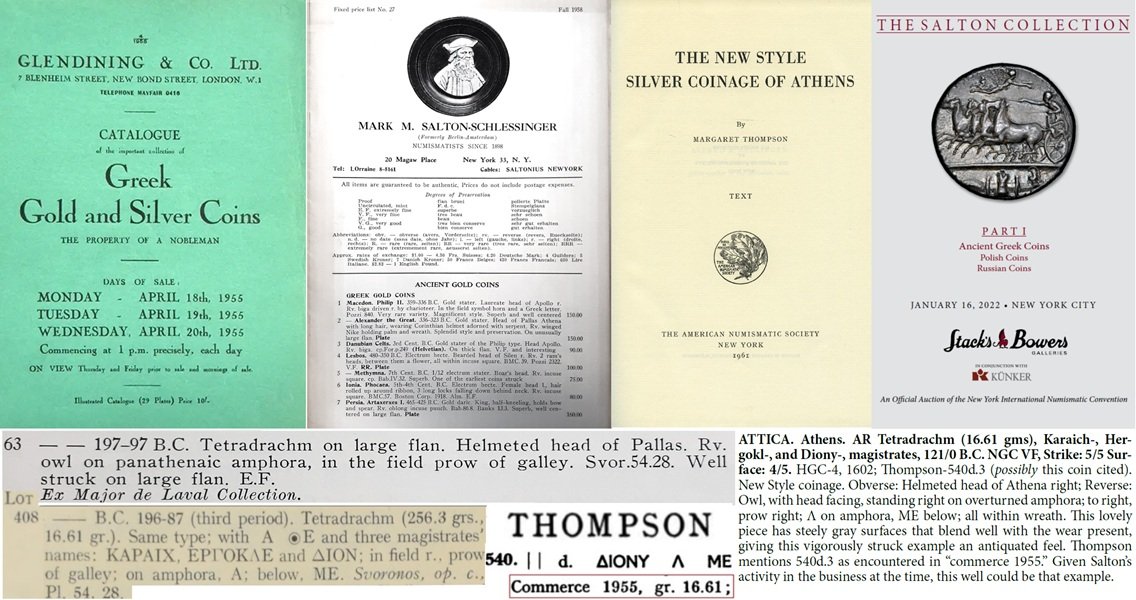
Attica, Athens AR Tetradrachm (16.61g, 28mm, 12h), “New Style” Coinage, Karaich–, Ergokle–, Diome–, c. 121/0 BCE. Athena / Owl.
(Photo credit: Stack’s.) Collection Hist.:
– Count Georg de Laval (Stockholm, 1883 – 1970) [Glendining’s, “The Property of a Nobleman” (18 Apr 1955), Lot 408.1];
– Salton Collection, Mark Salton-Schlessinger (1914-2005) & Lottie Salton (née Aronstein, 1924-2020) [Stack’s Bowers, “Salton, Part I: Greek” (NYINC 14 Jan 2022), Lot 4268; Salton-Schlessinger FPL 27 (Fall 1958), No. 63 (“Ex Major de Laval Collection”)]
Publication: Thompson 540d.3, this coin cited (“Commerce 1955, gr. 16.61”) in The New Style Silver Coinage of Athens (1961, NY: ANS).
Note: See also Salton-Schlessinger FPL 27 & “Property of a Nobleman” [Laval] on Catalog Collection Favorites page. [Also from Salton FPL 27: Laodicea ad Mare, Elagabalus AE.]

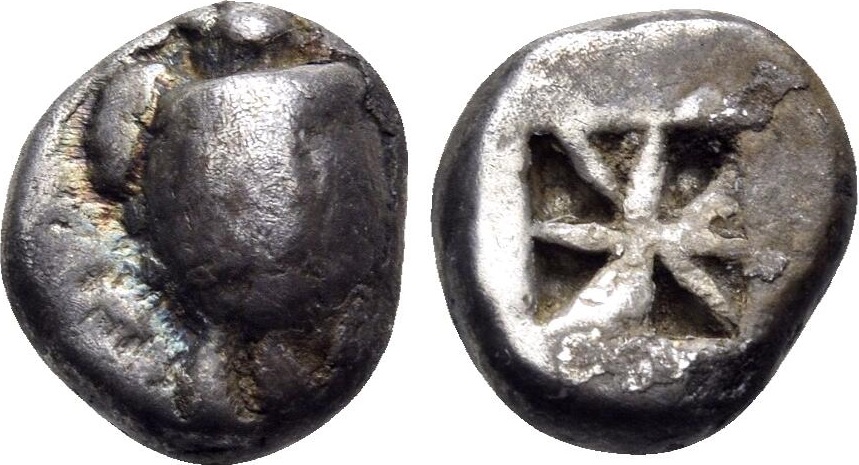
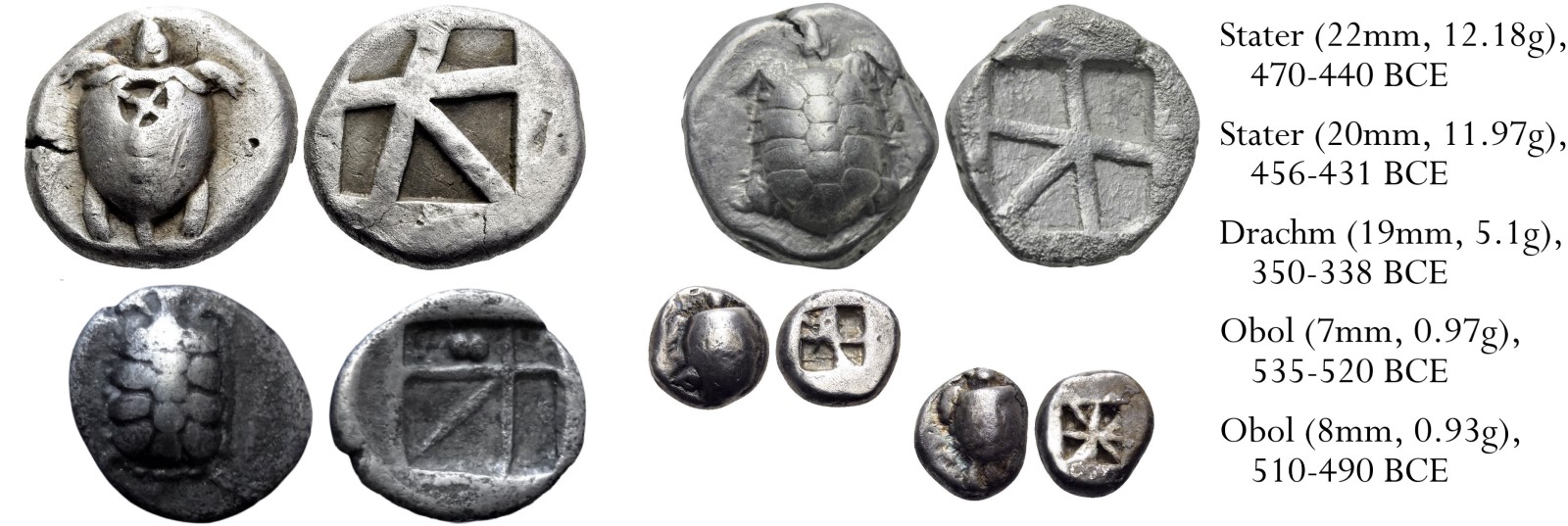
Islands off Attica, Aegina AR Obol (8mm, 0.93g), c. 510-490 BCE. Sea turtle / Cross shape incuse square.
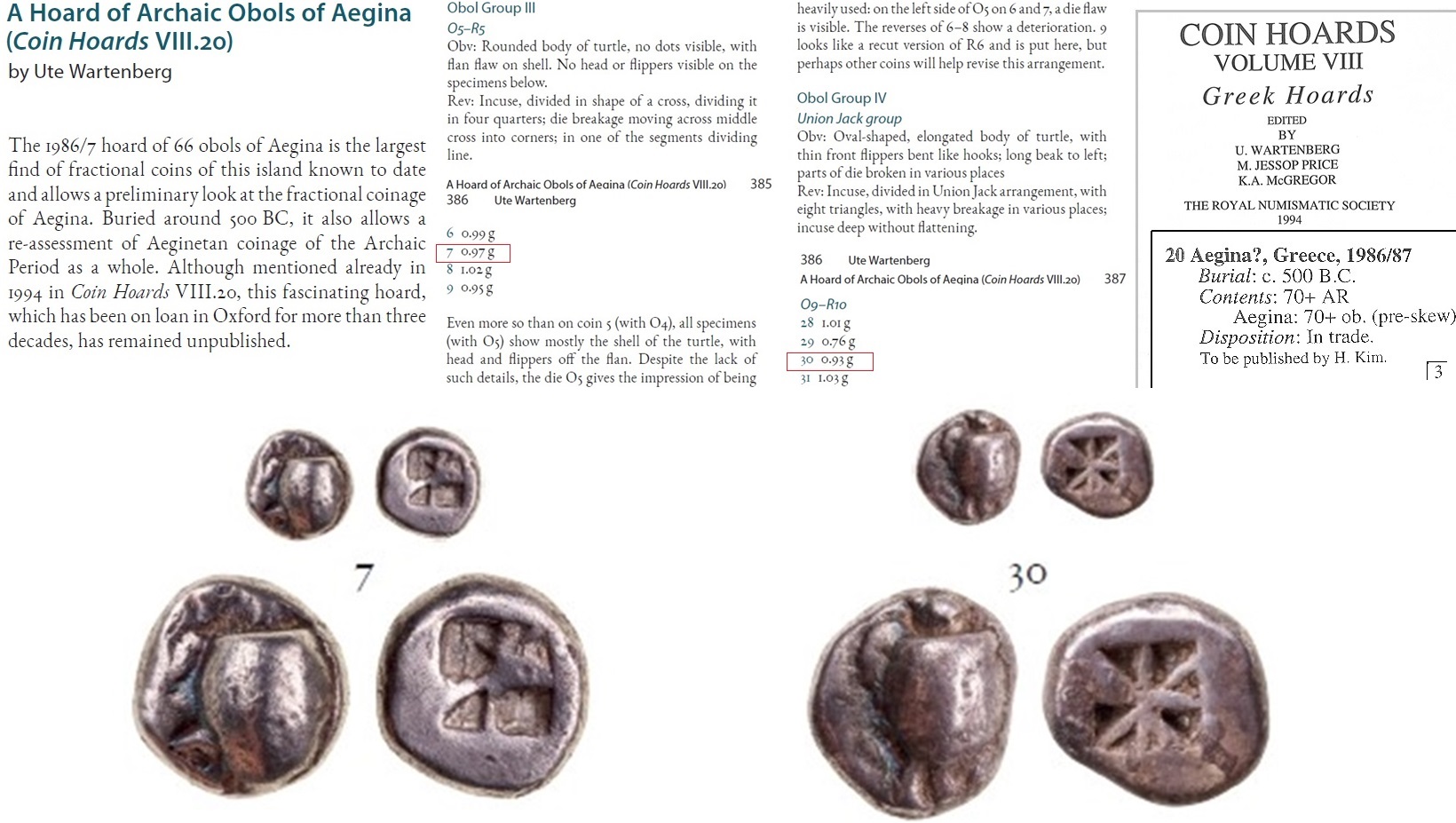
Islands off Attica, Aegina AR Obol (7mm, 0.97g), c. 535-520 BCE. Sea turtle / Union Jack pattern incuse.
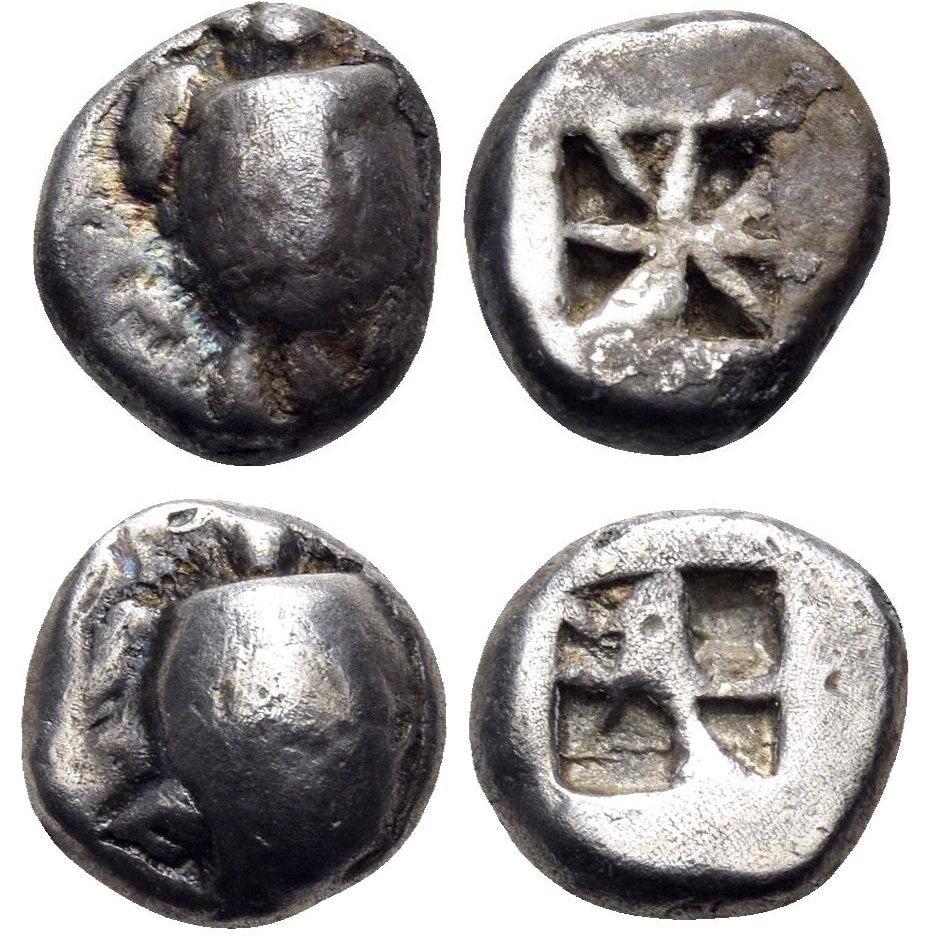
(Photo credit: Nomos AG.) Collection Hist.:
– Jonthan Kagan Collection [Nomos Obolos 33 (11 Sep 2024), Lot 274 & Lot 278];
– Temp. custody of American Numismatic Society (NY), c. 2020, for study/photography;
– Loan to Oxford University (UK), Ashmolean Museum, Heberden Coin Room, c. 1986-2010s;
– “Aegina?, Greece, 1986/7” Hoard [CH VIII, p. 3, 20].
Publication: Wartenberg 7 & 30 (these coins illustrated), in Ute Wartenberg (2021), “A Hoard of Archaic Obols of Aegina (Coin Hoards VIII.20),” pp. 379-392 in Ciołek & Chowaniec (eds.) Aleksanderia… Wiesbaden: Harrassowitz Verlag.
See also: This hoard summarized in Hoard 20 (p. 3), of Wartenberg et al. (1994), Coin Hoards VIII, London: RNS.
Video: https://youtube.com/shorts/UrlTJc7s6qM
Note: A group of turtles is a “bale.” It might not be common to see land tortoises and sea turtles mingling, much less ones born up to 200 years apart, but I’ll take a bit of poetic license to show my bale of 5 turtles together below, to scale. The Drachm was my first-even auction win in 1991; my copy of C.C.E. Mail Bid Sale 59 shown on “Catalog Favorites.”
(Photo credit: Jackson-Jacobs.) Collection Hist.:
– Dr. S. Pozzi (1846 – 1918) [Naville Ars Classica I (Lucerne, 14 Mar 1921), 1688];
– Collezione Valerio Traverso (Genova) [Michele Baranowsky (Milan, 25 Feb 1931), 593 (Pl. XXII)].
Publication: Serge Boutin 3756 in Catalogue de Monnaies Grecques Antiques de l’Ancienne Collection Pozzi (1979, Maastricht: van der Dussen).
Note: There are multiple digitized copies of Ars Classica I online. The best is probably the BNF – Gallica copy linked above. Daniel L. Koppersmith listed Baranowsky’s Traverso sale in his article on “Important Auction Catalogs Offering Archaic and Classical Greek Coins” (The Celator May 2007: p. 22, 1 star).
Acquired at Glass Shoppe Coins (Tucson, AZ) c. 1991 (not from owner Halden Birt but – I believe – future owner Tony Tumonis): Where was it for 60 years since Baranowsky-Traverso?
Re: Dr. Pozzi, see Note 2C, Pozzi Bio. See also the Pelinna Obol above.
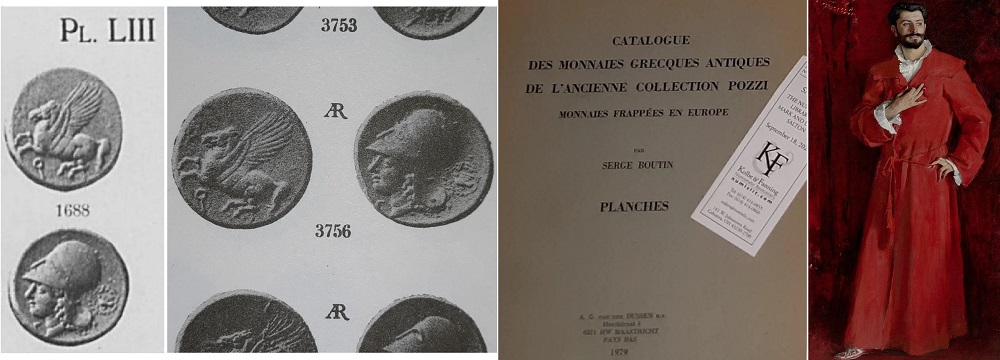
Literature Notes: The Pozzi-Boutin copy above is ex Salton (larger photo on Imgur; I also have the Wenninger copy).
The Baranowsky-Traverso below is ex Libraries of Jacques Schulman (under Maurits, bound by Koster Boekbinderij 1931/2), Harry Bass Jr., Tom Cederlind, Malter (Lot 641, one of three copies!), and Kirk Davis. More about this copy on my “Catalog Favorites” page.


Notes
Note, Sternberg (return): Frank Sternberg, Auction 1 (Zurich, 30 Nov 1974), Sternberg Collection of Roman. “Vorwort“:
“Bei der Ermittlung der Provenienzen hat sich die Feststellung wiederholt, dass die wahrhaft guten Münzen sich von Auktion zu Auktion zuruckverfolgen lassen. Solche Münzen gelangen nur selten in den freien Handel. Was in dieser Auktion geboten wird, war teilweise einmal Besitztum folgender bekannter Sammler: F.Martinetti & G.Nervegna (Sambon/Canessa 1907), Consul E.F. Weber (Hirsch 1909), R. Jameson (Feuardent 1913), J.Horsky (Hess 1917), P. Vautier (Naville 1922), M.L.Vierordt (Schulman 1923), Niclovits (Hamburger 1925), E.J.Haeberlin (Cahn/Hess 1933), Sir A.J. Evans (Ars Classica 1934), Fürst Waldeck (Mzhdlg. Basel 1935), Franz Trau (Gilhofer & Ranschburg/Hess 1935), Vicomte de Sartiges (Ars Classica 1938), H.Platt Hall (Glendining 1950), G.Mazzini (Ratto 1957).”
(It is rather depressing to realize that, despite having coins from most of the major Greek & Roman Provincial Collections, I’m still lacking an example from almost all of the Roman collections cited as important by Sternberg!)
Note, Bartlett-Muñoz (return): Prov. Notes: Miguel Muñoz was known as “The Dean of Mexican Numismatics,” a well-known author of books on Mexican coinage, president of the Mexican Numismatic Society / Sociedad Numismática de México (SNM). Many of Bartlett’s coins were accessioned into the ANS Collection. The remainder, sold at Keystone 4, present a fascinating catalog of a pivotal time in the U.S. ancient coin market (he recorded provenance unusually thoroughly for the 1980s), soon after “Silver Thursday” and the collapse of the rare coin market (along w/ the Hunt Brothers’ fortune).
Note, Bretti symbol: Possibly the only known example of this type with the plow (?) control symbol (“uncertain” per CNG). Importantly, the plow symbol is well known on the (rarer) Herakles / Athena issue of the same denomination in the name of the Brettii, from roughly the same period, which makes the present example potentially useful for understanding the controversial dating around the end of the Second Punic War (see Triton V (2002), 80 [w/ refs], CNG EA 224 (2009), 14, and Thonemann 2015 The Hellenistic World.., p. 106 – 107). Prow & rudder (acsearch exs.) are also rarely used, though none look quite like this one.
Note, Grantley (return): It’s clear from Lockett’s purchase records (58 vols. pub by BNS as PDFs) that he was the largest buyer of Grantley coins. Grantley was likewise among the most active buyers from the Spyridion Mavrojani (1866-1930) collection (Sotheby’s 1936). Vermeule was, in turn, a major buyer at the Lockett Sales (1955-1961).
In each case — Mavrojani (Sotheby, 1936), Grantley (Glendining 1940s), Lockett (Glend. 1955-1961), Vermeule (Triton III, 1999) — the vast majority of Greek & RPC bronze coins were sold in large group lots, only minimally described, no weights or photos. Few still retain provenances recorded back to Grantley or Mavrojani. (Especially unfortunate since Lord Grantley’s were sold during WWII shortages; thus, one of the finest collections of Greek bronze ever formed was never photographed. An SNG series was planned for Lockett’s bronzes, but only the AR/AV Sylloge was completed before he died in 1950.)
Importantly, however, the observant provenance researcher can often reconstruct these object biographies — especially for coins still accompanied by their old collector tags. Vermeule and Lockett usually preserved prior collectors’ hand-written tray tags and added their own notes, often naming the prior collector.
For instance, coins from one or two of Vermeule’s groups — including 1655 — have appeared in several Naville e-auctions in recent years, but with limited provenance info. Some are described as ex Grantley or British Collection formed in the 1930s or similar. On occasion, the tags are included in the auction photos. Some are readily recognizable as Lockett’s handwriting, others in the hand of Baldwin’s or whoever else regularly cataloged his coins (w/ Lockett’s corrections & additions), a few have Vermeule’s blue ink notes added, some have “Grantley coll.” or “Mavrojani coll.” penciled on the back (in Lockett’s hand).
Having been sold about 25 years ago (Triton III, NYINC, 30 Nov – 1 Dec 1999), other such groups are occasionally being dispersed. (E.g., my Augustus Samos from CNG.) One must, of course, be careful of confirmation bias or overreaching (e.g., assigning one too many links in the chain of prior ownership). But it is worth trying to take in the full context and marshal the available evidence, especially now that new information has been digitized.
Note, Virzi & Hardy (return): Virzi’s famous collection of Greek bronze was dispersed in several waves, many of the coins privately sold rather than at public auction. But all were documented in his rare (and very expensive!) set of photographs.
Little is (publicly) known about the “Tony Hardy Collection” (even if it’s a real name; I suspect not), only that the consignor was European, died, and had a vast collection (many dealers surely know much more). It is cited as an “important collection” (Classical Economies; Brousseau Annexe, p. 579; FAC-Numiswiki) in size & value, dispersed by CNG c. 2002-5 (MBS 61, 62 [Triton VI], 64, 67, 68 [Triton VIII], 69). (See also his entry in my Provenance Glossary.)
Note 2A (return): (a) The Hirsch XXIX – Lambros sale (Munich, 9 Nov 1910) is available online in multiple sites, but none are ideal. Uni Heidelberg (my usual preference) only has a copy without plates as far as I know; the Archive copy has plates and is nice enough, but is missing Pl. VII; for Pl. VII (and the rest), but poor image quality, see the HathiTrust copy [via Harvard] and Google Books’ copy.
(b) BCD Thessaly (Nomos 4 1060) also included a second Heraclea obol with a similar provenance pathway, from the Lambros Collection (but of earlier style) to the Sir Hermann Weber Collection, 2812 (rather than Jameson Collection, 1081A). That coin was purchased at Nomos 4 by Sheik Saoud Al Thani (no surprise, he bought most of them!). Apparently it was Edward J. Waddell (et al.) who soundly outbid me on this and the others from the “Man in Love with Art” sale at NAC 124 (23 Jun 2021).
Note 2B, Rogers – Pozzi – Pelinna (return): Rogers (1932: p. 142) cited this coin (“Pozzi 1236”) as part of his collection, but the description & illustration were for a different coin (Type 430, Fig. 234, now British Museum, ex Rogers & Vlasto). Rogers collected Thessalian silver too, but his book was about The Copper Coinage of Thessaly.
Unfortunately, in places, the references are a bit of a mess: Rogers also erroneously cited his Fig. 229 to Pozzi 1237 (to Rogers Collection, also ex Vlasto, now British Museum), but illustrated a different example (if Pozzi, it was absent from Boutin & Ars Classica). Rogers correctly noted that the actual Pozzi 1237 was reproduced by Regling 1924: pl. XXXVIII, 799, who himself erroneously listed it as an AR Triobol from Pelinna!
Rogers did, indeed, acquire most of Pozzi’s Thessalian AEs (some were correctly cataloged!) and at least some AR. Many or most AEs were ex Vlasto, Pozzi, and Rogers, but it’s unclear in what order Vlasto fell. (The same combinations of collectors are recorded in Thessalian AEs from the Morcom collection.)
Boutin cataloged 6 of Pozzi’s Pelinna coins (based on Dieudonne’s c. 1910s photos). Rogers acquired nearly all (or, in the case of the silver, at least published Pozzi 1236 & 1237 as from his collection). Rogers also owned at least two more Pozzi Pelinna AEs absent from Boutin (now, BM 1933,0214.629 & 1933,0214.625, both ex-Pozzi AEs from Pelinna).
Likewise for the rest of Thessaly. Rogers had a massive collection of the bronzes. He incorporated most of Pozzi’s (and, apparently, Vlasto’s), but they were only a fraction of the total. Rogers also acquired some of Pozzi’s silver Thessalian coins. The Aenianes Drachm is splendid (Pozzi 1192 = BM 1933.0214,245 = Robinson, BMQ, 1933: Pl. XVI, 11).
Most of the Rogers Thessaly collection was “purchased (with the help of a substantial gift from the owner)” by the British Museum in 1933 (Robinson, BMQ, 1933; also, see especially Robinson, NC, 1936, pp. 174-184, emphasizing the interconnected Pozzi, Vlasto, and Warren provenances, and counting 902 coins [683 AE + 219 AR]; my online search yields 724). (Other portions were bought by Baldwin’s [one now my coll.] or sold directly to collectors such as Lord Grantley or RK Morcom [one of these also now my coll.], or auctioned by Naville and Ratto.)
The BMC’s digital catalog is the best available resource on Rogers’s Thessaly coins, incl. provenances. It can be tricky, though: of the 724 coins, fewer than 1/4 can be found searching “Thessaly” (179 coins); the others require the city name; for the whole group, it is easiest to search by name & acquisition year. A great many of the “plate coins” from The Copper Coinage of Thessaly are there.
Returning to the Pelinna Obol, it is plausible that Rogers acquired all the Pelinna coins at the 1921 Naville Pozzi sale (plus a bunch hors catalogue, perhaps from Vlasto who may have bought them earlier), then mixed up some references when writing his 1932 book (i.e., first printed in Spink’s Numismatic Circular, 1929-1931, but expanded in the reprint). Of course, he could’ve also mixed them up without buying 1236 and 1237, but the mistake would be easier to understand if he had.
There are other possibilities:
Leo Mildenberg kept many of the Pozzi AR fractions in his private collection (incl. my Sikyon Obol & Tarentum Hemilitron), presumably inherited from Jacob Hirsch. Is that where BCD got this coin? He bought a lot of other “old stock” Hirsch coins.
BCD also bought “some rare fractions from the Pozzi collection” in Berlin 1981. (LHS 96, 1037: “An old collection dispersed?”) Was this coin one of those? Had they passed through the Rogers collection?
At present, there seems to be insufficient evidence to say. But that could change. One coin’s object-biography often sheds light on another’s, sometimes only in combination, so there’s always a chance of learning something new and a reason to share what one knows, if only so that one day someone else may find it useful.
Note 2C, Pozzi Bio (return to Pelinna or Corinth): “La Collection Pozzi” owes its fame not only to the outstanding quality and breadth of its member coins, and to the brilliant vision and meticulous work of its catalogueur sans pareille Jacob Hirsch (1874-1955).
It also owes much to the allure of the flamboyant and tragic collector himself, Dr. Pozzi (1846-1918) — “the seductive Doctor Samuel Pozzi, eminent surgeon, senator, collector, poet and traveler…” (L. Joseph, quoted by Miller & de Costa [n.d., 2024]). The subject of a famous painting, “Dr. Pozzi at Home,” by John Singer Sargent (1881). A book about his intense affair & decades-long friendship with famous French actress (and his patient!), Sarah Bernhardt (1844-1923).
I posted the first draft of my Pozzi bio on Reddit, incl. some more bibliography & biography: “A French Gynecologist Playboy, Nazis, and Numismatic Bibliomania” (relevant text in comments).
Note 3 (return): Unfortunately, the BCD Collector tag was apparently lost when the coin went unsold at Naville Auction 14 in 2015 (Naville is a partner firm of NAC, who cataloged the primary BCD Collection of Lokris-Phokis for NAC Auction 55 in 2010). However, there’s enough circumstantial evidence to fill in the almost-certain pathway for this coin from the legendary Danish Royal Cabinet (cataloged in SNG Copenhagen) to BCD.
The vast majority of BCD’s published Copenhagen Duplicates were acquired directly from the Danish coin dealer and preeminent expert of Greenland’s coinage, Johan Christian Holm (1914-1987). The Danish National Museum has a longstanding policy of not selling coins from its collection, but in exceptional cases may trade duplicates for important new acquisitions.
According to BCD, in the early 1960’s Holm:
“exchanged a unique and extremely important early Danish coin for many boxes of the Copenhagen museum’s Greek duplicates that were not published in the SNG. The writer [BCD] was shown some of these boxes and spent many hours sorting out the more desirable pieces for his collection. […] this was by no means the last visit to Mr. Holm’s shop. As there were no other interested parties for this material, the writer ended up buying practically everything that was within his collecting areas.” [CNG Triton XV, “BCD Thessaly II” (3 Jan 2012), Lot 760; see also NAC 55, “BCD Lokris-Phokis” (8 Oct 2010), Lot 130.2; CNG Triton XV, “BCD Thessaly II” (3 Jan 2012), 278; and 5 other ACSearch lots.]
It would appear from BCD’s various provenances given in published auctions that he purchased these coins on occasions in 1966, 1974, and 1975, at a minimum (for others, no date is given). BCD also acquired multiple Peloponnesos AE from Bruun-Rasmussen Auction 498 (Copenhagen, 17 Sep 1987), but it’s probable these were also Holm’s “inventory,” from his estate, as he’d died that same year (and had a relationship w/ the firm). Later, Baldwin’s [Auction 3 (London, 5 Oct 1994)] dispersed his personal “collection of Roman silver portrait coins, as well as aes grave and other ancient coins” [The Celator, Oct 1994, 8 (10): 28].)
Note, “Rhodios of Phocis” (return): Okay, so this is just a speculative curiosity. The serif may make it impossible for this period, I don’t know the epigraphy well enough. Nonetheless…
Is that a Rho or a curl? Could a 4th cent. Phokian Rho have an apparent serif?
There are some Lokrian signatures (e.g., ΠY & ΠO), but no known Phokian engravers’ initials/signatures. So, finding one would be a surprise. Nonetheless, this die (Williams R.195) has what looks rather like a tiny letter above Apollo’s hair (10h). At least it does in some die-states.
The name “Rhodios” (Ῥόδιος) is attested in this general region & period (LGPN). (See also Miletos Drachms in acsearch & Ephesos Tetradrachms [Kunker 204, 290; CH IX 421: pp. 178, 200, citing Hesperia 40/41, 92; copy in my lib.].)
(2nd & 3rd coin: Williams plate & Obolos 21, 316. See also R.193; BCD Lokris-Phokis 279.1 = CNG 99, 115 = e460, 187 = Roma 2, 180. Williams: “All the heads of Apollo are…the work perhaps of a single artist” [p. 63]. Perhaps a “Rhodios of Phocis”?)
Note, Franke – Morcom – Pozzi (return): Possibly ex Morcom Collection. Likely ex Triton XI, 1743, a group of 94, incl. “AE issues…BOEOTIA, Federal coinage (2),” other coins from which seem to have ended up in Franke’s collection.
The ownership history for this Boeotian League bronze is unknown for almost a century (from the photographs taken of the Pozzi collection until the Franke sale). However, Reginald Keble Morcom (1877-1961) bought many of Pozzi’s Greek AEs that were absent from the Naville-Ars Classica auction, but present in Boutin’s plates. Another of my “lost & found provenance” coins is the Elis AE below, one of many the Franke acquired from CNG’s sales of the Christopher Morcom (1939-) “Collection of pedigreed Coins of Greece,” the bronzes having been inherited from his grandfather..
Note, W.P. Wallace (return [AR Obol]; return [AE]): William Pitkin Wallace was an important classicist at the University of Toronto, and pre-eminent expert on Euboia. (His son, Malcom B. Wallace [d. 2008] was also a distinguished scholar in the same field, in the same department. WP’s father, and MB’s grandfather, Malcom William Wallace [1873-1960] had been an English prof. at Toronto.)
The analysis of the Eretrian Obols (above) has figured into long-running debates not only about the early coinages of Athens and Euboia, but the relationship between the two poleis in the 6th and 5th cent. (Was the numismatic similarity a sign of cooperation between, or similarities in the historical development of, the cities?)
Pictured above: My library/collection also includes an inscribed copy of his book (w/ correspondence laid in) on the (much later) coinage of the Euboian League.
See also: Rynearson Nov 1980 List & Gans FPL 21 (Spring 1957), 5092-5094 for group offerings from Wallace Collection & his study (both lightly annotated in Catalog Library, ex BCD Lib. Dupl.).
Note 4 (return): As described in the Comparanda for the “Numislit Exhibit,” based on the weight and die axis, I feel confident this is the “12 mm, 1.18 g, 12 h” (Nomos 24, 136.2) Epidauros AE, ex Rhousopoulos, that BCD bought from Bank Leu in 1979 (presumably “old stock of Jacob Hirsch,” along with the many other Hirsch AEs that BCD acquired, 1975-1979). In my view, the collector tags and auction descriptions must’ve been switched for my coin and Nomos 24, Lot 136.2 (I haven’t seen it in person, but assume it actually measures 1.74g, 13mm, 2h, and should be accompanied by my Maleatas & BCD tags, “ex Am. Coll. Oct ’77”). I am less certain whether it’s the coin described in Hirsch XIII, 2729. Leu’s “Hirsch stock” included others from his auctions (unsold? purchased for his collection?); but not all of Rhousopoulos’ coins were in the auction. The description is close (AE 11.5mm, just as I measure it), but the reference to BMC 22 may be in error (it’s not ill. in 1887, but it is in the digital BMC; rather than an “E,” type 22 is an “E-Π” [E-P] monogram, for which this coin might easily be mistaken).
Note 5 (return): In BCD Peloponnesos this coin was described as the only known example with the ΣΠΑ monogram to left; recently (confirmed, 24 Jul 2022), I’ve seen another example in the inventory of Dr. C. Stadler (who seems to be a colleague of Traeger in the BNG and to have sold or consigned much of his collection, including this coin!).
Note 6 (return): The references/descriptions in Peus 430 were a bit scrambled for this and another coin, so I can’t be 100% sure this is the Traeger 454 plate coin until I see the volume.
Note 7 (return): The name for the “Athens Master” derives from a famous specimen housed at the Numismatic Museum of Athens. (There is also a “Copenhagen Master” and a “Paris Master” of Arkadian Hemidrachms, as well as a “Koppa Master.”) Williams commented specifically on these individual dies (O59 & R52). Of the obverse, which is the most important and original element of this coin’s design (p. 42):
“Among the obverses… there are two of outstanding quality, O. 59 and 60, which show two developments…. a tail of the himation thrown over the lap and appearing below the level of the seat of the throne with a zigzag edge running back representing the folds in this tail. The second refinement concerns the structure of the throne; on O. 59 and 60 the rear leg of the throne is realistically rendered in the form of an animal’s leg.”
Of the Athens Master’s reverses, depicting Kallisto (pp. 41-2):
“On his dies the hair is represented by lines, not beads, and is waved along the brow in a manner reminiscent of that on the Demareteion, which appeared only a short while before the first die of the Athens master. The binding of the goddess’ hair into the bun reveals the delicate line of her neck, which is further emphasised by a necklace placed high….The Athens master continued to work during the period of this section and cut the charming die R. 52.”