Asia Minor, Persia, and Jewish Coinage [>32 Coins]
Created: 29 May 2023 ; Last Updated: 9 Dec 2025. Change Log.
Other Pages in this Series:
- Return to: The “Top Shelf”: Object Biography, Plate Coins & Provenance Glossary
- Return to: Page I (Greek, West: Celts through Central Greece)
- Continue to: Page III (Roman Provincial: Eurasia)
- Continue to: Page IV (Roman Provincial: Egypt)
- Continue to: Page V (Roman Republican & Imperial)
- Continue to: Page VI (Byzantine & Contemporaries)
Contents of This Page (or click photos or scroll):
Asia Minor, p. I (Bithynia, Ionia, Lesbos, Troas) [6 coins];
Asia Minor, p. II (Caria) [6 coins];
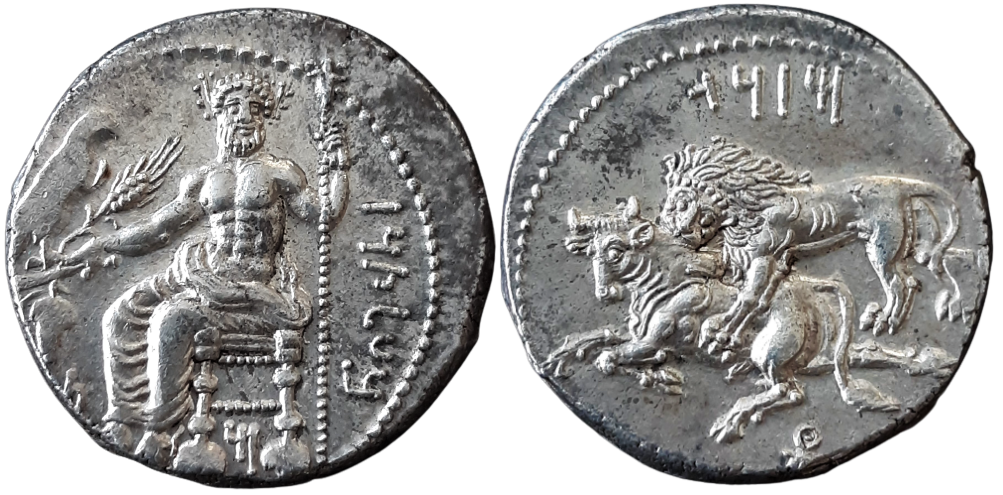
Asia Minor, p. III (Pamphyilia, Cilicia, Phoenicia) [4 coins];
Kings of Cappadocia [>5 coins];
Jewish & Levant [3 coins];
Persia [6 coins]
North Africa [2 coins];
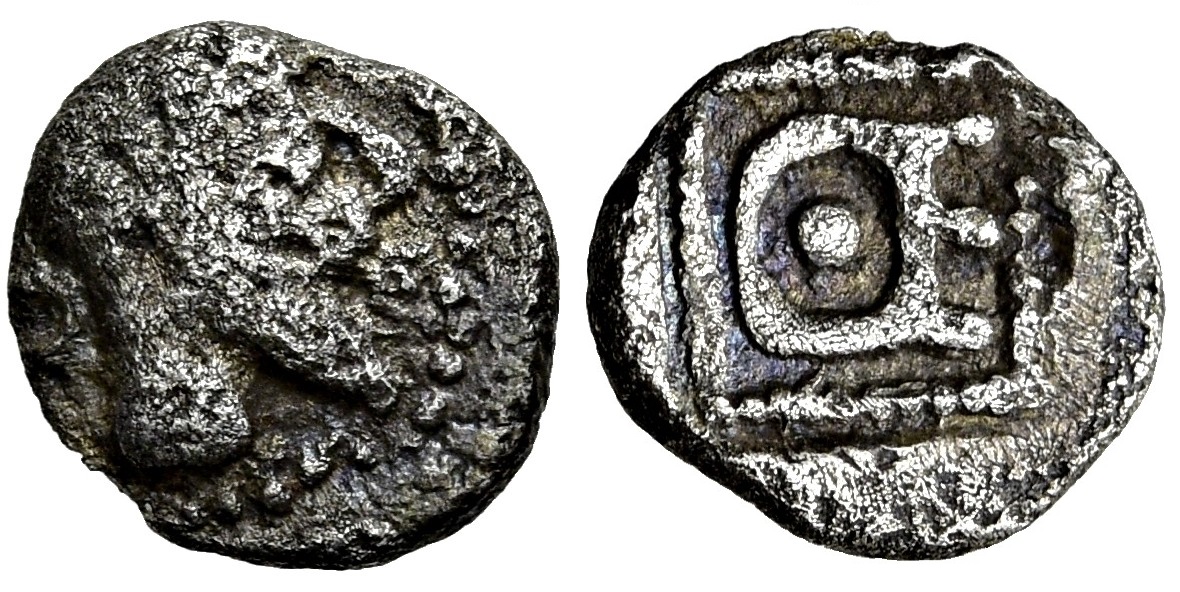
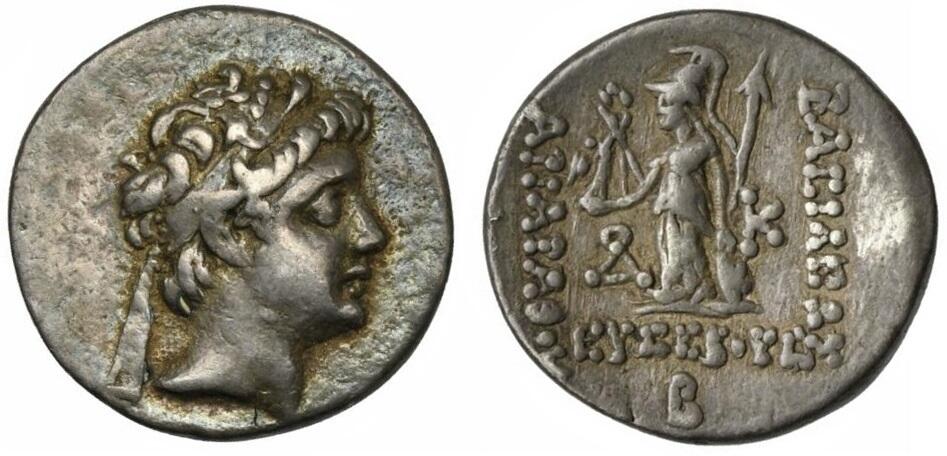
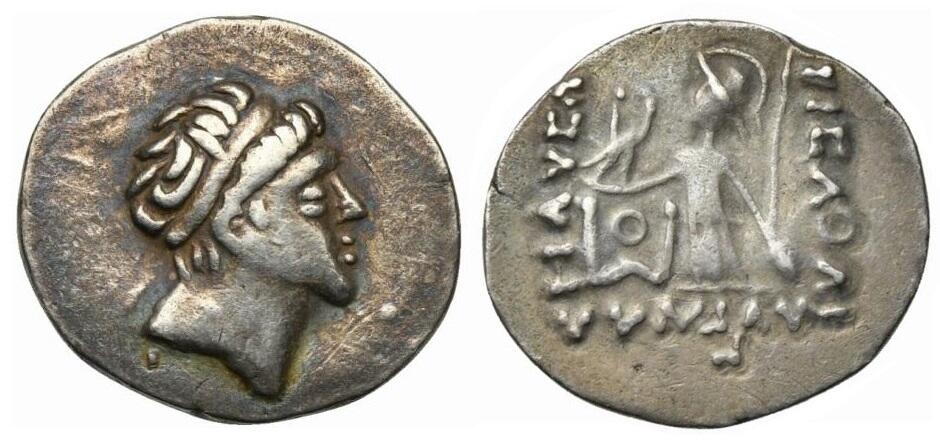
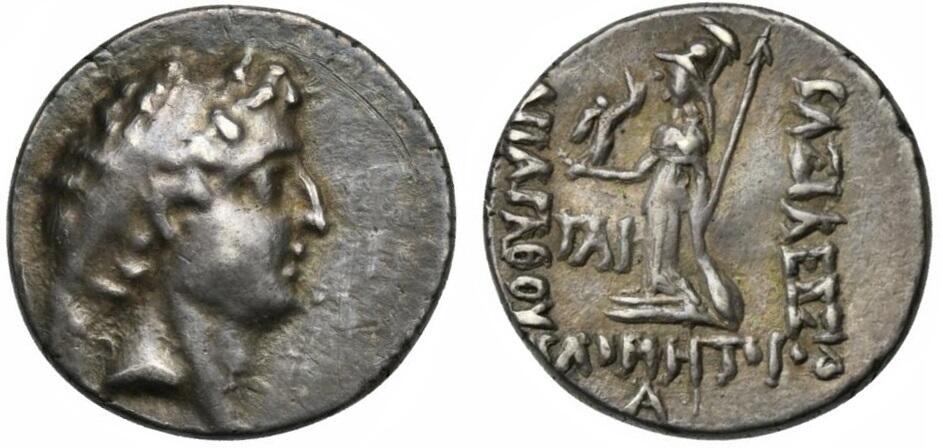
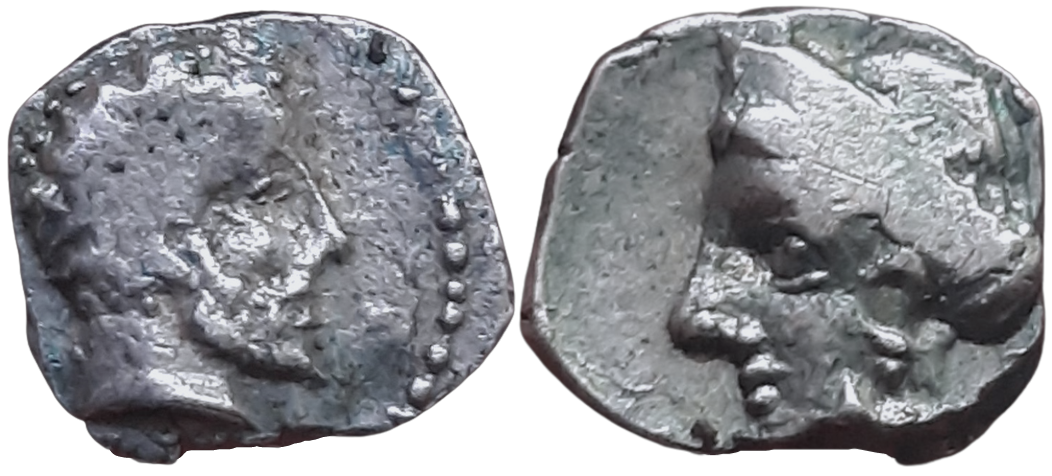
ASIA MINOR (Bithynia, Ionia, Lesbos, Troas) [6 Coins; top]:
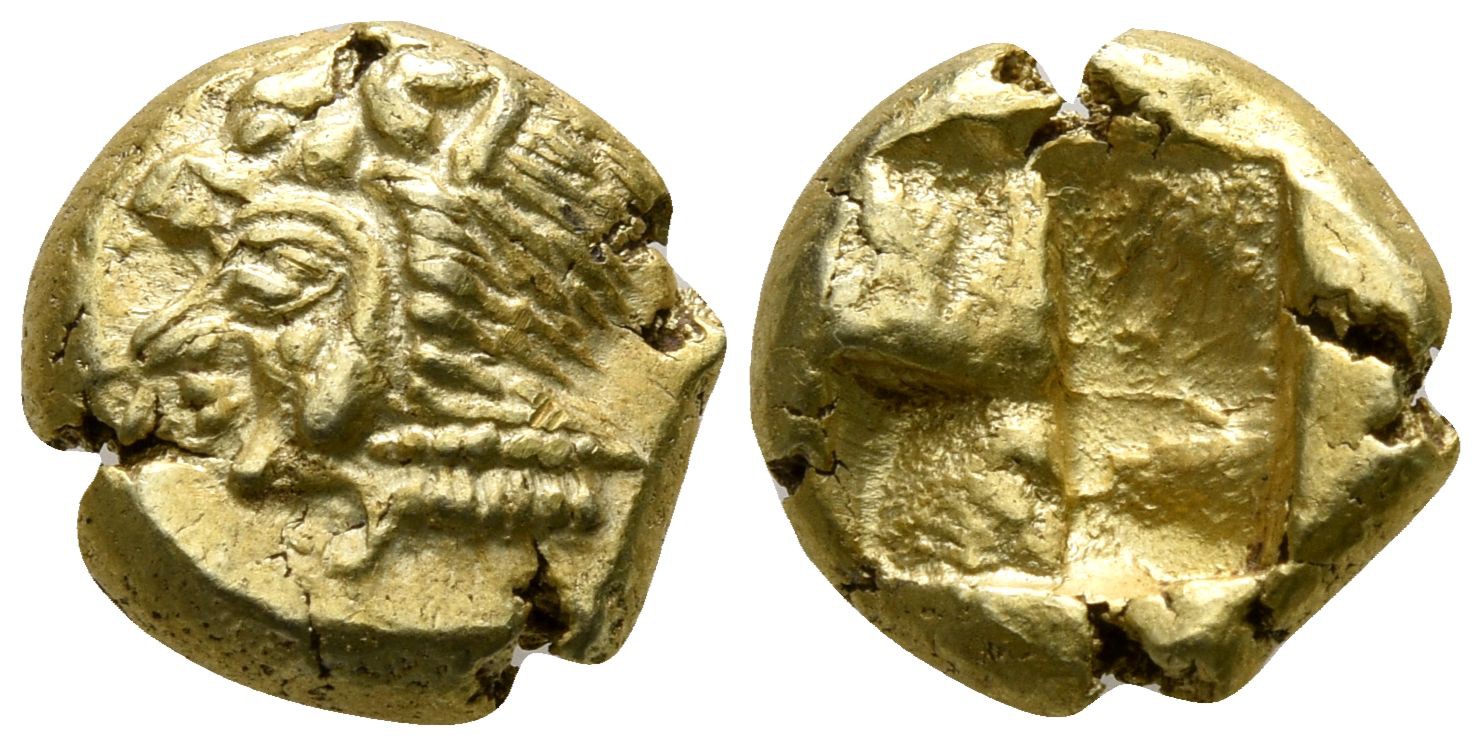
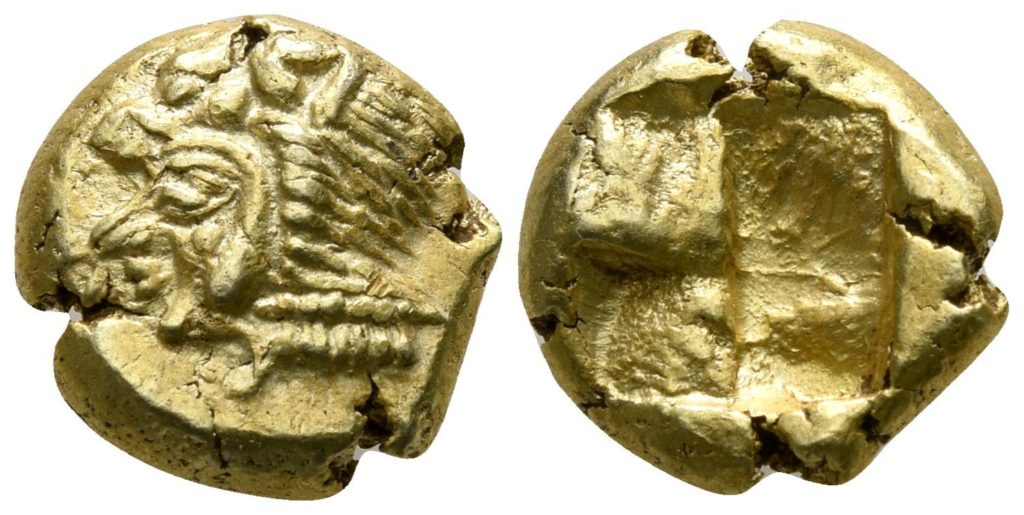
(Photo credit: Savoca.) Sale Hist.:
– ex Artemide Aste LII (San Marino, 26 Oct 2019), 102;
– ex Savoca Numsmatik, 18th Silver (Munich, 8 Oct 2017), 153.
Publication:
– W. Fischer-Bossert Group 2, No. 10 (V 5’’/R 9, this coin) in “Die Elektronhekten mit dem Herakleskopf” (2020, Numismatische Zeitschrift 126: 15-164), described on page 89 & illustrated on page 156. Fischer-Bossert provides extensive and compelling evidence for reattributing the type from Erythrae to Heraclea-Pontica. A splendid die study.
Also: Featured in “Ancient Coins: Gold Coins” (20 Oct 2020) video by Classical Numismatics on Youtube.

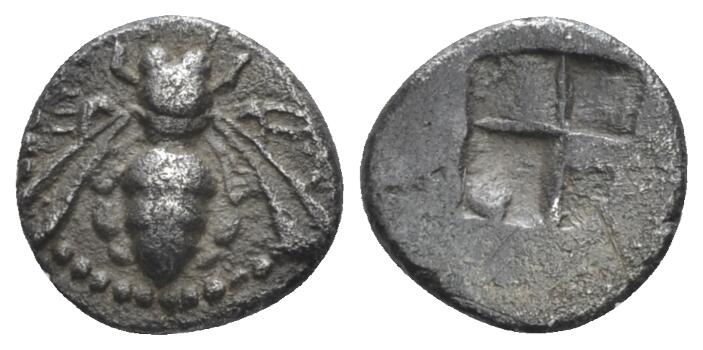
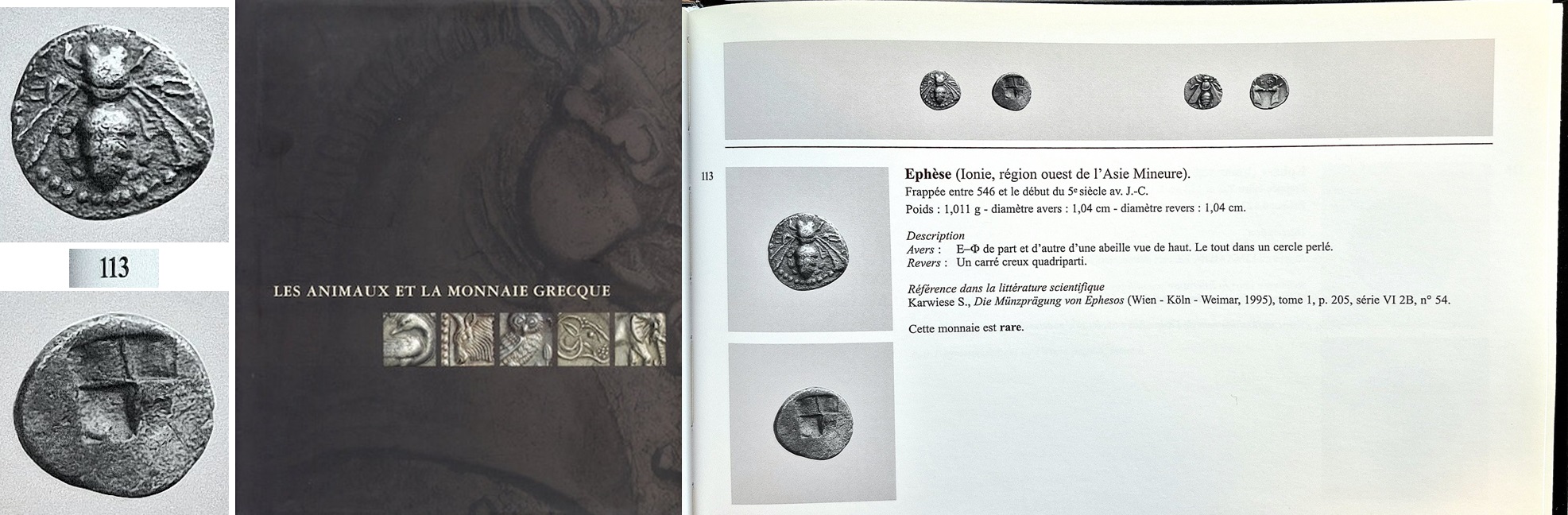
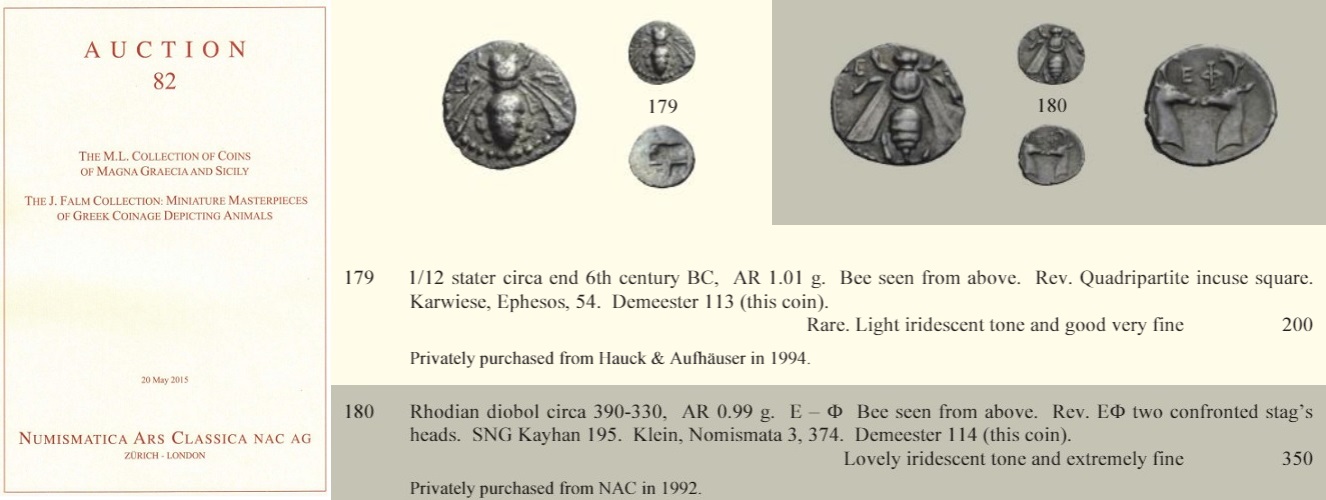
Ionia, Ephesos AR Diobol or Twelfth Stater (12mm, 1.01g), c. 6th cent. BCE. Bee / Quadratum incusum.
(Photo credit: Naville.) Collection Hist.:
– J. FALM Collection: Miniature Masterpieces of Greek Coinage depicting Animals [NAC 82 (Zurich, 19 May 2015), 782 ; priv. purchase, Hauck & Aufhäuser, 1994 (w/ at least 2 others)].
Published:
– Demeester 113 (this coin illustrated on p. 145) in Anne Demeester & Bernard Daubersy (photos) (2003), Les Animaux et la Monnaie Grecque (Brussels: Arnumis).
Note: Might this coin also be Aufhäuser 10 (5 Oct 1993), 146 = Karwiese (2019), Die Münzprägung von Ephesos 2: p. 176, n. 7?
Ionia, Magnesia. Themistokles AR Hemiobol (7mm, 0.36g), c. 459 BCE. Bearded male head (Hephaestus or Themistokles?), Θ-Ε / Θ-Ε Monogram.
(Photo credit: Gorny & Mosch.) Collection/Sale Hist.:
– Sammlung Gert Cleff [Gorny & Mosch EA 288 (27 Jul 2022), Lot 3];
– ex Giessener Münzhandlung Gorny Auction 97 (11 Oct 1999), Lot 376.
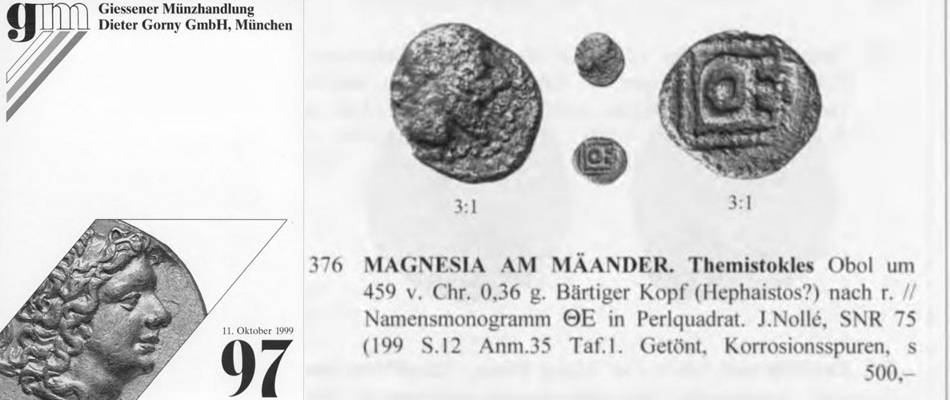
Published (referenced to Gorny 97 but not a “plate coin”):
– J. Nollé & A. Wenninger (1998, JNG 48), p.67, Th5a (this coin cited);
– H. C. von Mosch (2022, JNG 72), “Die vielen Gesichter der Lykomidai. Themistokles und Archepolis in Magnesia und Athen,” p. 71, 11d (this coin cited).
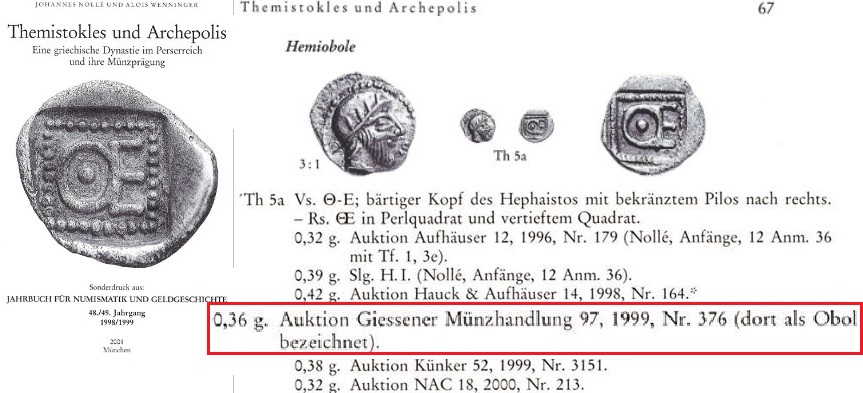
Note: When H.A. Cahn proposed that a portrait of Themistokles appears on some of his coins struck in Magnesia (Cahn-Gerin 1988 & Cahn-Mannsperger 1991), the theory was initially well-received. Opinion seemed to quickly turn against Cahn a few years later, in favor of Nollé, who argued that the coins depict Hephaestus instead (Nollé 1996 & Nollé-Wenninger 1998 [JNG 48]; see also Sheedy 2017).
The obverses characters are hard to see on my example (Θ to left & Ε to right), but the large reverse monogram is unmistakable (Θ-Ε ligate). As I see it, the unusual presence of Themistokles’s initials on both sides demands a better explanation than Nollé & Wenninger gave. Combined with evidence of his sculptural portraits, I think it’s worth considering that it may be Themistokles’ portrait (or, at least, Themistokles in the guise of Hephaestus).
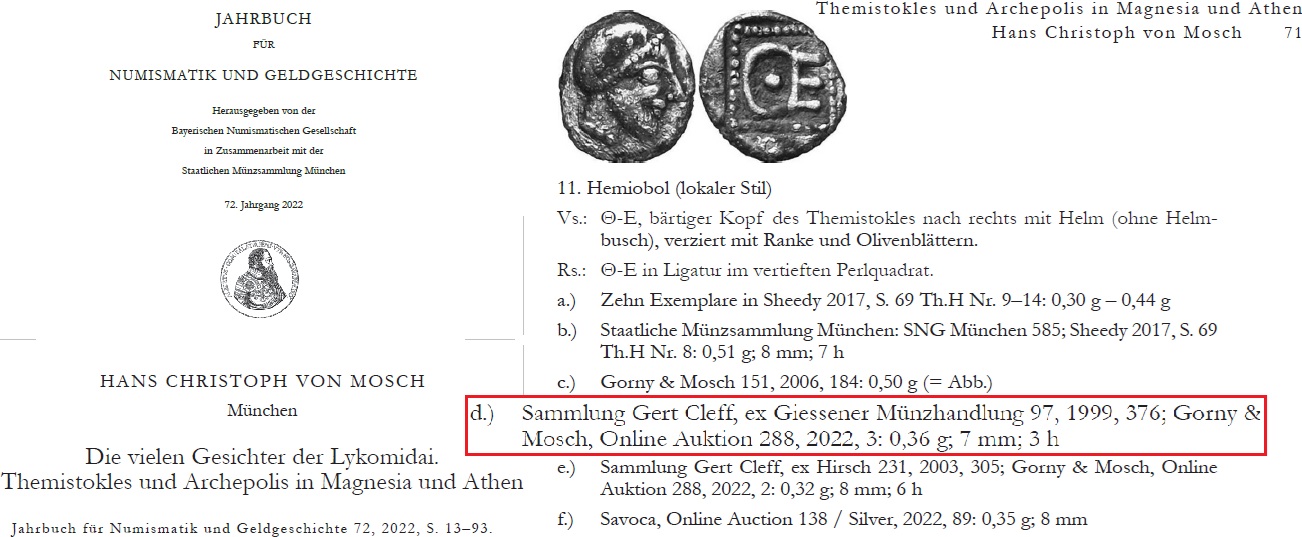
The newest entry from the pro-Themistokles side (above): Hans Christoph von Mosch’s (2022) article in JNG 72 argues in favor of Cahn’s original “portrait” hypothesis. I find the idea highly plausible & von Mosch’s argument compelling, but look forward to seeing the scholarly reception.
If so, this might be the earliest numismatic portrait of a living person!
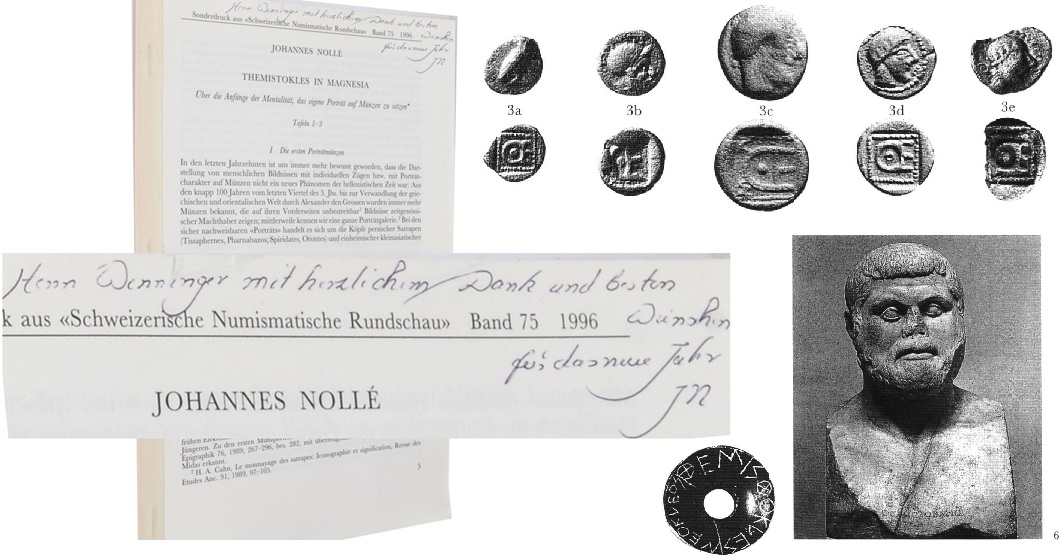
Incidentally, my copy of Nollé 1996 (above) is signed & inscribed to Alois Wenninger, his collaborator who, as a dealer, first recognized “Θ-Ε” as Themistokles! The two referenced my coin in the 1998 article.

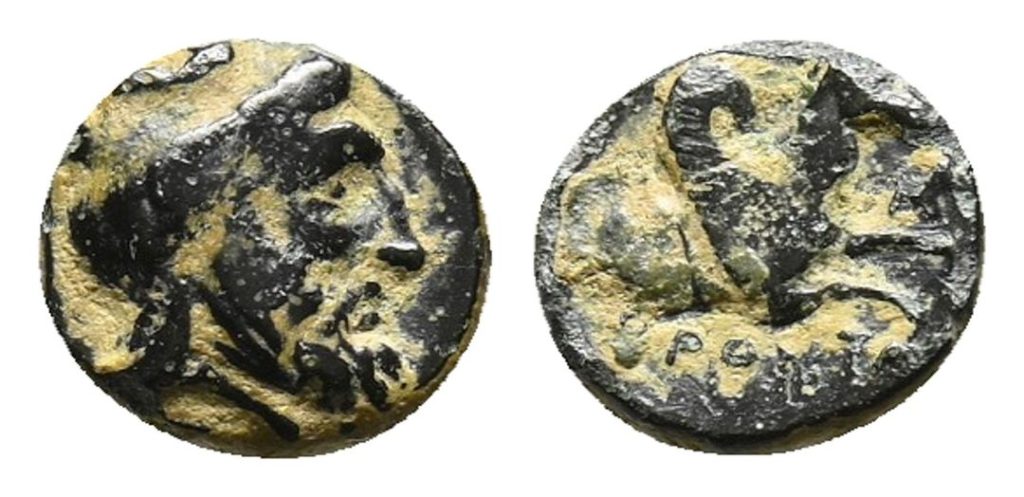
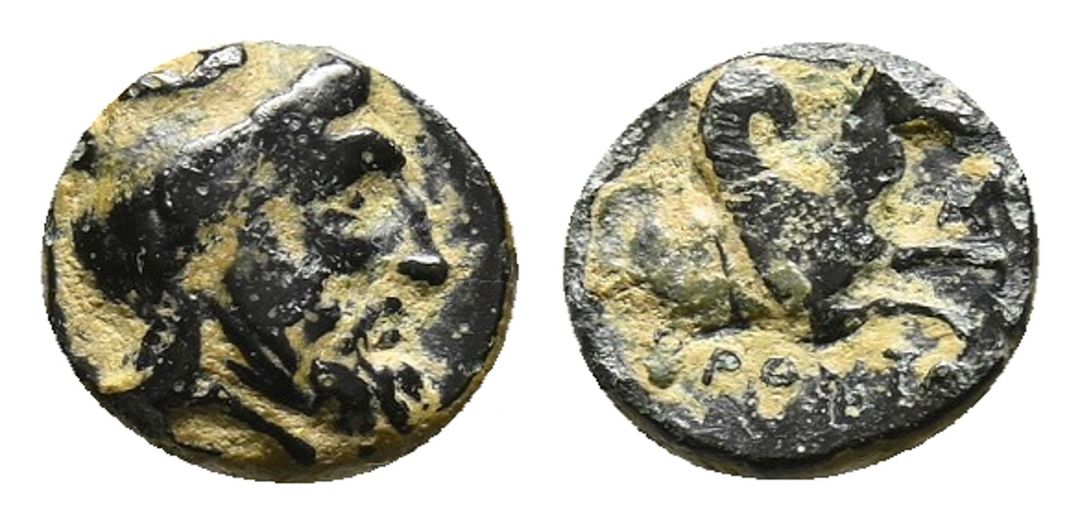
Mysia, Adramytteion (Orontas) AE (Hemichalkon?, 9mm, 0.64g, 12h), c. 357-352 BCE. Satrap in Tiara / Pegasos protome.
(Photo credit: Künker.) Collection Hist.:
– “Sammlung Eines Geschichtsfreundes” (Axel Winzer?) [Künker 312 (Osnabruck, 8 Oct 2018), 2281].
Publication:
– Winzer 16.5 (this coin illustrated) in Antike Portraitmünzen der Perser und Griechen aus vor-Hellenistischer Zeit (2005, Kronberg: Winzer), descr. on p. 44, ill. p. 8;
– H. H. Nieswandt Category 5, Orontas Type 3 (first coin described) in “Stoffbinden im Achaimenidischen Reich…,” in Lichtenberger et al. (eds.), Das Diadem der Hellenistischen Herrscher (2012, Bonn: Habelt): p. 100, note 284 (this coin cited).
Note: My copy of Winzer ex Bibliothek Alois Wenninger (w/ his monogram):
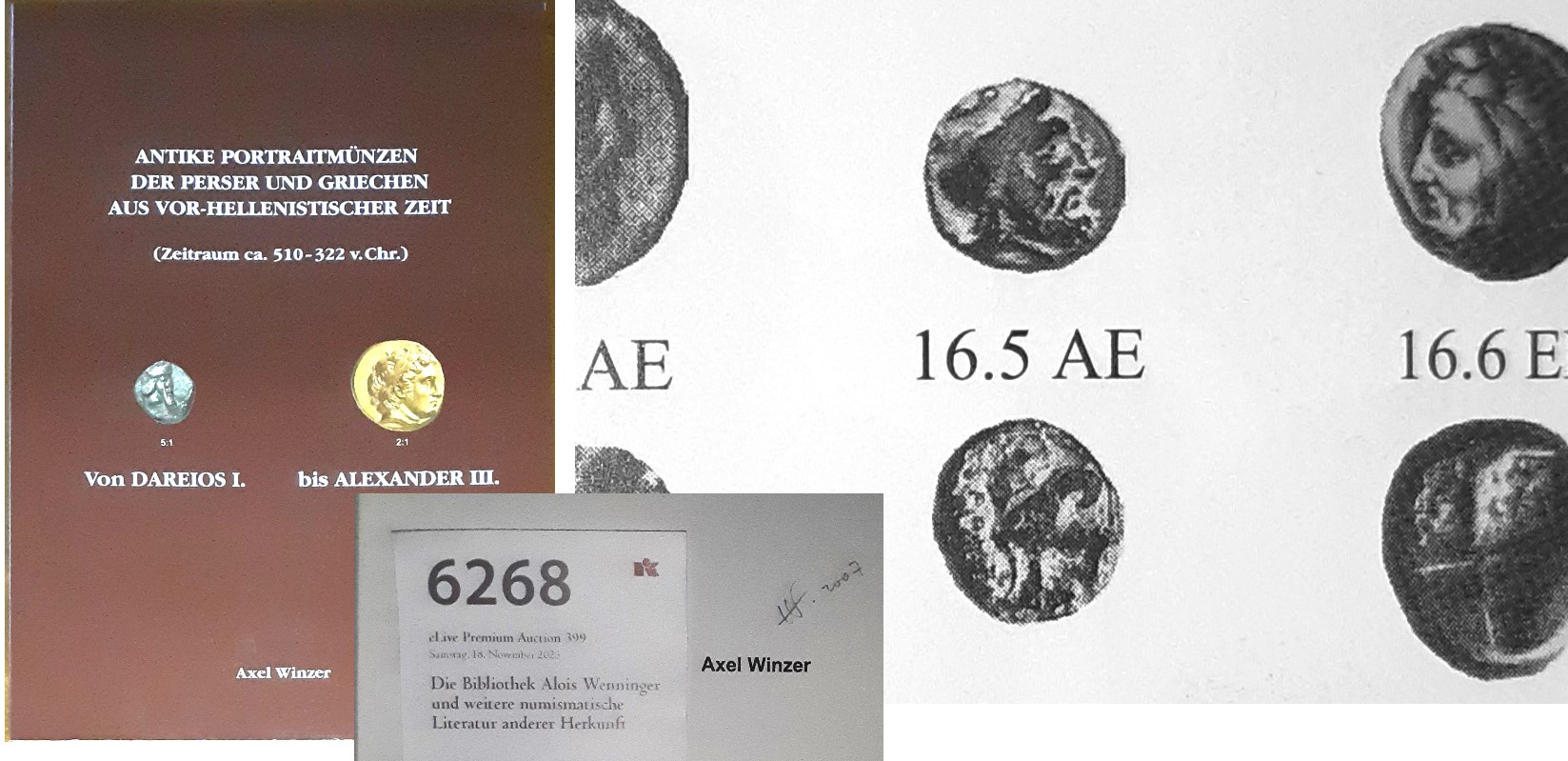
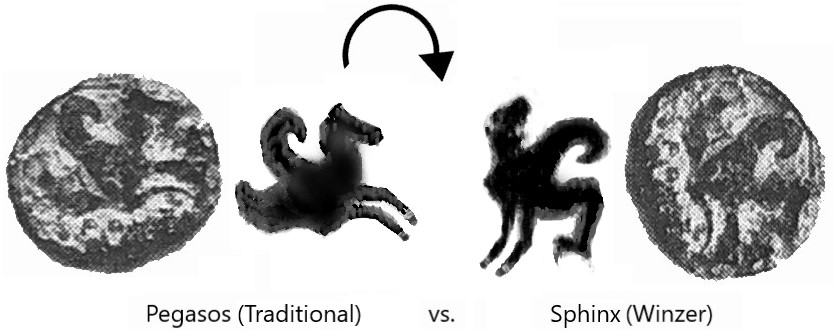
A remarkable detail: Axel Winzer interpreted the reverse as a Sphinx, rather than a Pegasos, because he viewed it from the “wrong” orientation. (Then again, who is to say that the Sphinx isn’t also “really” there? I see it.) Rotated 90′ clockwise, as in his plate above, this specimen does look remarkably like a Sphinx (assisted by this specimen’s rather poor preservation). Interestingly, in either orientation (as Pegasos or Sphinx), the same feature appears as wings, as with the forelegs. (Only the head and body are switched.) The same perceptual phenomenon (but deliberate) is a central feature of Celtic numismatic art.
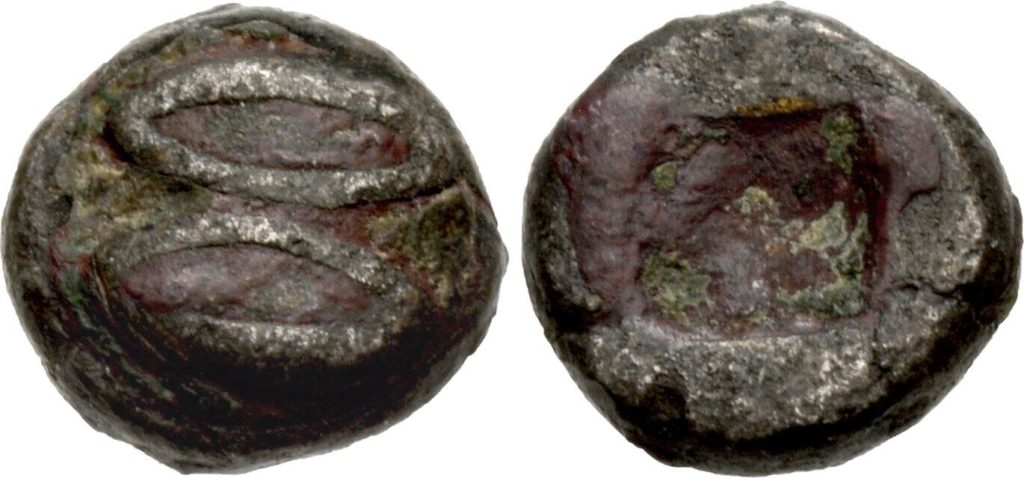
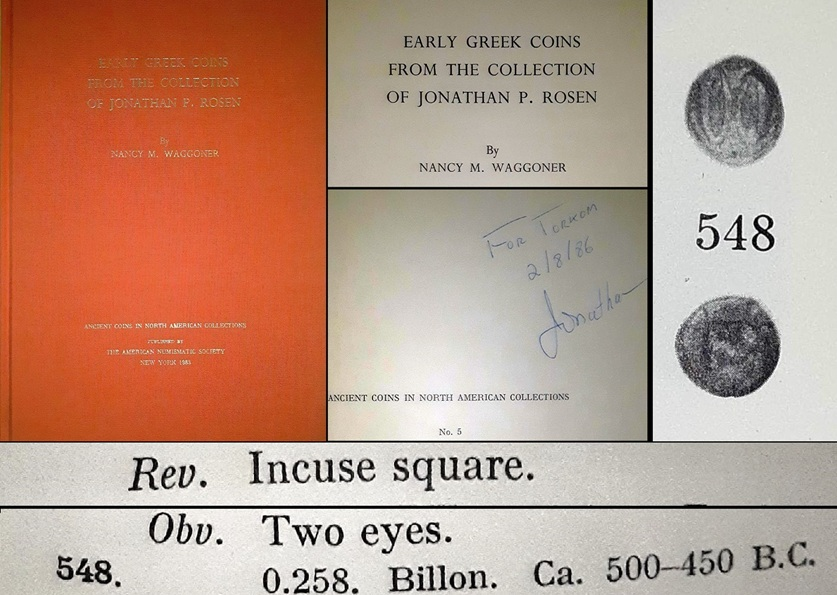
Lesbos, Koinon (?) Billon 1/48 Stater (5.5mm, 0.26g), c. 525-513 BCE. Two eyes (or grains or shields?) / Quadratum Incusum.
(Photo credit: CNG.) Collection Hist.:
– Jonathan P. Rosen [NFA Winter 1987 MBS (18 Dec 1987), 579 (part, not ill.), desc. by Lorber as “Probably a small hoard”];
– William B. Porter [CNG EA 494 (23 Jun 2021), 196].
Institutional Hist.:
– J. Paul Getty Museum, housed c. 1983-1987, among 773 coins cataloged by Waggoner (below), 100 exhibited and 50 cataloged in Archaic Coins: An Exhibition at the J. Paul Getty Museum from the Collection of Jonathan Rosen (1983, Malibu: Getty).
Publication:
– Waggoner-Rosen 548 (this coin illustrated on pl. 20) in: Nancy Waggoner (1983, ACNAC 5), Early Greek Coins from the Jonathan P. Rosen Collection. (NY: ANS) [my copy signed by Rosen & inscribed to Torkhom Demirjian].
See also:
– Lazzarini (2006, RIN 107), “Contributo alla conoscenza delle emissioni monetali del koinon arcaico di Lesbo” (this coin cited on p. 39).
– Lazzarini (2010, Obolos 9), “A contribution to the study of the Archaic billon coinage” (this coin one of 25 specs. summarized on p. 91, though not individually enumerated).
– Peter van Alfen & Jay M. Galst, Ophthalmologia Optica & Visio in Nummis (2018, NYC: ANS) p. 546 (this coin cited).
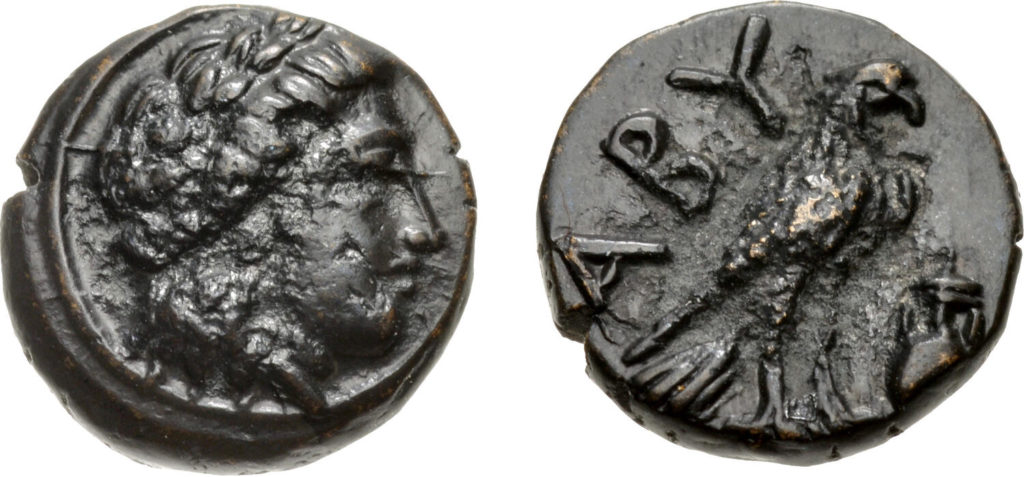
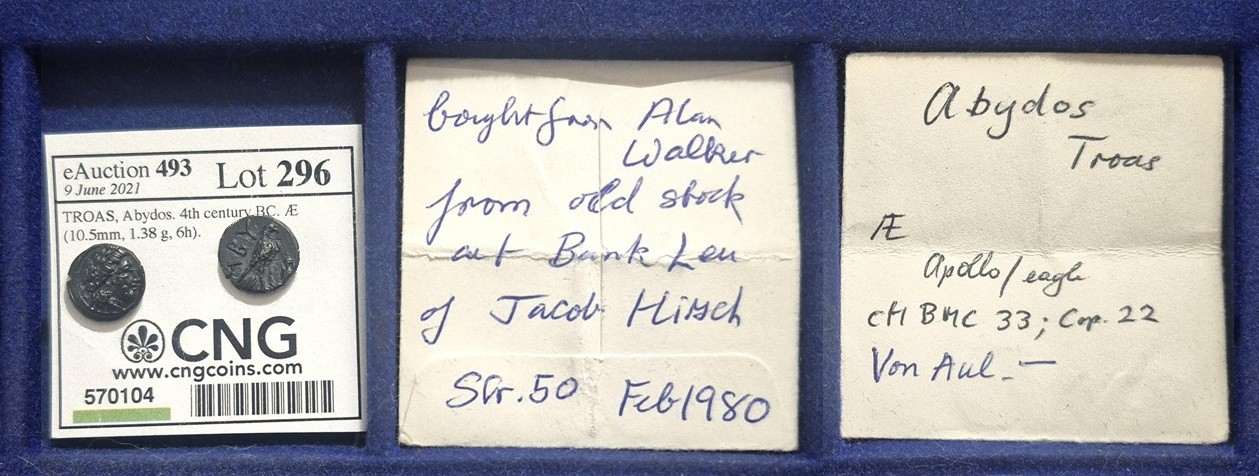
Troas, Abydos AE Chalkous (10.5mm, 1.38 g, 6h), c. 375-325 BCE. Apollo / Eagle, amphora.
(Photo credit: CNG.) Collection Hist.:
– Prowe-Egger III 596 (this coin illustrated) = Fedor Ivanovich (Theodor) Prowe (Moscow, 1872-1932) [Brüder Egger Auktion XLVI (Wien, 11 May 1914), 596 (ill. on pl. XI)];
– Jacob Hirsch (1874-1955) Estate [acq. by Bank Leu, Zurich, c. 1955];
– G.M.R.H. Collection (Malcolm Hay), London [acq. from Alan S. Walker, Bank Leu, Feb 1980, per collector ticket in his hand (provenance to Prowe-Egger lost by then)].
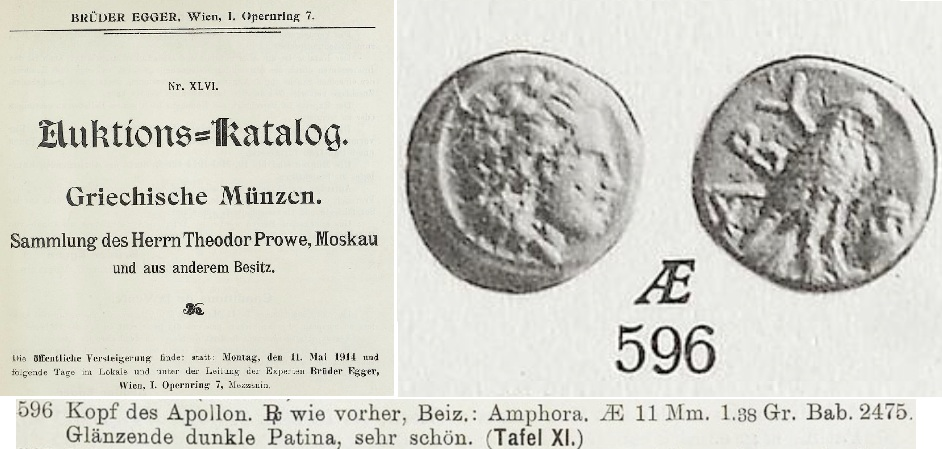
See Also: (possibly) Athanasios Rhousopoulos (1823–1898) Collection [Hirsch No. XIII (15 May 1905), 3982 = 10mm, no photo or weight, but a scarce enough var., esp. then, in this condition; quite a few Prowe coins came from Rhousopoulos; Hirsch seemed to have a propensity for reacquisitions, which might explain why he held onto it for >40 years until his death, as he did w/ many others from the Rhousopoulos coll.].
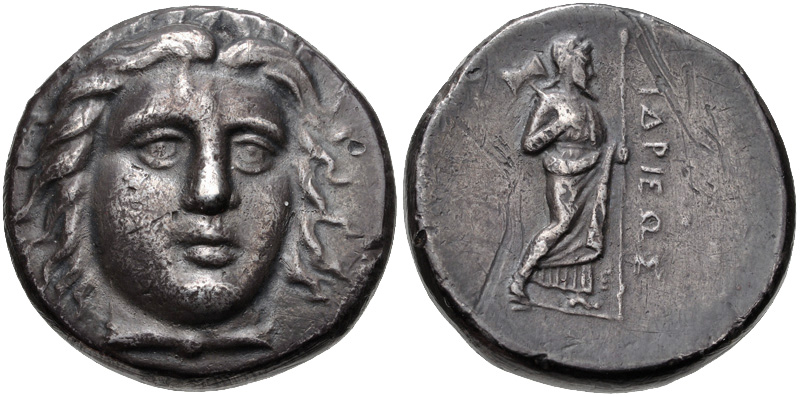
ASIA MINOR (Caria) [6 Coins; top]:
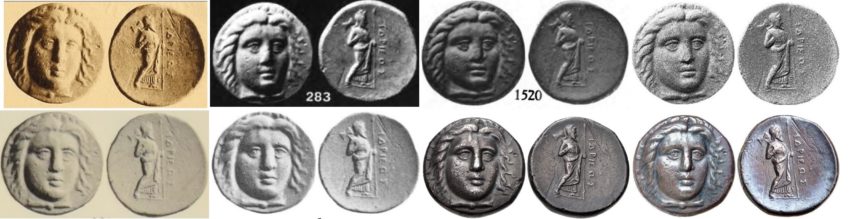
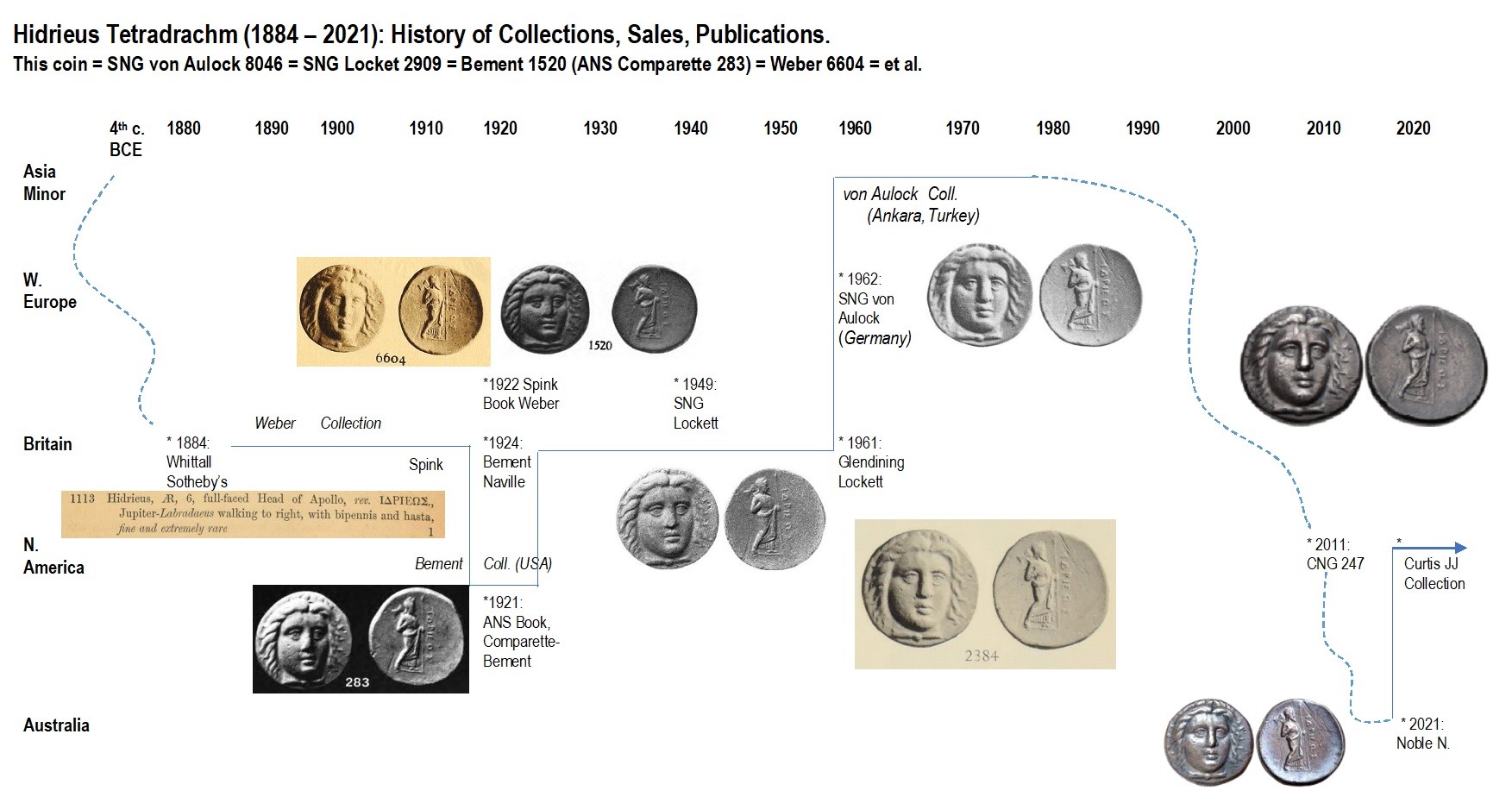
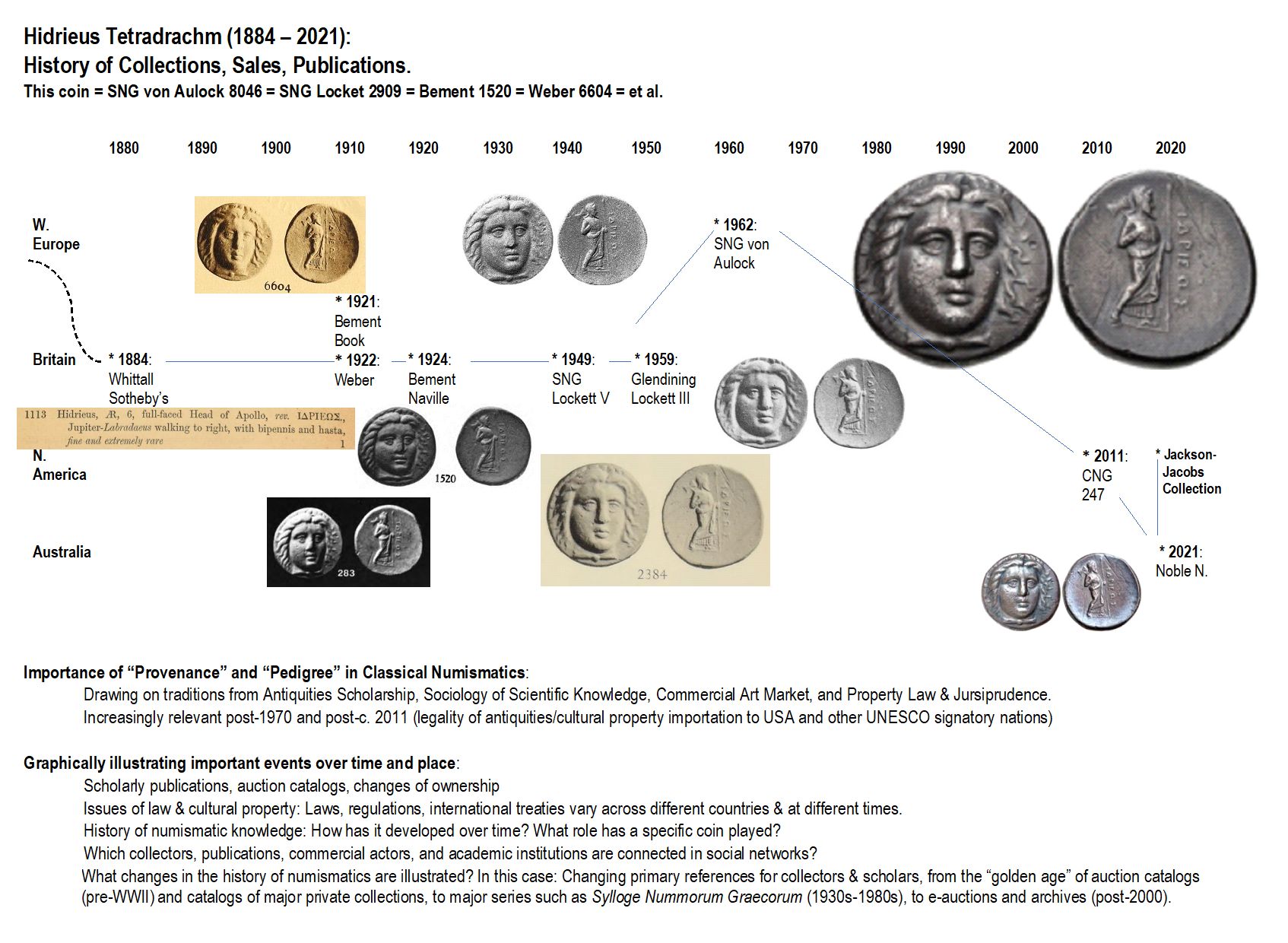
(Photo credit: CNG.) Collection History:
– James Whittall (1819-1883) [Sotheby, Wilkinson, & Hodge (London, 10 Jul 1884), 1113];
– Sir Hermann Weber (1823 – 1918);
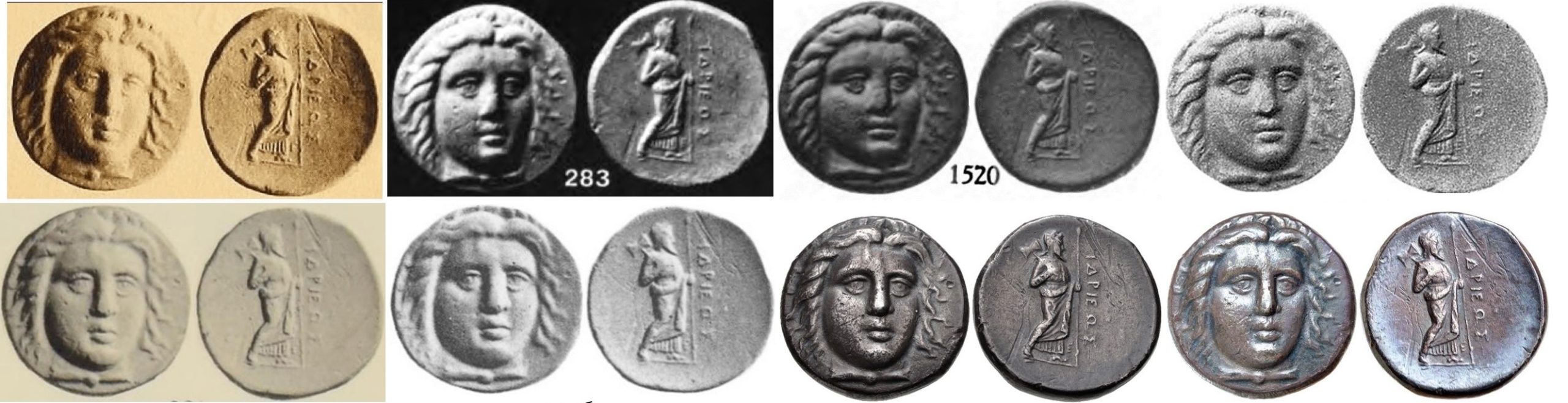
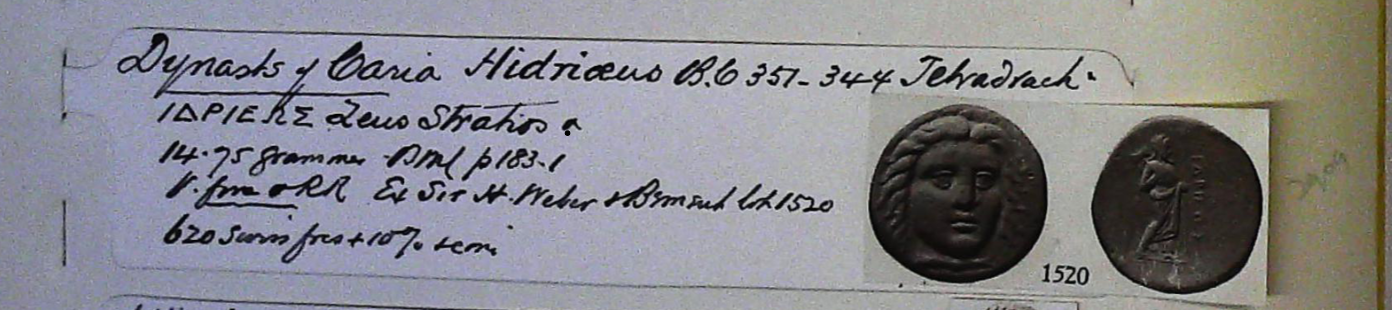
– Clarence S. Bement (1843-1923) [Naville VII (Lucerne, 23 Jun 1924), 1520];
– Richard Cyril Lockett (1873-1950) [Part XII/Greek IV, Glendining (London, 21 Feb 1961), 2384];
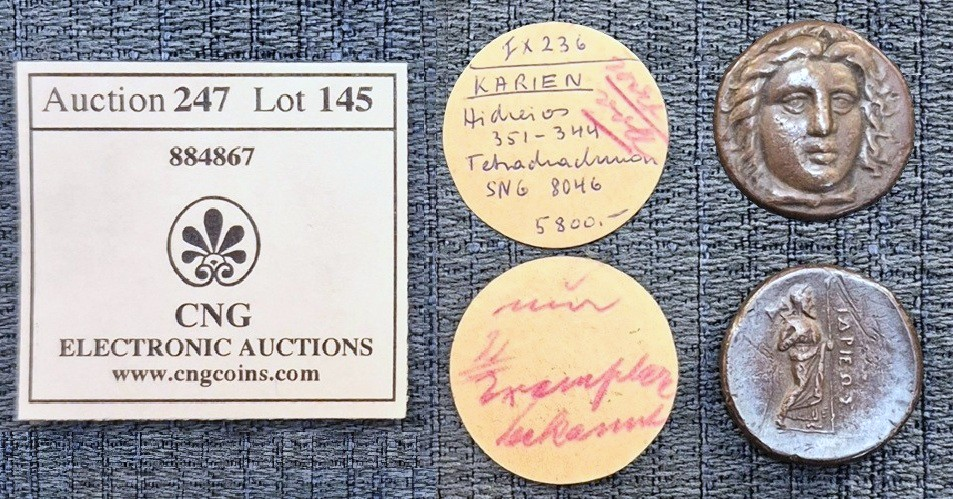
– Hans von Aulock (1906-1980) w/ (his?) handwritten tray tag.
Publication:
– T.L. Comparette 283, in A Descriptive Catalogue of Greek Coins, Selected from the Cabinet of Clarence S. Bement (1921, NY: ANS), p. 79 & Pl. XIX;
– Weber 6604, in L. Forrer, The Weber Collection: Greek Coins, vol. III (1925 & 1926, London: Spink), described in Vol III, pt. 1 on p. 390, illustrated on plate 233;
– SNG Lockett 2909, in Sylloge Nummorum Graecorum. British Series. Volume III. The Lockett Collection. Part V (1949, London);
– SNG von Aulock 8406, in K. Kraft & D. Kienast, Sylloge Nummorum Graecorum, Deutschland, Sammlung Hans von Aulock. Fascicle 7: Karien (Berlin, 1962);
– Atak 2409, in E. Atak, Antik Grek Sikkeleri Katalogi 1980 (1980, Istanbul: Atak), p. 61 & pl. 67 (using the Lockett-Glendining photo; my copy signed & inscribed to Hermann Lanz).
See Also:
– Historia Numorum Caria n° 1399, #5 (“digital plate coin”);
– SNG Online (Lockett 2909) (“digital plate coin”);
– Delrieux (1999) “Les Monnaies de Mylasa aux Types de Zeus Osogôa et Zeus Labraundeus,” Numismatic Chronicle 159: p. 36, Note 7 (this coin cited, as SNG von Aulock 8046);
– Plant (1979) Greek Coin Types and Their Identification, 413-C (this coin used as model for line drawing & measurements, after Weber 6604, as was R. Plant‘s usual practice for coins absent from his own collection; see my post).
The British Numismatic Society owns Lockett’s 58-volume handwritten collection catalog. By digitizing & publishing PDFs of each vol., the BNS has given a spectacular gift to provenance researchers. Below is the entry for this coin (the penciled 2909 refers to SNG):
See also: “provenance chart” (1884-present) for this coin (or gallery, also incl. 8 photos 1921-2021) or the Blog Post: “Provenance Diagrams’ for Ancient Coins“; and my “Catalog Favorites” page: Bement (ex ANS) & Lockett (ex Bastien).
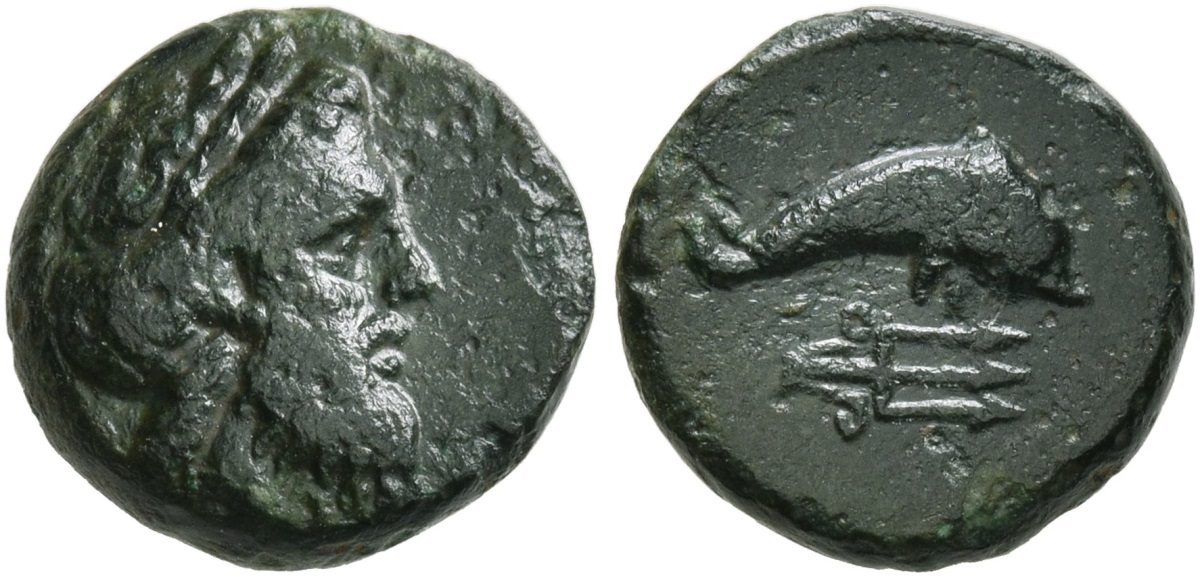
Caria, Mylasa AE Chalkous (10mm, 1.16g, 7h), c. 4th cent. BCE. Zeus Osogos / Dolphin & trident.
(Photo credit: Leu.) Collection Hist.:
– Dr. P. Vogl Collection [Leu WA 16 (22 May 2021), Lot 1055];
– Sammlung Prof. Dr. Peter Robert Franke (1926-2018) [Grün 64 (20 Nov 2014), Lot 1046];
– Slg. Erich Karl (1924-2009) [Lanz 131 (27 Nov 2006), Lot 246; acq. Kölner Münzkabinett 49 (30 Oct 1989), Lot 27];
Publication:
– Dimakopoulos (2009) Sanctuaries and Cult of Zeus in Caria, Table 41e (this coin illustrated);
– Lenger (2016) AIIN 62: p. 282, note 8 (this coin cited).
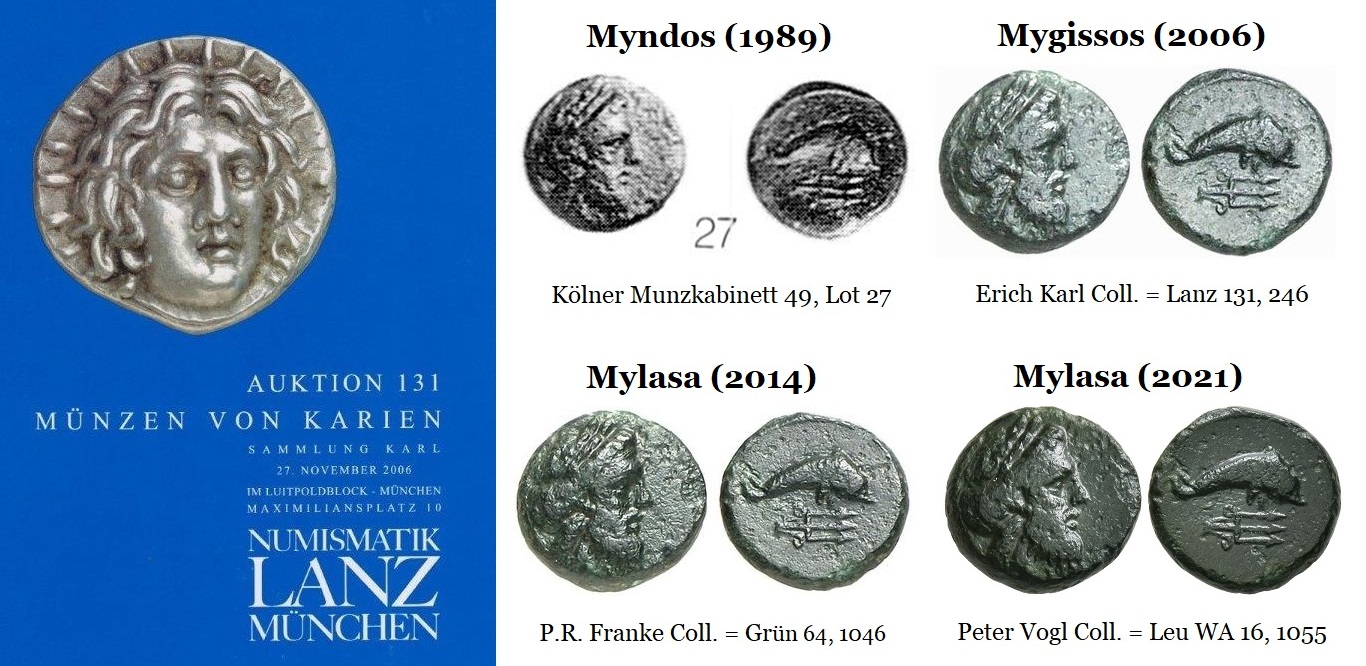
See also:
– Historia Numorum Online (HNO Caria) 1883.1 (this coin);
– M. Miller (2020) Greek IV, p. 238, #515 (this coin ill. online).
Notes: An example of particular intellectual value (if not commercial) for having been included in several important collections near the center of a decades-long debate, and individually attributed to at least three different mints (Myndos, Mygissos, Mylasa) by its different catalogers (and others when published in scholarly numismatic literature). Fortunately, Konuk’s (2022) excellent new contribution (“MY Stands for Mylasa” in Presbeus [Essays Ashton]) should finally settle the debate!
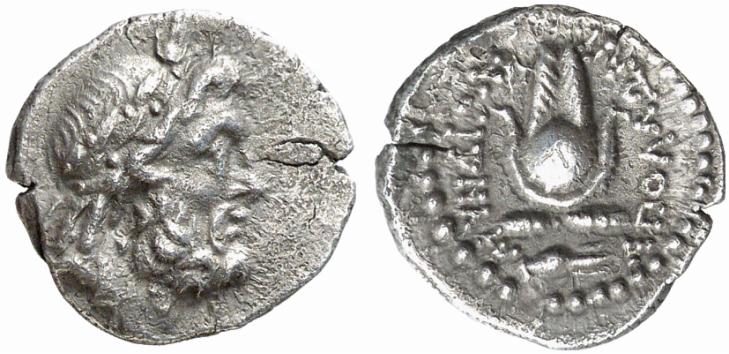
Caria, Myndos AR Drachm (18mm, 3.34g, 12h), naming Apollonios, c. mid 2nd BCE. Serapis / Headdress of Isis.
(Photo credit: Lanz.) Collection/Publication Hist.:
– Sammlung Erich Karl (1924-2009) [Lanz 131 (27 Nov 2006), 266];
– Slg. Laurent Bricault (1963-) [Gorny & Mosch 247 (10 Mar 2017), 4030 (part)];
– GTP Collection [CNG EA 543 (2 Aug 2023), 97].
Published:
– Historia Numorum Online (HNO Caria) 2653 (this coin illustrated, “digital plate coin”);
– Bricault (2008), SNRIS (Sylloge Nummorum Religionis Isiacae et Sarapiacae) Myndus 02 (a6) (this coin).
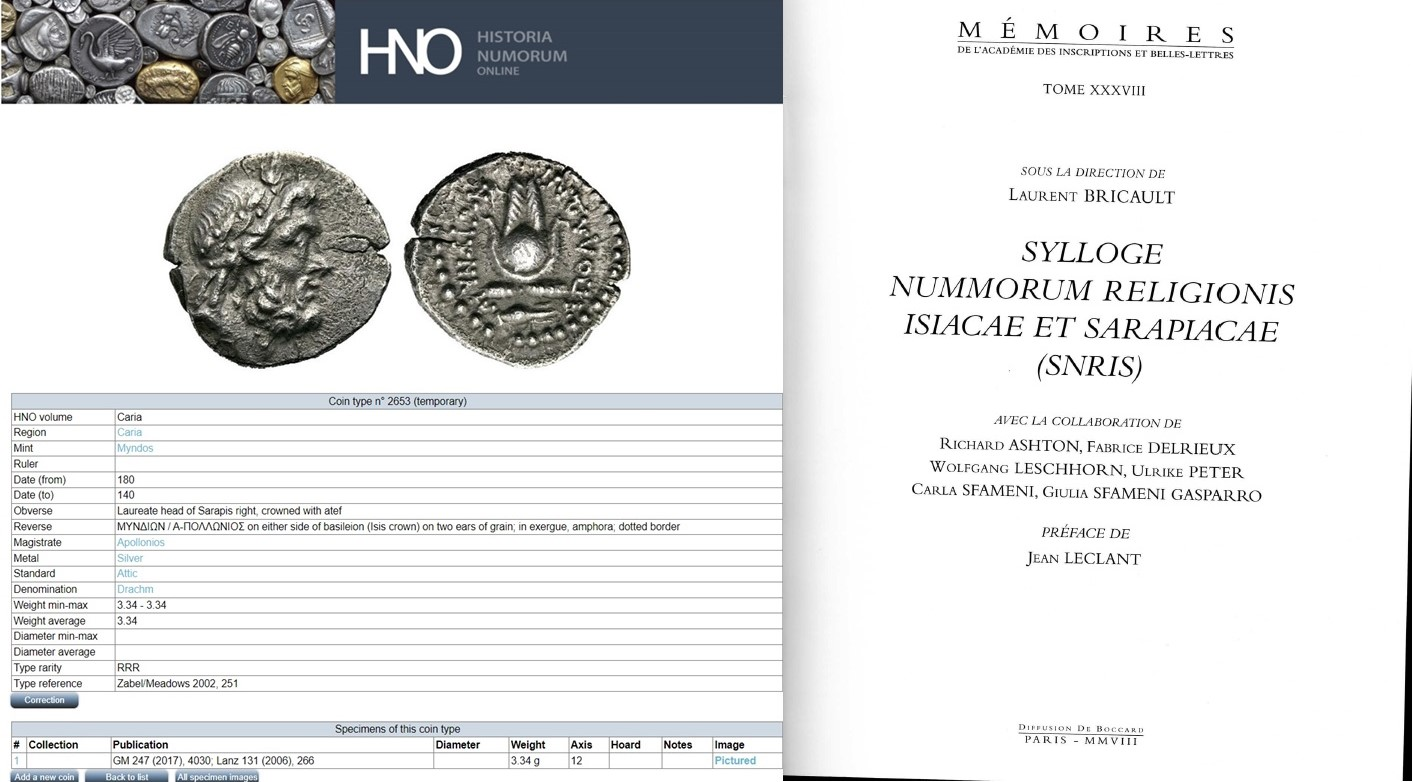
Notes: The present coin is the third or fourth example known, and second photographed.
Two 19th cent. specimens are described (conceivably the same) by Drexler (1889) NZ 21: p. 135) from the Prokesch-Osten colllection (weight uknown) & Whittall collection (3.93g or 4.06g), the latter being Imhoof-Blumer (1876), ZfN 3 [to PDF]: p. 326, n. 4 = Whittall (Sotheby 1867, 517 [part]).
Another example from the same dies as my coin appeared at Gorny Auktion 81 (3 Mar 1997), Lot 342 (3.18g), cited in Meadows & Zabel (2009), Coin Hoards IX, 522: pp. 248 n. 7 & 251.

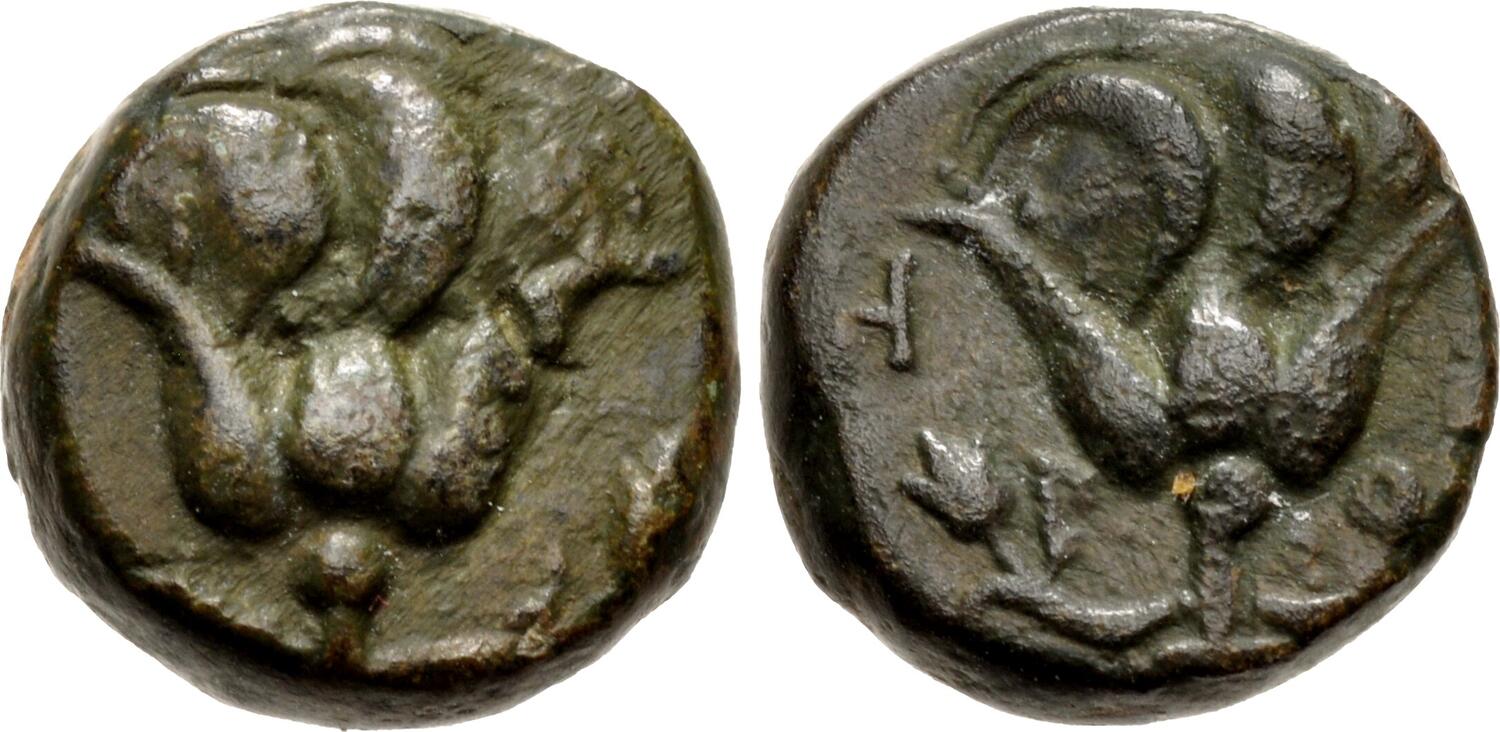
Caria, Rhodes, Rhodos AE Chalkous (9mm, 0.94g, 12h), c. 200 BCE. Rose / Rose.
(Photo credit: CNG.) Collection/Publication Hist.:
– Thomas Bentley Cederlind (1959-2015) Estate [CNG EA 387 (30 Nov 2016), Lot 197];
– Sammlung Karien [Gorny & Mosch 169 (12 Oct 2008), Lot 750, corr. (weight)].
Published Online:
– Historia Numorum Online (HNO Caria) 1474.2 (this coin illustrated, “digital plate coin”).

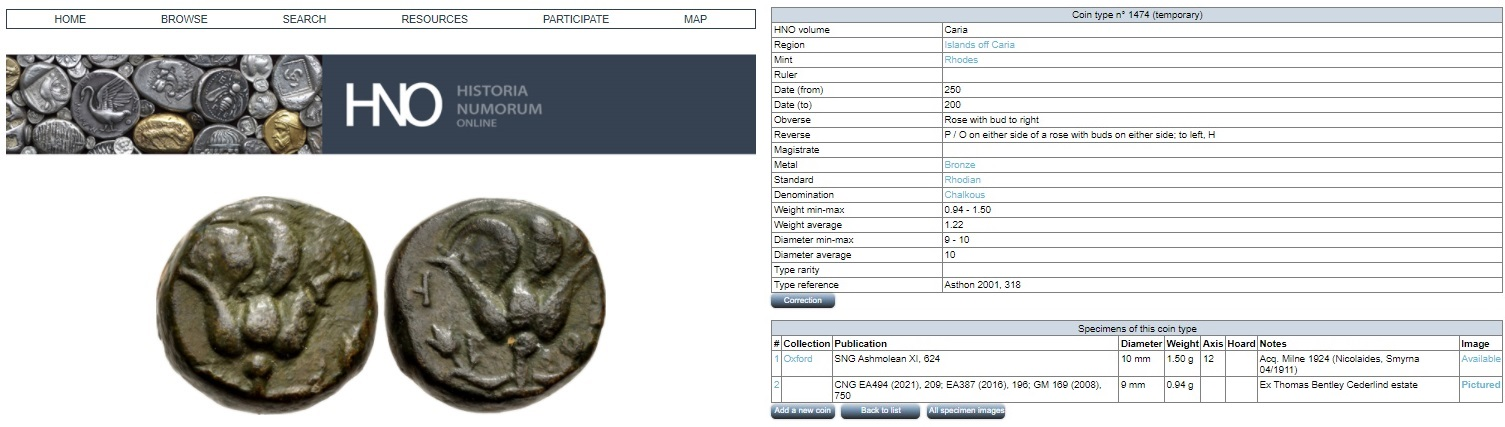
Notes: As in other dealer-collector “estates” (e.g., J. Hirsch), there is no strict differentiation between collection & inventory. In this case, though, it seems clear Cederlind collected this type; his estate included no fewer than 13 (incl. at least one other ex Slg. Karien, most also illustrated in HNO Caria). In any case, a really nice little bronze.
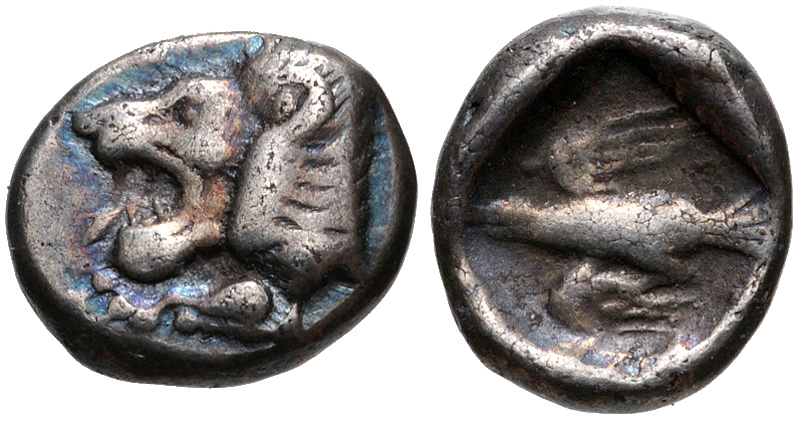
Caria, Uncertain AR Obol (8.5mm, 0.69g), c. 450-400 BCE. Roaring lion / Eagle flying left.
(Photo credit: CNG.) Collection/Publication Hist.:
– Otrera Collection [CNG EA 525.1, Lot 350 (corr., flying l.)];
– George Mihailuk (1932-2018) Collection [Noble 123 (2 Apr 2020), Lot 3140; acq. from Richard Welling (14 Aug 2010); CNG EA 238 (11 Aug 2010), Lot 138];
– Leu stock, 1990s;
– Ex “Unknown findspot [Turkey], before 1992” Hoard (CH 9, 359).
Published:
– S. M. Hurter (1998) “Lions and Lionesses, Eagles and a Few Heads: A New Uncertain Mint in Caria” in Essays Hersh, Group 1, No. 10 (this coin illustrated).
See also: Asia Minor Coins #7375 (“digital plate coin”).

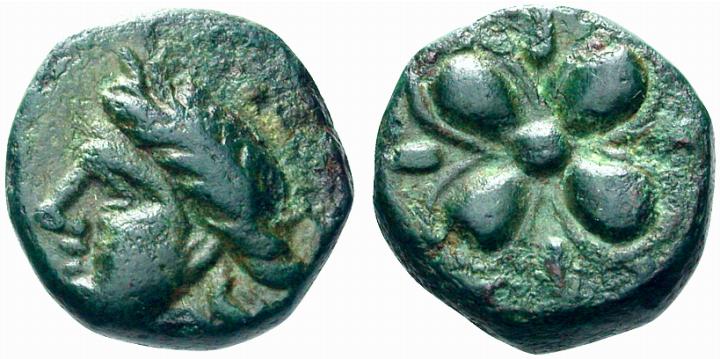
Uncertain Asia Minor AE Kleinbronze (3.31g, 12mm), 4th cent. BCE. Head of Apollo (?) / Rosette in stellate style.
(Photo credit: MMDE & Leu.) Collection Hist.:
– Maurice Laffaille (1902-1989) Collection [Münzen & Medaillen AG 76 (19 Sep 1991), 662, w/ ticket];
– Hans Hermann Gutknecht Collection [Münzen & Medaillen GmbH 17 (4 Oct 2005), 710].
Publication:
– Laffaille 662 (this coin, illustrated on p. 162) in: Pierre Strauss (1990), Collection Maurice Lafaille – Monnaies Grecques en Bronze.
See also: Asia Minor Coins 3052 (this coin) [added 19 Oct 2005].
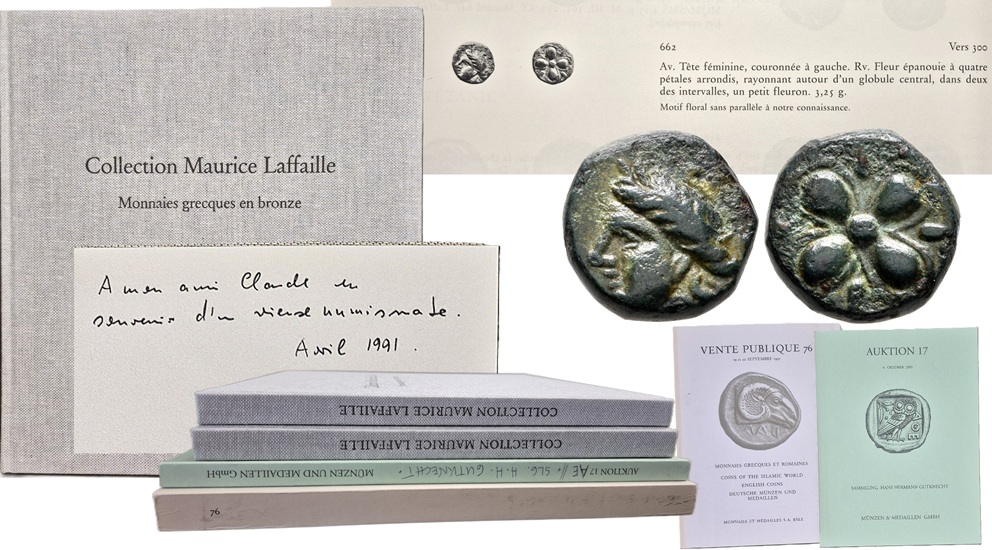
My copy of the Gutknecht sale is ex Bibliothek Wenninger. A fantastic sale with intro essays by Voegtli, Brendle, Demetriadi, Kampmann, and Kellner. (BCD’s spectacular leather-bound copy with portrait-cover sold for $4,000 plus fees!) One of my copies of the Laffaille-Strauss book is ex BCD Library Duplicates, the other inscribed by (I believe) Strauss to “Claude.”
Reference Notes: The references & this coin’s four auction appearances (1990 – 2024) all describe the coin as “unpublished” or “Unikum(?).” Neither Pierre Strauss (MMAG) nor Hans Voegtli (MMDE) found any published examples or relevant comparanda. Nor did the later catalogers at Noble (2024) & Leu (2022, I was 2nd underbidder), nor the distinguished collectors Laffaille & Gutknecht.
However, there is apparently a second example (or at least a very similar type): Waddington et al. (1910), Recueil Général, page 616, no. 3 (Plate CVI, 7).
That example was published from the collection of the great F. Imhoof-Blumer (1838-1920) (possibly now in Winterthur and/or published in Bloesch’s catalog?), who attributed it to the rare mint of Tium in Bithynia (alternately Tius, Tios, Tion) & identified the obv. as Zeus, probably in error. (My piece clearly is not Zeus; it is likely Apollo.) The editors of RecGen kept F.I.B.’s mint, but called it “douteuse. Peut-être à Cromna,” but without justifying either mint. (Kromna seems unlikely, no doubt based on the supposed depiction of “Zeus”).
NOT my coin (same type?):
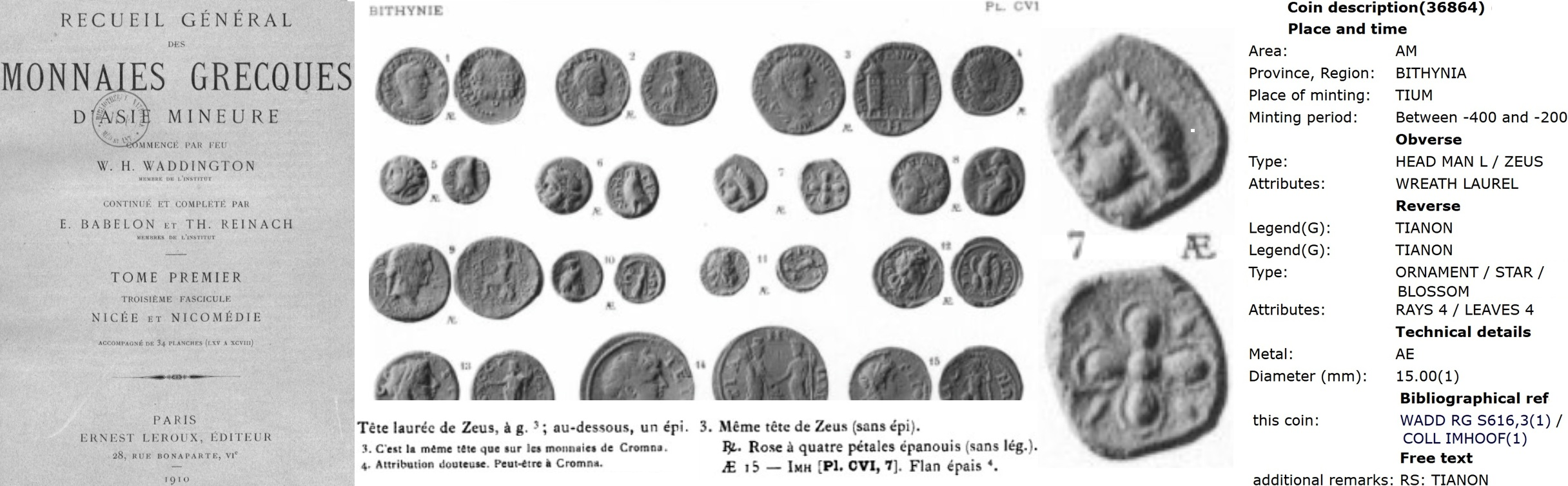
Unfortunately there is no weight given for the example above, but the diameter is reported at 15mm, which could be the same denomination. The coin is included in the Isegrim database, but mistakenly lists a legend, “TIANON,” though the type appears to be anepigraphic (online: Type 36864; Excel [2023]: line 10004).
My speculation is that this coin may be from the Hekatomnid period, temp. Pixodaros or Hekatomnos, possibly struck in Caria, Halikarnassos. The obverse of the AV fractions is remarkably similar, and there are parallels w/ reverses on AR fractions (and some AE, but slightly different pattern). The main difficulty may be the weight (3.3g is much heavier than others early Carian bronzes), but perhaps a brief attempt as issuing Dichalkoi. It doesn’t fit well elsewhere either.
The other possibilities would be the Ionian cities Miletos (some of the bronze reverses are quite similar, and the weight/fabric is more consistent) or conceivably Erythrai.
ASIA MINOR (Pamphylia, Cilicia, Phoenicia) [4 Coins; top]:
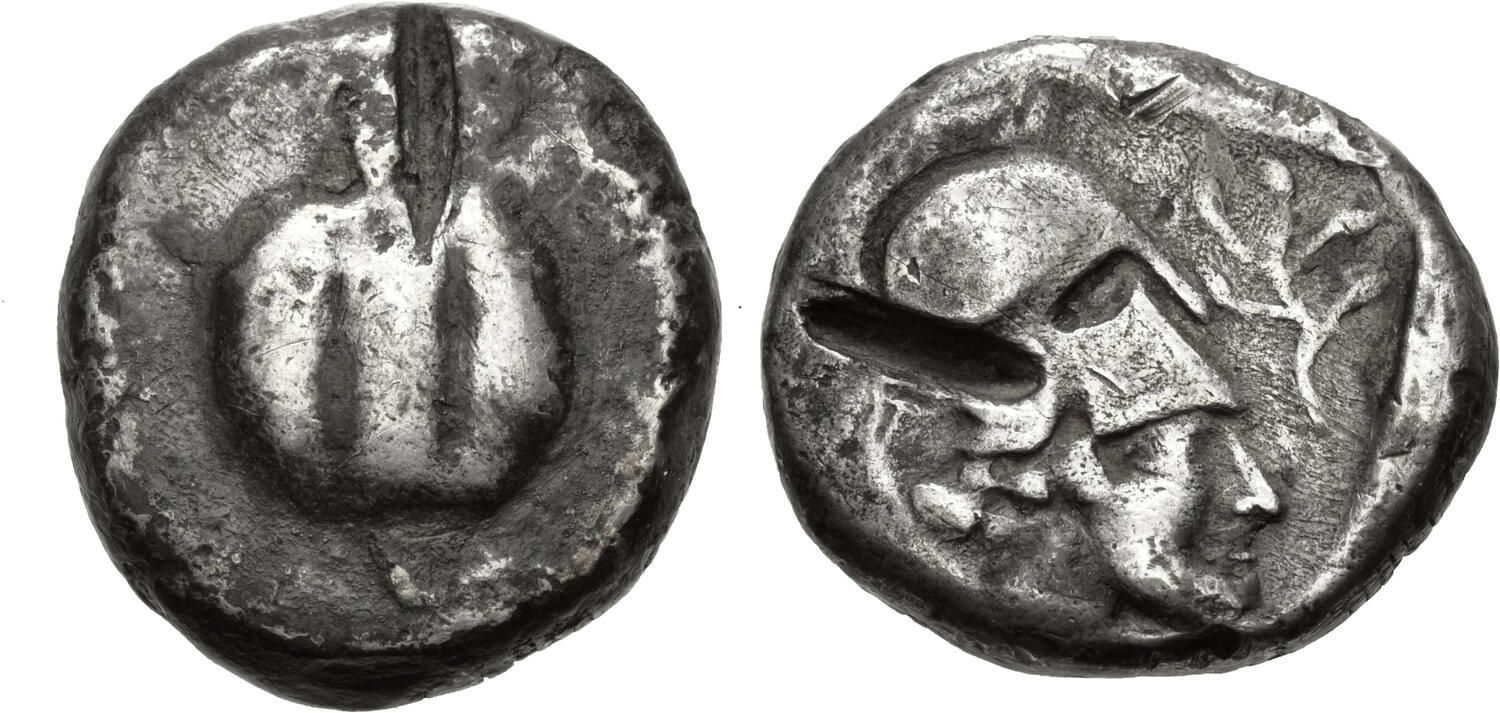
Pamphylia, Side Fourrée (?)* Stater (19mm, 8.71g, 3h), c. 430-400 BCE. Pomegranate / Athena.
* See note re: AR vs. plated counterfeit or local imitation.
(Photo credit: CNG.) Auction History (all erroneously describing it as official AR issue):
– Ex Kress 121 (4 December 1961), lot 198;
– Alex G. Malloy MBS XII (25 Apr 1978), Lot 457;
– Malloy MBS XV (30 Nov 1979), Lot 313;
– CNG EA 487 (10 Mar 2021), Lot 194.
Publication (erroneously describing it as official AR issue):
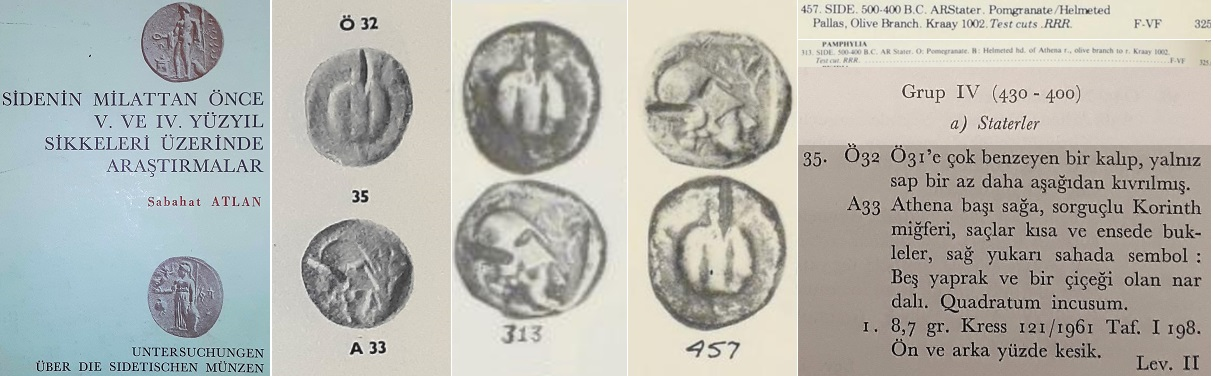
– Atlan, Sabahat (1967), Sidenin Milattan önce V ve IV Yüzyil Sikkeleri Üzerinde Arastirmalar (Ankara), No. 35.1 (O32/A33 – this coin illustrated).
See also (same):
– Kraay, C. (1969), “Notes on the Mint of Side…,” NC 9 [129]: p. 18 (this coin cited, being the only specimen of type 35).

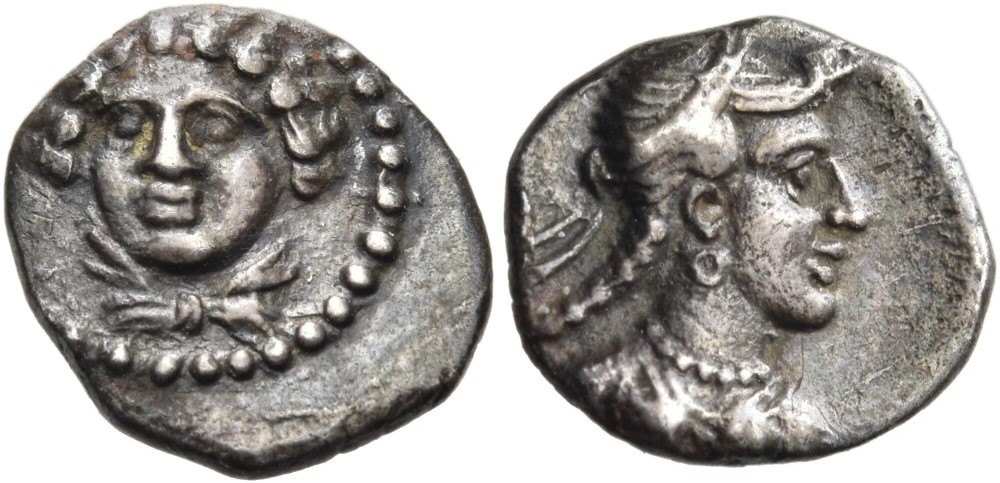
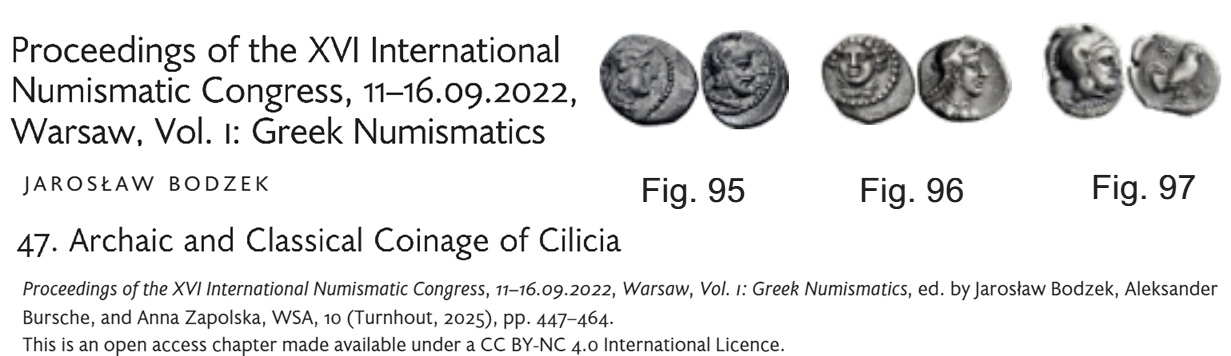
Cilicia, Tarsus AR Obol (9mm, 0.68g), temp. Datames, c. 380 BCE. Herakles (?)* / Aphrodite (?).
* See note re: obv. description.
(Photo credit: Nomos 29.) Collection History:
– Collection sans Pareille [CsP II = Nomos 29 (5 Nov 2023), 914];
– Leo Mildenberg (1913-2001) Collection, w/ collector tag [acq. en bloc by CsP, 1970s];
– Hans von Aulock (1906-1980) Collection.
Publication:
– SNG von Aulock 5419 (this coin);
– Bodzek Fig. 96 (this coin illustrated on p. 461), in: Jarosław Bodzek (2022), “Archaic and Classical Coinage of Cilicia: An Overview,” INC XVI Proceedings, Ch. 47: pp. 447-464.
See also: Goldman (2000), “The Sign of the Lily … (Part II),” Shnaton 12: page 107, note 9 (this coin cited).
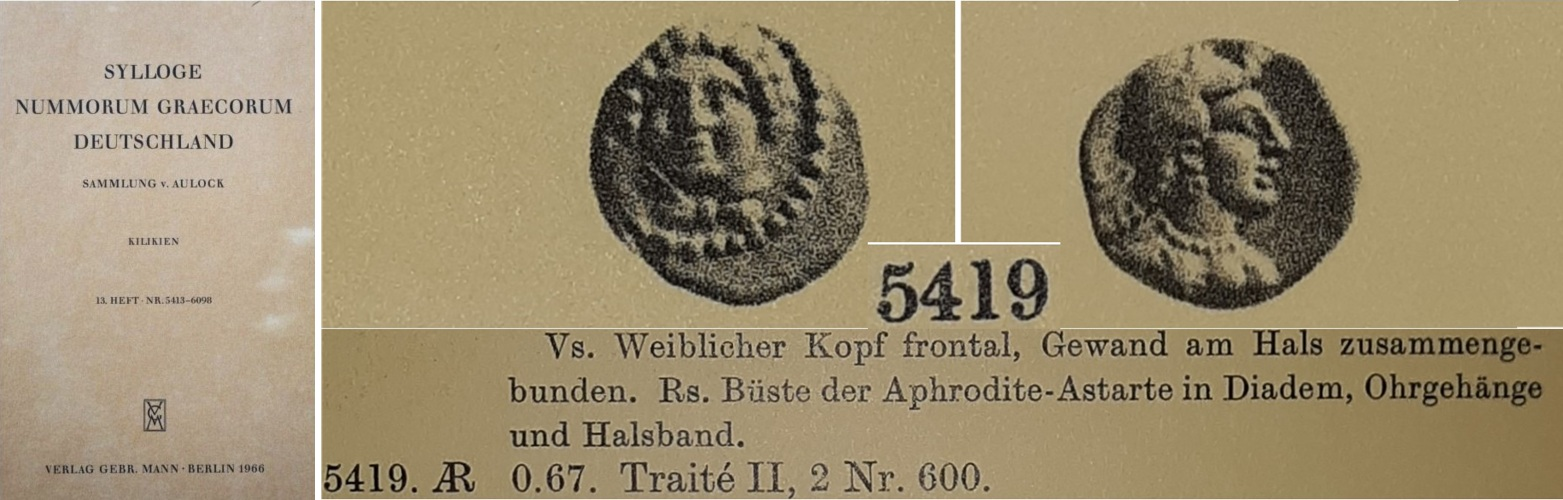
Notes: Interestingly, although Mildenberg owned this coin, he instead illustrated the SNG Levante 217 or 218 specimens when publishing this type (e.g., his contrib. to Pour Denyse [2000: nr. 33]).
Coin-in-hand video (23.5s – imgur).

(Photo credit: Jackson-Jacobs.) Collection Hist.:
– (presumably) Ex “Tarsus Hoard” (late 1970s; unpublished, but see Bing 1998: p. 63, n. 6 & p.73);
– Athena Fund (Merrill Lynch, Bruce McNall) [Sotheby’s & NFA (Zurich, 27 Oct 1993), Lot 808.1];
– CNG MBS XXIX (30 March 1994), Lot 252;
– Dr. Joseph M. Seventko (1939-) Collection [ICG Encapsulated (AU53) #5571290112 (removed Feb 2021); Heritage Auctions Signature Sale 296 (27 Jul 2002), Lot 11134];
– J.B. (Edmonton, Canada, d. 2019) Collection [CNG EA 455 (30 Oct 2019), Lot 168; acq. Calgary Coin Gallery (R. Kokotailo), Autumn 2004].
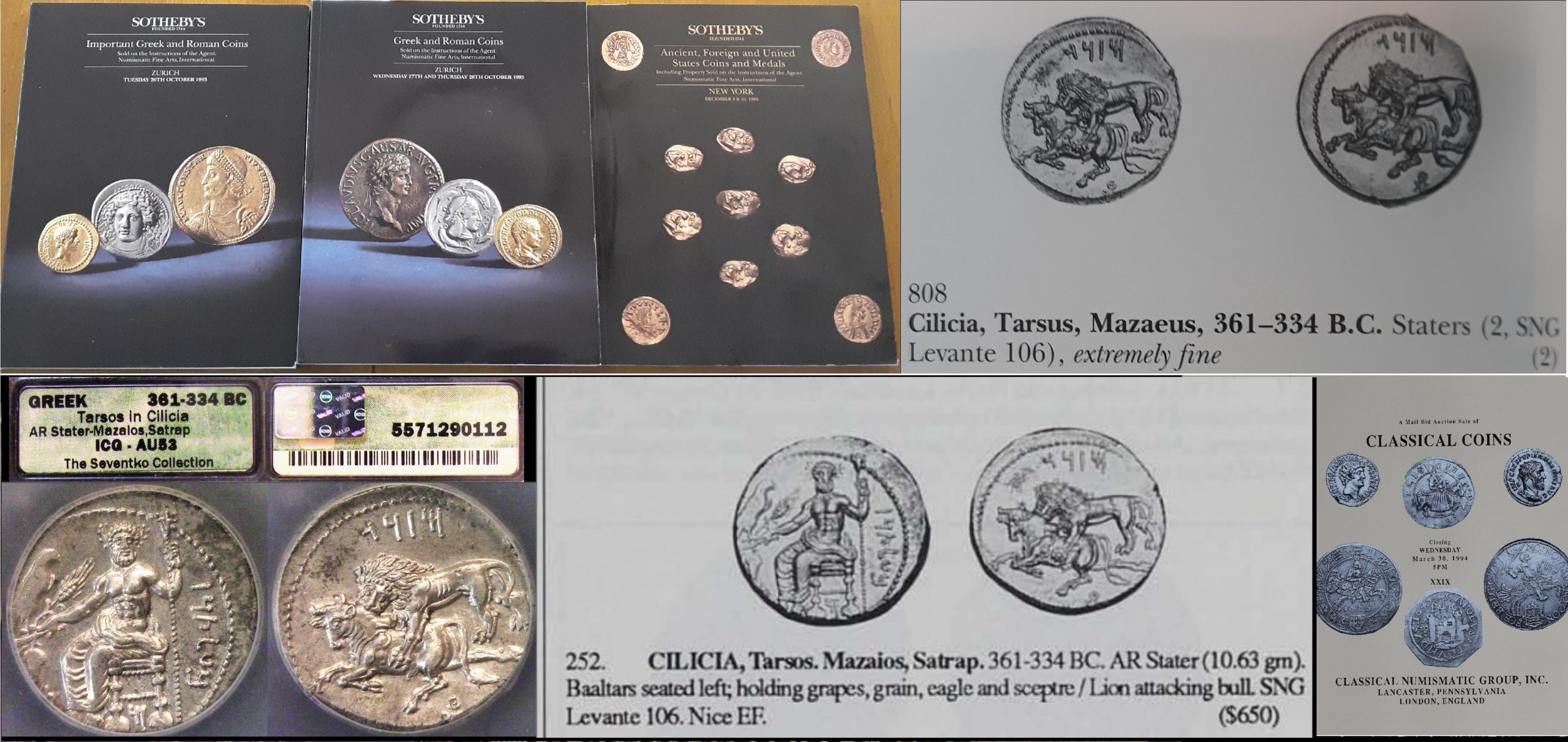
See also: Blog Post: “‘Provenance Diagrams’ for Ancient Coins.” This coin is notable for having been in an early famous ancient coin investment fund & having been one of the first ancient coins ever slabbed (provenance chart [1980-2020] for this coin).
![provenance chart [1980-2020]](http://conservatoricoins.com/wp-content/uploads/2022/08/Tarsos-Stater-Provenance-Chart-28-Dec-2021-draft-image.png)

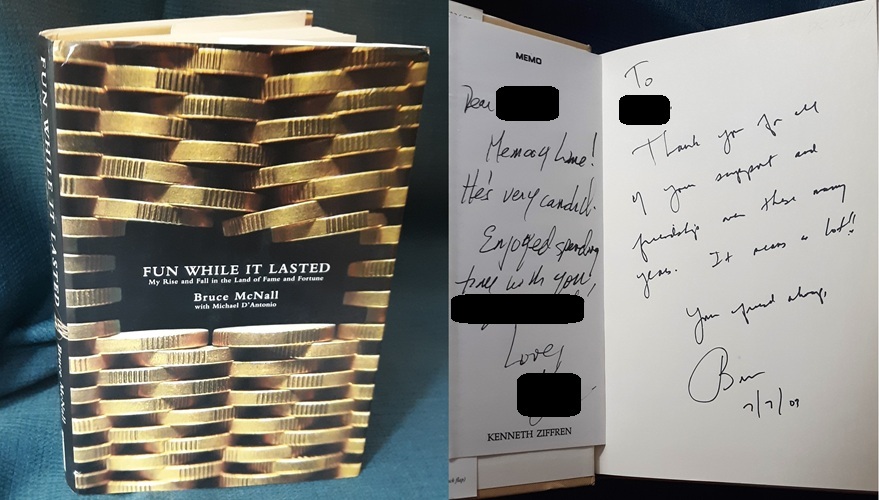
Bruce McNall, who ran Merrill-Lynch’s “Athena Fund” before it collapsed, was imprisoned for financial crimes. He wrote an excellent autobiography, which covers much of his career in the ancient coin world. Below is my autographed copy, which he inscribed to one of his lawyers (who in turn inscribed it to a family member)! (Names redacted below as they’re still public figures.)
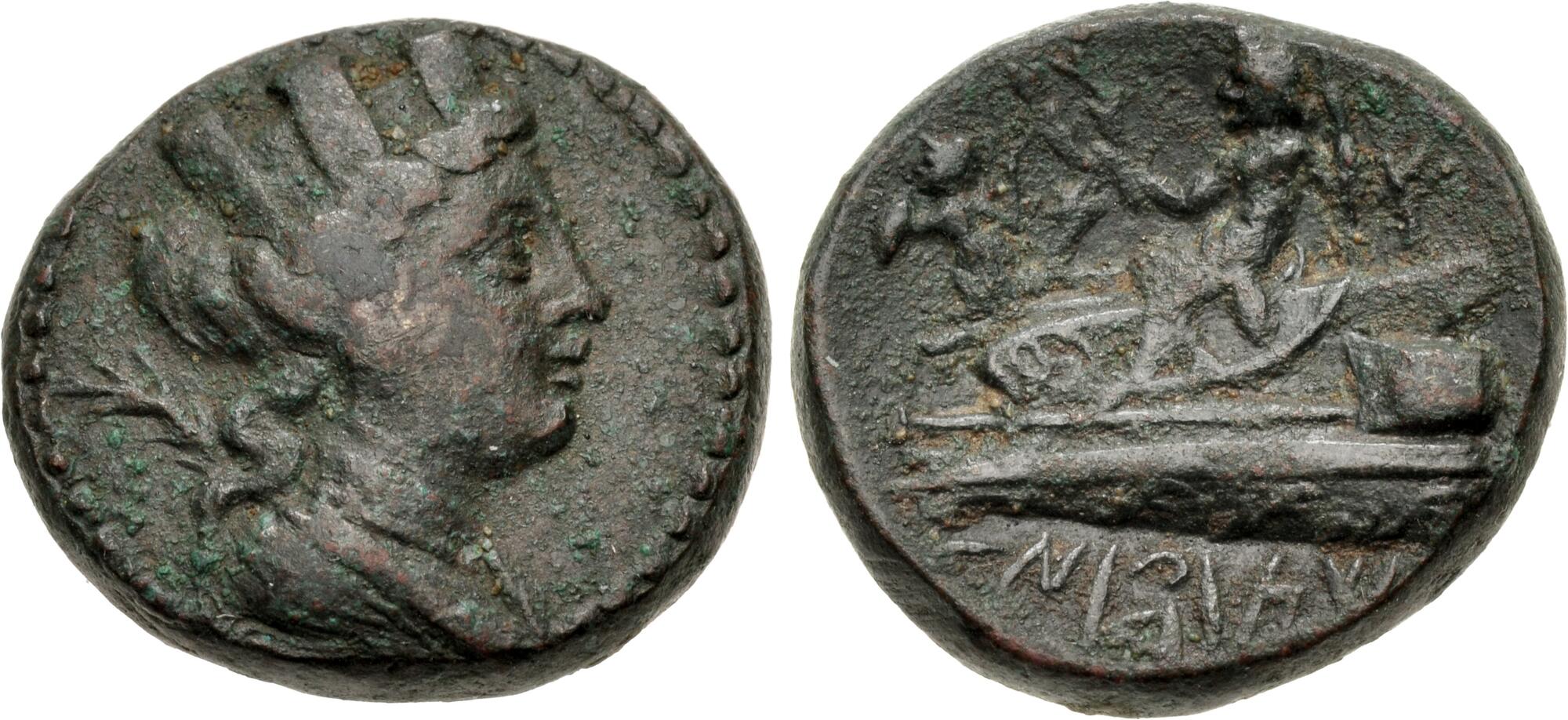
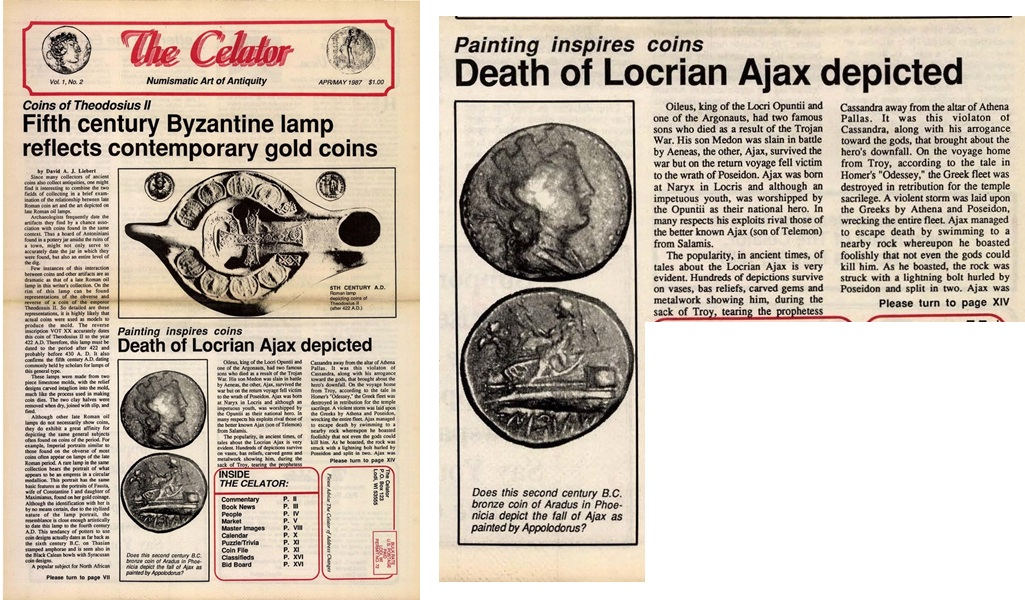
Phoenicia, Arados AE Dichalkon [?] (21mm, 8.45g, 12h), c. 129 BCE. Tyche / Poseidon with Athena on Prow.
(Photo credit: CNG.) Auction History:
– Ex Cederlind FPL 84 (Spring 1989), no. 65;
(published by Wayne G. Sayles, was it in his collection?);
– CNG EA 515 (4 May 2022), Lot 231;
– Naville Auction 81 (7 May 2023), Lot 205.
Publication:
-W.G. Sayles, “Death of Locrian Ajax depicted” in The Celator Vol. 1, No. 2 (April/May 1987), p. 1 (this coin illustrated on the cover below the fold).

CAPPADOCIA (Kings) [5+ Coins; top]:
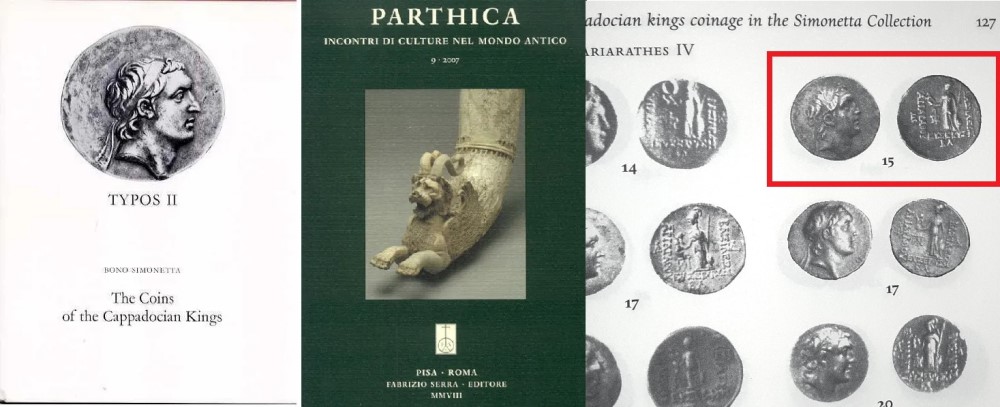
My collection includes 10 of the Cappadocian reference coins from the Simonetta collection. Seven were in Bono Simonetta‘s (1903-1987) collection, inherited by his son Alberto Mario Simonetta (1930-2021), who added the remaining three.
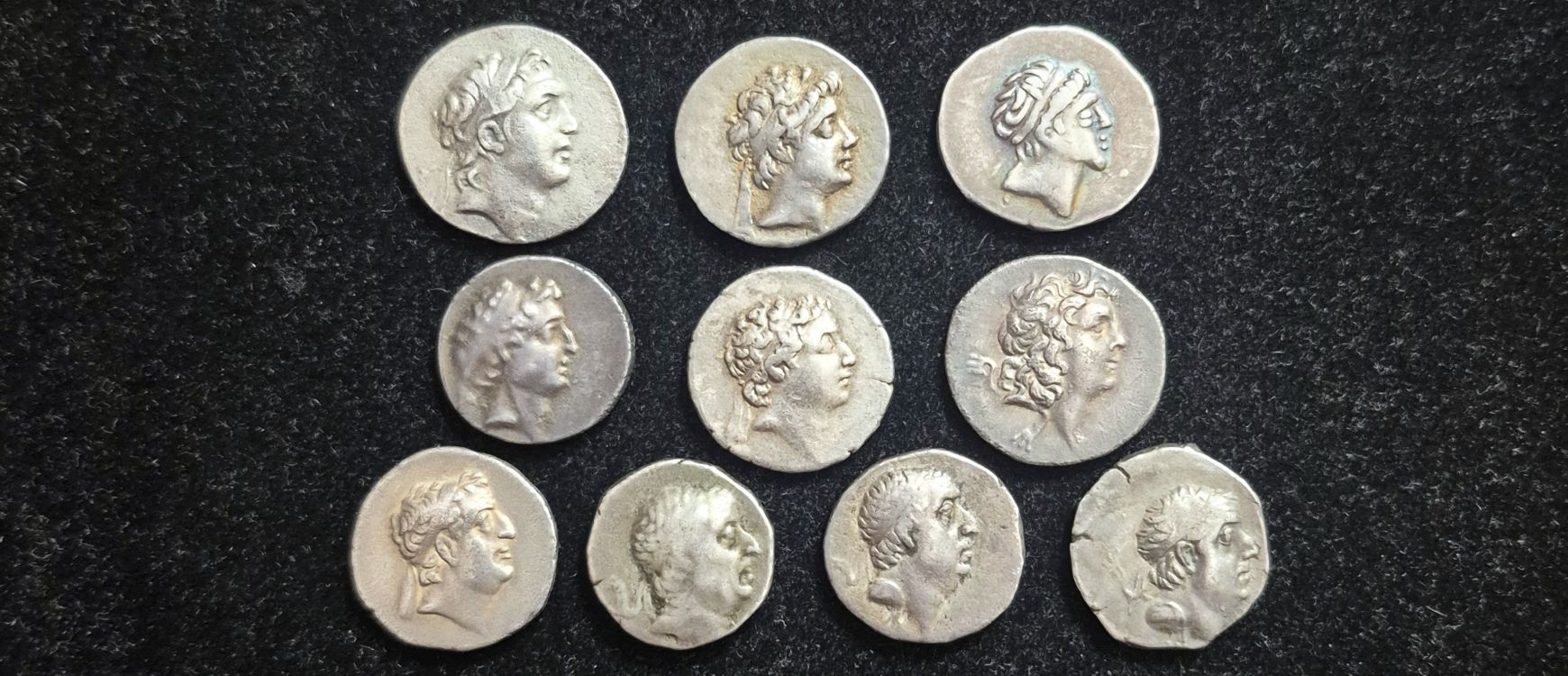
All are published at least once in AMS’s 2007 sylloge, but most appear repeatedly in BS’s 1977 book & many classic & controversial articles on Cappadocian coinage, c. 1950s-1970s. Importantly, they trace much of the long-running & infamous dispute with Otto Mokholm, who cited several of them in his replies. In her article on “The Silver Coinage of Ariarathes V,” Lorber summarizes much of the debate (RBN 2018: see pp. 255-258), citing the Ariarathes IX Drachm below (attributed to Ariarathes V by the Simonettas).
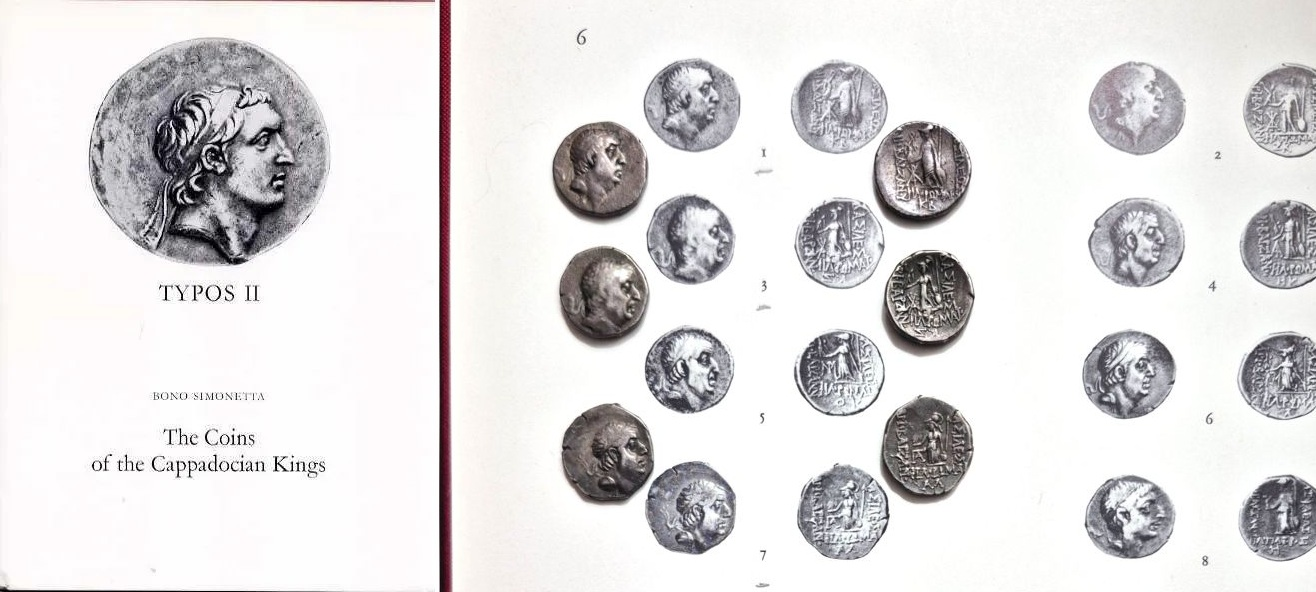
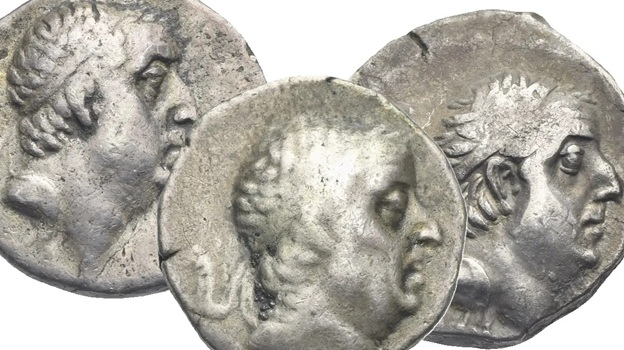
Above: Three Ariobarzanes Drachms illustrated on Plate 6 of Bono Simonetta’s 1977 book, The Coins of the Cappadocian Kings.
Appearing in the primary references, the Simonetta coins are often cited in the literature. Below, I’ve tried to note a few of the more interesting ones.
Cappadocia, Ariarathes V [Simonetta, Ar. IV] AR Drachm (3.82g, 19mm, 12h), Year 32 = 131/130 BCE. Ariarathes diademed / Athena.
(Photo credit: Bertolami.) Collection Hist.:
– B. Simonetta Collection [“bought from Rinaldi in 1942”];
– A. M. Simonetta Collection [Bertolami 109 (Munich, 4 May 2022), Lot 191].
Publication:
– Simonetta 1961 (NC), Ariarathes IV, No. 10., ex. 2 (this coin cited);
– Simonetta 1977 (Typos II), Ariarathes IV, p. 23, No. 11 (this coin cited);
– Morkholm 1979 (NC), Ariarathes V, p. 245 (this coin cited);
– Lorber et al. 2006 (NC), Ariarathes V, p. 56, note 41 (this coin cited);
– A. Simonetta 2007 (Parthica), Ariarathes IV, No. 15/1 (this coin illustrated);
– E. Cohen 2011 (Dated Coins of Antiquity), p 267, Type 454, ex. 5 (this coin cited).
See also: Morkholm 1964, 1969 NC articles, reassigning this type to Ar. V.
If B. Simonetta had this coin since 1942, it’s unclear why it’s not in his 1958 article (RIN, p. 15, 11).
Note: My copies of Simonetta 1977 & 2007 both ex-Bibliothek Alois Wenninger (w/ monogram).
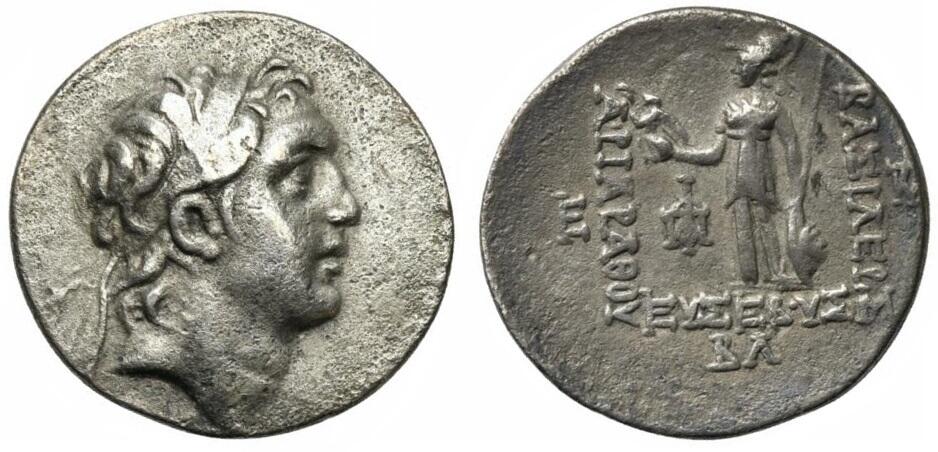
Cappadocia, Ariarathes IX [Simonetta, Ar. V] AR Drachm (4.13g, 18mm, 12h), 100/99 BCE. Ariarathes diademed / Athena.
(Photo credit: Bertolami.) Collection Hist.:
– Hans von Aulock (1906-1980) Collection, unpublished duplicate [gifted to B. Simonetta, n.d. (c. 1960s)];
– B. Simonetta Collection;
– A. M. Simonetta Collection [Bertolami 109 (Munich, 4 May 2022), Lot 206].
Publication:
– Simonetta 1970 (RIN), Pl. II, No. 3 (this coin illustrated);
– Simonetta 1977 (Typos II), Ariarathes V, p. 27, No. 8, pl. II, 14 (this coin illustrated);
– Morkholm 1979 (NC), Ariarathes IX, p. 245 (this coin cited);
– A. Simonetta 2007 (Parthica) Ariarathes V, No. 10/1 (this coin illustrated);
– Lorber et al. 2006 (NC), p. 50, note 7 (this coin cited: “Simonetta, CCK, p. 27, no. 8 (with the controls ⧊ — K) is the first coin in his arrangement to exhibit control linkage to the tetradrachms of Seleucid type”);
– Lorber 2018 (RBN), p. 256, note 11 (this coin cited; see also Cappadocia Note above, re: Morkholm v Simonetta).
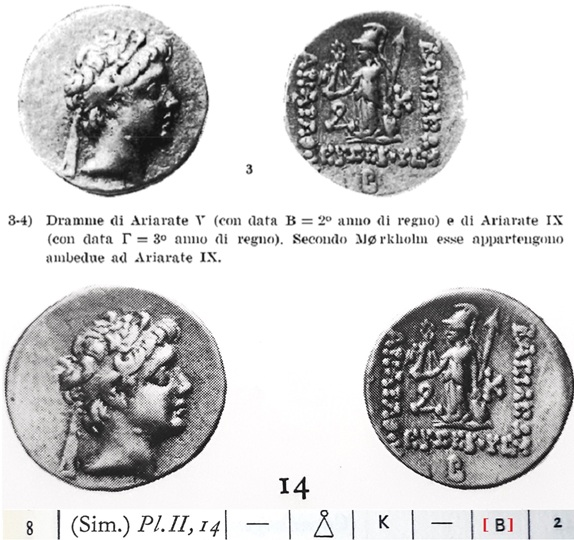
Prov. Notes: Not illustrated in SNG, but same type as SNG von Aulock 6302 = Morkholm (1968) a2-p6, pl. 32.
See also: Morkholm 1968 (Essays Robinson); see Note, von Aulock (Capp.).
Note: My copies of Simonetta 1977 & 2007 both ex-Bibliothek Alois Wenninger (w/ monogram).

Cappadocia, Ariarathes V [Morkholm, Barb. Imit.] AR Drachm (19mm, 3.70g, 12h), c. 160 BCE (?). Ariarathes diademed / Athena.
(Photo credit: Bertolami.) Collection Hist.:
– B. Simonetta Collection [acq. by 1958];
– A. M. Simonetta Collection [Bertolami 119 (Online, 10 Jul 2022), Lot 7].
Publication:
– Simonetta 1958 (RIN), p.17, Ariarathes V, No. 12, ex. 3 (this coin cited);
– Simonetta 1961 (NC), p. 33, Ariarathes V, No. 14b, ex. 3 (this coin cited);
– Simonetta 1974 (RIN [PDF issue]), Pl. III, “Dramma barbarica … di Ariarathes V,” No. 10 (this coin illustrated);
– Simonetta 1977 (Typos II), Ariarathes V (“very barbarous style”), p. 27, No. 15b, pl. III, 4 (this coin illustrated);
– A. Simonetta 2007 (Parthica) Ar. VIII?, 3a-b/1, Pl. XV. 3a (this coin illustrated).
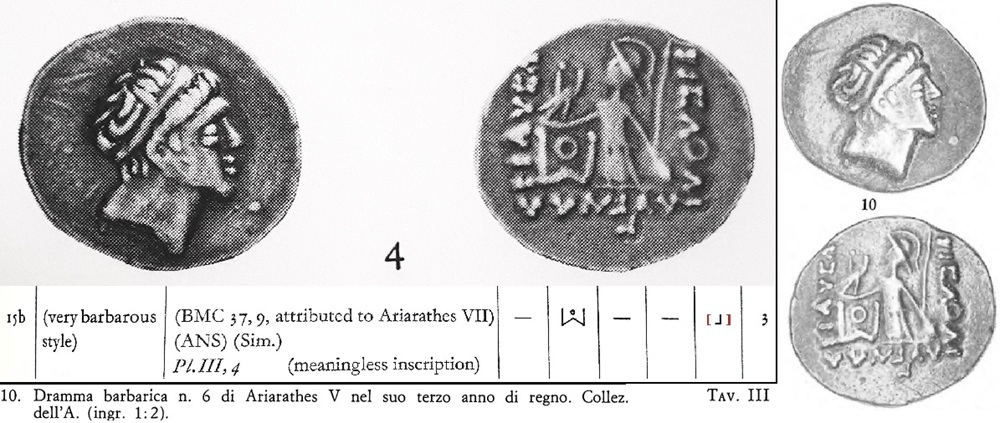
See also: Morkholm 1968 (p. 250) & 1969 (p. 30), both as “Barbarian Imitation,” and Simonetta 1967 (reaffirming Ar. V during the revolt of Orophernes, 161-159 BCE).
Note: My copies of Simonetta 1977 & 2007 both ex-Bibliothek Alois Wenninger (w/ monogram).

Cappadocia, Ariarathes VII AR Drachm (3.93g, 16mm, 12h), dated RY 1 = 116/5 BCE (?). Ariarathes / Athena.
(Photo credit: Bertolami.) Collection Hist.:
– B. Simonetta Collection [acq. in Basel, 1950];
– A. M. Simonetta Collection [Bertolami 119 (Online, 10 Jul 2022), Lot 10].
Publication:
– Simonetta 1961 (NC), Ariarathes VII, No. 1, ex. 2, Pl. III, 26 (this coin illustrated);
– Simonetta 1977 (Typos II), Ariarathes VII, p. 35, n. 1, pl. IV, 11 (this coin illustrated);
– Morkholm 1978 (SNR), Ariarathes VII, p. 145, Ar VII, Mint A, No. 2 (this coin cited; see also GreekCoinage.org/IRIS/ for type);
– Toynbee 1978 (Portraits), p. 127, n. 1 (this coin cited after NC 1961, pl. 3, 26);
– Lorber et al. 2006 (NC), Ariarathes VII, p. 56, note 43 (this coin cited);
– A. Simonetta 2007 (Parthica) Ariarathes VII, No. 4/1 (this coin illustrated);
– E. Cohen 2011 (Dated Coins of Antiquity), p 268, Type 456, ex. 1 (this coin cited);
– Krengel 2011 (SNR), page 56: Ariarathes VII Drachm, Series 5, No. 2 (this coin cited).
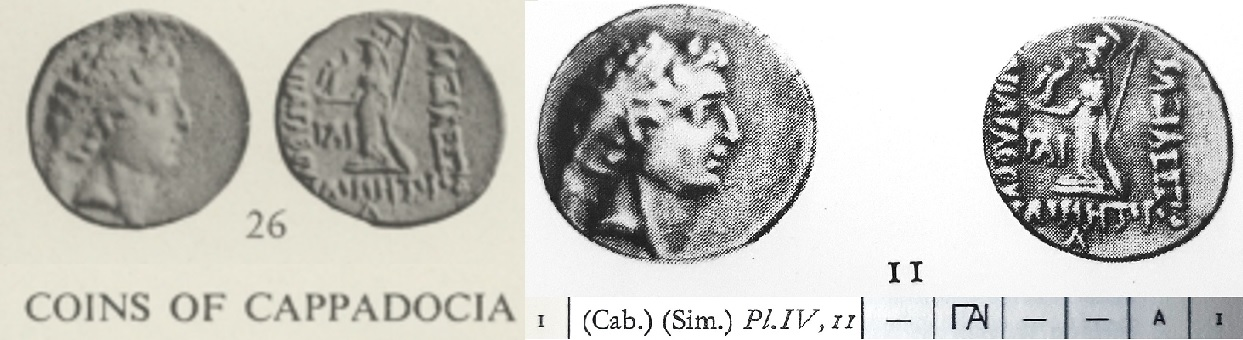
See also: Morkholm 1969 (NC), p. 31 (confirming Ariarathes VII).
Note: My copies of Simonetta 1977 & 2007 both ex-Bibliothek Alois Wenninger (w/ monogram).

Jewish Coinage (Levant, Samaria, Judaea) [3 Coins; top]:
Samaria, “Middle Levantine” AR Obol / Ma’eh (0.57g, 8mm, 12h), 4th BCE. Male Head / Female Head.
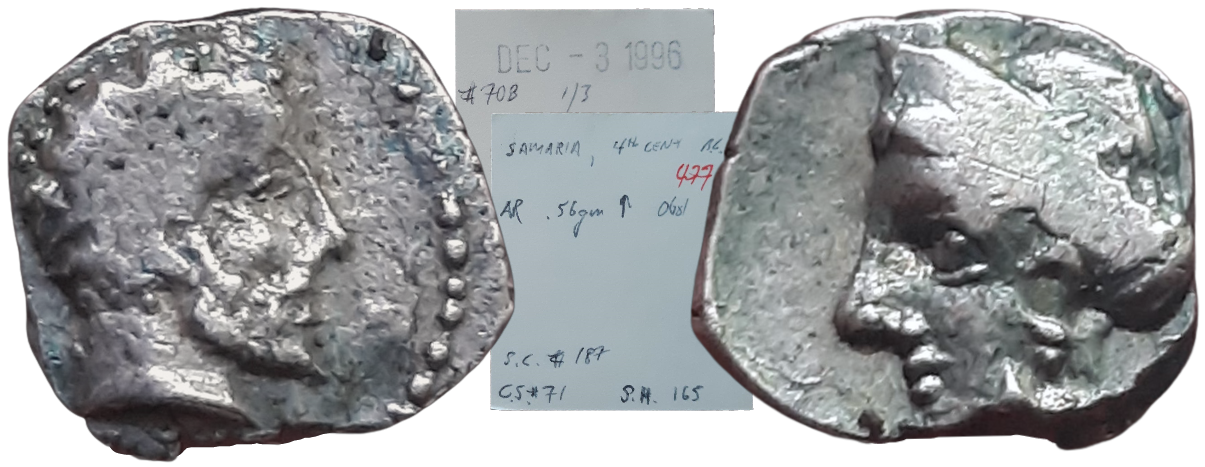
(Photo: CJJ) Collection Hist.:
– Samaria Hoard (before 1990 [possibly 1968], CH 8.587 = CH 9.413), No. 165;
– Athena Fund (Merrill Lynch, Bruce McNall), Part II [Sotheby’s & NFA (Zurich, 27 Oct 1993), Lot 972];
– Jay M. Galst (1950-2020) [Stack’s (3 Dec 1996), Lot 708 (part); CNG Triton XXV (Online, 11 Jan 2022), Lot 6169].
Selected Publication History:
– Samaria Hoard 165 (this coin illustrated) = Meshorer & Qedar (1991) 71, in The Coinage of Samaria in the Fourth Century BCE (Jerusalem: NFA Intl.);
– Meshorer & Qedar (1999) 187 (this coin cited) in Samarian Coinage (Jerusalem: INS);
– Wyssmann, MQ 187.i (this coin cited) in Vielfältig Geprägt (Leuven: Peeters);
– Elayi & Elayi, pp. 223 (this coin cited) in Trésors de monnaies phéniciennes et circulation monétaire (Ve−IVe siècle avant J.-C.) (1993).
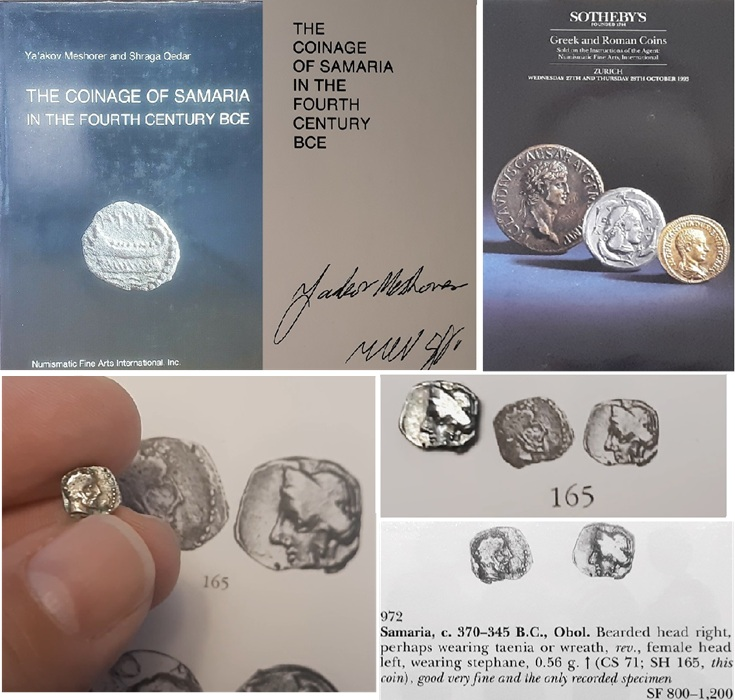
See also:
– LCO 29 (this coin cited as “Reference: Samaria Hoard 165,” corr. link), in ANS (2025) Levantine Coins Online, after Gitler et al. (forthcoming) A Corpus of Samarian Coinage;
– Ariel (2016) p. 18 & Table 2: 28-3, in “Circulation of Locally Minted Persian-Period Coins in the Southern Levant,” Notae Numismaticae 11 (this coin cited en bloc);
– CH IX, 413 & CH VIII, 587 (brief hoard reports).
Notes: The first known when published in 1991, one other was known by 1994 & 1999, between 2010 & 2019 the number of known specimens rose to at least 11.
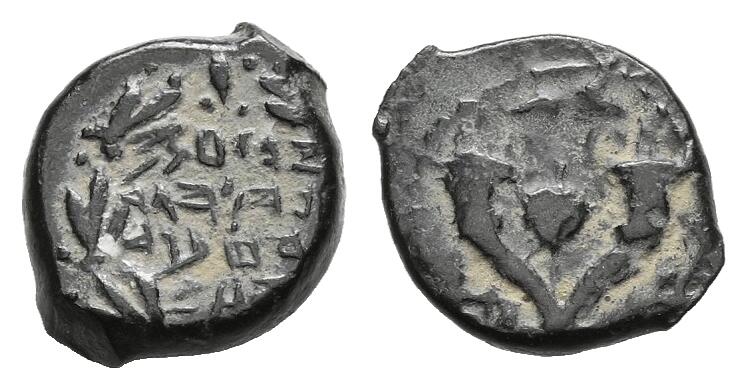
Judaea, John Hyrcanus AE Prutah (2.32g, 16mm, 12h), 135-104 BCE. Legend in Wreath / Cornucopiae & Pomegranate.
(Photo credit: Künker.) Collection Hist.:
– Josef Samel (1913 – 2005) & Angela Arluk (1920 – 2015, née Samel) [Künker 334 (17 Mar 2020), Lot 2018, cataloged by Johannes Nollé].
Exhibition:
– Staatliche Munzsammlung Munich (with The Israel Museum Jerusalem, Israel Antiquities Authority), “Das Heligeland: Antike Münzen und Siegel aus einem Jahrtausend Jüdischer Geschichte,” curated by Ya‘akov Meshorer & Bernhard Overbeck (30 Nov 1993 – 4 Apr 1994).
Publication:
– Overbeck-Meshorer 58 (this coin illustrated) in Das Heligeland (1993, Munich: SMM).
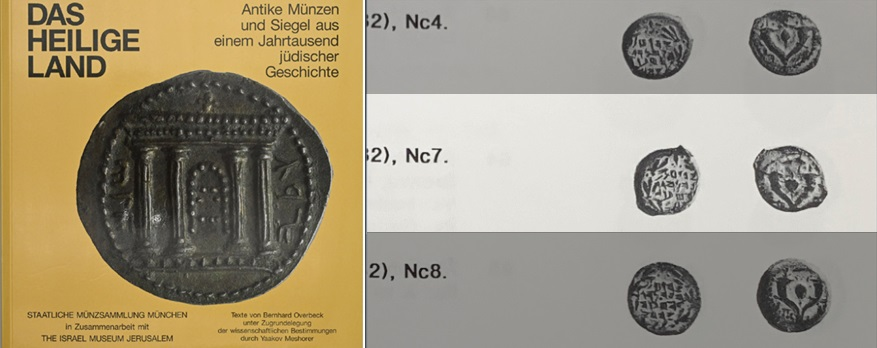
Note: My copy of Overbeck-Meshorer ex Jay Galst Library.

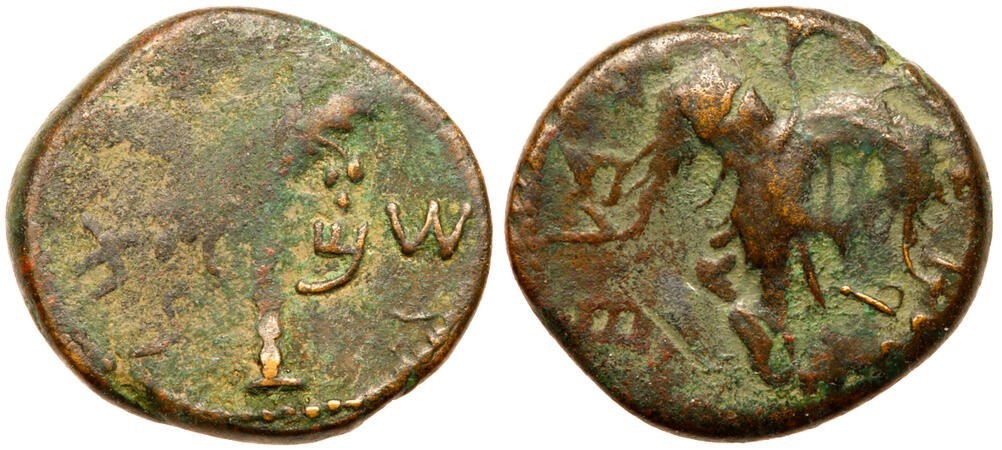
Judaea, Bar Kochba Rebellion AE Middle Bronze (25mm, 9.88 g, 6h), 133/4 CE. Palm / Grape Vine [Overstruck on Agrippa II – Titus].
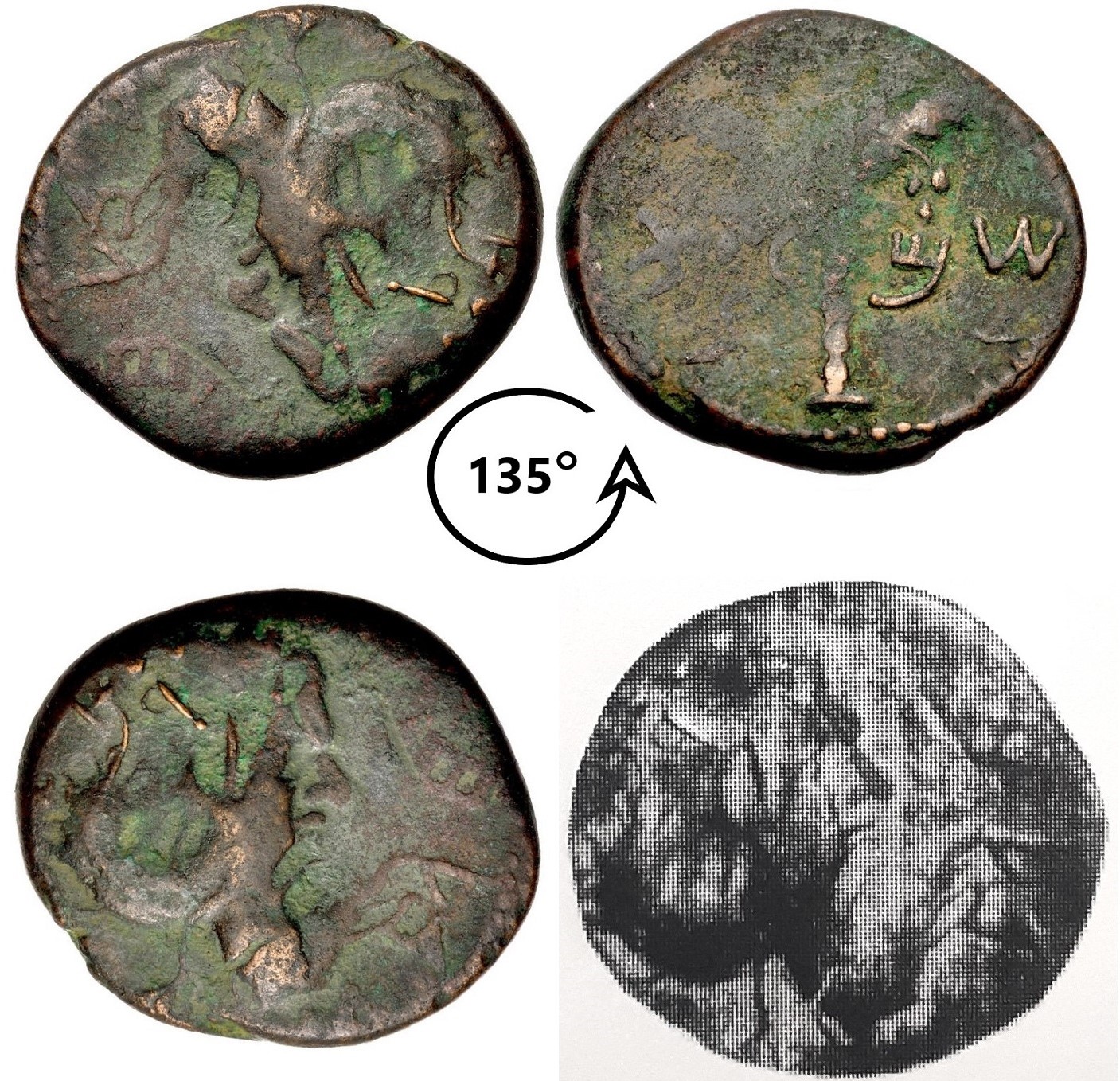
(Photo credit: CNG & NYS.) Collection Hist.:
– David Hendin Collection, w/ his hand-written round collector tag;
– (prob.) Goldberg Sale 21 (15-17 2003, Pre-Long Beach Auction), Lot 1607;
– also: NY Sale 48 (14 Jan 2020), Lot 90; Goldberg 116 (2 Jun 2020), Lot 894; CNG e-486 (24 Feb 2021), Lot 245; NY Sale 54 (11 Jan 2022), Lot 105; CNG e-538 (10 May 2023), Lot 244.
Publication:
– GBC 160a (this coin illustrated) in: David Hendin (1987), Guide to Biblical Coins, 2nd ed.;
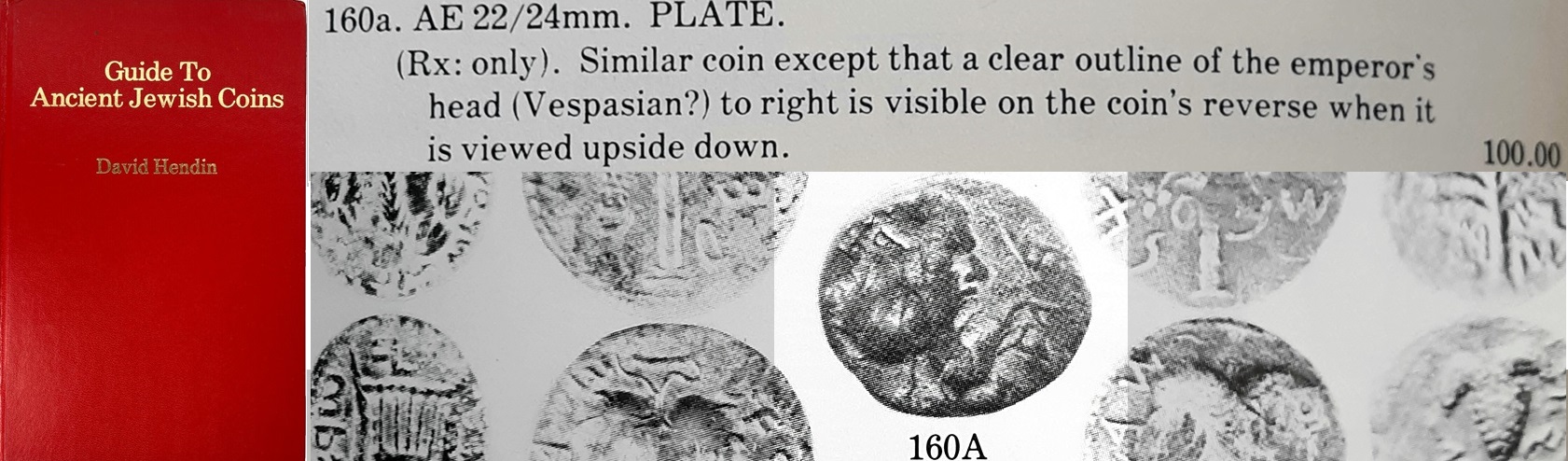
– AJC160a (this coin illustrated) in: David Hendin (1976), Guide to Ancient Jewish Coins.

Notes: A fascinating overstrike with visible Flavian bust, probably a “Judaea Capta” issue of Agrippa II struck in Caesarea Paneas, 75/6 CE. In my opinion, the undertype is RPC II 2285 and the bust of Titus is a die match to example 7 (ex Galst).
Specimen not cited in Mildenberg’s corpus; is it cited in Kaufman’s (2002) “Additions to the Corpus of Leo Mildenberg’s Coinage of the Bar Kokhba War”?
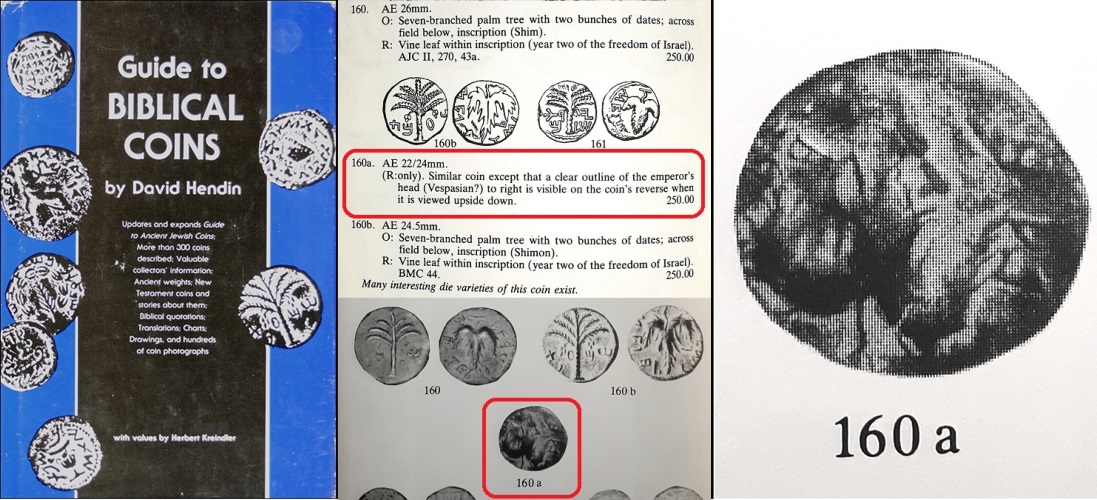
Note: Two copies of GBC (1987), first signed by Hendin, second ex Ray Dobbins (1947-2021, AKA Jim Flannigan); AJC (1976) below ex-ANS Library.
PERSIA (Achaemenid, Parthia, Persis, Saka) [6 Coins; top]:
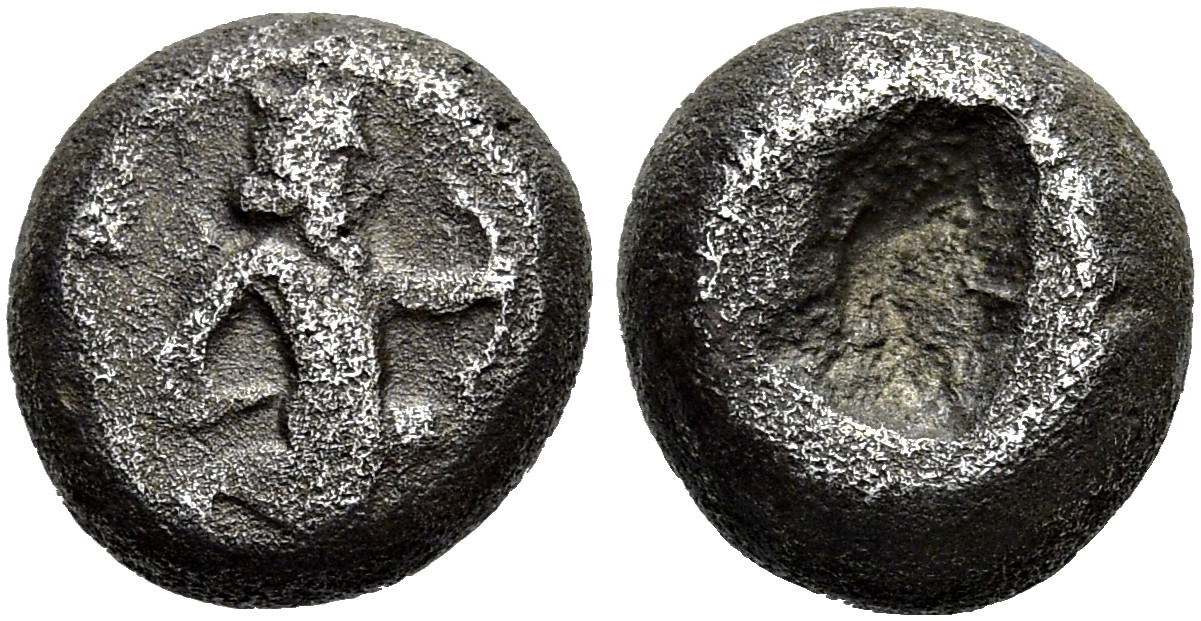
Persia, Achaemenid Empire AR 1/4 Siglos (1.26g, 8mm), Sardes, 4th cent. BCE. Great King, Bow & Dagger / Incuse Punch.
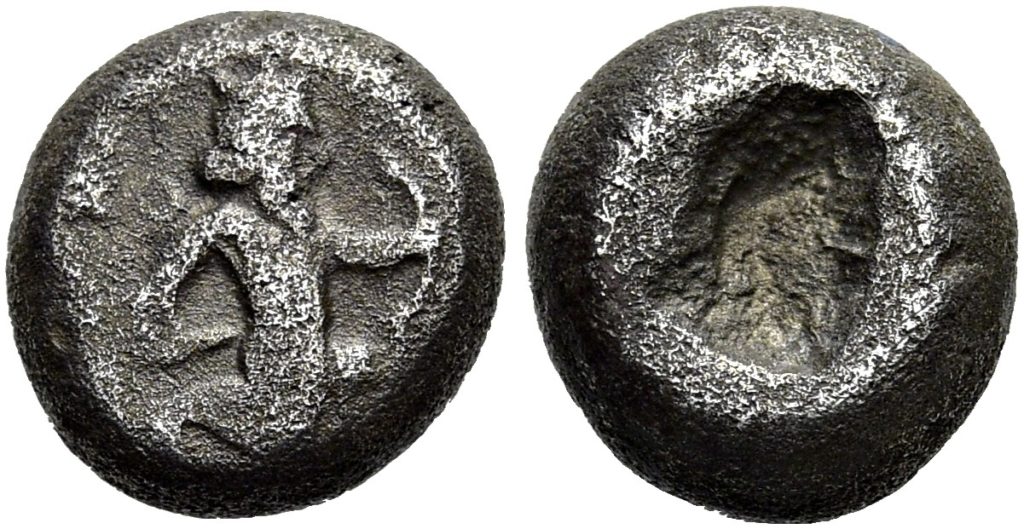
(Photo credit: Gorny & Mosch.) Collection Hist.:
– Sammlung Dieter Klein (1931- [?]) [prob. Hauck & Aufhäuser 18 (Munich, 6 Oct 2004)];
– Sammlung Gert Cleff, Part I [Münz Zentrum 174 (Solingen, 3 Sep 2015), Lot 184; Gorny & Mosch 288 (Online, 27 Jul 2022) Lot 42].
Publication:
– Klein 764 (this coin illustrated) in Sammlung von Griechischen Kleinsilbermünzen und Bronzen, Nomismata 3 (1999, Berlin/Milan: Ennerre).
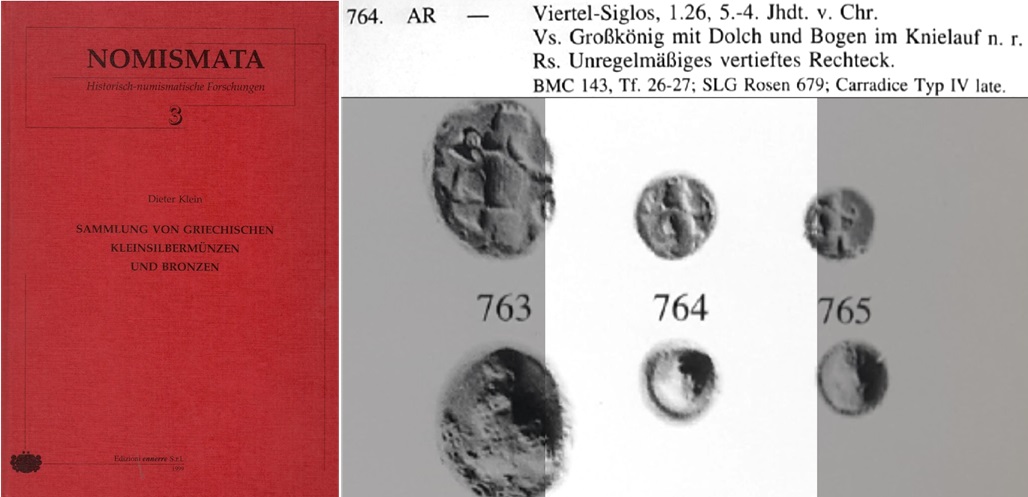
Note: My copy of Klein ex-Bibliothek Alois Wenninger 6061, part (unmarked duplicate).
See Also: Corfu (2010, AMIT 42) p. 166, note 15 (this coin cited en bloc); Corfu (2012, QT 41) p. 48, Table 3, No. 80 & p. 52, note 23 (this coin cited); B. Nelson, ed. (2011) Numismatic Art of Persia: The Sunrise Collection (this coin cited).
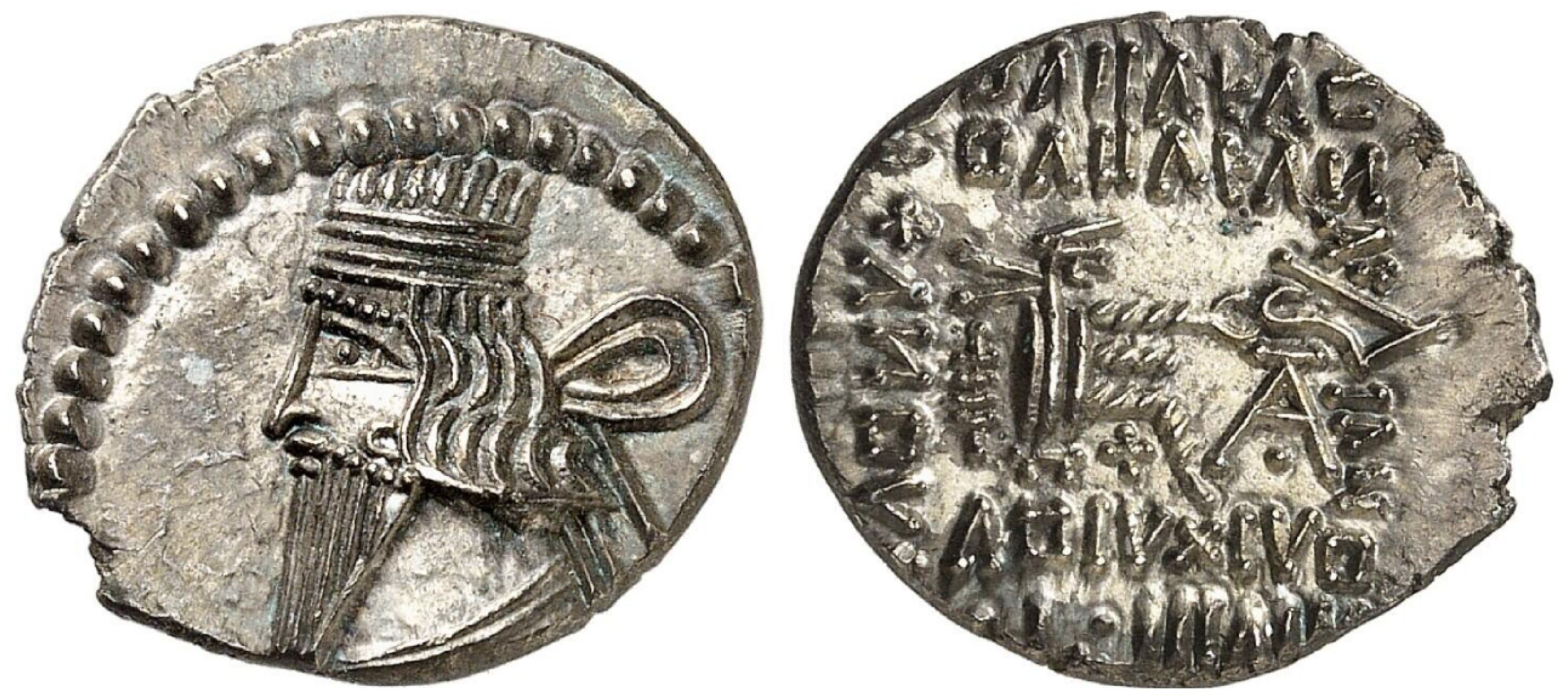
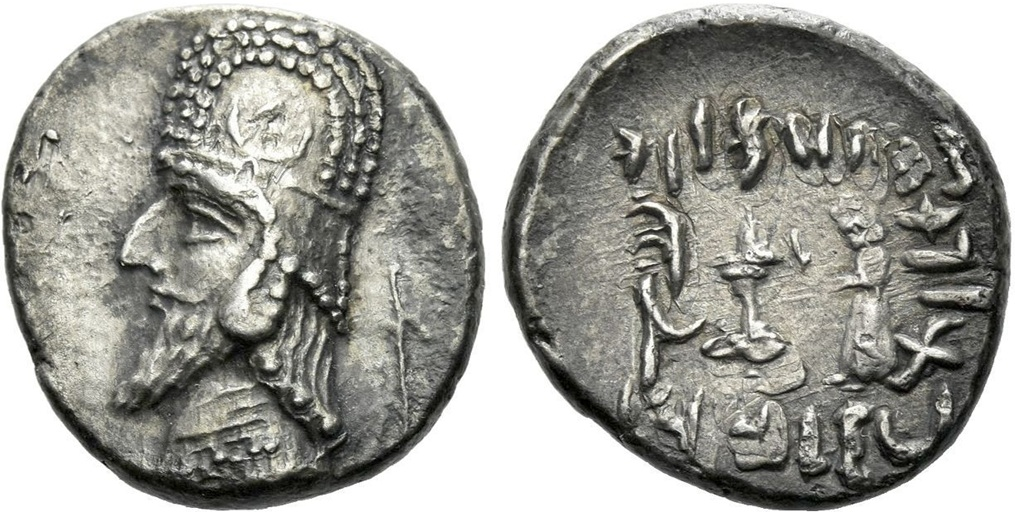
Parthia, Pakoros AR Drachm (3.59g, 21mm, 12h), Ekbatana, c. 78 – 120 CE. Diademed Bust / Archer Seated.
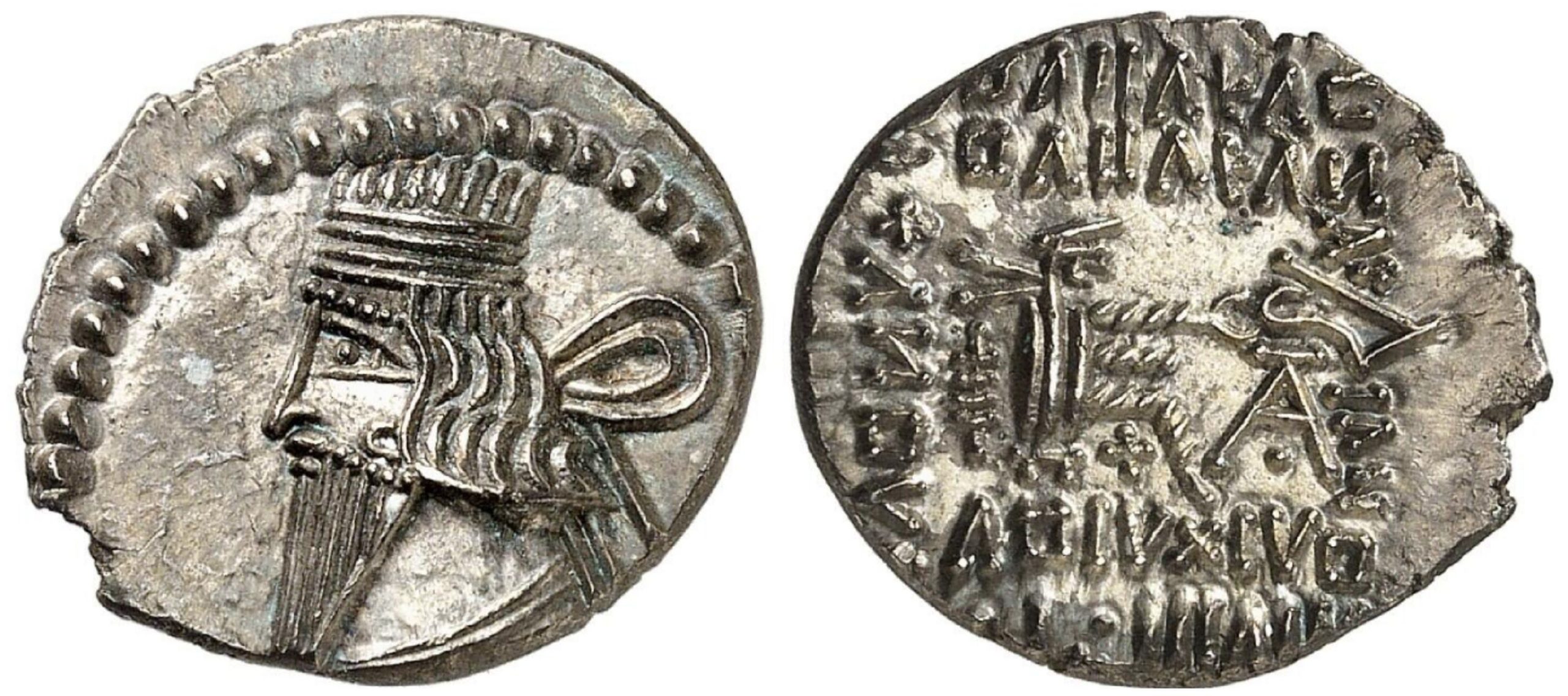
(Photo credit: Künker.) Collection Hist.:
– Slg. Dieter Klein (1931- [?]);
– Slg. Dr W.R. “Roma Universa,” Part V (Greek IV) [acq. Hauck & Aufhäuser, Dec 2004; Künker Auktion 341 (1 Oct 2020), Lot 5229].
Publication:
– Klein 769 (this coin illustrated) in Sammlung von Griechischen Kleinsilbermünzen und Bronzen, Nomismata 3 (1999, Berlin/Milan: Ennerre).
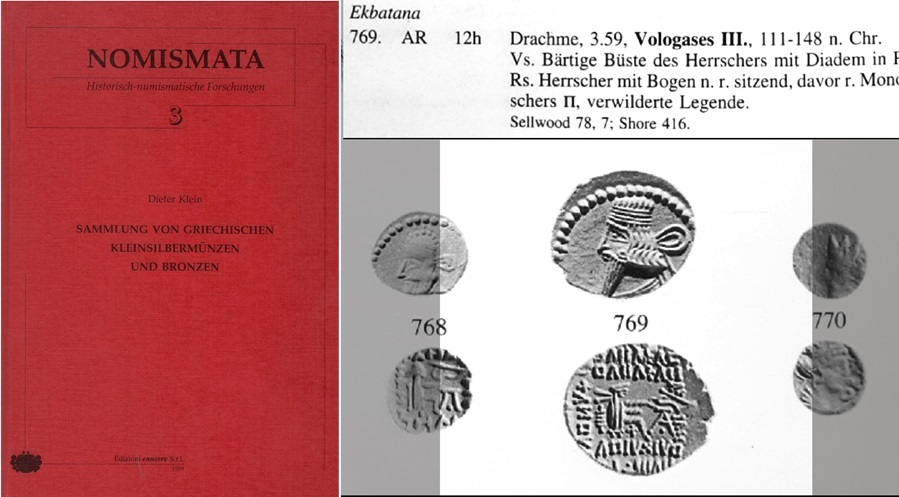
Note: My copy of ex-Bibliothek Alois Wenninger 6061, part (unmarked duplicate).

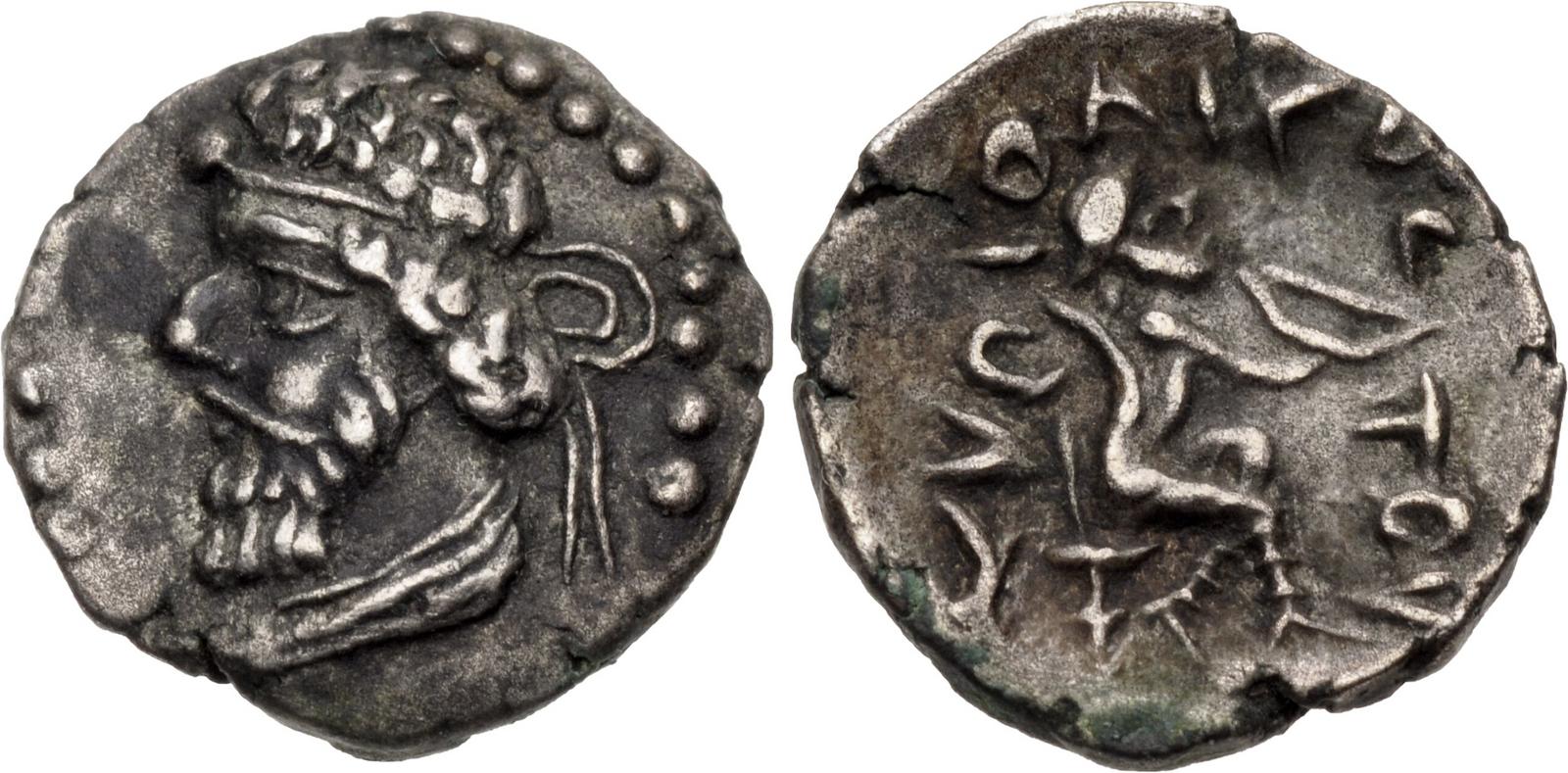
Parthia, Vologases I (?) AR Diobol (1.21g, 13.5mm, 12h), uncertain Persis mint, c. 58-77 CE (?). Diademed Bust / Archer Seated.
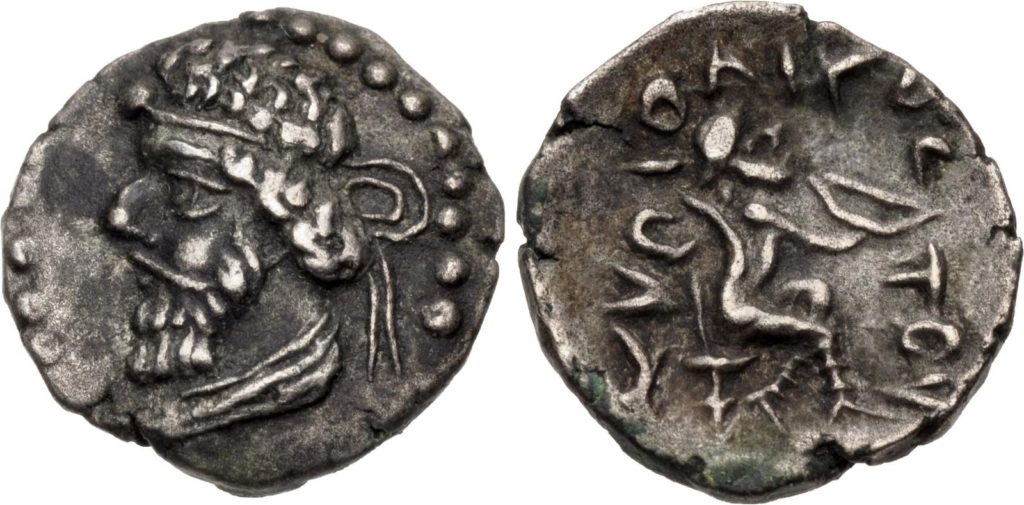
(Photo credit: CNG.) Collection Hist.:
– (presumably) Ex Shiraz, Fars Hoard (1981);
– David Sellwood (1925-2012) Collection (Part 4), Tray 22, No. 1935 [Baldwin’s 100 (27 Sep 2016), lot 429 (part of)];
– Robert Langnas Collection [acq. Musa Numismatic Art (Glen Lindwall, Berkely, CA), Apr 2017; CNG EA 510 (23 Feb 2022), Lot 365].
Publication:
– Langnas 21 (this coin illustrated) in “An Introduction to Parthian Silver Fractions, The Little Anomalies of Arsacid Coinage,” KOINON I (2018). (My copy ex BCD Library.)

See Also: PDC 23257 (this coin illustrated), Parthia.com, Sellwood Coll. Page 1, photographed & cataloged by Chris Hopkins;
incl. in many online discussions from which the Koinon article evolved (FAC [2017], CC [2017], CT [2017]).

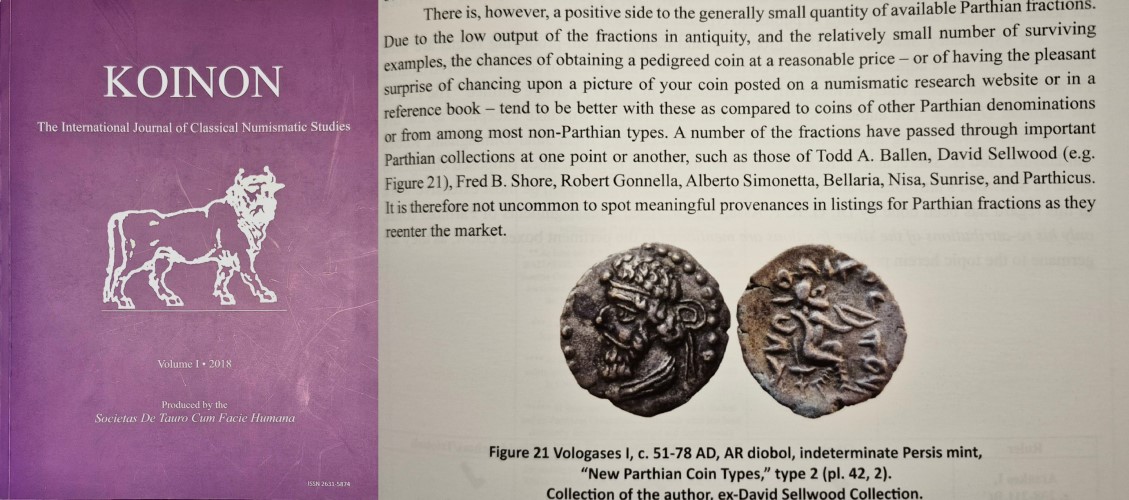
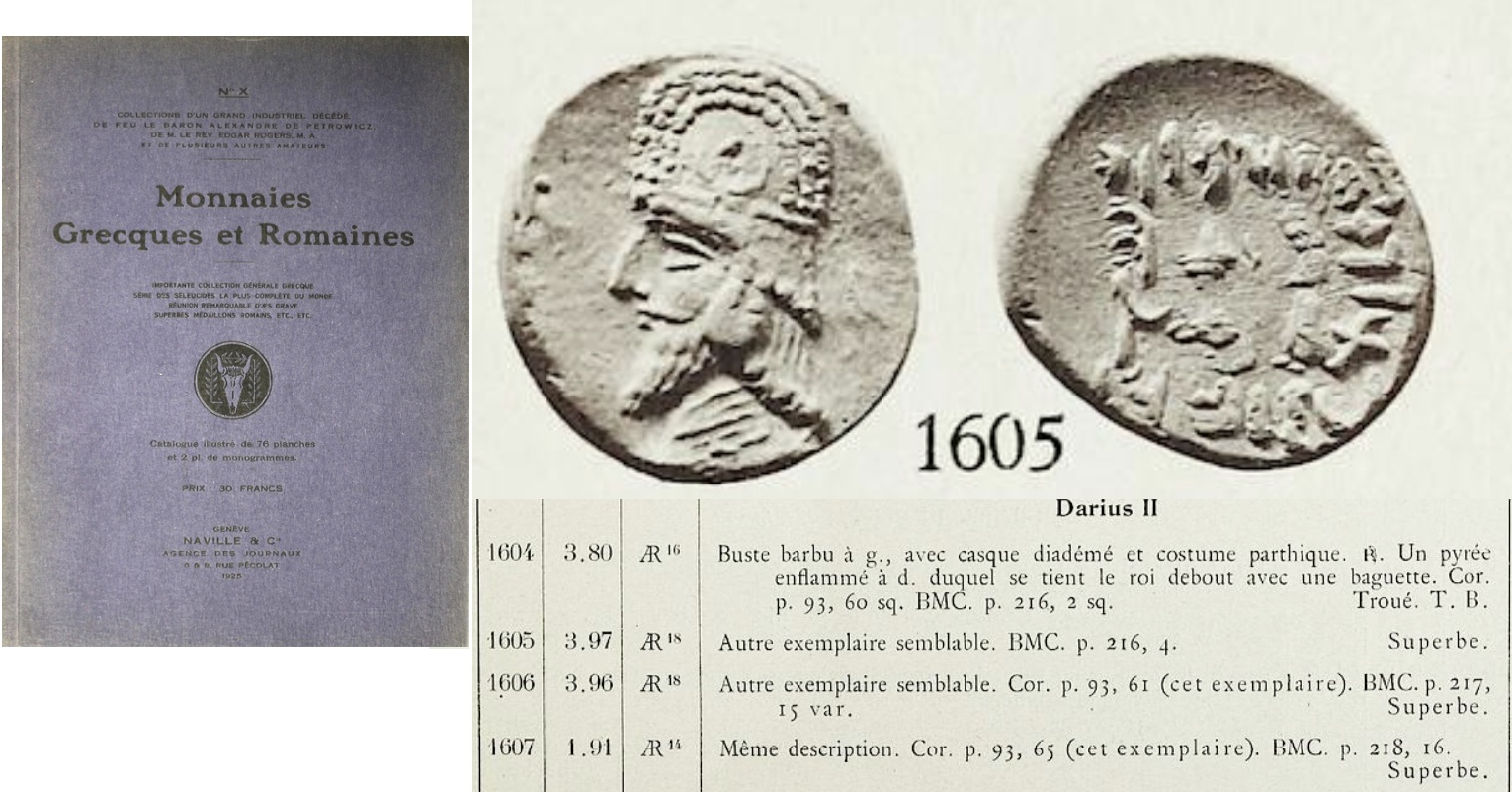
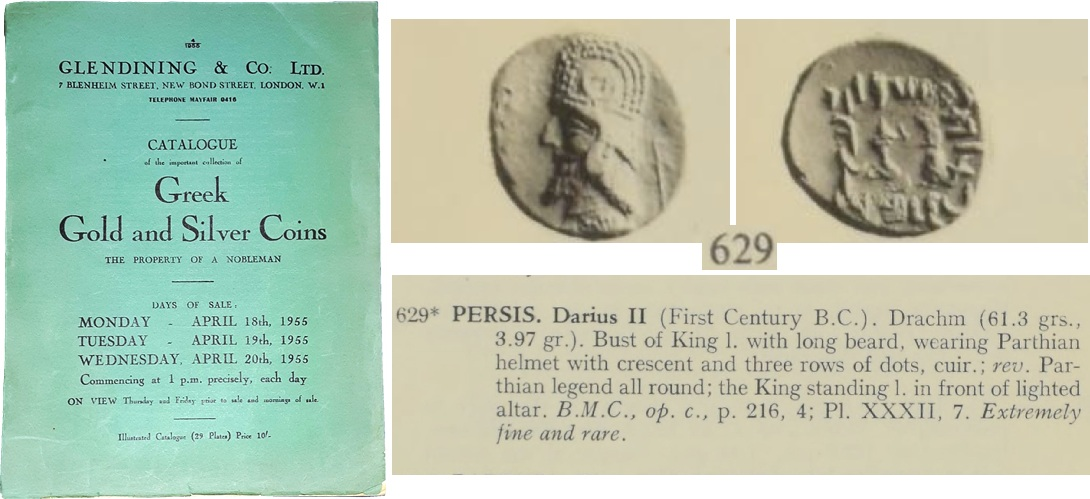
Persis, Darios II [Darayan / Darev] AR Drachm (18mm, 3.97g), Istakhr (Persepolis), 1st BCE. Diademed bust / King sacrificing before altar.
(Photo credit: Naville) Collection Hist.:
– Baron Alexandre de Petrowicz (1857-1925 [?]) [Ars Classica X (15 Jun 1925), 1605];
– Count Georg de Laval (Stockholm, 1883-1970) [Glendining, “The Property of a Nobleman” (18 Apr 1955), Lot 629];
– “Collection of a Mentor” (George Muller) [Naville 99 (7 Dec 2025), 316].
Note: See also my copy of “Property of a Nobleman” (Laval) on Catalog Collection Favorites page, w/ handwritten note from George Muller (“Mentor” Collection).
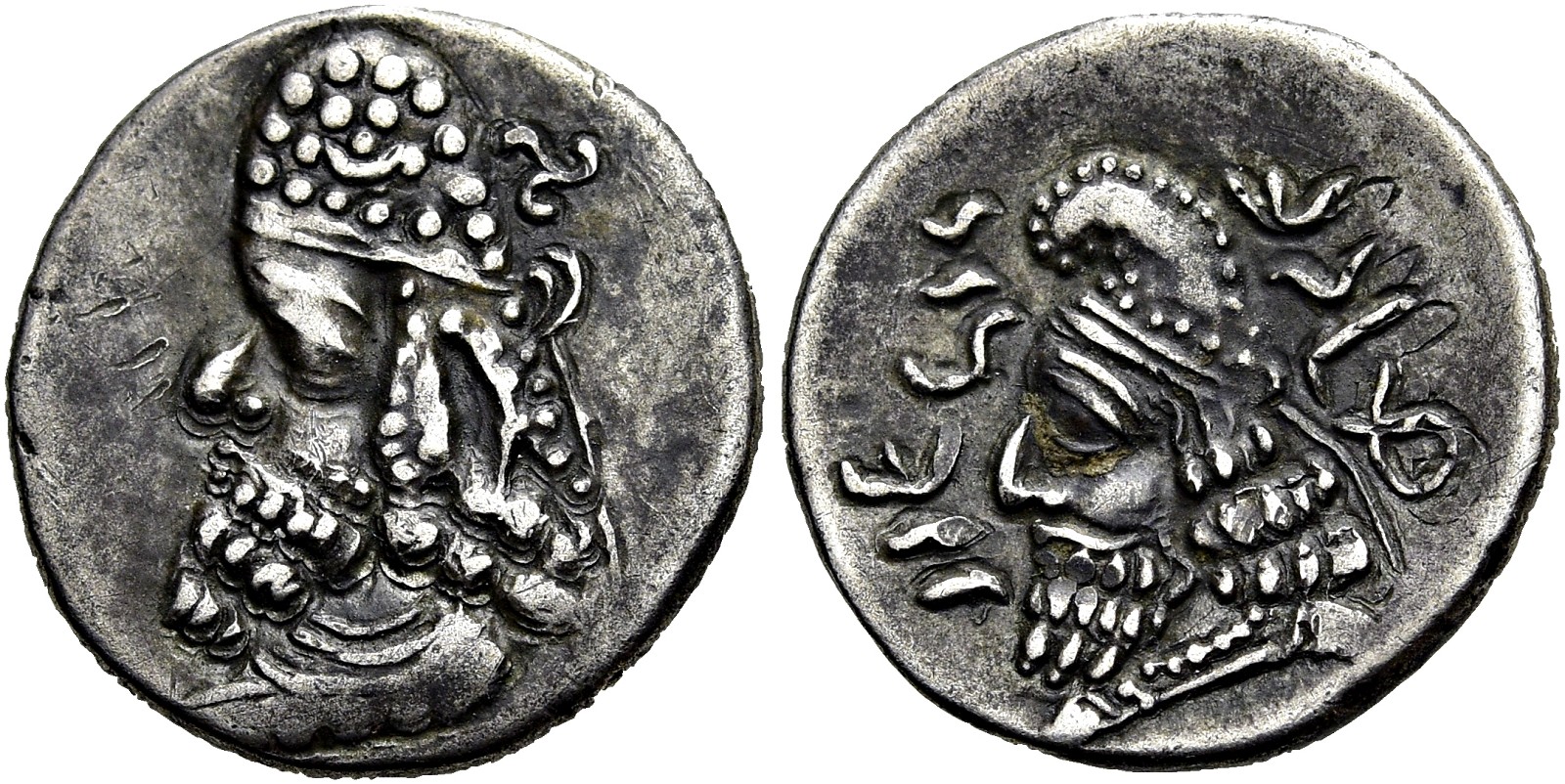
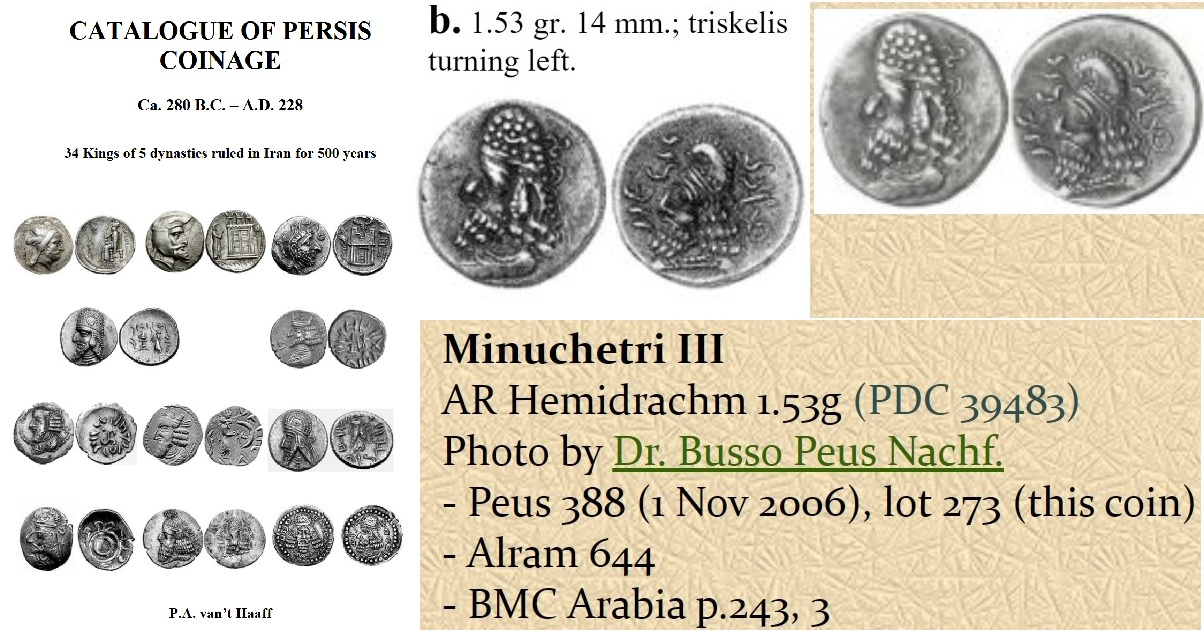
Persis, Manchihr III [Mančihr / Minuchetri] AR Hemidrachm (15mm, 1.53g), Persepolis, 2nd CE. Diademed Bust & Triskeles / Diademed Bust.
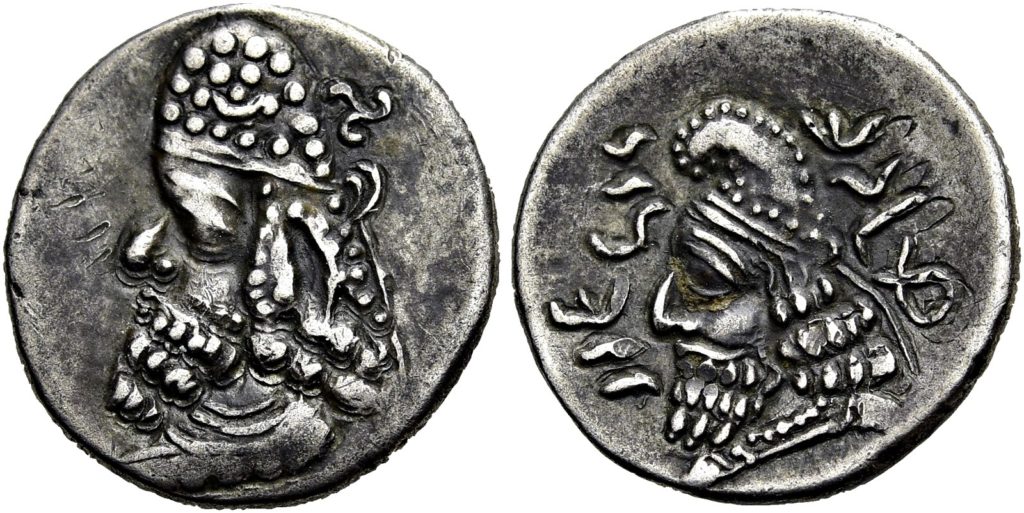
(Photo credit: Gorny & Mosch) Collection Hist.:
– Slg. Robert Gonnella (1935-2009) [Peus 388, 273];
– Slg. Peter Robert Franke (1926-2018) [Peus 393, Lot 320; Grün 64, 1536];
– Slg. Gert Cleff, Part I [Gorny & Mosch 288 (Online, 27 Jul 2022) Lot 69].
Publication:
– van’t Haaff 644b (this coin illustrated on p. 196) in Catalogue of Persis Coinage (2010/2020, Lancaster, PA: CNG).
See Also: Illustrated twice on PDC (PDC 47121 = Peus 393, Lot 320 & PDC 39483 = Peus 388 [Gonnella], 273).
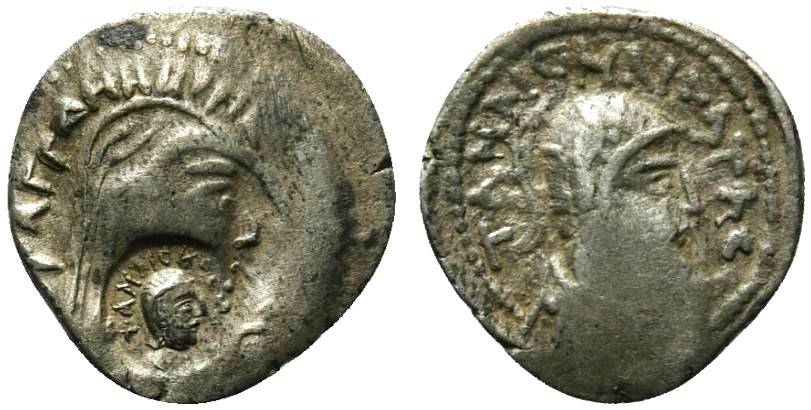
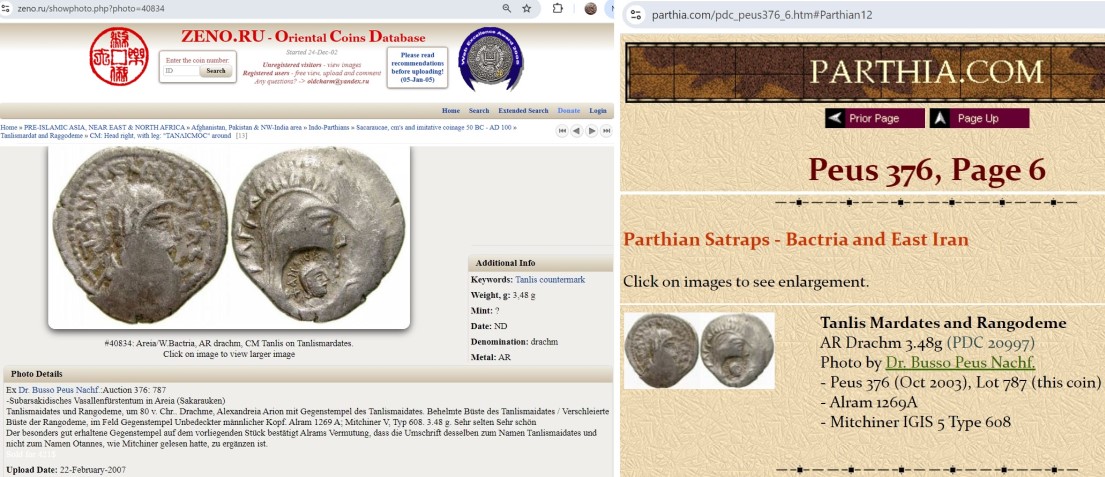
(Photo credit: BFA [ed.]) Collection Hist.:
– Sammlung Wolf D. Derfler, Hoffheim [Peus 376 (29 Oct 2003), 787];
– Collezione Alberto Mario Simonetta (1930-2011) [BFA e-105 (21 Oct 2021), 287].
Publication (online):
– Zeno 40834 (this coin);
– PDC 20997 (this coin, both illustrated after Peus 376).
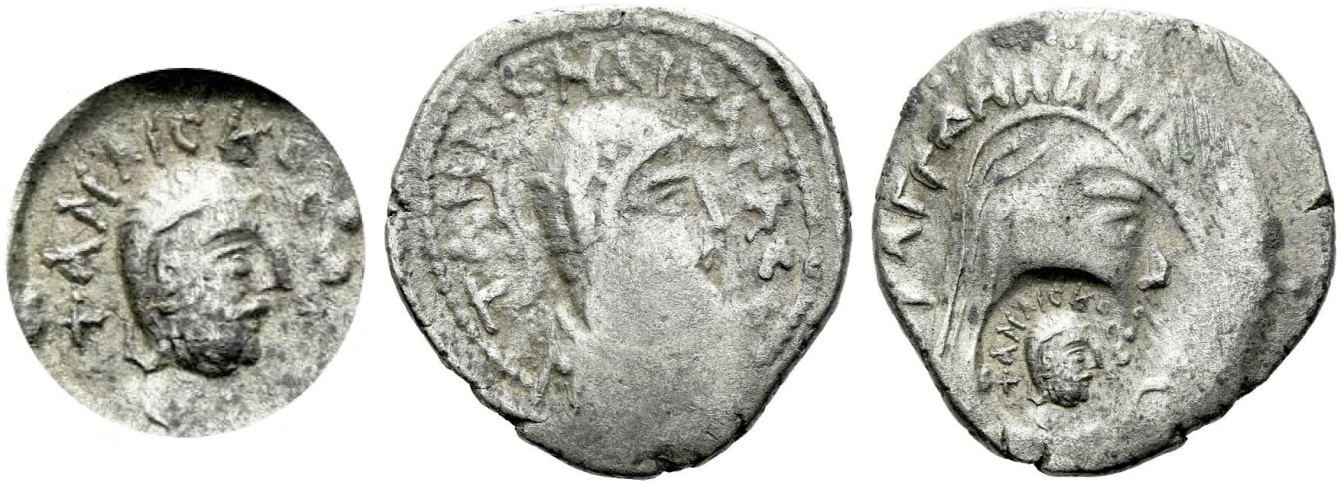
Notes: Important specimen of a mysterious & historically interesting type. This coin was the first fully legible example of the countermark and may still be the best known:
“The particularly well-preserved counterstamp on the present piece confirms Alram’s assumption that the inscription should be read as naming Tanlismaidates and not naming Otannes, as Mitchiner had read” (translated commentary on Zeno 40834, quoting Peus 376).
(Continued in “Notes” on this coin’s description page.)
NORTH AFRICA [2 Coins; top]:
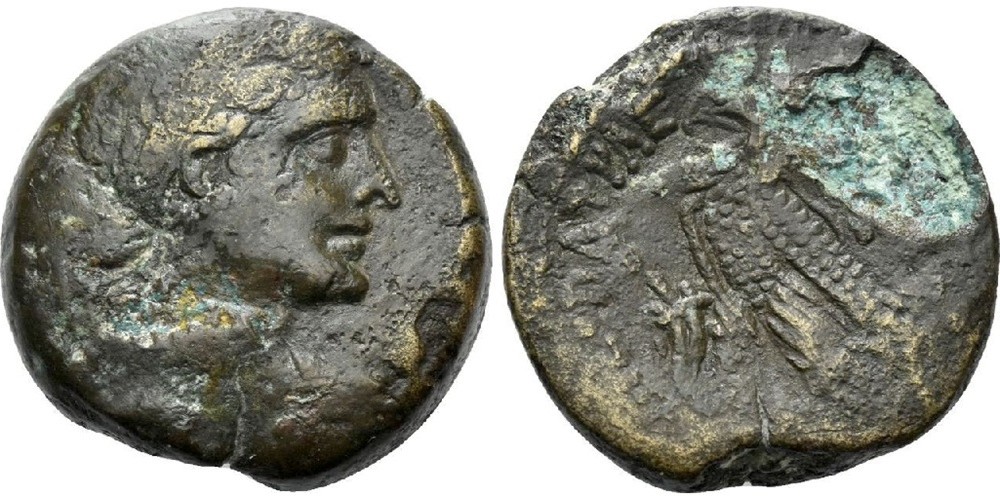
Egypt, Cleopatra VII AE Diobol-80 Drachmae (27mm, 19.01g, 12h), Alexandria, c. 47-40 BCE. Diademed portrait / Eagle.
(Photo credit: Naville) Collection Hist.:
– Found in 1880 excavation of “standing obelisk,” Caesareum in Alexandria (“Cleopatra’s Needle”);
– Henry H. Gorringe (1841-1885) Collection;
– heirs by descent, 1885-2015 [Kaminski (28 Nov 2015), part of 2106];
– Dr. Briggs Bralliar Collection [Naville 94 (23 Feb 2025), 236].
Institutional Hist:
– Worcester Art Museum Loan (“in storage,” 1915-2015);
– Various exhibitions in USA (1880-4), incl.: ANS [ANAS] exhibits/loan (NYC, c. Dec. 1880, Apr 1882 – Mar 1883); Am. Philosophical Soc. (Philadelphia, 1881); Nat. Academy of Design, Pedestal Fund (NYC, 1883/4); possibly 1883 (?) Detroit Art Loan (coins not among his 39 entries in 1883 catalog, but see Peck 2005, BDIA: p. 6, “coins”).
Publication:
– Gorringe p. 72/3 (this coin illustrated, obverse only) in H. Gorringe (1882), Egyptian Obelisks (my copy signed by author & inscribed to Chas Colné [1832-1924]);
– Crawford, Appendix I: Foundation Deposits (this find & the four coins referenced), in Michael Crawford (2003), “Thesauri, Hoards and Votive Deposits.”

Selected Exhibition Reports:
– 1883 Art Loan Cat. No. 535 (group of 3 cited, prob. incl. this coin), on p. 149 in Catalogue of the Pedestal Fund art loan exhibition at the National Academy of Design…December 1883;
– March 1883 Exhibition (one of 13 Ptolemaic AEs found in excavation), by Gaston Feuardent at American Numismatic and Archaeological Society (now ANS), as reported by W. Poillon (1883) Proceedings of the ANAS v. 25: pp. 21-24.
See also: My blog post (13 Mar 2025), “‘Cleopatra’s Needle’ & the Bronze Portrait Coins Found by Commander Gorringe in 1880,” for a much more detailed discussion of the background, historical significance & potential implications of the find, object biography, and further references.
The endnote about the composite portrait plate (shown above, portrait by Mounier, coin photos by Gaston Feuardent) lists several additional mentions in contemporary literature, including, e.g., Harper’s Dictionary of Classical Literature and Antiquities (1897: 367), which reproduced Mounier’s portrait of Cleopatra (above) w/ the caption: “From a Composite Photograph of the Heads on four Egyptian Coins…”
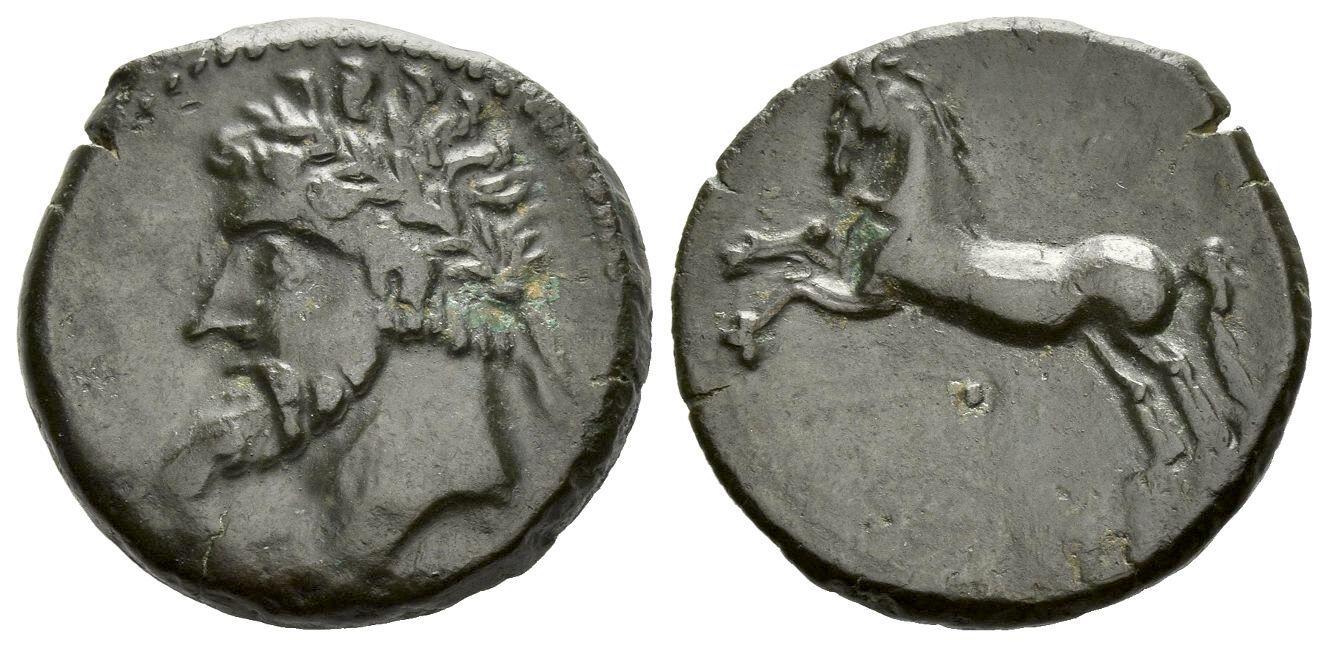
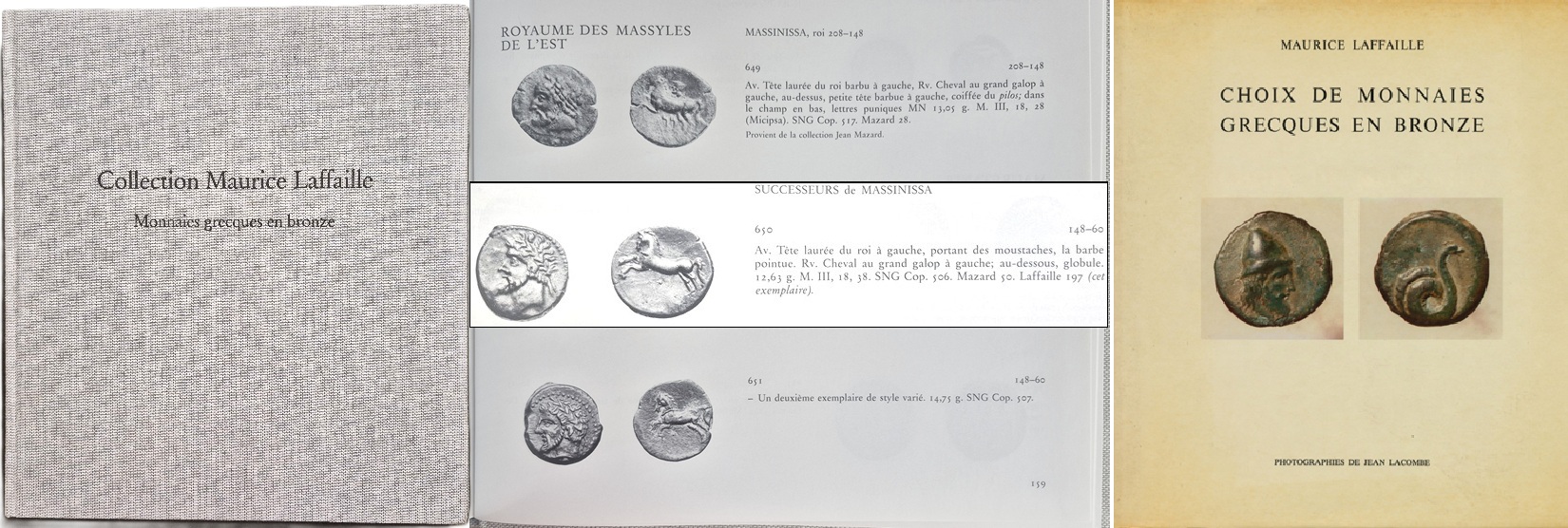
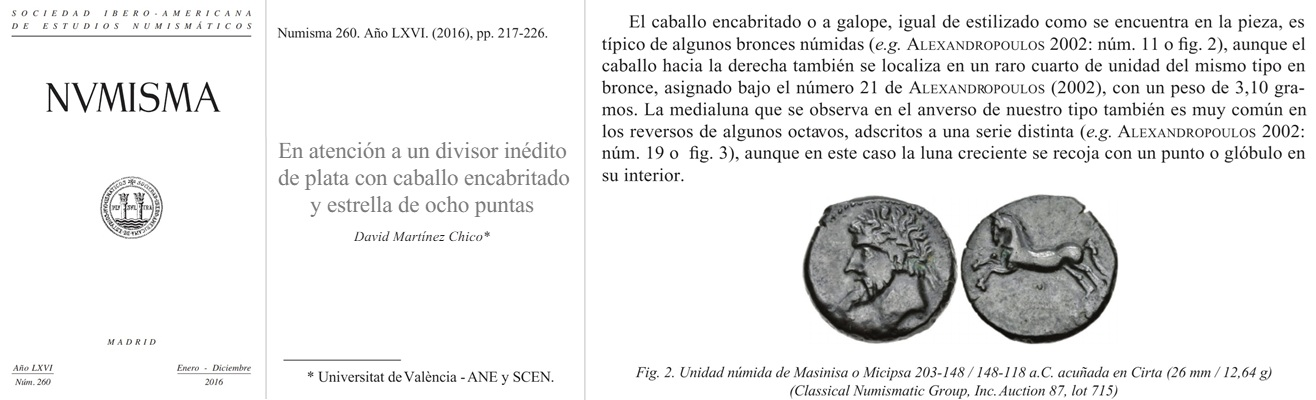
Numidia, Micipsa or Massinissa AE Obol (12.64g, 26mm, 12h), Cirta, 2nd cent. BCE. Uncertain male hd. / Horse prancing.
(Photo credit: NAC.) Collection Hist.:
– Maurice Laffaille (1902-1989) Collection [Münzen und Medaillen A.G./Monnaies et Médailles S.A. Auction 76 (19 Sep 1991), 650];
– Sheik Saoud Al-Thani (1966-2014) Collection [NAC Summer 2025 (30 Jul 2025), 771, ex CNG 87 (18 May 2011), 715].
Publication:
– Laffaille 650 (this coin, illustrated on p. 159) in: Pierre Strauss (1990), Collection Maurice Lafaille – Monnaies Grecques en Bronze;
– Laffaille 197 (this coin illustrated) in: Maurice Laffaille (1982), Choix de Monnaies Greques en Bronze;
– Martínez-Chico Fig. 2 (this coin illustrated on p. 220, after CNG 87), in: Martínez-Chico, David. 2016. “En Atención a un Divisor Inédito de Plata con Caballo Encabritado y Estrella de Ocho Puntas.” Numisma 260: pp. 217-226.
Provenance notes: At least three of Laffaille’s Numidian (plus two Mauretanian) came from Jean Mazard’s collection (important Algerian/French author of major references on ancient N. African coinage); unclear when or whether this coin could’ve also been among them.
Literature notes: The Laffaille Collection, important for Greek bronzes, was documented in two fine books, 1982 & 1990, and (part of) a major auction catalog. (His Roman AE were also excellent; see the pair of Vinchon sales, 1976 [“Collection M.L..” on Gallica] & 1989 [on Gallica].)
Laffaille wrote the 1982 book, Choix de Monnaies Grecques en Bronze, w/ enlarged black & white photos by Jean Lacombe. It contained his 200 favorite coins, fewer than 1/3 of those in Pierre Strauss’s book about the same collection, 8 years later (but with 1/3 more pages)! (Some of the 463 additional coins were bought after 1982, up to 1988, but it’s unclear how many.)
The 1991 M&M auction catalog, also by Strauss, includes the same 663 coins & descriptions as in his 1990 book, but with a new Preface (and without Amandry’s Intro).
The 1982 book is harder to find than the 1990 one. (I have two copies of the latter; for the former, I’ve used the photo from Kuenker eLive 29 above.)
Notes:
Note, Pamphylia, Side Stater (Atlan 35.1), plated (return): Though previously unnoticed, I believe this coin must be a plated contemporary counterfeit (“fourrée”). Since the core is not visible, I suppose it could be a solid, but underweight contemporary imitation. In any case, there are several clear indicators that this coin is not an official issue from the Side mint.
It’s a tossup whether the first clue should’ve been the low weight (by about 2 grams, nearly 20%), or the bizarre style of Athena and the branch on the reverse. Nor are any other specimens known from either die.
Surprisingly, neither Atlan nor Kraay (presumably working only from Kress’s photos, in their defense) recognized that this coin is not an official AR Stater. Nor did Kress, Malloy (twice!), or CNG recognize anything off about the coin.
There are two large test cuts on this coin, but the core does not seem to have been exposed. It’s possible the cut simply failed to break plating, or that the cuts were applied by forgers before plating the coin (as in the case of this Athens Tetradrachm). (For technical reasons, I doubt the cuts were part of the die itself.) It’s possible the coin is also solid silver, in which case being 20% underweight might provide enough incentive for forgery if not weighed (though 5th cent. hoards from Asia Minor suggest coins were often used by weight), or simply that it was a local imitation (Aspendus and earlier Side Staters are well-known, but usually of full weight).
Whatever the nature of the imitation, it’s an interesting case in which the provenance matters because the published record is mistaken, based on the misinterpretation of this specific example. There are several other such published misidentifications in my collection: Orontas AE (Winzer 16.5); Domitian, Anazarbus (Lindgren & Kovacs 2192, RPC II 5146 [deleted]); see also Mylasa AE (Karl 246 = HNO 1883.1), Arados AE (Sayles 1987: The Celator 1.2).
Note, Datames Obol, Obverse Description (SNG von Aulock 5419 = CSP 914) (return): Hans von Aulock (this coin), Levante (SNG 217), and Mildenberg all followed the traditional identification of the obverse head as female. (Mildenberg [2000: p. 149, nr. 33] suggested she was “in Art des Kimon.”)
More recently, however, A.S. Walker et al. have suggested a different interpretation, cataloging this coin (CsP II 914) in 2023 as “Youthful male head facing.” In later sales, they identified the figure as Herakles and explaining their reasoning (Nomos Obolos 33, 579 & 580; see also Obolos 36, 479):
“The obverse type is commonly described as a facing female head, but the lion skin tied around the neck–an extremely clear feature on this coin–indicates that the head is really that of a young Herakles. No doubt he is the Hellenized version of the old Hittite deity Sandan who continued to be worshiped at Tarsos into the Roman period.”
As Herakles, this coin is an interesting complement to the contemporary Cilician Obol of type SNG Levante 220-221, showing the same pair but with an older, bearded Herakles & Aphrodite veiled, and switching their profile orientations (see, e.g., the Sunrise 105 example).
(See also Haymann [Slg. “de Face” 1278], who agrees the figure is male, but suggested Apollo.).
Note, von Aulock (Cappadocia) (return): Morkholm 1968 (Essays Robinson) cites a specimen of this type and weight (4.14g) from the von Aulock Collection (p. 250, Ariar. IX, II-1), but illustrates the coin published as SNG von Aulock 6302, making this coin a duplicate. (Note, however, that this specimen’s dies are not illustrated in Morkholm’s die catalog, but von Aulock’s catalog was limited to years and monograms.)
Otto Morkholm and Bono Simonetta were clearly both friendly with von Aulock (if not always each other), and had ready access to his collection, of which both made extensive use. (Morkholm also cataloged portions of his SNG.) Had Simonetta not begun publishing his collection before the third volume of SNG von Aulock (1964), the latter would surely have become the preeminent reference collection of Cappadocian coinage.
Change Log (return to top): 29 May 2023 (created) ; 27 June 2023 (Lazzarini 2006/2010 citation to/enumeration of Rosen 548); 1 Jan 2023 (new citation [Mosch 2022] to Themistokles Hemiobol); 11 Mar 2024 (Myndos Drachm); 5 Sep 2024 (Tanlis); 15 Mar 2025 (Cleopatra); 7 Jul 2025 (new notes on Side Stater [Fourree?]); 26 Aug 2025 (Asia Minor AE unicum & Numidia AE); 16 Nov 2025 (poss. new specimen of Laffaille 662); 9 Dec 2025 (Ariobarzanes et al. & Darios II).