
Updated: 10 Aug 2022
click images to enlarge, text beneath for full descriptions
NOTE: I posted a previous version on Cointalk (3 Feb 2021). The replies there illustrate a great variety of Roman captives coinage from CT member collections. See also: Page for my “Barbarians, Captives, and Enemies” Collection (the first two-captives-and-trophy, Julius Caesar, is here), which shows about 150 of my favorites.
Prisoners of war are among the most consistent and versatile tropes spanning the history of Roman coins, from the Republican period through the late Imperial. Frequently described only as “captive” or “bound captive” in the major references, the figures depicted are presumably destined for slavery or, occasionally, awaiting execution. They often represent members of specific tribal groups, sometimes indicated with written legends, but more often represented through minute cultural details of hairstyle, clothing, or headwear.

Such images were not limited to “Barbarians, Captives, and Enemies” coinage (main page for my Roman “BCE Collection,” as I call it) or even to Roman coins as a whole, but were commonplace in Roman culture. (The most popular images may, however, have first appeared on coins; see Kinnee 2016, 2018. I’ve drawn on her explanation of the “trophy tableau monument” to discuss the Marian-era Republican Quinarii of Fundanius and Cloelius.)
Images of captives were routinely included in monumental artworks, friezes, and architecture. But they were also found in mundane objects inhabiting the lives of ordinary Romans, such as small figurines and statuettes in family homes, and everyday items around the house (e.g., terracotta oil lamps decorated with a bound captive [see Wieclaw Collection #84, H.J. Berk 2019, several other records avail. on request]; silver serving dish handle [The Met, NY], whose seated captives, though damaged, unmistakably resemble those on coins).
Two captives bound to a trophy motif
One of the most fascinating features of Roman “Barbarians, Captives, and Enemies” coinage is the continuity of certain motifs, combined with the changing variety of cultural details and political messages. The most stable of these motifs may be the depiction of two bound captives at the base of a military trophy consisting of confiscated arms, used on coins for nearly 400 years (c. 46 BCE – 337 CE). (One version of “The Trophy Tableau Monument,” as Kinnee [2016] called it.)
It is routinely pointed out that depictions of the captives of war and other military symbols are unsurprising, given the militaristic nature and ethos of the Roman Republic and Empire. But there is an additional feature of Roman society that helps explain their prevalence, particularly during the Imperial Period: its reliance upon foreign wars for a steady supply of captives to continuously replenish the slave labor force on which the Empire depended. The portraits of the captives served at once to glorify the Empire and its military, and to dehumanize and depict the vanquished as suitable slaves.
Republican Period
The Roman artistic tradition of depicting captives bound to a trophy began during the Republican period, at the turn of the 1st cent. BCE. The first depiction of the distinctively Roman “Trophy Tableau” with a captive, to use Kinnee’s (2016) term, was actually on a coin. (Trophies had appeared on much older Greek coins, but not as part of a scene, or “tableau,” with captives. Bound captives first appeared on Roman coins.) The numismatic imagery soon spread to other Roman art, from everyday items to monumental architecture.
The earliest examples are the pair of AR Quinarii struck to commemorate Marius’ military victory in Germania by Caius Fundanius, 101 BCE (Crawford 326/2), and then by Titus Cloelius, 98 BCE (Crawford 332/1). (My examples: Fundania Quinarius & Cloelia Quinarius.) Each depicts a single captive male Teuton, probably King Teutobodus himself, bound to the base of a trophy of captured Germanic arms; Victory stands, reaching over him to place a wreath on the trophy. (Thus, visually conveying the concept of “Victory over Germania.”)
Similarly, Caius Memmius’ (C.f) AR Denarius in 56 BCE (Crawford 427/1) commemorated his victory in Asia Minor portraying a kneeling captive at the base of a trophy – a design later imitated by, among others, Titus (who also imitated the two-captives-and-trophy design described below). The first to introduce multiple captives had been L. Aemilianus Lepidus Paullus’ AR Denarius in 62 (Crawford 415/1), commemorating his ancestor’s victory in the Third Macedonian War (171-168), depicting Perseus and sons standing before a trophy and Lucius Aemilius Paullus. [*Note: Four Republican coin types described by Crawford number above, not (yet!) in my own collection, are linked to examples from Andrew McCabe’s collection; those of Titus are from the British Museum collection.]
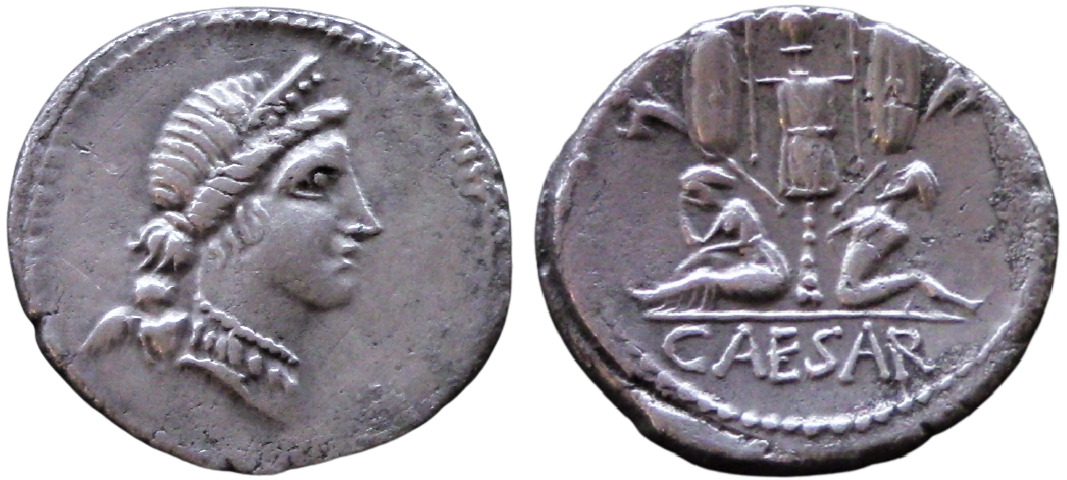
The coin that would, however, establish the long-running archetype – remaining in frequent use through the time of Constantine – was an AR Denarius of Julius Caesar struck in 46 BCE, commemorating his Gallic Wars (Crawford 468/1; pictured above, video of my example here). On its reverse, two Gallic captives are seated at the base of a trophy of Gallic arms – shields, helmet, spears, and trumpets/carnyxes. In an important element of the design, often preserved in later homages, the male warrior or leader is depicted bound (in different postures, depending on the issue), while the female personification of Gaul is shown with her hands free but cradling her head in a posture of mourning.
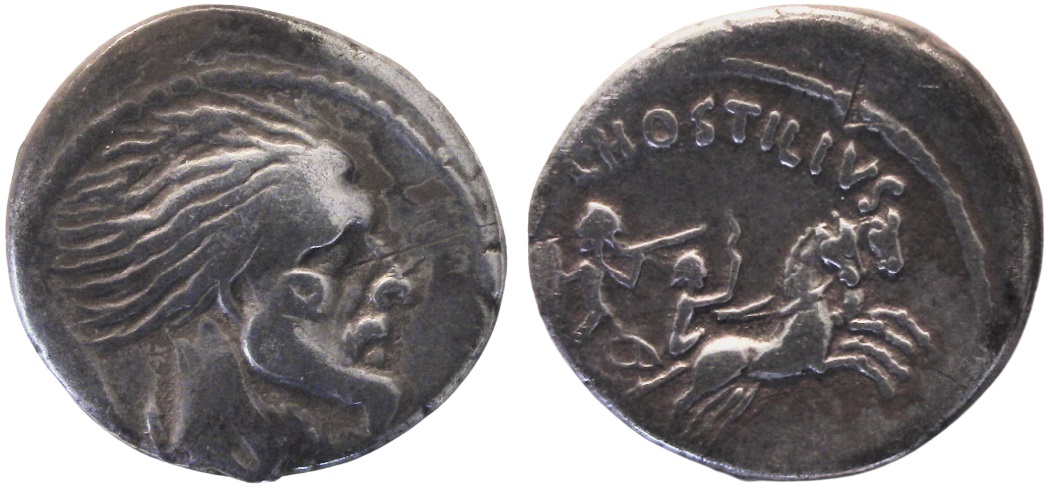
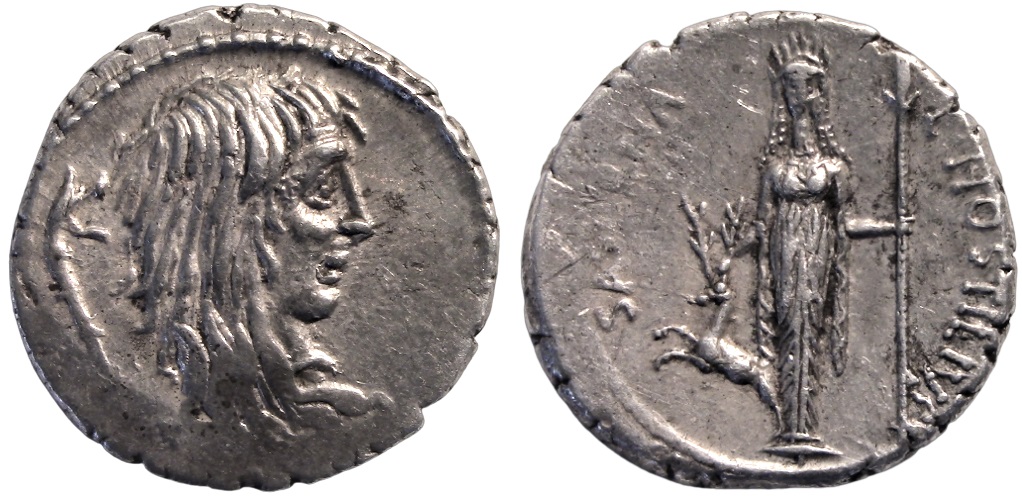
The two figures are believed by many to be the same as those portrayed on the obverse of the pair of “Gallic captives” AR Denarii of Hostilius Saserna, struck c. 48 BCE (pictured below). The male captive is frequently identified as Vercingetorix, leader of the Gallic resistance (or Vercingetorix-as-Pavor) and the female as Gallia (or Gallia-as-Pallor; though neither without disagreement).
I am aware of the trophy-and-two captives design on the coinage of, at a minimum, the following Roman Imperial rulers and family members:
- Brutus, Titus, Trajan, Marcus Aurelius, Commodus, Septimius Severus, Caracalla, Severus Alexander, Julia Mamaea, Maximinus I, Trajan Decius, Gallienus, Claudius II Gothicus, Postumus, Probus, Constantine I, Constantine II, Crispus, Licinius I, and Licinius II;
- Pupienus, Macrinus, and Gordian III used the same image as a smaller element within larger designs;
- additional rulers used slightly different images, for instance, Aurelian placing Sol in place of the trophy, Lucius Verus’ Medallion showing one captive standing and Victory to the left, or Vespasian using only captive at the base of the trophy, among others.
Examples of several of these types from the Jackson-Jacobs Collection are illustrated below.
Imperial Period
Notably, the primary emphasis shifted with Caesar’s captives (and later types), from an anonymous, defeated soldier to living, emotive captives, suitable for filling the Roman Empire’s never-ending demand for slaves.
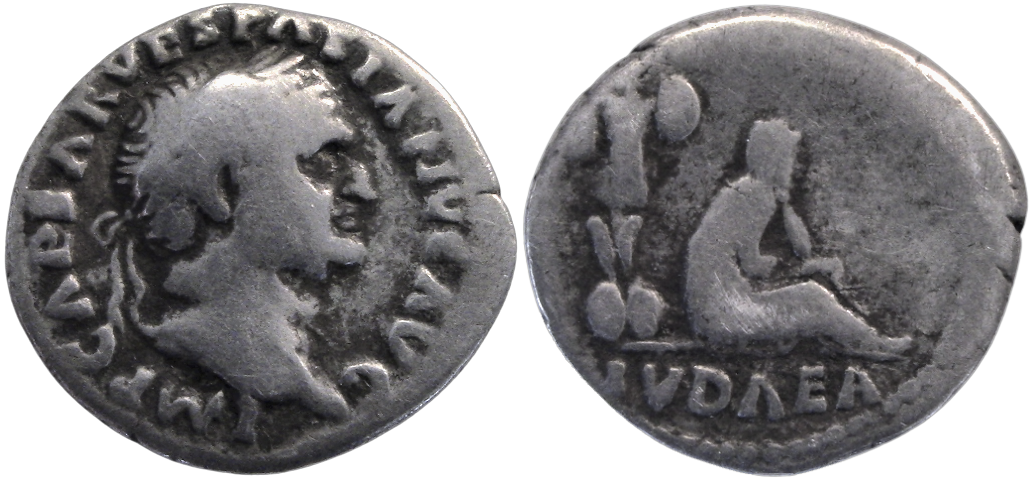
In the first and second centuries, Titus and Commodus used very similar reverses on their coinage (especially AR Denarii). But images of single captives prevailed on Vespasian’s historic and famous “Judaea Capta” series (pictured below), and also notably on Trajan’s “Dacia Capta” coinage and the Dacia/Parthia series under Lucius Verus. (Examples shown on the main “Barbarians, Captives, Enemies” page.) As in Caesar’s depiction of Gallia, Judaea is depicted as a female personification wearing long robes and/or veil, and seated in mourning at the base of the trophy.
In the third century, the pair of captives frequently represented two of Rome’s greatest and most enduring enemies, one to The East, one to The North: Persia and Germania.
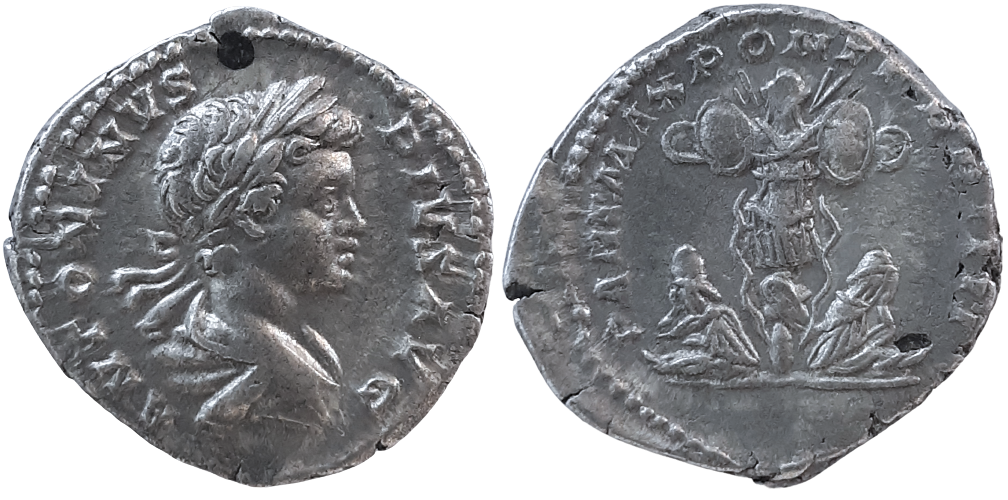
Caracalla (AR Denarius) portrayed Parthian captives with distinctive pointed headwear, similar to a Phrygian cap:
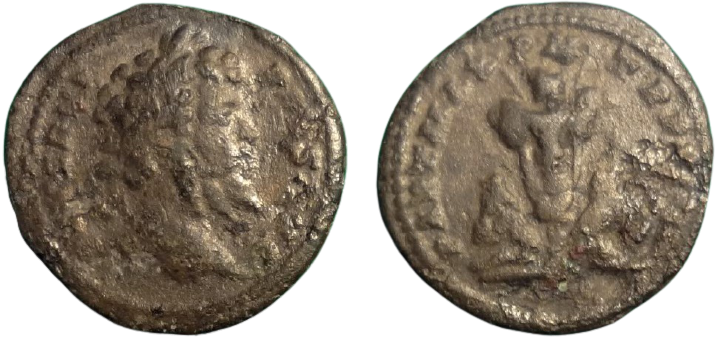
The type was carried over from Septimius Severus’ earlier denarius, also with a PART MAX reverse legend, leaving no doubt as to the captives being Parthians, represented below by a base “Limes” Denarius (perhaps issued for use by soldiers defending against Germanic enemies on the northern Limes/border [this coin was sold, no longer in the collection]):
Third Century coinage of Alexandria (one of the few Provinicial mints that regularly produced captives coinage) often depicted Germans, particularly the Potin Tetradrachm series that began under Severus Alexander and Julia Mamaea shortly before their murder, but continued under Maximinus and successors.
Although the Germans were depicted as captives on the coin below — the imagery was a “promise” of forthcoming war — Sev. Alexander reached a peace with them, averting war. This peace is often given as the reason why his army killed him and his mother, installing Maximinus as his replacement:
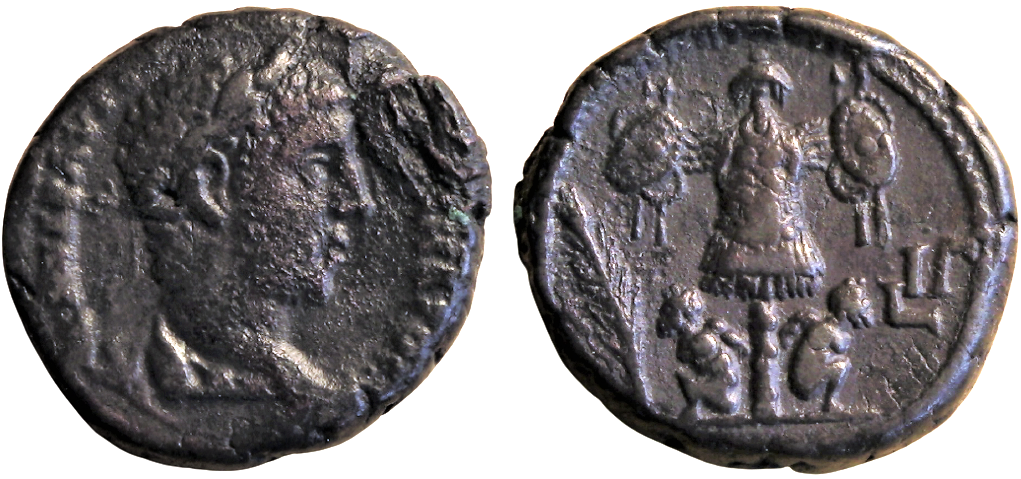
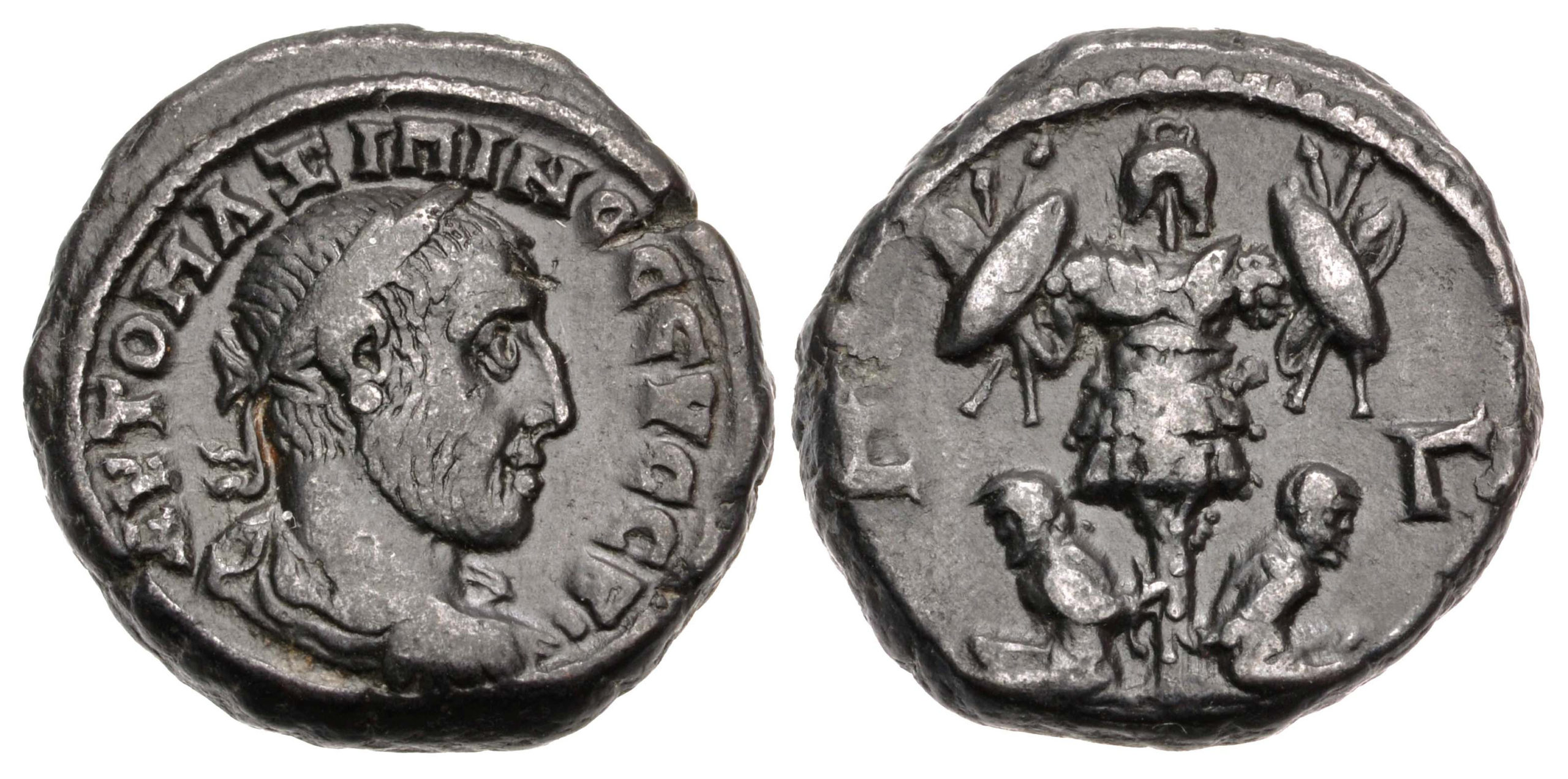
Photo: CNG.
The Severus Alexander tetradrachm above appears to include a novel detail: The Suebian Knot. Just as the Gauls were depicted on Caesar’s wearing hair in knotted cords (now known as “dreadlocks”), occasionally the dies depict Germanic captives with the distinctive hairstyle in which the hair is twisted forward and knotted to the side or top. (Roman bronze and stone sculpture uses the hairstyle quite frequently to portray Germans.)
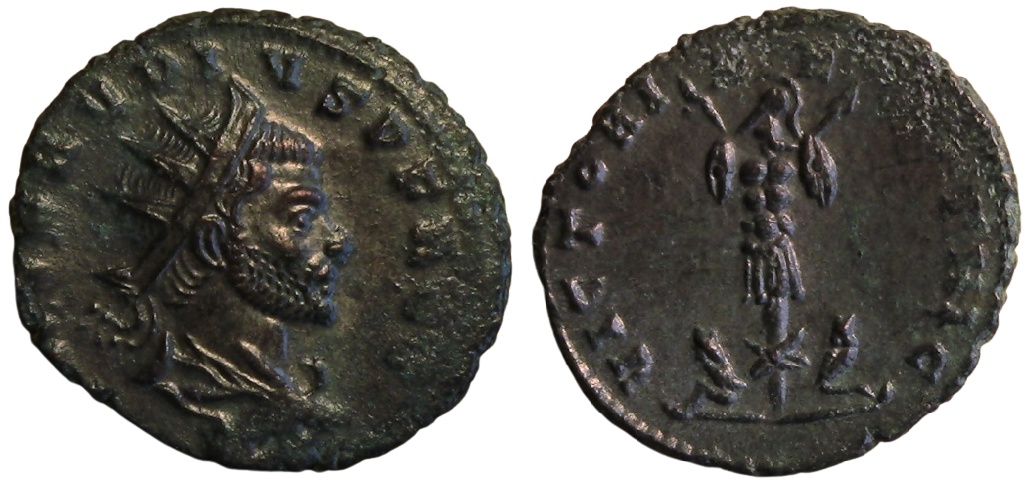
At times, though, one wonders if the engravers ignored the details of specific peoples, despite the intended message. On the Claudius II billon Antoninianus below, depicting his namesake Gothic captives, the pointed helmet/cap may be a carryover from previous designs depicting Parthians/Persians:
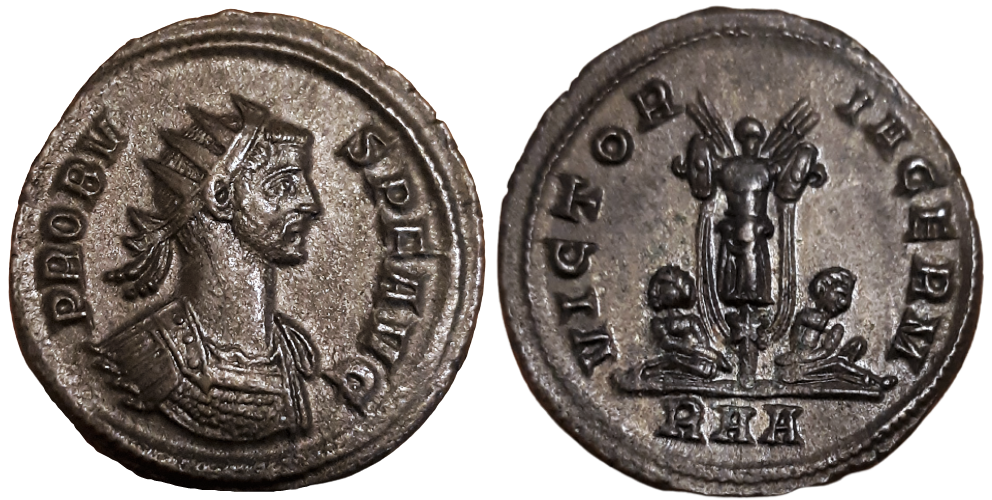
Probus’ Germanic captives, bareheaded, are shown in some detail, but without distinctive indicators of ethnicity:
Just as many have proposed that the Fallen Horseman series depicts various “barbarian” enemies of Rome (e.g., Cruz 2019; Dane Kurth; Failmezer 1992, 2002), it seems Constantinian era captives-and-trophy coinage depicts a range of tribal peoples on different issues from different mints. I am not aware of anyone having thoroughly studied the topic.
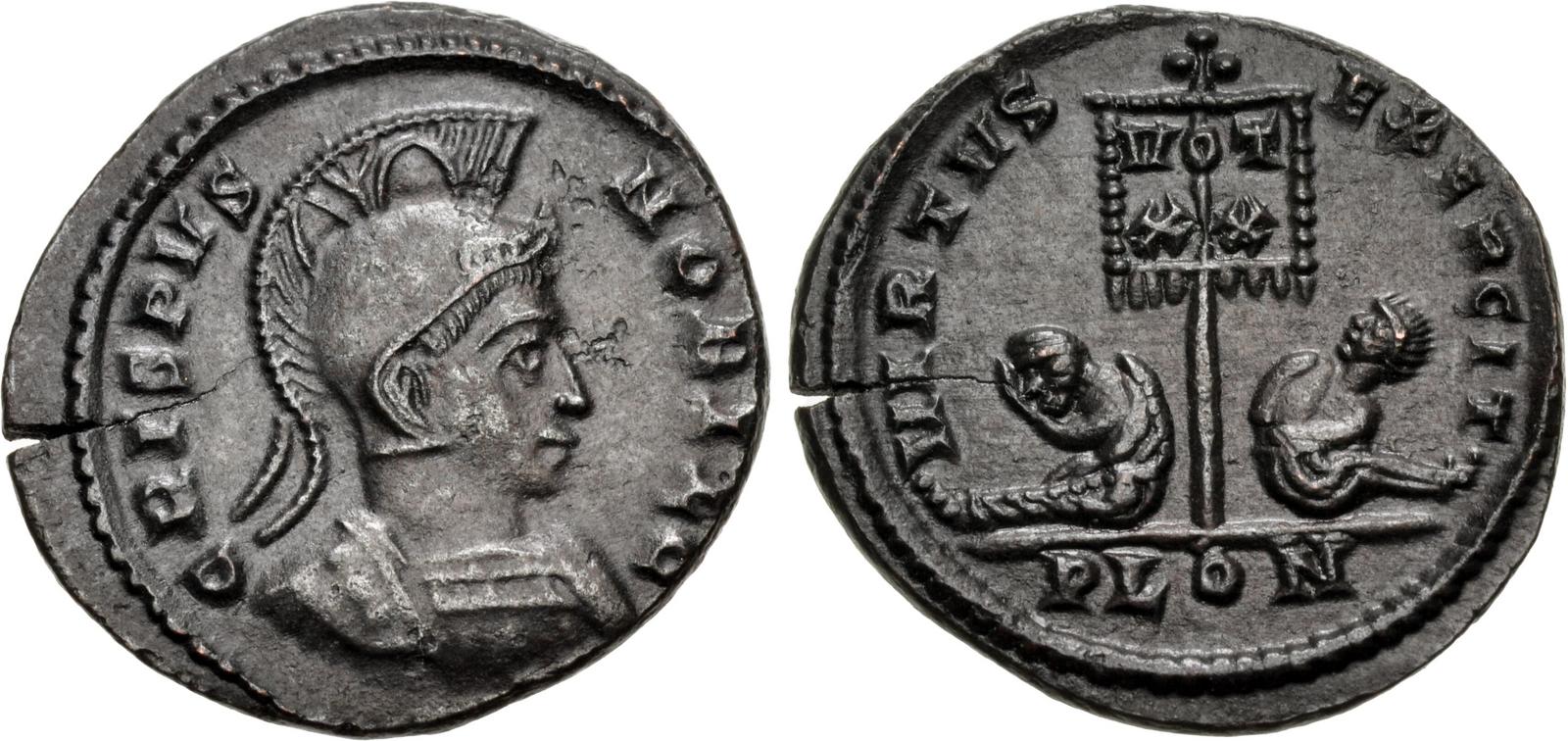
The first issue of Constantine below (if not both), like several other examples (but not all) in the collection, seems consistent with Roman portraits of Germanic captives, including the long beard and ragged hair (which sometimes appear on depictions of Persians), but especially the typical loose-fitting, baggy clothing:
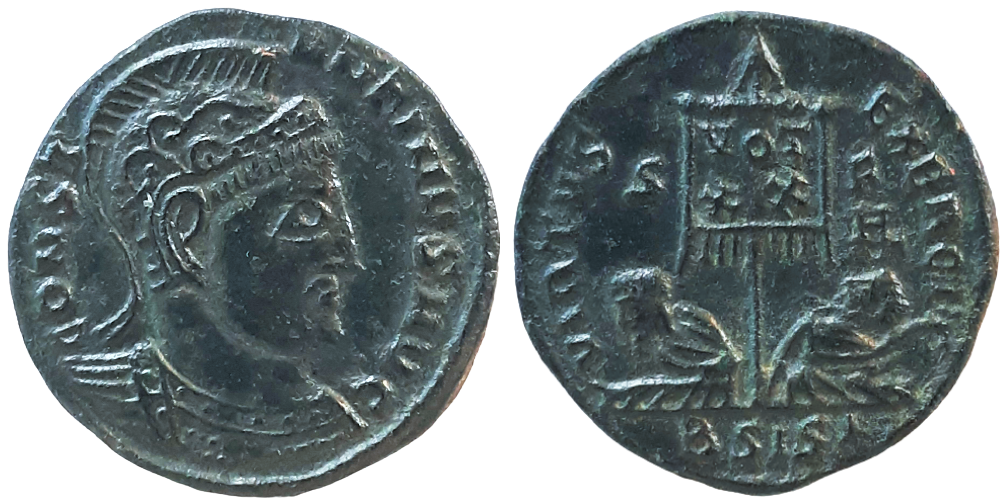
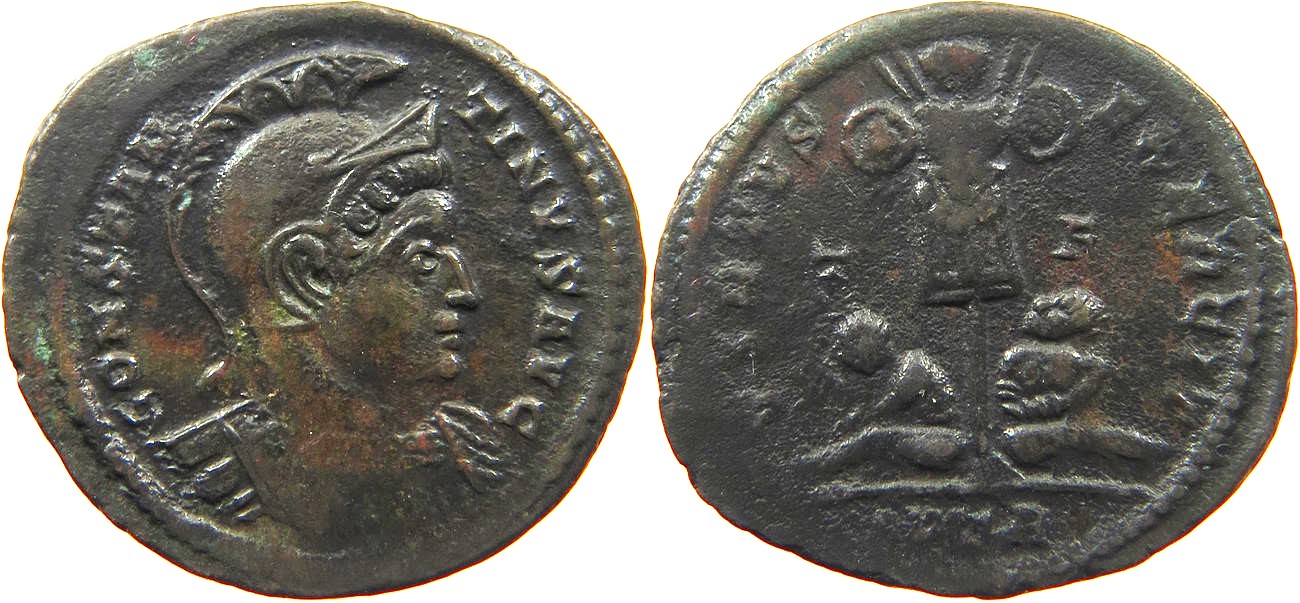
Photo by Munzhandel A.J. Koci
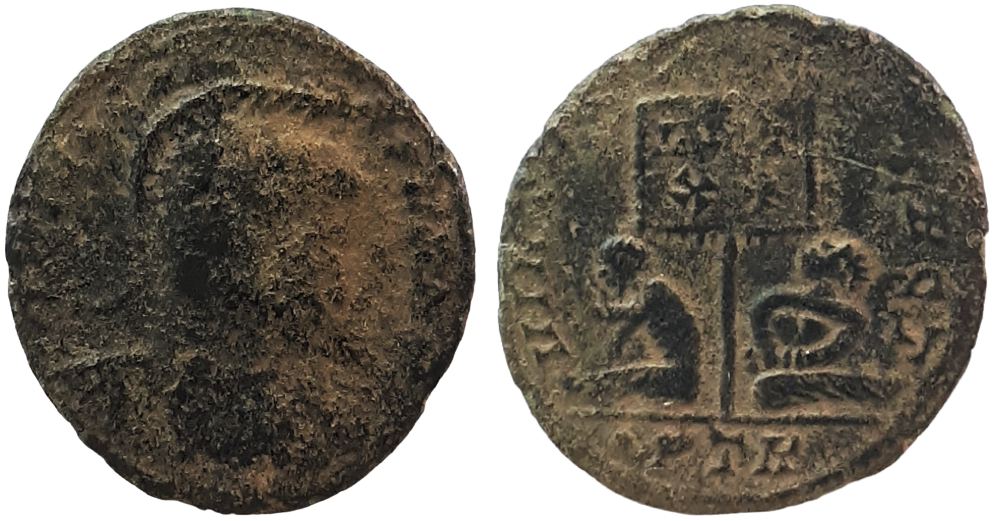
Finally, an ironic example of a “barbarous imitation” depicting a “barbarian” captive on the reverse of a Licinius II type AE3 Follis (for comparisons, see a few results on acsearch, especially the Leu e-10 example; although they mostly get the spelling of EXERCIT correct!):
A final detail deserves mention: the upward gaze. Beginning with Julius Caesar’s archetypal denarii, it appears with some frequency throughout, but is most obvious on Constantinian era issues. On Caesar’s types, the bound male captive (“Vercingetorix”) looked up at the trophy, while the female looked down in dejection.
Although both captives are male on Constantinian issues, every one shows the same pattern; one captive looking downward, the other turning his head to gaze upward at the trophy or vexillum. (The same description applies to those of Licinius, Crispus, Constantine II [about nine examples shown on the “BCE Coll.” page]. Cf. Constantius II AV Solidus & Constans AE Medallion, both captives looking upward [RIC 34, Thessalonica & Platt 199, shown on Dane Kurth’s wildwinds]).


The detail is so prevalent, deliberate, and enduring that it must have been important. As I read it, the captive’s upward gaze indicates his recognition of Roman superiority and dominance (always “above/over” him), sense of awe at Rome’s power, and, perhaps, acknowledgment of defeat and submission.
For References cited: See combined-bibliography page, include online links where available.
Recommended reading:
Kinnee, Lauren. 2016. “The Trophy Tableau Monument in Rome: From Marius to Caecilia Metella.” Journal of Ancient History 4(2): 191–239.
- I was only able to access an electronic version through a university library subscription; I couldn’t find access to a free copy. It doesn’t appear she’s set up a Researchgate.net or Academia.edu page, but if she ever does, and posts the article, I’ll add a link (let me know if you see it available anywhere with permission of the copyright holder or legal “fair use”)
See also her book: 2018. The Greek and Roman Trophy: From Battlefield Marker to Icon of Power. New York: Routledge.
- I have only begun perusing but I’d assume there is considerable overlap. A substantial preview is available on Google Books.